


 |
市場調查報告書
商品編碼
2157147
冷藏貨櫃運輸:市場佔有率分析、行業趨勢和統計數據、成長預測(2026-2031)Refrigerated Container Shipping - Market Share Analysis, Industry Trends & Statistics, Growth Forecasts (2026 - 2031) |
||||||

※ 本網頁內容可能與最新版本有所差異。詳細情況請與我們聯繫。
根據 Mordor Intelligence 預測,冷藏貨櫃航運市場規模將從 2025 年的 99.9 億美元成長到 2026 年的 104.8 億美元,到 2031 年達到 126.4 億美元,預計 2026 年至 2031 年的複合成長率為 3.81%。
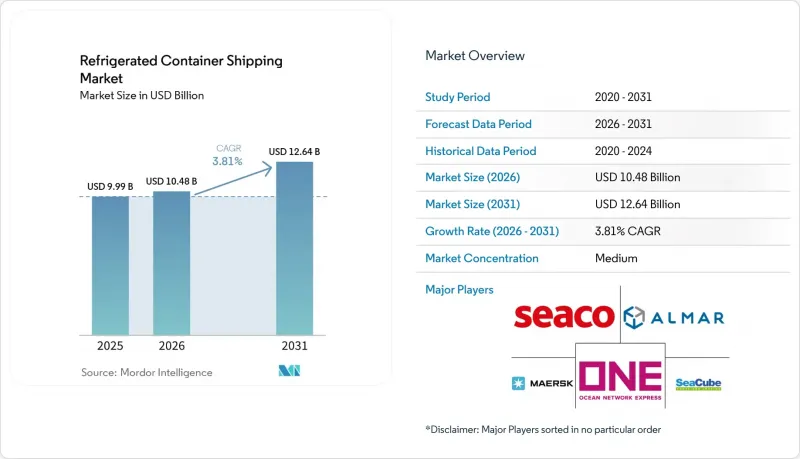
這一成長主要得益於亞太地區蛋白質貿易的擴張以及有利於低全球暖化潛勢(GWP)冷凍技術的監管政策。然而,近期繞開蘇伊士運河的航線調整導致有效運輸能力緊張,現貨運費上漲,使托運人面臨成本波動風險。本報告按運輸方式(例如海運)、貨櫃尺寸(小箱、大箱、高箱)、溫度範圍(冷藏、冷凍)、應用領域(園藝產品、乳製品、肉類、魚類、家禽、加工食品等)以及地區(北美、南美、亞太、歐洲、中東和非洲)進行細分。市場預測以美元計價。
全球冷藏貨櫃運輸市場趨勢及洞察
擴大貿易關係
諸如RCEP(區域全面經濟夥伴關係協定)等優惠關稅框架使中國出口商能夠以優惠關稅出口其92%的水果和蔬菜,預計到2026年初,生鮮食品出口將同比成長18.7%。連接廣西和胡志明市的冷藏貨櫃快捷環線將運輸時間縮短了最多兩天,與空運相比成本降低了60-70%,從而推動了冷藏集裝箱需求從長途點對點模式轉向更靈活的亞洲內部支線服務。墨西哥價值100億美元的農產品貿易正利用USMCA(美國-墨西哥-加拿大協定)簡化的海關程序,加強通往北美的南北冷藏庫走廊。最佳化的關稅和更短的前置作業時間正在推動運輸網路的重組,承運商正將貨櫃從擁擠的幹線轉移到區域樞紐輻射式網路。
生鮮食品的需求增加
預計到2025年,中國冷鏈物流吞吐量將達到3.814億噸,年增4.5%,主要得益於生鮮電商平台承諾的當日送達服務。智利櫻桃在區域城市的基礎設施改善下,能夠在可控條件下完成20天的運輸,且不會影響其保存期限。由於買家轉向成本較低的東南亞貨源,新鮮魚類和冷藏魚的進口量激增97%。這清楚地展現了一個「啞鈴型市場」:大宗商品運輸優先考慮效率,而高階貨物則需支付額外費用以確保可靠的裝貨點。這種兩極化迫使冷藏貨櫃運輸市場調整其運能、定價和服務水平,以滿足兩個不同的價值層級的需求。
冷藏貨櫃維修成本高昂
雖然變速風扇和先進壓縮機可降低高達 20% 的能耗,但檢修和調整仍佔年度設備收入的 10% 至 20%。歐盟的 F-gas 法規和美國的 AIM 指令正在加速向 R744 等天然冷媒的過渡,這增加了資本投入,加重了小規模企業的負擔。同樣,中國將於 2025 年 12 月訂定的旨在促進低碳冷鏈發展的指令預計將加速老舊卡車的淘汰,縮短投資回收期,同時提高長期效率。
細分市場分析
到2025年,海運將佔據冷藏貨櫃運輸市場81.69%的市場佔有率,並繼續在洲際航線上保持主導地位,這主要得益於其每公斤貨物的成本效益。然而,隨著中國-東協快速環線將門到門運輸時間縮短至多兩天,預計鐵路-海運多式聯運將以4.55%的複合年成長率成長。非海運方式的冷藏貨櫃運輸市場規模仍然小規模。儘管如此,都市區對配備充電樁的鐵路坡道和電動卡車的持續投資表明,運輸方式正朝著更靈活的多式聯運網路發展。由於運輸方式的轉換可能會影響冷鏈的完整性,因此設備的標準化和即時協調至關重要。
當地緣政治緊張局勢擾亂海上運輸時,運輸方式的轉變會加速。開普敦在亞歐航線的改道,促使托運人轉向中亞鐵路走廊,儘管那裡的運費更高。到2025年中期,隨著電動卡車在中國的普及率超過35%,零排放的「最後一公里」配送將在污染嚴重的大都會圈成為可能。然而,制約因素依然存在。底盤供不應求、都市區的配送時間限制以及二級港口發電機燃料基礎設施不足等問題,都可能導致服務中斷,除非承運商與相關人員進行協調。
預計到2025年,高立方貨櫃將佔據47.79%的市場佔有率,年複合成長率(CAGR)為4.01%。其13%的額外負載容量正在降低高密度航線的每公斤運費,儘管需加收5-15%的附加費,但這仍然是新船訂單傾向於選擇這種規格貨櫃的原因。在橋樑淨空、內陸鐵路隧道或堆場裝卸設施等高度限制為9英尺6英寸的地區,標準40英尺冷藏貨櫃的市場仍然十分重要。小型貨櫃在線上食品雜貨和藥品樣品的物流中繼續發揮關鍵作用,因為在這些領域,柔軟性比規模更為重要。
中集集團2025年上半年售出9.2萬個標準箱冷藏貨櫃,是去年同期銷售的兩倍多。同時,勝獅集團加快了客製化儲能貨櫃和多溫區貨櫃的生產。這些投資凸顯了貨櫃尺寸細分正在從單純的尺寸分類演變為涵蓋隔熱性能、門型配置和物聯網封裝等諸多因素,從而最佳化總體擁有成本(TCO)以滿足貨物運輸需求。
區域分析
預計到2025年,亞太地區將佔全球銷售額的41.02%,年複合成長率達4.10%。到2025年,中國冷藏倉庫容量將達到2.77億立方米,年增5.53%,這將為中小城市的都市區運輸提供支持,並消化智利櫻桃和東南亞魚貝類的配送需求。目前,電動卡車已佔中國冷藏運輸車輛的35.8%,有效減少了「最後一公里」的碳排放,並為其他新興市場樹立了標竿。
北美正面臨進口需求放緩的困境。美國零售聯合會(NRF)預測,2026年第一季進口貨櫃數量將比去年同期下降7%,這將直接導致用於運輸農產品和消費必需品的冷藏貨櫃數量減少。同時,由於需繞道開普敦,歐洲航線面臨延長,但勒阿弗爾港碼頭的維修以及赫伯羅特公司新建的達米埃塔樞紐提高了冷藏集裝箱插接點的周轉率,在一定程度上緩解了運輸能力的壓力。
拉丁美洲的出口模式佔冷鏈需求的40%。 2025年初,韋拉克魯斯港的貨運量激增57%,導致出口供應和發電機物流緊張。巴西牛肉和智利鮭魚幾乎完全依賴冷藏貨櫃運輸,這使得區域經濟容易受到貨運衝擊,同時即使在乾貨市場疲軟的情況下,也支撐著租船需求。
儘管來自中東和非洲的貨物運輸量仍然不大,但風險卻極高。 2026年霍爾木茲海峽的AIS欺騙事件以及蘇伊士運河的關閉,導致戰爭風險溢價飆升至每標準箱1500美元,迫使航運公司重新考慮航線安排。運往歐洲和亞洲的南非柑橘需要更充足的預算,而東非水產品出口商如果產品在海上滯留超過保存期限,則被迫改用包機運輸。
其他好處:
- Excel格式的市場預測(ME)表
- 3個月的分析師支持
目錄
第1章:引言
- 研究假設和市場定義
- 調查範圍
第2章:調查方法
第3章執行摘要
第4章 市場狀況
- 市場概覽
- 市場促進因素
- 擴大貿易關係
- 生鮮食品的需求增加
- 對溫度敏感型藥物的需求不斷成長
- 快速成長的跨境線上食品銷售和食材自煮包訂閱服務
- 新興亞洲國家向高蛋白飲食的過渡
- 氣候變遷導致的漁業遷移
- 市場限制因素
- 冷藏貨櫃維修成本高昂
- 冷藏貨櫃運費波動劇烈,與燃油額外費用費密切相關。
- 港口擁塞導致品質劣化的風險
- 冷藏貨櫃遙測資料遭受的網路攻擊日益增多
- 價值供應鏈分析
- 監理情勢
- 科技趨勢(物聯網、人工智慧監控、天然冷媒)
- 波特五力分析
- 價格分析
- 新冠疫情的影響以及由此導致的供應鏈中斷
第5章 市場規模與成長預測
- 透過運輸方式
- 海上運輸
- 其他
- 按容器尺寸
- 小容器
- 大型貨櫃
- 高立方貨櫃
- 按溫度範圍
- 冷藏
- 冰凍
- 透過使用
- 園藝(新鮮水果和蔬菜)
- 乳製品(牛奶、冰淇淋、奶油等)
- 肉類、魚類、家禽
- 加工食品
- 製藥和生命科學
- 其他用途
- 按地區
- 北美洲
- 美國
- 加拿大
- 墨西哥
- 南美洲
- 巴西
- 秘魯
- 智利
- 阿根廷
- 其他南美國家
- 亞太地區
- 印度
- 中國
- 日本
- 澳洲
- 韓國
- 東南亞
- 其他亞太國家
- 歐洲
- 英國
- 德國
- 法國
- 西班牙
- 義大利
- 比荷盧經濟聯盟(比利時、荷蘭、盧森堡)
- 北歐國家(丹麥、芬蘭、冰島、挪威、瑞典)
- 其他歐洲國家
- 中東和非洲
- 阿拉伯聯合大公國
- 沙烏地阿拉伯
- 南非
- 埃及
- 其他中東和非洲國家
- 北美洲
第6章 競爭情勢
- 市場集中度
- 策略性措施(併購、船隊擴編、環保維修)
- 市佔率分析
- 公司簡介
- AP Moller-Maersk
- MSC Mediterranean Shipping Co. SA
- CMA CGM Group
- China International Marine Containers(CIMC)Group
- Hapag-Lloyd AG
- Ocean Network Express Pte. Ltd.
- ZIM Integrated Shipping Services Ltd.
- Triton International Ltd.
- Seaco Srl
- SeaCube Container Leasing Ltd.
- Singamas Container Holdings Ltd.
- BSL Containers Ltd.
- Almar Container Group
- Textainer Group Holdings Ltd.
- Daikin Reefer
- Carrier Transicold Container Refrigeration
- Thermo King Marine
- Klinge Corp.
- Hyundai Translead
- Dong Fang International Container(DFIC)
- Polar Leasing Inc.
- C & C Reefer Services
第7章 市場機會與未來展望
According to Mordor Intelligence, the refrigerated container shipping market is projected to expand from USD 9.99 billion in 2025 to USD 10.48 billion in 2026 and reach USD 12.64 billion by 2031, registering a 3.81% CAGR between 2026 and 2031.
Growth is anchored in Asia-Pacific's expanding protein trade and in regulatory tailwinds that favor low-GWP refrigeration technology, yet recent rerouting around the Suez Canal has tightened effective capacity and pushed spot rates higher, exposing shippers to cost volatility. This report is Segmented by Transportation Mode (Seaways, and More), by Container Size (Small, Large, High Cube), by Temperature Range (Chilled, Frozen), by Application (Horticulture, Dairy, Meat/Fish/Poultry, Processed Food, and More), and by Geography (North America, South America, Asia-Pacific, Europe, Middle East and Africa). The Market Forecasts are Provided in Terms of Market Value (USD).
Global Refrigerated Container Shipping Market Trends and Insights
Growing Trade Relations
Preferential tariff frameworks such as RCEP allow Chinese exporters to ship 92% of fruits and vegetables under reduced duties, prompting an 18.7% year-on-year rise in fresh-produce exports during early 2026. Express reefer loops linking Guangxi to Ho Chi Minh City cut transit by up to two days and deliver 60-70% cost savings versus air, steering reefer demand from long-haul point-to-point models toward nimble intra-Asia feeders. Mexico's USD 10 billion produce trade leverages USMCA customs streamlining, reinforcing north-south reefer corridors into North America. The gravitational pull of tariff optimization and compressed lead times is realigning fleets, with carriers redeploying boxes toward regional hub-and-spoke networks and away from congested mainline passages.
Increased Demand for Perishable Goods
China's cold-chain logistics volume rose to 381.4 million tons in 2025, a 4.5% gain driven by online grocery platforms that promise same-day delivery. Infrastructure build-outs in lower-tier cities now enable Chilean cherries to traverse 20-day routes under controlled atmospheres without jeopardizing shelf life. Fresh chilled fish imports rocketed by 97% in volume as buyers sourced lower-cost Southeast Asian supplies, illustrating a barbell market where commodity flows chase efficiency while premium cargo pays for guaranteed plug points. This bifurcation forces the refrigerated container shipping market to tailor capacity, pricing, and service levels to two distinct value pools.
High Cost of Maintaining Reefers
Variable-speed fans and advanced compressors can trim energy use by up to 20%, yet overhaul and calibration still absorb 10-20% of annual unit revenue. EU F-gas and the United States AIM Act mandates accelerate the switch to natural refrigerants such as R744, pushing capital requirements higher and straining small operators. China's December 2025 directive promoting low-carbon cold chains likewise retires legacy trucks, compressing payback windows but promising longer-term efficiency dividends.
Other drivers and restraints analyzed in the detailed report include:
- Rising Demand for Temperature-Sensitive Pharmaceuticals
- Shift Toward Protein-Rich Diets in Emerging Asia
- Volatile Reefer Freight Rates Linked to Fuel Surcharges
For complete list of drivers and restraints, kindly check the Table Of Contents.
Segment Analysis
Seaways commanded 81.69% market share in 2025, retaining primacy for intercontinental lanes where the refrigerated container shipping market benefits from cost-per-kilogram efficiency. Rail-sea intermodal, however, is forecast to grow at a 4.55% CAGR as China-ASEAN express loops shave up to two days off door-to-door schedules. The refrigerated container shipping market size for non-maritime modes remains modest. Still, it attracts investment in plug-point rail ramps and electric urban trucks, signaling a pivot toward agile, blended networks. Equipment harmonization and real-time orchestration become critical because cold-chain integrity can falter during mode transfers.
The modal shift accelerates when geopolitical tensions disrupt the oceans. Cape detours on Asia-Europe strings push shippers toward Central Asian rail corridors despite higher tariffs, and electric truck penetration surpassing 35% in China by mid-2025 unlocks zero-emission last-mile loops in polluted megacities. Yet constraints persist: limited chassis pools, urban delivery curfews, and scarce genset fuel infrastructure in secondary ports risk service gaps unless carriers coordinate across stakeholders.
High cube units held 47.79% market share in 2025 and are expanding at 4.01% CAGR. Their 13% extra volume lowers per-kilogram freight on dense trade lanes, explaining why newbuild orders favor the format even at a 5-15% premium. The refrigerated container shipping market for standard 40-ft boxes endures where bridge clearances, inland rail tunnels, or yard-handling gear restrict 9 ft 6 inches of height. Small boxes retain relevance for e-grocery and pharmaceutical sample flows that prize flexibility over scale.
CIMC sold 92,000 TEU of reefers in H1 2025, more than doubling year-on-year, while Singamas accelerated custom builds for energy storage and multi-temperature designs. These investments underscore how size segmentation has evolved beyond dimensional categories into a spectrum of insulation grades, door configurations, and IoT packages that tailor total-cost-of-ownership to cargo needs.
Complete Report Scope:
- By Transportation Mode
- Seaways
- Others
- By Container Size
- Small Containers
- Large Containers
- High Cube Containers
- By Temperature Range
- Chilled
- Frozen
- By Application
- Horticulture (Fresh Fruits and Vegetables)
- Dairy Products (Milk, Ice-cream, Butter, etc.)
- Meat, Fish, and Poultry
- Processed Food Products
- Pharma and Lifesciences
- Other Application
- By Region
- North America
- United States
- Canada
- Mexico
- South America
- Brazil
- Peru
- Chile
- Argentina
- Rest of South America
- Asia-Pacific
- India
- China
- Japan
- Australia
- South Korea
- South East Asia
- Rest of Asia-Pacific
- Europe
- United Kingdom
- Germany
- France
- Spain
- Italy
- BENELUX (Belgium, Netherlands, and Luxembourg)
- NORDICS (Denmark, Finland, Iceland, Norway, and Sweden)
- Rest of Europe
- Middle East and Africa
- United Arab Emirates
- Saudi Arabia
- South Africa
- Egypt
- Rest of Middle East And Africa
- North America
Geography Analysis
Asia-Pacific generated 41.02% of 2025 revenue and is advancing at 4.10% CAGR. China's 277 million m3 of cold storage, up 5.53% during 2025, supports urban distribution to lower-tier cities, absorbing flows of Chilean cherries and Southeast Asian fish. Electric trucks already account for 35.8% of China's refrigerated road fleet, reducing last-mile emissions and setting benchmarks that other emerging markets aim to emulate.
North America wrestles with softer import demand: NRF forecasted inbound boxes in Q1 2026 at 7% below the prior year, directly trimming reefer volumes tied to produce and consumer staples. Europe, meanwhile, faces longer Cape detours, but terminal upgrades at Le Havre and Hapag-Lloyd's new Damietta hub mitigate some capacity crunch by speeding reefer plug-point turnover.
Latin America's export model accounts for 40% of cold-chain demand. Polarport Veracruz volumes jumped 57% in early 2025, straining socket availability and genset logistics. Brazil's beef and Chile's salmon rely almost exclusively on maritime reefers, exposing regional economies to freight shocks yet also anchoring charter demand even when dry-cargo markets soften.
Middle East and Africa contribute modest volumes yet carry oversized risk. AIS spoofing incidents in the Strait of Hormuz and Suez transits suspensions in 2026 amplified war-risk premiums to USD 1,500 per TEU, forcing carriers to recalc service rotations. South African citrus bound for Europe and Asia must now budget wider buffers, while East African seafood exporters pivot to charter flights when maritime dwell exceeds shelf life.
- A.P. Moller-Maersk
- MSC Mediterranean Shipping Co. S.A.
- CMA CGM Group
- China International Marine Containers (CIMC) Group
- Hapag-Lloyd AG
- Ocean Network Express Pte. Ltd.
- ZIM Integrated Shipping Services Ltd.
- Triton International Ltd.
- Seaco Srl
- SeaCube Container Leasing Ltd.
- Singamas Container Holdings Ltd.
- BSL Containers Ltd.
- Almar Container Group
- Textainer Group Holdings Ltd.
- Daikin Reefer
- Carrier Transicold Container Refrigeration
- Thermo King Marine
- Klinge Corp.
- Hyundai Translead
- Dong Fang International Container (DFIC)
- Polar Leasing Inc.
- C & C Reefer Services
Additional Benefits:
- The market estimate (ME) sheet in Excel format
- 3 months of analyst support
TABLE OF CONTENTS
1 Introduction
- 1.1 Study Assumptions and Market Definition
- 1.2 Scope of the Study
2 Research Methodology
3 Executive Summary
4 Market Landscape
- 4.1 Market Overview
- 4.2 Market Drivers
- 4.2.1 Growing Trade Relations
- 4.2.2 Increased Demand for Perishable Goods
- 4.2.3 Rising Demand for Temperature-Sensitive Pharmaceuticals
- 4.2.4 Booming Cross-Border E-Grocery and Meal-Kit Subscriptions
- 4.2.5 Shift Toward Protein-Rich Diets in Emerging Asia
- 4.2.6 Climate-Change-Driven Fisheries Relocation
- 4.3 Market Restraints
- 4.3.1 High Cost of Maintaining Reefers
- 4.3.2 Volatile Reefer Freight Rates Linked to Fuel Surcharges
- 4.3.3 Port Congestion-Induced Spoilage Risk
- 4.3.4 Rising Cyber-Attacks on Reefer Telemetry
- 4.4 Value / Supply-Chain Analysis
- 4.5 Regulatory Landscape
- 4.6 Technological Outlook (IoT, AI-based monitoring, natural refrigerants)
- 4.7 Porter's Five Forces Analysis
- 4.7.1 Bargaining Power of Suppliers
- 4.7.2 Bargaining Power of Buyers/Consumers
- 4.7.3 Threat of New Entrants
- 4.7.4 Threat of Substitutes
- 4.7.5 Intensity of Competitive Rivalry
- 4.8 Pricing Analysis
- 4.9 Impact of COVID-19 and Subsequent Supply-Chain Shocks
5 Market Size and Growth Forecasts (Value, USD)
- 5.1 By Transportation Mode
- 5.1.1 Seaways
- 5.1.2 Others
- 5.2 By Container Size
- 5.2.1 Small Containers
- 5.2.2 Large Containers
- 5.2.3 High Cube Containers
- 5.3 By Temperature Range
- 5.3.1 Chilled
- 5.3.2 Frozen
- 5.4 By Application
- 5.4.1 Horticulture (Fresh Fruits and Vegetables)
- 5.4.2 Dairy Products (Milk, Ice-cream, Butter, etc.)
- 5.4.3 Meat, Fish, and Poultry
- 5.4.4 Processed Food Products
- 5.4.5 Pharma and Lifesciences
- 5.4.6 Other Application
- 5.5 By Region
- 5.5.1 North America
- 5.5.1.1 United States
- 5.5.1.2 Canada
- 5.5.1.3 Mexico
- 5.5.2 South America
- 5.5.2.1 Brazil
- 5.5.2.2 Peru
- 5.5.2.3 Chile
- 5.5.2.4 Argentina
- 5.5.2.5 Rest of South America
- 5.5.3 Asia-Pacific
- 5.5.3.1 India
- 5.5.3.2 China
- 5.5.3.3 Japan
- 5.5.3.4 Australia
- 5.5.3.5 South Korea
- 5.5.3.6 South East Asia
- 5.5.3.7 Rest of Asia-Pacific
- 5.5.4 Europe
- 5.5.4.1 United Kingdom
- 5.5.4.2 Germany
- 5.5.4.3 France
- 5.5.4.4 Spain
- 5.5.4.5 Italy
- 5.5.4.6 BENELUX (Belgium, Netherlands, and Luxembourg)
- 5.5.4.7 NORDICS (Denmark, Finland, Iceland, Norway, and Sweden)
- 5.5.4.8 Rest of Europe
- 5.5.5 Middle East and Africa
- 5.5.5.1 United Arab Emirates
- 5.5.5.2 Saudi Arabia
- 5.5.5.3 South Africa
- 5.5.5.4 Egypt
- 5.5.5.5 Rest of Middle East And Africa
- 5.5.1 North America
6 Competitive Landscape
- 6.1 Market Concentration
- 6.2 Strategic Moves (MandA, fleet expansions, green retrofits)
- 6.3 Market Share Analysis
- 6.4 Company Profiles (Includes Global Level Overview, Market Level Overview, Core Segments, Financials as Available, Strategic Information, Market Rank/Share for Key Companies, Products and Services, and Recent Developments)
- 6.4.1 A.P. Moller-Maersk
- 6.4.2 MSC Mediterranean Shipping Co. S.A.
- 6.4.3 CMA CGM Group
- 6.4.4 China International Marine Containers (CIMC) Group
- 6.4.5 Hapag-Lloyd AG
- 6.4.6 Ocean Network Express Pte. Ltd.
- 6.4.7 ZIM Integrated Shipping Services Ltd.
- 6.4.8 Triton International Ltd.
- 6.4.9 Seaco Srl
- 6.4.10 SeaCube Container Leasing Ltd.
- 6.4.11 Singamas Container Holdings Ltd.
- 6.4.12 BSL Containers Ltd.
- 6.4.13 Almar Container Group
- 6.4.14 Textainer Group Holdings Ltd.
- 6.4.15 Daikin Reefer
- 6.4.16 Carrier Transicold Container Refrigeration
- 6.4.17 Thermo King Marine
- 6.4.18 Klinge Corp.
- 6.4.19 Hyundai Translead
- 6.4.20 Dong Fang International Container (DFIC)
- 6.4.21 Polar Leasing Inc.
- 6.4.22 C & C Reefer Services
7 Market Opportunities and Future Outlook
- 7.1 White-space and Unmet-need Assessment

 2026-2030年全球貨櫃班輪市場
 保溫運輸貨櫃市場預測至2034年-按貨櫃類型、隔熱材料、溫度範圍、可重複使用性、最終用戶和地區分類的全球分析
 港口貨物裝卸服務市場:全球市場預測,2026-2032年
 全球貨櫃市場
 裝卸輸送機市場規模、佔有率和成長分析:按輸送機類型、運作模式、應用、最終用戶產業、輸送機配置和地區分類-2026-2033年產業預測
 印尼拼箱貨運 (LCL):市場佔有率分析、行業趨勢和統計數據以及成長預測 (2026-2031)新加坡航運代理服務:市場佔有率分析、產業趨勢與統計及成長預測(2026-2031 年)亞太地區拼箱貨運 (LCL):市場佔有率分析、產業趨勢和統計數據以及成長預測 (2026-2031)北美保溫運輸貨櫃:市場佔有率分析、產業趨勢與統計及成長預測(2026-2031 年)
 貨櫃短期租賃市場分析及預測(至2035年):按類型、產品、服務、技術、組件、應用、部署、最終用戶及解決方案分類