


 |
市場調查報告書
商品編碼
2163342
南美洲汽車零件鎂合金壓鑄:市場佔有率分析、產業趨勢與統計及成長預測(2026-2031 年)South America Automotive Parts Magnesium Die Casting - Market Share Analysis, Industry Trends & Statistics, Growth Forecasts (2026 - 2031) |
||||||

※ 本網頁內容可能與最新版本有所差異。詳細情況請與我們聯繫。
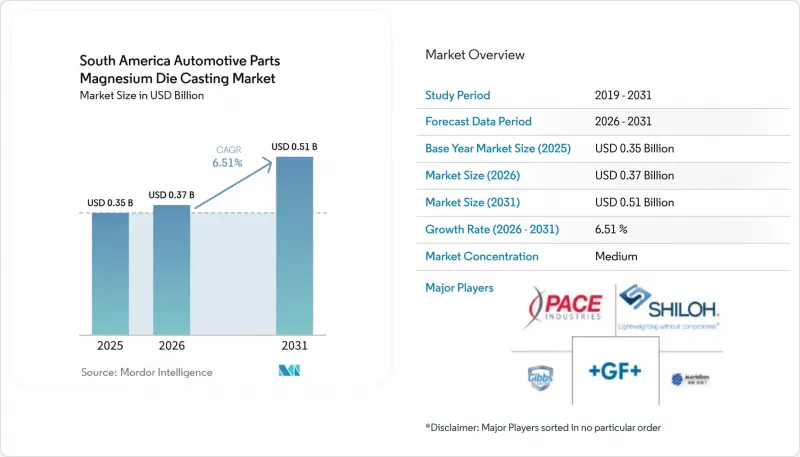
根據 Mordor Intelligence 的數據顯示,2025 年南美洲汽車零件鎂合金壓鑄市場價值為 3.5 億美元,預計 2026 年將達到 3.7 億美元。預計在預測期(2026-2031 年)內,該市場將以 6.51% 的複合年成長率成長,到 2031 年將達到 5.1 億美元。
南美洲汽車零件鎂合金壓鑄市場趨勢及洞察。
隨著電動車產量的快速成長,對鎂合金外殼和冷卻板的需求也增加。
在拉莫斯阿里斯佩、薩爾蒂約和聖保羅的工廠,電池式電動車(BEV) 生產線需要馬達外殼、冷卻板和電池托盤框架。這些部件需要高導熱性和輕量化。鎂合金 AE42 和 WE43 具有卓越的導熱性,同時與鋁合金 6061 相比,重量顯著降低。麥格納位於科阿韋拉的結構件工廠(一家投資巨大的工廠)和尼馬克位於 Blazer 電動車生產線內的工廠,已經開始向位於德克薩斯州的通用汽車公司供應真空鑄造的逆變器外殼。這項合作將前置作業時間從幾週大幅縮短至一周多。巴西國內的鎂冶煉廠每年生產大量的鎂。這些鎂的生產在穩定原料價格和緩解中國現貨市場價格波動方面發揮著至關重要的作用。此外,作為「移動計畫」的一部分,研發津貼正在支持大型零件鑄造的先導計畫。這些先導計畫已成功通過嚴格的屈服強度測試,這是碰撞安全結構的關鍵要求。
為了符合二氧化碳排放和燃油效率法規,需要減輕車重。
為應對巴西日益嚴格的二氧化碳排放法規,汽車製造商正從鋁合金轉向鎂合金,以顯著減輕零件重量。巴西的「Mover Program」為含有大量再生材料的零件提供稅額扣抵,凸顯了鎂的優勢,例如其重熔能耗低、可回收性高。同樣,符合美國CAFE標準的法規也促使通用汽車等原始設備製造商(OEM)在瓜納華托州和科阿韋拉州建立輕量化電動車平台。這項轉變推動了對壓鑄轉向柱、座椅框架和橫樑的需求。美墨加協定(USMCA)的在地採購要求進一步提升了本地採購鎂合金零件的重要性。此外,基於墨西哥官方標準的認證要求也限制了低成本進口產品的競爭。隨著法規合規期限的臨近,原始設備製造商正在敲定採購計劃,這推動了對新型高壓壓鑄(HPDC)工廠的投資。
進口鎂價格波動劇烈
中國主導全球鎂原料市場,滿足了大部分需求。近年來,中國減產導致鎂價大幅上漲,較以往水準顯著成長。雖然巴西的冶煉廠能夠滿足部分需求,但鄰國阿根廷和智利嚴重依賴進口。這些進口產品面臨漫長的運輸延誤和高額關稅,進一步加劇了供應壓力。此外,該地區的外匯波動也加劇了成本壓力。由於缺乏區域內的對沖手段,壓鑄製造商被迫進行現貨採購,但現貨價格短期內波動劇烈,導致合約利潤率承壓。
細分市場分析
預計到2031年,真空壓鑄將以7.55%的複合年成長率成長,這主要得益於電池平台對用於碰撞安全關鍵車身部件的無孔鑄件的需求。在南美洲汽車零件鎂合金壓鑄市場,真空系統市場預計將會擴張。這是因為到2025年,高壓壓鑄仍將佔據61.32%的市場佔有率,而新型巨型鑄件的生產能力已接近極限。 Nemac公司位於科阿韋拉州的工廠的真空壓機屈服強度可達250兆帕,能夠為通用汽車(GM)的電動汽車項目生產一體成型的後底盤部件,從而證明了其溢價的合理性。
對於大批量生產的殼體零件,高壓壓鑄因其90秒的快速成型週期而具有顯著的成本優勢,仍然是首選製程。然而,重力鑄造和擠壓鑄造在厚壁和近淨成形零件的製造領域仍佔有一席之地。在聖保羅工廠增設真空泵,符合巴西「Mover計畫」的回收材料積分要求。同時,近岸外包熱潮正將新的資金直接投入真空成型單元的建造中。不具備這項技術的供應商只能生產座椅框架和非結構性支架,導致其在南美鎂合金壓鑄汽車零件市場的佔有率不斷萎縮。
2025年,傳動系統和動力傳動系統鑄件的銷售量佔比達34.46%,成為最暢銷的產品。然而,預計到2031年,車身和底盤零件將以7.53%的複合年成長率(CAGR)引領市場成長。雪佛蘭Blazer電動車型採用鎂合金而非鋁合金打造後電池托盤框架,顯著減輕了重量並大幅提升了續航里程。因此,在整車製造商(OEM)致力於提升續航里程和確保碰撞安全性的推動下,鎂合金壓鑄車身結構件在南美汽車行業的市場佔有率逐年成長。
隨著混合動力汽車和純電動車(BEV)平台的發展勢頭強勁,傳統的內燃機(ICE)相關鑄件,例如承油盤和氣門室蓋,正逐漸被淘汰。這種轉變導致產能轉向電池托盤、避震塔和B柱等零件。此外,對內裝結構(尤其是儀錶面板橫樑)的需求也在成長。這主要是因為鎂合金零件符合巴西強制性的輕量化標準,從而可以獲得可觀的稅額扣抵。另外,真空壓鑄技術能夠製造高度氣密的機殼,也增加了對電氣元件(尤其是逆變器外殼)的需求。
其他好處:
- Excel格式的市場預測(ME)表
- 3個月的分析師支持
目錄
第1章:引言
- 研究假設和市場定義
- 調查範圍
第2章:調查方法
第3章執行摘要
第4章 市場狀況
- 市場概覽
- 市場促進因素
- 隨著電動車產量的快速成長,鎂合金外殼和冷卻板變得不可或缺。
- 為符合二氧化碳排放和燃油效率標準,需要減輕重量
- 隨著美國OEM供應鏈向南美國家轉移,HPDC的產能正在擴大。
- 高真空結構鑄造技術可以製造大型零件。
- 巴西對減重技術的稅收優惠
- 拉丁美洲新興的閉合迴路廢棄物網路
- 市場限制因素
- 進口鎂價格波動劇烈
- 來自成熟的鋁高壓壓鑄解決方案的競爭
- 拉丁美洲缺乏原生鎂冶煉能力
- 針對鎂粉塵和火災隱患,制定了嚴格的安全規則。
- 價值供應鏈分析
- 監理情勢
- 技術展望
- 波特五力分析
第5章 市場規模與成長預測
- 透過生產過程
- 壓力壓鑄
- 真空壓鑄
- 重力鑄造
- 擠壓壓鑄
- 透過使用
- 傳動系統和動力傳動系統
- 內部和外部
- 電氣和電子設備
- 車身和底盤
- 車輪和輪胎
- 其他類型
- 透過推進力
- 內燃機
- 電池式電動車
- 油電混合車
- 插電式混合動力電動車
- 燃料電池電動車
- 車輛類型
- 搭乘用車
- 商用車輛
- 按銷售管道
- 目的地設備製造商 (OEM)
- 售後市場
- 國家
- 巴西
- 阿根廷
- 智利
- 秘魯
- 其他南美國家
第6章 競爭情勢
- 市場集中度
- 策略趨勢
- 市佔率分析
- 公司簡介
- Nemak, SAB de CV
- Meridian Lightweight Technologies
- George Fischer AG
- Dynacast(Form Technologies)
- Pace Industries
- Ryobi Die Casting
- Magna International(Cosma)
- Gibbs Die Casting Group
- Rima Industrial
- Iochpe-Maxion
- Montupet(Linamar)
- Sundaram-Clayton
- CIE Automotive
- Teksid
- Dynacast Brazil
- Shiloh Industries Inc.
第7章 市場機會與未來展望
According to Mordor Intelligence, the South America automotive parts magnesium die casting market size was valued at USD 0.35 billion in 2025, and is expected to reach USD 0.37 billion in 2026, and is projected to reach USD 0.51 billion by 2031 at a CAGR of 6.51% during the forecast period (2026-2031).
South America Automotive Parts Magnesium Die Casting Market Trends and Insights
Rapid EV Production Ramp-Up Requiring Magnesium Housings & Cooling Plates
In Ramos Arizpe, Saltillo, and Sao Paulo, battery-electric vehicle lines require motor housings, cooling plates, and battery-tray frames. These components demand high thermal conductivity and minimal mass. Magnesium alloys AE42 and WE43 provide superior conductivity while achieving significant weight reduction compared to aluminum 6061. Magna's structural-parts plant in Coahuila, with a substantial investment, and Nemak's facility within the Blazer EV line, are already supplying vacuum-cast inverter casings to General Motors in Texas. This collaboration has notably reduced lead times from several weeks to just over a week. In Brazil, domestic magnesium smelters produce a considerable amount annually. This output plays a crucial role in stabilizing feedstock prices and mitigating fluctuations from the Chinese spot market . Additionally, R&D grants, part of the Mover Program, are supporting large-part casting pilots. These pilots have successfully met stringent yield-strength tests, a critical requirement for crash structures.
Lightweighting Mandates For CO2 & Fuel-Economy Compliance
In response to tightening CO2 regulations in Brazil, automakers are shifting from aluminum to magnesium alloys to significantly reduce component weight. Brazil's Mover Program offers tax credits for parts containing a substantial proportion of recycled material, highlighting magnesium's advantages, including low remelting energy requirements and high recyclability. Similarly, the regulations, aligned with U.S. CAFE standards, are prompting OEMs such as General Motors to establish lightweight EV platforms in Guanajuato and Coahuila. This shift is increasing demand for die-cast steering columns, seat frames, and cross-car beams. USMCA local-content thresholds further increase the importance of regionally sourced magnesium components. In addition, certification requirements under Official Mexican Standards limit competition from lower-cost imports. With compliance deadlines approaching, OEMs are finalizing purchasing commitments, supporting investments in new high-pressure die-casting (HPDC) capacity.
Volatile Imported Magnesium Prices
China dominates the global primary magnesium market, supplying the vast majority of the demand. In recent years, production curtailments in China have significantly driven up prices, marking a substantial increase compared to previous levels. While Brazil's smelting base caters to a portion of the demand, neighboring Argentina and Chile rely heavily on imports. These imports face lengthy shipping delays and high tariffs, adding to the challenges. Additionally, currency fluctuations in the region further exacerbate cost pressures. Without regional hedging tools, die casters are forced to make spot purchases, which can experience significant fluctuations over short periods, thereby squeezing contract profit margins.
Other drivers and restraints analyzed in the detailed report include:
- Near-Shoring of US OEM Supply Chains into South American Nations Stimulates HPDC Capacity
- High-Vacuum Structural Casting Unlocks Large Body Parts
- Competition From Mature Aluminum HPDC Solutions
For complete list of drivers and restraints, kindly check the Table Of Contents.
Segment Analysis
Vacuum die casting is on course for a 7.55% CAGR to 2031, driven by battery platforms that need porosity-free castings for crash-critical body parts. The South American automotive parts magnesium die casting market size for vacuum systems is expected to expand as pressure die casting, although still holding 61.32% of the 2025 share, reaches strength limits for new giga-castings. Vacuum presses in Nemak's Coahuila plant deliver 250 MPa yield strength, enabling single-piece rear underbodies for General Motors EV programs and justifying the price premiums.
Pressure die casting remains preferred for high-volume housings, where 90-second cycles cut costs, but gravity and squeeze die casting maintain niche roles for thick-section or near-net-shape parts. Retrofitting Sao Paulo plants with vacuum pumps qualifies them for recycled-content credits under Brazil's Mover Program, while near-shoring boom steers fresh capital straight into vacuum-ready cells. Suppliers without the technology risk are relegated to seat frames and non-structural brackets, thereby shrinking their addressable share of the South American automotive parts magnesium die-casting market.
Driveline and powertrain castings led 2025 revenue at 34.46%, yet body and chassis components will pace the market with a 7.53% CAGR through 2031. Chevrolet Blazer EV models now feature rear battery-tray frames that are significantly lighter when crafted from magnesium instead of aluminum, boosting their range noticeably. As a result, the market share for magnesium die casting in structural body parts within South America's automotive sector is witnessing an annual uptick, driven by OEMs' focus on enhancing range and ensuring crashworthiness.
As hybrid and fully electric BEV platforms gain momentum, traditional ICE-related castings like oil pans and valve covers are becoming obsolete. This shift redirects production capacity towards components such as battery trays, shock towers, and B-pillars. Additionally, interior structures, notably instrument-panel beams, are seeing increased demand. This is largely because magnesium components are achieving mandated weight-saving thresholds, thereby unlocking valuable tax credits in Brazil. Furthermore, electrical components, especially inverter housings, are on the rise due to vacuum die casting's ability to ensure leak-proof enclosures.
Complete Report Scope:
- By Production Process
- Pressure Die Casting
- Vacuum Die Casting
- Gravity Die Casting
- Squeeze Die Casting
- By Application
- Driveline & Powertrain
- Interior & Exterior
- Electrical & Electronics
- Body & Chassis
- Wheel & Tires
- Other Types
- By Propulsion
- Internal Combustion Engine
- Battery-Electric Vehicle
- Hybrid Electric Vehicle
- Plug-in Hybrid Electric Vehicle
- Fuel-Cell Electric Vehicle
- By Vehicle Type
- Passenger Car
- Commercial Vehicle
- By Sales Channel
- Original Equipment Manufacturer (OEM)
- Aftermarket
- By Country
- Brazil
- Argentina
- Chile
- Peru
- Rest of South America
List of Companies Covered in this Report:
- Nemak, S.A.B. de C.V.
- Meridian Lightweight Technologies
- George Fischer AG
- Dynacast (Form Technologies)
- Pace Industries
- Ryobi Die Casting
- Magna International (Cosma)
- Gibbs Die Casting Group
- Rima Industrial
- Iochpe-Maxion
- Montupet (Linamar)
- Sundaram-Clayton
- CIE Automotive
- Teksid
- Dynacast Brazil
- Shiloh Industries Inc.
Additional Benefits:
- The market estimate (ME) sheet in Excel format
- 3 months of analyst support
TABLE OF CONTENTS
1 Introduction
- 1.1 Study Assumptions & Market Definition
- 1.2 Scope of the Study
2 Research Methodology
3 Executive Summary
4 Market Landscape
- 4.1 Market Overview
- 4.2 Market Drivers
- 4.2.1 Rapid EV Production Ramp-up Requiring Magnesium Housings & Cooling Plates
- 4.2.2 Lightweighting Mandates for Co2 & Fuel-Economy Compliance
- 4.2.3 Near-Shoring Of US OEM Supply Chains into South American Nations Stimulates HPDC Capacity
- 4.2.4 High-Vacuum Structural Casting Unlocks Large Body Parts
- 4.2.5 Brazilian Fiscal Incentives for Weight-Reduction Technologies
- 4.2.6 Emerging Closed-Loop Scrap Feedstock Networks in Latam
- 4.3 Market Restraints
- 4.3.1 Volatile Imported Magnesium Prices
- 4.3.2 Competition from Mature Aluminum HPDC Solutions
- 4.3.3 Scarce Primary Mg Smelting Capacity in Latam
- 4.3.4 Stringent Safety Rules for Mg Dust & Fire Hazards
- 4.4 Value / Supply-Chain Analysis
- 4.5 Regulatory Landscape
- 4.6 Technological Outlook
- 4.7 Porter's Five Forces Analysis
- 4.7.1 Bargaining Power of Suppliers
- 4.7.2 Bargaining Power of Buyers
- 4.7.3 Threat of New Entrants
- 4.7.4 Threat of Substitutes
- 4.7.5 Competitive Rivalry
5 Market Size & Growth Forecasts (Value (USD))
- 5.1 By Production Process
- 5.1.1 Pressure Die Casting
- 5.1.2 Vacuum Die Casting
- 5.1.3 Gravity Die Casting
- 5.1.4 Squeeze Die Casting
- 5.2 By Application
- 5.2.1 Driveline & Powertrain
- 5.2.2 Interior & Exterior
- 5.2.3 Electrical & Electronics
- 5.2.4 Body & Chassis
- 5.2.5 Wheel & Tires
- 5.2.6 Other Types
- 5.3 By Propulsion
- 5.3.1 Internal Combustion Engine
- 5.3.2 Battery-Electric Vehicle
- 5.3.3 Hybrid Electric Vehicle
- 5.3.4 Plug-in Hybrid Electric Vehicle
- 5.3.5 Fuel-Cell Electric Vehicle
- 5.4 By Vehicle Type
- 5.4.1 Passenger Car
- 5.4.2 Commercial Vehicle
- 5.5 By Sales Channel
- 5.5.1 Original Equipment Manufacturer (OEM)
- 5.5.2 Aftermarket
- 5.6 By Country
- 5.6.1 Brazil
- 5.6.2 Argentina
- 5.6.3 Chile
- 5.6.4 Peru
- 5.6.5 Rest of South America
6 Competitive Landscape
- 6.1 Market Concentration
- 6.2 Strategic Moves
- 6.3 Market Share Analysis
- 6.4 Company Profiles (includes Global Level Overview, Market Level Overview, Core Segments, Financials as Available, Strategic Information, Market Rank/Share for Key Companies, Products and Services, SWOT Analysis, and Recent Developments)
- 6.4.1 Nemak, S.A.B. de C.V.
- 6.4.2 Meridian Lightweight Technologies
- 6.4.3 George Fischer AG
- 6.4.4 Dynacast (Form Technologies)
- 6.4.5 Pace Industries
- 6.4.6 Ryobi Die Casting
- 6.4.7 Magna International (Cosma)
- 6.4.8 Gibbs Die Casting Group
- 6.4.9 Rima Industrial
- 6.4.10 Iochpe-Maxion
- 6.4.11 Montupet (Linamar)
- 6.4.12 Sundaram-Clayton
- 6.4.13 CIE Automotive
- 6.4.14 Teksid
- 6.4.15 Dynacast Brazil
- 6.4.16 Shiloh Industries Inc.
7 Market Opportunities & Future Outlook
- 7.1 White-space & Unmet-Need Assessment

 汽車結構鋁壓鑄市場:全球市場預測,2026-2032年汽車動力傳動系統總成用鋁壓鑄市場:全球市場預測,2026-2032年汽車結構鋁壓鑄合金市場:全球市場預測,2026-2032年
 印度汽車零件鋁壓鑄市場:市場佔有率分析、產業趨勢與統計及成長預測(2026-2031)歐洲汽車壓鑄:市場佔有率分析、產業趨勢與統計及成長預測(2026-2031)汽車沖壓設備市場-全球市場預測(2026-2032年)北美汽車壓鑄:市場佔有率分析、產業趨勢與統計及成長預測(2026-2031 年)汽車鋁製零件高壓壓鑄(HPDC):市場佔有率分析、行業趨勢和統計數據以及成長預測(2026-2031 年)
 汽車壓鑄潤滑劑市場報告:按類型、材料類型、應用和地區分類(2026-2034年)汽車零件鎂合金壓鑄市場報告:按製造流程、應用和地區分類,2026-2034年