


 |
市場調查報告書
商品編碼
2113801
印度汽車零件鋁壓鑄市場:市場佔有率分析、產業趨勢與統計及成長預測(2026-2031)India Automotive Parts Aluminum Die Casting - Market Share Analysis, Industry Trends & Statistics, Growth Forecasts (2026 - 2031) |
||||||

※ 本網頁內容可能與最新版本有所差異。詳細情況請與我們聯繫。
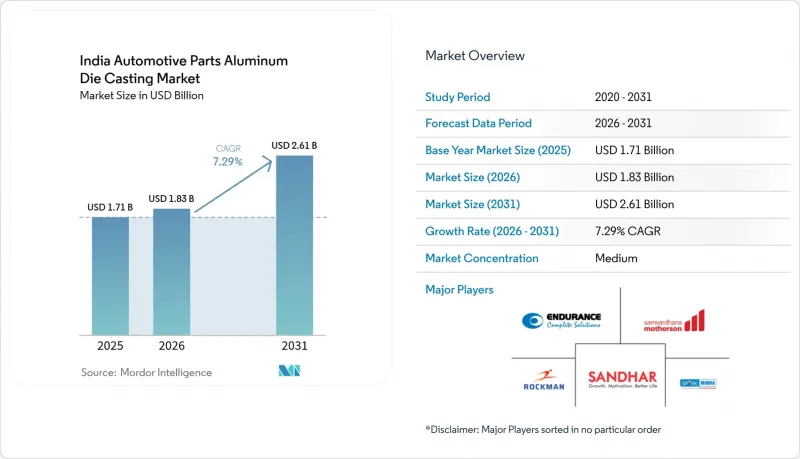
據 Mordor Intelligence 稱,2025 年印度鋁壓鑄汽車零件市場價值為 17.1 億美元,預計到 2031 年將從 2026 年的 18.3 億美元成長至 26.1 億美元,預測期(2026-2031 年)複合年成長率為 7.29%。
本報告按製造程序(壓鑄、重力鑄造及其他)、應用類型(引擎零件、車身及結構件及其他)、車輛類型(乘用車、摩托車及其他)、鑄造合金系列(鋁矽合金及其他)、最終用戶和地區進行細分。市場預測以價值(美元)和數量(噸)表示。
印度汽車零件用鋁壓鑄件市場趨勢及洞察。
電動車產量增加,電池外殼需求增加
預計2020年至2024年間,電動車(EV)產量將以76%的複合年成長率(CAGR)激增,目前電動車零件佔汽車零件總價值的6%。電池外殼需要兼具電磁屏蔽和碰撞能量吸收能力的鋁鎂合金,這推動了合金技術的創新。特斯拉與塔塔集團供應商之間價值20億美元的年度採購協議凸顯了其出口潛力。採用低壓砂型鑄造製程製造的具有複雜冷卻通道的溫度控管鑄件正在湧現。 ASK Automotive在拉賈斯坦邦和卡納塔克邦工廠擴建產能後,電動車相關產品的銷售額成長了133%。根據FAME-II計劃,政府已通過與生產連結獎勵計畫,投資11億美元用於先進零件製造設施。
汽車輕量化和燃油效率標準
企業平均燃油經濟性(CAFE)法規和印度第六階段排放標準(Bharat Stage VI)正在加速向鋁材的轉型,預計每輛車的平均鋁材用量將從2024年的29公斤增加到2030年的160公斤。這一轉變波及整個鑄造供應鏈,鋁製部件取代了鐵製部件,在不影響剛性的前提下,重量減輕了40%。 ICRA預測,到2025年,國內鋁材需求將以每年9%的速度成長,其中大部分成長將來自汽車應用領域。高壓壓鑄技術目前正被用於製造一體式變速箱殼體,可將製造成本降低高達30%。印度標準局(BIS)制定的標準確保合金品質標準化,並確保機械性能符合安全標準。隨著原始設備製造商(OEM)對模具認證速度的要求不斷提高,模擬主導設計正在縮短開發週期並降低缺陷率。
原物料價格波動及發電用煤短缺
2024年,原生鋁現貨價格在每噸2,160美元至2,480美元之間波動。同時,根據印度中央電力局報告,印度工業平均電價年增6%,對壓鑄製造商的營業利潤率造成壓力。煤炭供應問題迫使提煉進口煤炭用於發電,並推高了成本。印度鋁業公司(Hindalco)投資100億美元用於擴大產能和向可再生能源轉型,以穩定投入成本。季度價格調整條款如今在原始設備製造商(OEM)合約中普遍存在,使預測和規劃更加複雜。外匯波動加劇了進口合金和工具鋼的風險。為了應對價格波動,主要壓鑄製造商正在引入廢料熔煉生產線,並將再生材料含量提高到近80%,從而降低對新金屬的依賴。
細分市場分析
至2025年,壓力壓鑄將佔印度汽車鋁壓鑄市場68.74%的佔有率。其主要應用包括引擎缸體、齒輪箱和整合式懸吊臂,這些應用對公差要求極高,必須控制在50微米以內。工業4.0儀錶板可追蹤注射壓力、熔化溫度和循環時間,從而將缺陷率控制在5%以下。目前,採用半固體和流變鑄造的印度汽車鋁壓鑄市場規模較小,但其低孔隙率使其成為電動車電池外殼的理想選擇,尤其適用於承受熱循環的場合,並且其複合年成長率高達9.32%。重力鑄造仍用於對錶面光潔度要求不高的卡車零件,但隨著高壓設備零件單位成本的降低,其市場佔有率正在萎縮。
ProCAST 和 MAGMASOFT 等先進模擬軟體套件可實現虛擬澆口偵測,為每套模具節省 50 萬美元的成本,並加快 PPAP 批准速度。自動化噴塗機器人和真空輔助填充技術可提升底盤零件的關鍵機械性能,而安全性至關重要。目前,我們全國超過 85% 的運作產能已通過 ISO 9001 和 IATF 16949 認證,不斷提升的品質標準正促使我們贏得更多來自東協組裝製造商的出口訂單,這些製造商對可預測的尺寸精度有著極高的要求。
預計到2025年,引擎零件將佔印度汽車鋁壓鑄市場45.98%的佔有率。這主要歸功於鋁材優異的導熱性能,使其能夠更有效地冷卻小型渦輪增壓引擎。雖然隨著電動車的普及,引擎零件在印度汽車鋁壓鑄市場中的佔有率預計將逐漸下降,但由於混合動力傳動系統系統日益複雜,其絕對銷售量預計仍將保持強勁。車身和結構件的成長速度最快,複合年成長率達8.61%,這主要得益於「超級鑄造」(gigacasting)技術的應用,該技術將後底盤整合到一個重達60公斤的鑄件中。隨著汽車製造商重新設計其平台以採用滑板式車身結構,到2020年代末,印度汽車鋁壓鑄市場中電池外殼鑄件的市場規模可能會超過引擎缸體。
結構鑄件的原始設備製造商 (OEM)檢驗流程目前與素車(BIW) 鋼焊接審核類似,均要求進行電腦斷層掃描檢測以驗證其內部完整性。最終用戶需支付 15-20% 的溢價,以省去 100 個或更多沖壓件和焊接夾具的需求。隨著行星齒輪變速器在混合動力汽車中的應用,變速箱和傳動系統鑄件的需求仍然強勁。由於鋁具有耐腐蝕性,因此用於暖通空調 (HVAC)、轉向和煞車部件,這一趨勢在沿海城市尤其明顯,因為鹽分會加速傳統鐵基合金的氧化。
其他好處
- Excel格式的市場預測(ME)表
- 3個月的分析師支持
目錄
第1章:引言
- 研究假設和市場定義
- 調查範圍
第2章:調查方法
第3章執行摘要
第4章 市場狀況
- 市場概覽
- 市場促進因素
- 電動車產量增加,電池外殼需求增加
- 汽車輕量化和燃油效率標準
- 國內乘用車產量成長
- 東協出口需求激增—“規避中國風險”
- OEM廠商採用千兆廣播平台
- 由於報廢車輛相關法規的訂定,廢鋁的需求增加。
- 市場限制因素
- 原物料價格波動及發電用煤短缺
- 對高噸位高壓壓鑄機械進行大量資本投資。
- 模擬主導設計領域熟練勞動力短缺
- 透過液壓成形和鈑金加工展開競爭。
- 價值供應鏈分析
- 監理情勢
- 技術展望
- 波特五力模型
第5章 市場規模與成長預測
- 透過製造程序
- 壓力壓鑄
- 重力鑄造
- 半固體流變鑄造
- 按應用程式類型
- 引擎部件
- 身體和結構部件
- 變速器和傳動系統部件
- 電動汽車電池外殼和溫度控管系統
- 其他應用(暖通空調、轉向、煞車)
- 按車輛類型
- 搭乘用車
- 摩托車
- 三輪車
- 輕型商用車
- 大型商用車輛和巴士
- 鑄造合金系列
- 鋁矽合金(ADC12、LM-6 等)
- 鋁鎂合金
- 鋁銅及其他
- 最終用戶
- OEM/一級供應商
- 獨立售後市場
- 按地區(印度)
- 西印度群島
- 南印度
- 印度北部
- 印度東部/印度東北部
第6章 競爭情勢
- 市場集中度
- 策略趨勢
- 市佔率分析
- 公司簡介
- Endurance Technologies
- Samvardhana Motherson Group
- Rockman Industries
- Sandhar Technologies
- Spark Minda(Minda Corp)
- Rico Auto Industries
- Jaya Hind Industries
- Sipra Quality Die Casting
- Form Technologies Inc.(Dynacast)
- Nemak India
- DR Axion India
- Indian Diecasting Industries
- Bhanderi Aluminium Casting
- Auto Die-Cast(New Delhi)
- Rane(Madras)Limited
第7章 市場機會與未來展望
According to Mordor Intelligence, the India automotive parts aluminum die casting market size was valued at USD 1.71 billion in 2025 and estimated to grow from USD 1.83 billion in 2026 to reach USD 2.61 billion by 2031, at a CAGR of 7.29% during the forecast period (2026-2031).
This report is Segmented by Production Process (Pressure Die Casting, Gravity Die Casting, and More), Application Type (Engine Parts, Body and Structural Parts, and More), Vehicle Type (Passenger Cars, Two-Wheelers, and More), Casting Alloy Family (Al-Si Alloys, and More), End-User, and Region. The Market Forecasts are Provided in Terms of Value (USD) and Volume (Tons).
India Automotive Parts Aluminum Die Casting Market Trends and Insights
Rising EV Production and Demand for Battery Housings
Electric-vehicle output surged at a 76% CAGR between 2020-2024, lifting EV components to 6% of total automotive part value. Battery enclosures demand Al-Mg alloys that provide electromagnetic shielding and crash energy absorption, spurring alloy innovation. A USD 2 billion annual sourcing agreement between Tesla and Tata Group suppliers underscores export potential. Thermal-management castings with intricate cooling channels emerge via low-pressure sand casting. ASK Automotive recorded 133% EV revenue growth after capacity expansion in Rajasthan and Karnataka plants. Production-Linked Incentives under FAME-II channel USD 1.1 billion toward advanced component facilities.
Vehicle Lightweighting and Fuel-Efficiency Norms
Corporate Average Fuel Economy rules and Bharat Stage VI standards accelerated aluminum substitution, pushing average content from 29 kg in 2024 toward 160 kg per vehicle by 2030. The shift cascades across casting supply chains, replacing ferrous parts with aluminum alternatives that trim mass by 40% without compromising stiffness. ICRA projects 9% annual domestic aluminum demand growth through 2025, with automotive uses dominant . High-pressure die casting now produces single-piece transmission housings, lowering manufacturing costs by up to 30%. Bureau of Indian Standards specifications harmonize alloy quality, ensuring mechanical properties remain within safety thresholds. Simulation-led design shortens development cycles and lowers defect rates as OEMs seek faster homologation.
Raw-Material Price Volatility and Power-Coal Shortages
Primary aluminum cash prices oscillated between USD 2,160 and USD 2,480 per tonne in 2024, while the Central Electricity Authority reported a 6% year-on-year rise in India's average industrial power tariff, squeezing die casters' operating margins. Coal supply issues forced smelters to import power-grade coal, raising costs. Hindalco committed USD 10 billion to expand capacity and transition toward renewables, hoping to stabilize input costs. Quarterly price-adjustment clauses now dominate OEM contracts, complicating forecast planning. Currency swings add risk for imported alloys and tool steel. To buffer volatility, leading die casters install scrap-melting lines, pushing recycled content toward 80% and lowering virgin-metal exposure.
Other drivers and restraints analyzed in the detailed report include:
- Growth in Domestic Passenger-Vehicle Production
- Export Demand Surge from ASEAN "China-De-Risking"
- High Capex for High-Tonnage HPDC Machines
For complete list of drivers and restraints, kindly check the Table Of Contents.
Segment Analysis
Pressure die casting captured 68.74% of the India automotive parts aluminum die casting market in 2025. Stronghold applications include engine blocks, gear housings, and integrated suspension arms, where tolerance windows below 50 microns are mandatory. Industry 4.0 dashboards track injection pressure, melt temperature, and cycle time, trimming rejection rates below 5%. The India automotive parts aluminum die casting market size generated by semi-solid rheocasting is small today, yet shows the highest 9.32% CAGR, thanks to lower porosity, making it ideal for EV battery cases exposed to thermal cycling. Gravity die casting persists in truck components with lower surface-finish needs, though share erodes as cost per part falls for high-pressure equipment.
Advanced simulation packs such as ProCAST and MAGMASOFT enable virtual gating trials, saving USD 0.5 million per tool set and accelerating PPAP sign-off. Automated die-spray robots and vacuum-assisted filling strengthen mechanical properties, crucial for safety-critical chassis parts. ISO 9001 and IATF 16949 certification levels now exceed 85% of installed capacity nationwide, raising baseline quality and attracting export orders from ASEAN assemblers seeking predictable dimensional profiles.
Engine parts held a 45.98% share in 2025, benefiting from aluminum's superior heat transfer that cools down-sized turbocharged engines more efficiently. The India automotive parts aluminum die casting market share for engine components will taper as EV penetration rises, yet absolute volume remains resilient due to hybrid powertrain complexity. Body and structural components grow fastest at 8.61% CAGR thanks to giga-casting adoption that consolidates rear under-bodies into single 60-kg castings. The India automotive parts aluminum die casting market size generated by battery housing castings may surpass engine blocks by the late 2020s as OEMs reorient platforms around skateboard architectures.
OEM validation protocols for structural castings now mirror BIW steel weld audits, demanding CT-scan inspections to verify internal integrity. End-users pay 15-20% price premiums for the elimination of 100-plus stamped parts and weld fixtures. Transmission and driveline castings remain steady as hybrids add planetary gearboxes. HVAC, steering, and brake parts embrace aluminum for corrosion resistance, especially in coastal cities where salt exposure accelerates oxidation on conventional ferrous alloys.
Complete Report Scope:
- By Production Process
- Pressure Die Casting
- Gravity Die Casting
- Semi-solid/Rheocasting
- By Application Type
- Engine Parts
- Body and Structural Parts
- Transmission and Driveline Parts
- E-mobility Battery Housings and Thermal Systems
- Other Applications (HVAC, Steering, Braking)
- By Vehicle Type
- Passenger Cars
- Two-Wheelers
- Three-Wheelers
- Light Commercial Vehicles
- Heavy Commercial Vehicles and Buses
- By Casting Alloy Family
- Al-Si Alloys (ADC12, LM-6 etc.)
- Al-Mg Alloys
- Al-Cu and Others
- By End-User
- OEM/Tier-1 Suppliers
- Independent Aftermarket
- By Region (India)
- West India
- South India
- North India
- East and North-East India
List of Companies Covered in this Report:
- Endurance Technologies
- Samvardhana Motherson Group
- Rockman Industries
- Sandhar Technologies
- Spark Minda (Minda Corp)
- Rico Auto Industries
- Jaya Hind Industries
- Sipra Quality Die Casting
- Form Technologies Inc. (Dynacast)
- Nemak India
- DR Axion India
- Indian Diecasting Industries
- Bhanderi Aluminium Casting
- Auto Die-Cast (New Delhi)
- Rane (Madras) Limited
Additional Benefits:
- The market estimate (ME) sheet in Excel format
- 3 months of analyst support
TABLE OF CONTENTS
1 Introduction
- 1.1 Study Assumptions & Market Definition
- 1.2 Scope of the Study
2 Research Methodology
3 Executive Summary
4 Market Landscape
- 4.1 Market Overview
- 4.2 Market Drivers
- 4.2.1 Rising EV Production and Demand for Battery Housings
- 4.2.2 Vehicle Lightweighting and Fuel-Efficiency Norms
- 4.2.3 Growth in Domestic Passenger-Vehicle Production
- 4.2.4 Export Demand Surge from ASEAN "China-De-Risking"
- 4.2.5 OEM Adoption of Giga/Mega-Casting Platforms
- 4.2.6 End-of-Life-Vehicle Rules Boosting Scrap Aluminum
- 4.3 Market Restraints
- 4.3.1 Raw-Material Price Volatility and Power-Coal Shortages
- 4.3.2 High Capex for High-Tonnage HPDC Machines
- 4.3.3 Skilled-Workforce Deficit in Simulation-Led Design
- 4.3.4 Competition from Hydroforming and Sheet-Metal Routes
- 4.4 Value / Supply-Chain Analysis
- 4.5 Regulatory Landscape
- 4.6 Technological Outlook
- 4.7 Porter's Five Forces
- 4.7.1 Bargaining Power of Buyers
- 4.7.2 Bargaining Power of Suppliers
- 4.7.3 Threat of New Entrants
- 4.7.4 Threat of Substitutes
- 4.7.5 Intensity of Competitive Rivalry
5 Market Size & Growth Forecasts (Value and Volume)
- 5.1 By Production Process
- 5.1.1 Pressure Die Casting
- 5.1.2 Gravity Die Casting
- 5.1.3 Semi-solid/Rheocasting
- 5.2 By Application Type
- 5.2.1 Engine Parts
- 5.2.2 Body and Structural Parts
- 5.2.3 Transmission and Driveline Parts
- 5.2.4 E-mobility Battery Housings and Thermal Systems
- 5.2.5 Other Applications (HVAC, Steering, Braking)
- 5.3 By Vehicle Type
- 5.3.1 Passenger Cars
- 5.3.2 Two-Wheelers
- 5.3.3 Three-Wheelers
- 5.3.4 Light Commercial Vehicles
- 5.3.5 Heavy Commercial Vehicles and Buses
- 5.4 By Casting Alloy Family
- 5.4.1 Al-Si Alloys (ADC12, LM-6 etc.)
- 5.4.2 Al-Mg Alloys
- 5.4.3 Al-Cu and Others
- 5.5 By End-User
- 5.5.1 OEM/Tier-1 Suppliers
- 5.5.2 Independent Aftermarket
- 5.6 By Region (India)
- 5.6.1 West India
- 5.6.2 South India
- 5.6.3 North India
- 5.6.4 East and North-East India
6 Competitive Landscape
- 6.1 Market Concentration
- 6.2 Strategic Moves
- 6.3 Market Share Analysis
- 6.4 Company Profiles (Includes Global Level Overview, Market Level Overview, Core Segments, Financials as Available, Strategic Information, Market Rank/Share for Key Companies, Products and Services, SWOT Analysis, and Recent Developments)
- 6.4.1 Endurance Technologies
- 6.4.2 Samvardhana Motherson Group
- 6.4.3 Rockman Industries
- 6.4.4 Sandhar Technologies
- 6.4.5 Spark Minda (Minda Corp)
- 6.4.6 Rico Auto Industries
- 6.4.7 Jaya Hind Industries
- 6.4.8 Sipra Quality Die Casting
- 6.4.9 Form Technologies Inc. (Dynacast)
- 6.4.10 Nemak India
- 6.4.11 DR Axion India
- 6.4.12 Indian Diecasting Industries
- 6.4.13 Bhanderi Aluminium Casting
- 6.4.14 Auto Die-Cast (New Delhi)
- 6.4.15 Rane (Madras) Limited
7 Market Opportunities & Future Outlook
- 7.1 White-space & Unmet-Need Assessment

 汽車結構鋁壓鑄市場:全球市場預測,2026-2032年汽車動力傳動系統總成用鋁壓鑄市場:全球市場預測,2026-2032年汽車結構鋁壓鑄合金市場:全球市場預測,2026-2032年
 南美洲汽車零件鎂合金壓鑄:市場佔有率分析、產業趨勢與統計及成長預測(2026-2031 年)歐洲汽車壓鑄:市場佔有率分析、產業趨勢與統計及成長預測(2026-2031)汽車沖壓設備市場-全球市場預測(2026-2032年)北美汽車壓鑄:市場佔有率分析、產業趨勢與統計及成長預測(2026-2031 年)汽車鋁製零件高壓壓鑄(HPDC):市場佔有率分析、行業趨勢和統計數據以及成長預測(2026-2031 年)
 汽車壓鑄潤滑劑市場報告:按類型、材料類型、應用和地區分類(2026-2034年)汽車零件鎂合金壓鑄市場報告:按製造流程、應用和地區分類,2026-2034年