


 |
市場調查報告書
商品編碼
2113383
歐洲汽車壓鑄:市場佔有率分析、產業趨勢與統計及成長預測(2026-2031)Europe Automotive Parts Die Casting - Market Share Analysis, Industry Trends & Statistics, Growth Forecasts (2026 - 2031) |
||||||

※ 本網頁內容可能與最新版本有所差異。詳細情況請與我們聯繫。
據 Mordor Intelligence 稱,2025 年歐洲汽車壓鑄市場價值為 161.1 億美元,預計到 2031 年將達到 219.8 億美元,而 2026 年為 169.7 億美元,預測期(2026-2031 年)的複合年成長率為 5.32%。
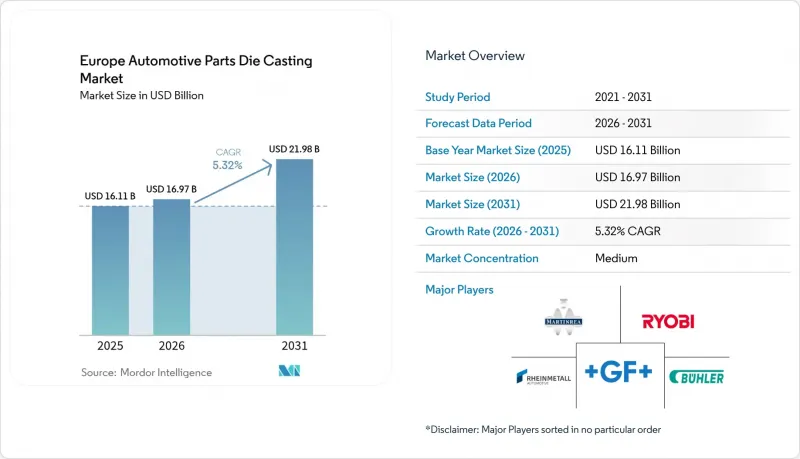
本報告按生產流程類型(例如,高壓壓鑄、真空高壓壓鑄)、金屬類型(例如,鋁)、應用領域(例如,引擎和動力傳動系統總成部件)、車輛類型(例如,乘用車)、推進系統(例如,內燃機)、鑄件尺寸(例如,小型)和國家/地區進行細分。市場預測以美元計價。
歐洲汽車壓鑄市場趨勢與洞察
電動車主導的向大型「一體式鑄造」結構組件的過渡
歐洲汽車製造商正在採用「一體式鑄造」技術,該技術將多達100個小型沖壓件整合到一個重量超過100公斤的鋁結構件中,從而減少焊接數量和所需的占地面積。沃爾沃哥德堡工廠和梅賽德斯-奔馳不來梅生產線已投入運作夾緊力超過6000噸的沖壓壓平機。這種轉變正在提高巨型鑄造在歐洲汽車壓鑄市場的佔有率,進一步加強汽車製造商和鑄造廠之間的技術合作,並使能夠獲得資金投資建設多套沖壓設備的供應商受益。特斯拉最近對其下一代一體式鑄造的重新設計凸顯了技術挑戰,但歐洲鑄造廠仍在繼續投資真空排氣、裂縫檢測和熱處理系統,以滿足汽車製造商的碰撞安全性能目標。高資本密集度正在加速區域整合,因為小規模的家族式鑄造廠難以籌集資金引進巨型沖壓機。從中長期來看,Gigacasting有望提高每噸沖壓機的運轉率,使鑄造廠的收入不再局限於傳統的動力傳動系統總成零件。
歐盟收緊二氧化碳與生命週期碳排放法規
將於2026年生效的歐7法規結構將排放法規與電池耐久性和材料回收標準相結合,迫使原始設備製造商(OEM)優先使用回收的低碳鋁坯。因此,壓鑄製造商必須依照ISO 14040/14044標準記錄生命週期評估;否則,將面臨在採購競標中落敗的風險。已運作閉合迴路合金回收系統的鑄造廠將獲得優先供應商地位,而採購原生金屬的競爭對手將面臨利潤率下降的風險。此外,該法規將範圍擴大到排放以外的顆粒物,推動了煞車、懸吊和車身本體的重新設計。這些要求預示著未來幾年對符合碰撞和腐蝕測試標準的無孔隙、薄壁鑄件的需求將持續成長。過渡期將使現有的本地鑄造製造商有時間進行維修,引入脫氣站和替代助熔劑,但反應遲緩的公司將被處以罰款或被要求與材料回收商成立合資企業。
鋁現貨價格波動與固定價格詢價單 (RFQ)
歐洲鑄造廠的利潤率會隨著倫敦金屬交易所 (LME) 現貨價格與汽車製造商發出的 12 至 24 個月期詢價單 (RFQ) 價格之間的差異而波動。近期能源價格飆升和潛在的貿易制裁威脅著鋼坯的穩定供應,迫使鑄造廠在支付高額溢價進行避險和承受不斷上漲的原料成本之間做出選擇。資金基礎有限的小規模鑄造廠面臨流動性緊張的困境,這可能會加速產業整合。一些供應商透過在新詢價單中加入價格調整條款來應對,但汽車製造商 (OEM) 為了保護材料清單(BOM) 的預測,抵制浮動價格。庫存緩衝雖然可以暫時緩解壓力,但會佔用營運資金並推高保險成本,凸顯了動態籌資策略的必要性。
細分市場分析
由於高壓壓鑄 (HPDC) 在批量生產零件方面具有生產效率優勢,預計到 2025 年,HPDC 將保持在歐洲汽車壓鑄市場 62.12% 的佔有率。然而,真空高壓鑄 (VHPDC) 預計將以 6.71% 的複合年成長率 (CAGR) 推動市場成長,這反映出原始設備製造商 (OEM) 對用於電池機殼和底盤節點的無孔結構的接受度不斷提高。歐洲汽車壓鑄市場中由真空高壓壓鑄 (VHPDC) 貢獻的佔有率直接受益於輕量化結構的應用。
隨著對扣夾力要求的不斷提高,鑄造製造商正在升級到多級排氣系統,以減少熔融氣體並實現焊接後熱處理。投資即時壓力監測可以縮短缺陷檢測的回饋週期,並減少廢品產生時間。雖然標準高壓鑄 (HPDC) 仍然適用於引擎缸體的批量生產,但隨著內燃機 (ICE) 需求趨於穩定,獲利潛力正轉向更高價值的巨型鑄造。擠壓鑄造和半固體鑄造過程在高階煞車卡鉗等細分市場仍然佔據重要地位,其優異的機械性能彌補了較長的生產週期。製程配置的轉變表明,決定歐洲競爭力的不僅是人事費用,還有技術規格。
鋁材憑藉其優異的密度、成本和成熟的回收途徑,預計到2025年將佔據歐洲汽車壓鑄市場75.12%的佔有率。循環經濟法規對使用原生材料進行處罰,推動了這個細分市場的發展,使其在歐洲汽車壓鑄市場中佔有重要地位。同時,鎂材預計到2031年將以9.25%的複合年成長率成長。合金成分技術的進步降低了人們對腐蝕的擔憂,並使得在不影響剛性的前提下減少壁厚成為可能。
鎂合金擴大被用於電池組機殼和轉向柱支架,以減輕電池重量並提高純電動車的續航里程。鋅和特殊合金則用於資訊娛樂系統外殼和感測器支架,在這些零件中,尺寸精度比抗張強度更為重要。隨著歐洲大型Gigapress壓機的引入,如果結構用鎂合金通過阻燃性測試,其應用範圍可能會進一步擴大。由於原生鎂大部分生產歐盟以外地區,供應穩定性仍存在不確定性,但廢鎂回收途徑的開發正在降低部分風險。
其他好處:
- Excel格式的市場預測(ME)表
- 3個月的分析師支持
目錄
第1章:引言
- 研究假設和市場定義
- 調查範圍
第2章:調查方法
第3章執行摘要
第4章 市場狀況
- 市場概覽
- 市場促進因素
- 電動車驅動的向大型「一體式鑄造」結構組件的過渡
- 加強歐盟關於二氧化碳和生命週期碳排放的法規
- 內燃機電動車的平行生產增加了對模具的需求。
- 原始設備製造商正在推廣他們自己的內部合金回收循環。
- 採用多級真空高壓壓鑄製程降低孔隙率
- 原始設備製造商和晶圓代工廠聯合開發電池外殼鑄件
- 市場限制因素
- 現貨鋁價波動與固定價格詢價的比較
- 歐盟收緊鑄造廠中 PFAS 和 HF 氣體的相關規定
- 中東歐 (CEE) 和德語區 (DACH)晶圓代工廠人手不足。
- 原始設備製造商(OEM)回歸國內生產的壓力,給二級供應商的利潤率帶來了壓力。
- 價值供應鏈分析
- 監理情勢
- 技術展望
- 波特五力分析
第5章 市場規模與成長預測
- 依製造程序類型
- 高壓壓鑄(HPDC)
- 真空高壓直流
- 擠壓鑄造
- 半固體金屬鑄造
- 重力鑄造和低壓壓鑄
- 按金屬類型
- 鋁
- 鋅
- 鎂
- 其他(銅基和鐵基合金)
- 透過使用
- 引擎和動力傳動系統部件
- 傳動部件
- 結構部件和車身本體部件
- 電池外殼和電力驅動外殼
- 底盤和懸吊部件
- 車輛類型
- 搭乘用車
- 輕型商用車
- 大型商用車輛
- 非公路用車輛
- 透過推進方法
- 內燃機(ICE)
- 混合動力電動車(HEV)
- 插電式混合動力車(PHEV)
- 電池式電動車(BEV)
- 燃料電池汽車(FCEV)
- 鑄造尺寸
- 小號(小於1公斤)
- 中型(1-10公斤)
- 大型(10-100公斤)
- 大型鑄件(超過100公斤)
- 國家
- 德國
- 英國
- 法國
- 義大利
- 西班牙
- 俄羅斯
- 其他歐洲國家
第6章 競爭情勢
- 市場集中度
- 策略趨勢
- 市佔率分析
- 公司簡介
- Nemak
- GF Casting Solutions
- Rheinmetall Automotive
- Ryobi Aluminium Casting
- Martinrea Honsel
- Buhler Prince(HPDC machines)
- Dynacast International
- Handtmann Megacasting
- DGS Druckguss Systeme
- Endurance Technologies
- Shiloh Industries
- Brabant Alucast
- Pace Industries
- Alucast SpA
- CIE Automotive
- Constellium Automotive Structures
- Tontarra Gusstechnik
- Alteams Group
第7章 市場機會與未來展望
According to Mordor Intelligence, the European automotive die casting market size was valued at USD 16.11 billion in 2025 and estimated to grow from USD 16.97 billion in 2026 to reach USD 21.98 billion by 2031, at a CAGR of 5.32% during the forecast period (2026-2031).
This report is Segmented by Production Process Type (High-Pressure Die Casting, Vacuum HPDC, and More), Metal Type (Aluminum and More), Application Type (Engine and Power-Train Parts and More), Vehicle Type (Passenger Cars and More), Propulsion Type (Internal Combustion Engine (ICE) and More), Casting Size (Small and More), and Country. The Market Forecasts are Provided in Terms of Value (USD).
Europe Automotive Parts Die Casting Market Trends and Insights
EV-Led Shift to Large "Gigacast" Structural Parts
European OEMs are adopting gigacasting to consolidate up to 100 smaller stampings into single 100 kg-plus aluminum structures, cutting weld points and floor-space requirements. Volvo's Gothenburg plant and Mercedes-Benz's Bremen line already operate presses exceeding 6,000 t clamping force. The transition elevates the share of mega-castings within the European automotive die casting market, encourages closer OEM-foundry engineering collaboration, and rewards suppliers capable of financing a large number of presses. While Tesla's recent reconsideration of its next-generation gigacast layout underlines technical hurdles, European foundries continue investing in vacuum evacuation, crack-detection, and heat-treatment systems to meet OEM crash-performance targets. The capital intensity is accelerating regional consolidation because smaller family-owned shops struggle to fund megapress installations. Over the medium term, gigacasting is expected to lift press-tonnage utilization rates and broaden foundry revenue beyond traditional powertrain parts.
Stricter EU CO2 and Lifecycle-Carbon Regulations
The Euro 7 framework, effective 2026, couples tailpipe limits with battery-durability and material-recycling thresholds, compelling OEMs to prioritize recycled low-carbon aluminum billets. Die casters, therefore, must record lifecycle assessments compliant with ISO 14040/14044 or risk losing sourcing bids. Foundries that already run closed-loop alloy recovery systems will achieve preferred-supplier status, whereas peers sourcing primary metal face margin dilution. The regulation also adds scope for non-exhaust particulates, driving brake, suspension, and body-in-white redesigns. These mandates provide multi-year demand visibility for porosity-free, thin-wall castings compatible with crash and corrosion criteria. Transition periods allow established regional foundries time to retrofit degassing stations and alternative fluxes, but laggards incur penalty fees or require joint ventures with material recyclers.
Spot Aluminum-Price Volatility vs Fixed-Price RFQs
European cast-house margins widen or compress depending on the mismatch between LME spot quotes and 12- to 24-month RFQs secured with automakers. Recent energy-price spikes and potential trade sanctions threaten consistent billet availability, forcing foundries to either hedge positions at elevated premiums or absorb raw-material inflation. Smaller facilities with limited balance-sheet strength face liquidity strain, potentially accelerating consolidation. Some suppliers respond by incorporating adjustment clauses into new RFQs, though OEMs resist variable pricing to protect bill-of-materials forecasts. Inventory buffers offer temporary relief but tie up working capital and raise insurance costs, underscoring the need for dynamic procurement strategies.
Other drivers and restraints analyzed in the detailed report include:
- ICE-EV Parallel Production Extending Tooling Demand
- OEM Push for In-House Alloy Recycling Loops
- Tightening PFAS and HF Gas Limits in EU Foundries
For complete list of drivers and restraints, kindly check the Table Of Contents.
Segment Analysis
High-pressure die casting retained a 62.12% European automotive die casting market share in 2025, thanks to its productivity advantage for high-volume parts. Vacuum HPDC, however, is forecast to outpace at a 6.71% CAGR, reflecting OEM acceptance of porosity-free structures for battery enclosures and chassis nodes. The European automotive die casting market size attributable to vacuum HPDC yields a direct gain in lightweight structural applications.
Rising clamping-force requirements motivate foundries to upgrade to multi-stage evacuation systems that reduce dissolved gases and enable post-weld heat treatment. Investments in real-time pressure monitoring shorten defect-detection feedback loops, reducing scrap times. Standard HPDC remains economical for engine block volumes, yet as ICE demand flattens, profit potential migrates to value-added gigacastings. Squeeze casting and semi-solid processes keep niche relevance for premium brake calipers, where superior mechanical properties offset cycle-time drawbacks. The shift in process mix illustrates how technical specifications, not just labor costs, define European competitiveness.
Aluminum commanded a 75.12% share of the European automotive die casting market size in 2025, given its balance of density, cost, and mature recycling paths. The segment captured a significant portion of the European automotive die casting market size, aided by circular-economy mandates that penalize virgin material. Magnesium, however, will post a 9.25% CAGR through 2031. Technological gains in alloy formulation attenuate corrosion concerns and allow thinner walls without sacrificing stiffness.
Battery-pack enclosures and steering-column brackets increasingly specify magnesium to offset cell weight, offering range benefits to BEVs. Zinc and specialty alloys serve infotainment housings and sensor brackets requiring dimensional accuracy rather than tensile strength. As Europe installs larger gigapresses, the alloy mix could widen further if structural magnesium alloys pass flammability tests. Supply security remains an open question because most primary magnesium originates outside the EU, but enhanced scrap-collection pathways mitigate part of the risk.
Complete Report Scope:
- By Production Process Type
- High-Pressure Die Casting (HPDC)
- Vacuum HPDC
- Squeeze Casting
- Semi-Solid Metal Casting
- Gravity and Low-Pressure Die Casting
- By Metal Type
- Aluminium
- Zinc
- Magnesium
- Others (Cu-, Fe-based alloys)
- By Application Type
- Engine and Power-train Parts
- Transmission Components
- Structural and Body-in-White Parts
- Battery Housings and e-Drive Casings
- Chassis and Suspension Components
- By Vehicle Type
- Passenger Cars
- Light Commercial Vehicles
- Heavy Commercial Vehicles
- Off-highway Vehicles
- By Propulsion Type
- Internal Combustion Engine (ICE)
- Hybrid Electric Vehicle (HEV)
- Plug-in Hybrid Electric Vehicle (PHEV)
- Battery Electric Vehicle (BEV)
- Fuel-Cell Electric Vehicle (FCEV)
- By Casting Size
- Small (Below 1 kg)
- Medium (1 to 10 kg)
- Large (10 to 100 kg)
- Mega-Castings (Above 100 kg)
- Country
- Germany
- United Kingdom
- France
- Italy
- Spain
- Russia
- Rest of Europe
List of Companies Covered in this Report:
- Nemak
- GF Casting Solutions
- Rheinmetall Automotive
- Ryobi Aluminium Casting
- Martinrea Honsel
- Buhler Prince (HPDC machines)
- Dynacast International
- Handtmann Megacasting
- DGS Druckguss Systeme
- Endurance Technologies
- Shiloh Industries
- Brabant Alucast
- Pace Industries
- Alucast S.p.A
- CIE Automotive
- Constellium Automotive Structures
- Tontarra Gusstechnik
- Alteams Group
Additional Benefits:
- The market estimate (ME) sheet in Excel format
- 3 months of analyst support
TABLE OF CONTENTS
1 Introduction
- 1.1 Study Assumptions and Market Definition
- 1.2 Scope of the Study
2 Research Methodology
3 Executive Summary
4 Market Landscape
- 4.1 Market Overview
- 4.2 Market Drivers
- 4.2.1 EV-Led Shift to Large "Gigacast" Structural Parts
- 4.2.2 Stricter EU CO? and Lifecycle-Carbon Regulations
- 4.2.3 ICE-EV Parallel Production Extending Tooling Demand
- 4.2.4 OEM Push for In-House Alloy Recycling Loops
- 4.2.5 Adoption of Multi-Stage Vacuum HPDC To Cut Porosity
- 4.2.6 OEM-Foundry Co-Development of Battery-Housing Castings
- 4.3 Market Restraints
- 4.3.1 Spot Aluminium-Price Volatility Vs Fixed-Price RFQs
- 4.3.2 Tightening PFAS And HF Gas Limits in EU Foundries
- 4.3.3 Foundry Labour Shortages in CEE and DACH Regions
- 4.3.4 OEM Re-Shoring Pressures Squeezing Tier-2 Margins
- 4.4 Value / Supply-Chain Analysis
- 4.5 Regulatory Landscape
- 4.6 Technological Outlook
- 4.7 Porter's Five Forces Analysis
- 4.7.1 Threat of New Entrants
- 4.7.2 Bargaining Power of Buyers
- 4.7.3 Bargaining Power of Suppliers
- 4.7.4 Threat of Substitutes
- 4.7.5 Intensity of Competitive Rivalry
5 Market Size and Growth Forecasts
- 5.1 By Production Process Type
- 5.1.1 High-Pressure Die Casting (HPDC)
- 5.1.2 Vacuum HPDC
- 5.1.3 Squeeze Casting
- 5.1.4 Semi-Solid Metal Casting
- 5.1.5 Gravity and Low-Pressure Die Casting
- 5.2 By Metal Type
- 5.2.1 Aluminium
- 5.2.2 Zinc
- 5.2.3 Magnesium
- 5.2.4 Others (Cu-, Fe-based alloys)
- 5.3 By Application Type
- 5.3.1 Engine and Power-train Parts
- 5.3.2 Transmission Components
- 5.3.3 Structural and Body-in-White Parts
- 5.3.4 Battery Housings and e-Drive Casings
- 5.3.5 Chassis and Suspension Components
- 5.4 By Vehicle Type
- 5.4.1 Passenger Cars
- 5.4.2 Light Commercial Vehicles
- 5.4.3 Heavy Commercial Vehicles
- 5.4.4 Off-highway Vehicles
- 5.5 By Propulsion Type
- 5.5.1 Internal Combustion Engine (ICE)
- 5.5.2 Hybrid Electric Vehicle (HEV)
- 5.5.3 Plug-in Hybrid Electric Vehicle (PHEV)
- 5.5.4 Battery Electric Vehicle (BEV)
- 5.5.5 Fuel-Cell Electric Vehicle (FCEV)
- 5.6 By Casting Size
- 5.6.1 Small (Below 1 kg)
- 5.6.2 Medium (1 to 10 kg)
- 5.6.3 Large (10 to 100 kg)
- 5.6.4 Mega-Castings (Above 100 kg)
- 5.7 Country
- 5.7.1 Germany
- 5.7.2 United Kingdom
- 5.7.3 France
- 5.7.4 Italy
- 5.7.5 Spain
- 5.7.6 Russia
- 5.7.7 Rest of Europe
6 Competitive Landscape
- 6.1 Market Concentration
- 6.2 Strategic Moves
- 6.3 Market Share Analysis
- 6.4 Company Profiles (Includes Global-level Overview, Market-level Overview, Core Segments, Financials, Strategic Information, Market Rank/Share, Products and Services, Recent Developments)
- 6.4.1 Nemak
- 6.4.2 GF Casting Solutions
- 6.4.3 Rheinmetall Automotive
- 6.4.4 Ryobi Aluminium Casting
- 6.4.5 Martinrea Honsel
- 6.4.6 Buhler Prince (HPDC machines)
- 6.4.7 Dynacast International
- 6.4.8 Handtmann Megacasting
- 6.4.9 DGS Druckguss Systeme
- 6.4.10 Endurance Technologies
- 6.4.11 Shiloh Industries
- 6.4.12 Brabant Alucast
- 6.4.13 Pace Industries
- 6.4.14 Alucast S.p.A
- 6.4.15 CIE Automotive
- 6.4.16 Constellium Automotive Structures
- 6.4.17 Tontarra Gusstechnik
- 6.4.18 Alteams Group
7 Market Opportunities and Future Outlook
- 7.1 White-space and Unmet-Need Assessment

 汽車結構鋁壓鑄市場:全球市場預測,2026-2032年汽車動力傳動系統總成用鋁壓鑄市場:全球市場預測,2026-2032年汽車結構鋁壓鑄合金市場:全球市場預測,2026-2032年
 南美洲汽車零件鎂合金壓鑄:市場佔有率分析、產業趨勢與統計及成長預測(2026-2031 年)印度汽車零件鋁壓鑄市場:市場佔有率分析、產業趨勢與統計及成長預測(2026-2031)汽車沖壓設備市場-全球市場預測(2026-2032年)北美汽車壓鑄:市場佔有率分析、產業趨勢與統計及成長預測(2026-2031 年)汽車鋁製零件高壓壓鑄(HPDC):市場佔有率分析、行業趨勢和統計數據以及成長預測(2026-2031 年)
 汽車壓鑄潤滑劑市場報告:按類型、材料類型、應用和地區分類(2026-2034年)汽車零件鎂合金壓鑄市場報告:按製造流程、應用和地區分類,2026-2034年