


 |
市場調查報告書
商品編碼
2113349
北美汽車壓鑄:市場佔有率分析、產業趨勢與統計及成長預測(2026-2031 年)North America Automotive Parts Die Casting - Market Share Analysis, Industry Trends & Statistics, Growth Forecasts (2026 - 2031) |
||||||

※ 本網頁內容可能與最新版本有所差異。詳細情況請與我們聯繫。
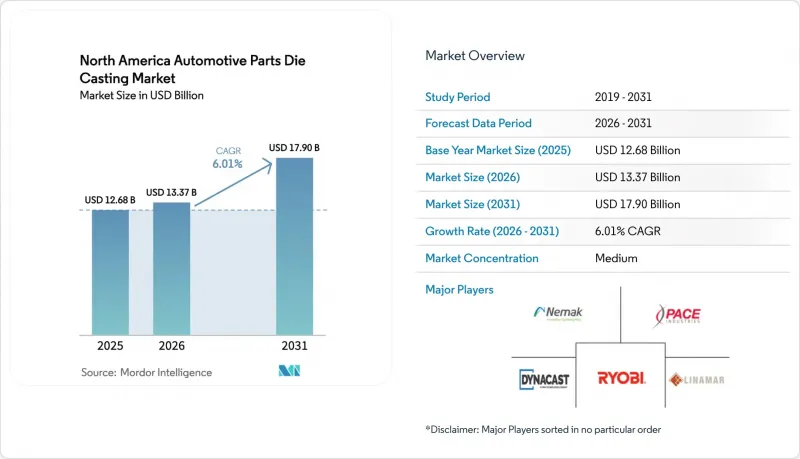
據 Mordor Intelligence 稱,2025 年北美汽車壓鑄市場價值為 126.8 億美元,預計到 2031 年將從 2026 年的 133.7 億美元成長至 179 億美元,預測期(2026-2031 年)的複合年成長率為 6.01%。
本報告按原料(鋁、鎂及其他)、製造流程(高壓壓鑄、重力壓鑄及其他)、應用領域(引擎零件及其他)、車輛類型(乘用車及其他)、最終用戶產業(原廠配套、售後市場)和國家/地區進行細分。市場預測以美元計價。
北美汽車壓鑄市場趨勢與洞察。
電動車電池托盤的需求正在激增。
隨著電動車 (EV) 在汽車市場日益普及,電池托盤正成為壓鑄領域的主要成長動力。特斯拉在其後底盤上應用了創新的「Gigacasting」技術,該技術透過整合多個零件並省去焊接工序,簡化了生產流程,從而降低了成本並提高了製造效率。通用汽車 (GM) 正在透過引入高產能壓平機來增強其電動車產能,以支持其電動皮卡零件的生產。同時,Linamer 的先進沖壓技術也為特斯拉的生產活動做出了貢獻,凸顯了加拿大作為 Gigacasting 中心地位的日益提升。這些一體式鑄件不僅最佳化了生產流程,還透過顯著降低車輛在高壓範圍內運行時發生漏水的風險,提高了電池安全性。
北美OEM廠商採用HPDC千兆廣播技術
2025年,通用汽車(GM)、福特和特斯拉簽署了一份為期多年的大規模契約,採購結構性Gigacasting組件。福特位於安大略省的工廠將於2025年下半年運作,將為多個電動車(EV)平台供應鋁製前後副車架,從而顯著減少每輛車的零件數量和焊接點,提高生產效率。 Linamaar位於韋蘭的生產線也反映了對Gigacasting技術的大量投資的必要性。 Gigacast前部模組能夠顯著提高車身車間的效率,大幅縮短生產時間,同時提升碰撞吸能性能。
鋁和鎂價格波動
2025年,鋁價波動劇烈,成本轉嫁延遲導致利潤率承壓。中國出口限制推高鎂價,迫使企業重新設計成本高的合金。這些波動對Linamar鑄造部門的利潤率造成了負面影響。鋁價上漲可能會大幅增加中型轎車的生產成本,但只有少數壓鑄製造商採取了價格避險等預防措施。
細分市場分析
到2025年,鋁合金憑藉其強度、導熱性和耐腐蝕性的完美平衡,將佔據北美汽車壓鑄市場57.12%的佔有率。鎂合金雖然成本顯著高於其他材料,但由於其優異的密度,預計到2031年將以8.25%的複合年成長率超越所有其他材料。鋅合金在門把、扣環和電子產品的生產中佔據重要佔有率,其優勢在於模具壽命是鋁的10倍。本田位於安娜的工廠在其鋁產品中大量使用再生鋁。這不僅降低了整個生命週期的二氧化碳排放,也加強了對美墨加協定(USMCA)採購規定的遵守。同時,Meridian位於斯特拉斯洛伊的工廠在鎂合金回收方面取得了顯著進展,這是克服氧化挑戰的重要一步。
需求趨勢受熱學和電磁學兩方面因素的影響。鋁具有優異的導電性,是電池托盤(散熱至關重要)的必備材料。同時,鎂的特性使其成為先進系統中逆變器屏蔽的理想選擇。美國能源局(DOE) 資助的研發項目展望了未來以廢料為基礎的合金成為主流的前景,旨在生產出性能與原生合金相當的再生鋁。這些進展不僅將鞏固鋁的主導地位,還將為鎂在超輕量電動車模組領域開闢一個巨大的細分市場。
到2025年,高壓壓鑄將佔總產量的79.25%,這主要得益於殼體和支架60-90秒的快速成型週期以及薄壁零件的可重複性。真空壓鑄預計到2031年將維持7.86%的複合年成長率,主要受市場對T6熱處理後孔隙率低於0.5%的懸吊轉向節和控制臂的需求所推動。重力鑄造在小批量原型件生產中發揮著重要作用,而擠壓鑄造在轉向節製造中應用日益廣泛,逐漸取代了較重的鋼製零件。
製程選擇需要在成本、產量和機械性能要求之間取得平衡。 Ryobi 的創新Ryobi閥系統顯著降低了氣孔率,從而使焊接 A 柱具有更高的屈服強度。擠壓鑄造的引擎支架即使在重載下也表現出卓越的性能,證明了其適用於重型卡車。雖然高壓壓鑄 (HPDC) 仍然是薄壁零件的主要製造程序,但真空鑄造和擠壓鑄造正擴大取代以往由沖壓成型工藝主導的結構件製造,這凸顯了北美汽車壓鑄行業技術的多元化進步。
其他好處:
- Excel格式的市場預測(ME)表
- 3個月的分析師支持
目錄
第1章:引言
- 研究假設和市場定義
- 調查範圍
第2章:調查方法
第3章執行摘要
第4章 市場狀況
- 市場概覽
- 市場促進因素
- 電動汽車電池外殼的需求正在激增。
- 北美某OEM廠商採用高壓壓鑄(HPDC)「Gigacasting」技術
- 更嚴格的減重規定和企業平均燃油消耗量(CAFE)標準。
- 根據《美國-墨西哥-加拿大協定》(USMCA) 的規定,OEM(目的地設備製造商)產品的近岸外包正在促進該地區的壓鑄生產。
- 利用自動化和工業4.0維修廠
- 採用70%或以上回收鋁/鎂原料的合金成分
- 市場限制因素
- 鋁鎂價格波動
- 4000噸級壓力機生產線的資本投資強度
- 鎂(Mg)供應鏈集中化所帶來的風險
- 美國環保署 (EPA) 與職業安全與健康管理局 (OSHA) 關於廢渣排放的排放法規/限制
- 價值供應鏈分析
- 監理情勢
- 技術展望
- 波特五力模型
第5章 市場規模與成長預測
- 按成分
- 鋁
- 鎂
- 鋅
- 其他
- 透過製造程序
- 壓力壓鑄
- 高壓
- 低壓
- 重力鑄造
- 真空壓鑄
- 擠壓壓鑄
- 壓力壓鑄
- 透過使用
- 引擎部件
- 堵塞
- 缸頭
- 傳動部件
- 住房
- 齒輪箱
- 身體部位
- 結構框架
- 括號
- 電動汽車零件
- 電池倉
- 馬達外殼
- 其他
- 引擎部件
- 車輛類型
- 搭乘用車
- 輕型商用車
- 中型和重型商用車輛
- 按最終用途行業分類
- OEMs
- 售後市場
- 國家
- 美國
- 加拿大
- 其他北美國家
第6章 競爭情勢
- 市場集中度
- 策略趨勢
- 市佔率分析
- 公司簡介
- Nemak, SAB de CV
- Pace Industries, Inc.
- Form Technologies(Dynacast)
- Ryobi Die Casting
- Linamar Corporation
- Martinrea International Inc.
- Dura|Shiloh
- Meridian Lightweight Technologies
- Gibbs Die Casting Corporation
- Alcast Technologies Ltd.
- Empire Casting Co
- KSM Castings Group
- Rheinmetall AG
- Cosma International
- Chicago White Metal Casting, Inc.
第7章 市場機會與未來展望
According to Mordor Intelligence, the North american automotive parts die casting market size was valued at USD 12.68 billion in 2025 and estimated to grow from USD 13.37 billion in 2026 to reach USD 17.90 billion by 2031, at a CAGR of 6.01% during the forecast period (2026-2031).
This report is Segmented by Raw Material (Aluminum, Magnesium, and Others), Process (Pressure Die Casting, Gravity Die Casting, and More), Application (Engine Components, and More), Vehicle Type (Passenger Cars, and More), End-Use Industry (Original Equipment Manufacturers, and Aftermarket), and Country. The Market Forecasts are Provided in Terms of Value (USD).
North America Automotive Parts Die Casting Market Trends and Insights
Exploding EV Battery-Housing Demand
As electric vehicles (EVs) continue to gain traction in the automotive market, battery trays have become a key driver in the growth of the die-casting segment. Tesla's innovative gigacasting for its rear underbody streamlines production by consolidating numerous parts and eliminating welds, resulting in cost savings and improved manufacturing efficiency. General Motors is advancing its electric vehicle (EV) production capabilities by installing high-capacity presses to support the manufacturing of components for its electric pickups. Meanwhile, Linamar's advanced press technology is contributing to Tesla's production efforts, highlighting Canada's growing prominence as a hub for gigacasting. These one-piece castings not only optimize production processes but also enhance battery safety by significantly reducing water-leak risks for vehicles operating within high-voltage ranges.
HPDC Gigacasting Adoption by NA OEMs
In 2025, General Motors, Ford, and Tesla secured significant multi-year contracts for structural gigacastings. Ford's Ontario facility, operational since late 2025, is set to deliver aluminum front and rear subframes for multiple electric vehicle (EV) platforms, streamlining production by significantly reducing the number of components and welds per vehicle. Linamar's Welland line highlights the substantial investments required in gigacasting technology . Gigacast front modules have transformed body-shop efficiency, drastically reducing production time while also improving crash absorption performance.
Aluminum/Magnesium Price Volatility
In 2025, aluminum prices experienced significant fluctuations, leading to margin compression due to delays in cost pass-through. Chinese export restrictions caused a sharp increase in magnesium prices, necessitating expensive alloy redesigns. This shift negatively impacted Linamar's casting margins. While rising aluminum prices can substantially increase the cost of producing a mid-size sedan, only a small proportion of die casters take the precaution of hedging prices.
Other drivers and restraints analyzed in the detailed report include:
- Light-Weighting Regulations and CAFE Tightening
- OEM Near-Shoring Under USMCA Rules Boosts Regional Die-Casting Volumes
- Capex Intensity of 4,000-ton Press Lines
For complete list of drivers and restraints, kindly check the Table Of Contents.
Segment Analysis
Aluminum alloys held 57.12% of the North American automotive parts die casting market share in 2025, riding on their balance of strength, thermal conductivity, and corrosion resistance. Magnesium is projected to outpace all materials at an 8.25% CAGR through 2031 thanks to its density advantage, despite a notable cost premium. Zinc claims a significant portion of output for door handles, buckles, and electronics, benefiting from die life that runs 10 times longer than aluminum. At Honda's Anna plant, aluminum boasts a high recycled content. This not only reduces lifecycle CO2 emissions but also bolsters compliance with United States-Mexico-Canada Agreement (USMCA) sourcing regulations. Meanwhile, at Meridian's Strathroy site, magnesium recycling has made significant progress, marking a stride in overcoming oxidation challenges.
Demand trends are influenced by both thermal and electromagnetic requirements. Aluminum, with its superior conductivity, is essential for battery trays that manage heat effectively. On the other hand, magnesium's properties make it ideal for shielding inverters in advanced systems. Research funded by the Department of Energy (DOE) is pushing towards a future where scrap-fed alloys dominate, aiming for recycled aluminum that matches the properties of primary alloys. These developments not only solidify aluminum's leading position but also carve out a substantial niche for magnesium in ultra-light EV modules.
High-pressure die casting accounted for 79.25% of volume in 2025, driven by 60-90 second cycles and thin-wall repeatability for housings and brackets. Vacuum die casting is projected to log a 7.86% CAGR through 2031, fueled by suspension knuckles and control arms that demand porosity below 0.5% for T6 heat treatment. Gravity die casting holds a significant position for low-volume prototype blocks, while squeeze casting is increasingly being used for steering knuckles, replacing heavier iron components.
Choosing a process involves balancing cost, volume, and mechanical objectives. Ryobi's innovative vacuum-valve system significantly reduces porosity, enabling welded A-pillars with impressive yield strength. Squeeze-cast engine mounts have demonstrated exceptional performance under heavy loads, proving their suitability for heavy-duty trucks. While High-Pressure Die Casting (HPDC) remains the preferred choice for thin-wall parts, both vacuum and squeeze methods are increasingly taking on structural roles, previously dominated by stampings, highlighting a diverse technological evolution in North America's automotive parts die casting landscape.
Complete Report Scope:
- By Raw Material
- Aluminum
- Magnesium
- Zinc
- Others
- By Process
- Pressure Die Casting
- High-Pressure
- Low-Pressure
- Gravity Die Casting
- Vacuum Die Casting
- Squeeze Die Casting
- Pressure Die Casting
- By Application
- Engine Components
- Blocks
- Cylinder Heads
- Transmission Components
- Housings
- Gear Cases
- Body Parts
- Structural Frames
- Brackets
- Electric Vehicle (EV) Components
- Battery Housings
- Motor Casings
- Others
- Engine Components
- By Vehicle Type
- Passenger Cars
- Light Commercial Vehicles
- Medium and Heavy Commercial Vehicles
- By End-Use Industry
- OEMs
- Aftermarket
- By Country
- United States
- Canada
- Rest of North America
List of Companies Covered in this Report:
- Nemak, S.A.B. de C.V.
- Pace Industries, Inc.
- Form Technologies (Dynacast)
- Ryobi Die Casting
- Linamar Corporation
- Martinrea International Inc.
- Dura | Shiloh
- Meridian Lightweight Technologies
- Gibbs Die Casting Corporation
- Alcast Technologies Ltd.
- Empire Casting Co
- KSM Castings Group
- Rheinmetall AG
- Cosma International
- Chicago White Metal Casting, Inc.
Additional Benefits:
- The market estimate (ME) sheet in Excel format
- 3 months of analyst support
TABLE OF CONTENTS
1 Introduction
- 1.1 Study Assumptions and Market Definition
- 1.2 Scope of the Study
2 Research Methodology
3 Executive Summary
4 Market Landscape
- 4.1 Market Overview
- 4.2 Market Drivers
- 4.2.1 Exploding Electric Vehicle (EV) Battery-Housing Demand
- 4.2.2 High-Pressure Die Casting (HPDC) Gigacasting Adoption by North America (NA) Original Equipment Manufacturers (OEMs)
- 4.2.3 Light-Weighting Regulations and Corporate Average Fuel Economy (CAFE) Tightening
- 4.2.4 Original Equipment Manufacturer (OEM) Near-Shoring Under United States-Mexico-Canada Agreement (USMCA) Rules Boosts Regional Die-Casting Volumes
- 4.2.5 Automation and Industry 4.0 Foundry Retrofits
- 4.2.6 Alloy Recipes Using Greater than/Equals 70 % Recycled Al/Mg Feedstock
- 4.3 Market Restraints
- 4.3.1 Aluminum/Magnesium Price Volatility
- 4.3.2 Capex Intensity of 4,000-ton Press Lines
- 4.3.3 Concentrated Magnesium (Mg) Supply Chain Risk
- 4.3.4 Environmental Protection Agency (EPA) and Occupational Safety and Health Administration (OSHA) Emissions / Waste-Slag Limits
- 4.4 Value / Supply-Chain Analysis
- 4.5 Regulatory Landscape
- 4.6 Technological Outlook
- 4.7 Porter's Five Forces
- 4.7.1 Threat of New Entrants
- 4.7.2 Bargaining Power of Suppliers
- 4.7.3 Bargaining Power of Buyers
- 4.7.4 Threat of Substitutes
- 4.7.5 Competitive Rivalry
5 Market Size and Growth Forecasts (Value in USD)
- 5.1 By Raw Material
- 5.1.1 Aluminum
- 5.1.2 Magnesium
- 5.1.3 Zinc
- 5.1.4 Others
- 5.2 By Process
- 5.2.1 Pressure Die Casting
- 5.2.1.1 High-Pressure
- 5.2.1.2 Low-Pressure
- 5.2.2 Gravity Die Casting
- 5.2.3 Vacuum Die Casting
- 5.2.4 Squeeze Die Casting
- 5.2.1 Pressure Die Casting
- 5.3 By Application
- 5.3.1 Engine Components
- 5.3.1.1 Blocks
- 5.3.1.2 Cylinder Heads
- 5.3.2 Transmission Components
- 5.3.2.1 Housings
- 5.3.2.2 Gear Cases
- 5.3.3 Body Parts
- 5.3.3.1 Structural Frames
- 5.3.3.2 Brackets
- 5.3.4 Electric Vehicle (EV) Components
- 5.3.4.1 Battery Housings
- 5.3.4.2 Motor Casings
- 5.3.5 Others
- 5.3.1 Engine Components
- 5.4 By Vehicle Type
- 5.4.1 Passenger Cars
- 5.4.2 Light Commercial Vehicles
- 5.4.3 Medium and Heavy Commercial Vehicles
- 5.5 By End-Use Industry
- 5.5.1 OEMs
- 5.5.2 Aftermarket
- 5.6 By Country
- 5.6.1 United States
- 5.6.2 Canada
- 5.6.3 Rest of North America
6 Competitive Landscape
- 6.1 Market Concentration
- 6.2 Strategic Moves
- 6.3 Market Share Analysis
- 6.4 Company Profiles (Includes Global Level Overview, Market Level Overview, Core Segments, Financials as Available, Strategic Information, Market Rank/Share for Key Companies, Products and Services, SWOT Analysis, and Recent Developments)
- 6.4.1 Nemak, S.A.B. de C.V.
- 6.4.2 Pace Industries, Inc.
- 6.4.3 Form Technologies (Dynacast)
- 6.4.4 Ryobi Die Casting
- 6.4.5 Linamar Corporation
- 6.4.6 Martinrea International Inc.
- 6.4.7 Dura | Shiloh
- 6.4.8 Meridian Lightweight Technologies
- 6.4.9 Gibbs Die Casting Corporation
- 6.4.10 Alcast Technologies Ltd.
- 6.4.11 Empire Casting Co
- 6.4.12 KSM Castings Group
- 6.4.13 Rheinmetall AG
- 6.4.14 Cosma International
- 6.4.15 Chicago White Metal Casting, Inc.
7 Market Opportunities & Future Outlook
- 7.1 White-space & Unmet-need Assessment

 汽車結構鋁壓鑄市場:全球市場預測,2026-2032年汽車動力傳動系統總成用鋁壓鑄市場:全球市場預測,2026-2032年汽車結構鋁壓鑄合金市場:全球市場預測,2026-2032年
 南美洲汽車零件鎂合金壓鑄:市場佔有率分析、產業趨勢與統計及成長預測(2026-2031 年)印度汽車零件鋁壓鑄市場:市場佔有率分析、產業趨勢與統計及成長預測(2026-2031)歐洲汽車壓鑄:市場佔有率分析、產業趨勢與統計及成長預測(2026-2031)汽車沖壓設備市場-全球市場預測(2026-2032年)汽車鋁製零件高壓壓鑄(HPDC):市場佔有率分析、行業趨勢和統計數據以及成長預測(2026-2031 年)
 汽車壓鑄潤滑劑市場報告:按類型、材料類型、應用和地區分類(2026-2034年)汽車零件鎂合金壓鑄市場報告:按製造流程、應用和地區分類,2026-2034年