


 |
市場調查報告書
商品編碼
2066501
汽車鋁製零件高壓壓鑄(HPDC):市場佔有率分析、行業趨勢和統計數據以及成長預測(2026-2031 年)Automotive Aluminum Parts High-Pressure Die Casting (HPDC) - Market Share Analysis, Industry Trends & Statistics, Growth Forecasts (2026 - 2031) |
||||||

※ 本網頁內容可能與最新版本有所差異。詳細情況請與我們聯繫。
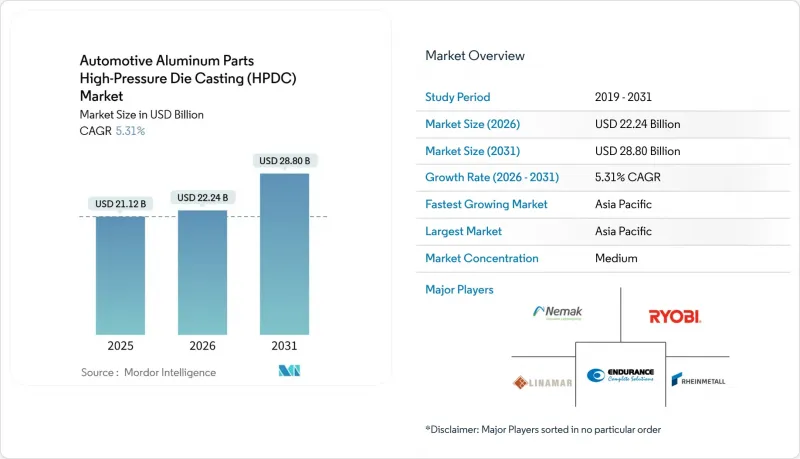
據 Mordor Intelligence 稱,汽車鋁製零件的高壓壓鑄 (HPDC) 市場預計將從 2025 年的 211.2 億美元成長到 2026 年的 222.4 億美元,到 2031 年達到 288 億美元,複合年成長率為 5.31%。
本報告按應用類型(車身本體件、底盤件等)、車輛類型(乘用車、輕型商用車等)、製造程序(設計工程、壓鑄等)、最終用途(整車製造商、售後市場供應商)、鑄造材料和地區進行細分。市場預測以價值(美元)表示。
汽車鋁製零件高壓壓鑄 (HPDC) 市場的全球趨勢和見解。
原始設備製造商的輕量化和排放氣體法規
美國企業平均燃油經濟性(CAFE)法規的目標是到2031年實現50.4英里/加侖的燃油經濟性,而歐盟則規定車輛二氧化碳排放量每克/公里罰款95歐元(約合109美元),這些規定對超標排放施加了處罰,迫使汽車製造商採用鋁材而非鋼材。這可以顯著降低零件的重量。通用汽車(GM)計劃提高鋁材的平均使用量,凸顯了其長期策略轉型。高壓壓鑄(HPDC)技術能夠成型複雜形狀,使電池托盤和橫樑等零件可以作為一體式零件製造,從而減少60多個焊點。由於減輕重量有助於避免因違反排放法規而受到罰款,並且還可以使用更小的驅動電池組,因此OEM採購主管們願意接受鋁材更高的成本。在全球法規日益嚴格的背景下,所有新型車輛平台對汽車鋁製零件的高壓壓鑄市場需求持續成長。
電動汽車電池外殼和電力驅動裝置的需求正在激增。
預計到2025年電動車銷量將超過2000萬輛,到2031年將實現顯著成長,因此,對用於保護電池和散熱的導熱鋁製機殼的需求日益成長。特斯拉將4680電池直接整合到大型結構鑄件中,在減輕車身重量的同時提高了扭轉剛度。比亞迪等中國領先製造商也正在效仿這一理念,將加工公差控制在0.1毫米以內,以確保電池組的平整度。 E-Drive的定子外殼採用富矽A380合金以提高導熱性,這表明合金開發和鑄造技術創新正在齊頭並進。這些發展正在擴大高壓壓鑄(HPDC)在汽車鋁製零件領域的市場。
鋁和能源價格波動
2025年,倫敦金屬交易所(LME)現貨價格波動,對六個月固定價格供應合約的利潤率帶來壓力。由於能源成本在原生鋁成本中佔很大比例,地緣政治動盪後歐洲天然氣價格飆升,導致冶煉廠產能緊張,區域供應減少。與鈑金沖壓製造商相比,壓鑄製造商每公斤電力消耗量更高,因此更容易受到能源價格大幅上漲的影響,從而大幅削減息稅前利潤。由於期貨曲線僅延伸至未來18個月,避險提供的風險緩解作用有限,迫使許多一級供應商在合約中加入價格上漲條款。這種價格波動正在抑制汽車鋁零件高壓鑄(HPDC)市場的短期成長前景。
細分市場分析
預計到2025年,車身本體零件的需求量將佔45.18%,成為汽車鋁製零件高壓壓鑄(HPDC)市場中最大的佔有率。超級鑄造技術將原本由171個焊接鋼部件組成的組裝簡化為兩個整合結構,提高了扭轉剛度並縮短了生產週期。隨著梅賽德斯-奔馳和豐田效仿特斯拉宣布結構鑄造項目,預計該細分市場在預測期內將以6.12%的複合年成長率成長。底盤模組的佔有率較小,這主要得益於懸吊臂和副車架等部件受益於鋁材的高剛度質量比。
儘管內燃機汽車的需求有所下降,但輕型卡車的單速變速箱和商用電動車的多速變速箱仍支撐著對變速箱殼體的需求。隨著鋁材的減振性能在低噪音、低振動(NVH)豪華車型的應用,引擎支架、橫樑和隔熱罩等小型結構件的需求也逐漸成長。這些趨勢共同作用,將在中期內增強汽車鋁製零件高壓壓鑄(HPDC)市場。
預計到2025年,乘用車將佔出貨量的75.03%,成為汽車鋁製零件高壓壓鑄(HPDC)市場的基礎。高產量和快速的車型更迭使得模具運轉率保持在高位,加速了鑄造自動化進程。同時,輕型商用車以7.62%的複合年成長率(CAGR)領先市場,這主要得益於電商中心對配備鋁製電池保護裝甲的城市配送貨車的需求不斷成長。
對於中型和重型卡車而言,採用鋁材的投資報酬率 (ROI) 與負載容量限制之間的平衡正在被權衡。車隊管理人員願意接受更高的初始成本,以換取多運載一盤貨物的機會。目前仍存在區域差異。歐洲的運輸公司正在積極推廣鋁材的應用,以符合碳排放稅,而亞洲的一些車隊仍然傾向於成本較低的鋼材。然而,隨著車輛電氣化的強制推行,採購趨勢將逐漸轉向更輕的材料,汽車鋁製零件高壓鑄 (HPDC) 市場的長期前景將十分光明。
區域分析
預計到2025年,亞太地區將佔全球銷售額的57.04%,反映了該地區從礬土開採到整車組裝的深度垂直整合。中國汽車製造商主導巨型鑄造技術的應用,而印度企業則利用生產連結獎勵計畫(PLI)來促進國內壓鑄投資。日本和韓國供應商已共同開發了流變高壓壓鑄(Rheo-HPDC)生產線,並正在全部區域出口其技術。都市化、對「最後一公里」配送的需求以及更嚴格的歐6排放氣體標準正在推動亞太地區汽車鋁製零件高壓壓鑄市場以7.02%的複合年成長率成長,進一步鞏固了該地區在汽車鋁製零件高壓壓鑄市場的主導地位。
在北美,受美墨加協定(USMCA)鼓勵本地採購的含量法規推動,預計到2031年,北美汽車鋁製零件(HPDC)市場將維持顯著的複合年成長率。 Nemac在密西根州的擴張和Linamaar在田納西州的生產線正受益於這些政策利好,而特斯拉在德克薩斯州的德克薩斯州則展現了大規模的本土化生產。聯邦基礎設施建設資金正在為輕量化零件生產基地增加電網容量,並降低高能耗鑄造廠的電力成本。這些因素共同表明,美洲地區的汽車鋁製零件(HPDC)市場將持續成長。
歐洲預計將在2025年成為銷售額的主要貢獻者,這得益於眾多高階品牌對鑄造品質的高標準要求。循環經濟指令強制要求使用再生材料,迫使鑄造製造商實施閉合迴路廢料回收系統。儘管先進高抗張強度鋼在某些結構件領域仍是強大的競爭對手,但鋁材在電池式電動車平台領域正逐漸佔據主導地位。此外,為降低地緣政治風險,整車製造商(OEM)正日益支持供應鏈的區域化重組,這刺激了歐盟內部的新投資,並提振了高性能鋁沉積(HPDC)汽車零件產業的前景。
其他好處:
- Excel格式的市場預測(ME)表
- 3個月的分析師支持
目錄
第1章:引言
- 研究假設和市場定義
- 調查範圍
第2章:調查方法
第3章執行摘要
第4章 市場狀況
- 市場概覽
- 市場促進因素
- 透過OEM實現輕量化和排放氣體法規
- 電動汽車電池、外殼和電動驅動裝置的需求激增
- 巨型鑄造機可實現大規模結構件鑄造。
- 透過循環經濟推廣再生鋁
- 真空輔助高壓鑄和自動去毛邊可提高成品率。
- Rheo-HPDC 為高溫鍛造合金開闢了新的可能性。
- 市場限制因素
- 鋁和能源價格波動
- 先進高強度鋼結構的替代方案
- Giga-Cast模組碰撞修復的複雜性
- 由回收合金製成的結構部件的腐蝕風險
- 價值供應鏈分析
- 監理情勢
- 技術展望
- 波特五力模型
第5章 市場規模與成長預測
- 按應用程式類型
- 白車身部件
- 底盤部件
- 傳動部件
- 其他結構部件
- 車輛類型
- 搭乘用車
- 輕型商用車
- 中型和大型商用車輛
- 透過製造程序
- 設計工程
- 壓鑄
- 表面處理
- 組裝
- 按最終用途
- OEMs
- 售後市場供應商
- 透過鑄造材料
- 原生鋁
- 再生鋁合金
- 按地區
- 北美洲
- 美國
- 加拿大
- 其他北美國家
- 南美洲
- 巴西
- 阿根廷
- 其他南美國家
- 歐洲
- 德國
- 英國
- 法國
- 義大利
- 西班牙
- 其他歐洲國家
- 亞太地區
- 中國
- 印度
- 日本
- 韓國
- 其他亞太國家
- 中東和非洲
- 阿拉伯聯合大公國
- 沙烏地阿拉伯
- 南非
- 土耳其
- 其他中東和非洲國家
- 北美洲
第6章 競爭情勢
- 市場集中度
- 策略趨勢
- 市佔率分析
- 公司簡介
- Nemak, SAB de CV
- Rheinmetall AG
- Linamar Corporation
- Endurance Technologies Limited
- Bocar Group
- Gibbs Die Casting Corporation
- Martinrea International Inc.
- Pace Industries, LLC
- Dynacast International LLC
- Ryobi Die Casting Inc.
- Rockman Industries Ltd.
- Guangdong Hongtu Technology(Holdings)Co., Ltd.
- Samkee Corp.
- Rane Holdings Limited
- LCN
- DL Motors Co., Ltd.
第7章 市場機會與未來展望
According to Mordor Intelligence, the automotive aluminum parts High-Pressure Die Casting (HPDC) market size is expected to increase from USD 21.12 billion in 2025 to USD 22.24 billion in 2026 and reach USD 28.80 billion by 2031, progressing at a 5.31% CAGR.
This report is Segmented by Application Type (Body-In-White Components, Chassis Parts, and More), Vehicle Type (Passenger Cars, Light Commercial Vehicles, and More), Manufacturing Process (Design Engineering, Die Casting, and More), End Use (OEMs, Aftermarket Suppliers), Casting Material, and Geography. The Market Forecasts are Provided in Terms of Value (USD).
Global Automotive Aluminum Parts High-Pressure Die Casting (HPDC) Market Trends and Insights
OEM Lightweighting and Emission Mandates
Corporate Average Fuel Economy rules targeting 50.4 mpg in the United States by 2031 and the European Union's EUR 95 (~USD 109) per gram CO2/km fleet ceiling penalize excess emissions, forcing automakers to substitute steel for aluminum, which reduces mass per part by a significant amount . General Motors plans to lift average aluminum content, underscoring a long-term strategic shift. High-pressure die casting (HPDC) enables complex geometries, allowing battery trays and cross-members to emerge as single pieces that eliminate upwards of 60 welds. OEM purchasing executives accept aluminum's material premium because weight savings avoid carbon fines and enable smaller traction-battery packs. As regulations tighten globally, the Automotive aluminum parts HPDC market gains recurring pull-through from every new vehicle platform.
EV Battery-Housing and E-Drive Demand Surge
EV sales exceeded 20 million units in 2025 and are tracking toward significant growth by 2031, intensifying the need for thermally conductive aluminum enclosures that shield cells and dissipate heat . Tesla integrates 4680 cells directly into large structural castings, trimming vehicle mass while boosting torsional rigidity. Chinese leaders such as BYD replicate the concept, specifying 0.1 mm machining tolerances to secure cell-to-pack flatness. E-drive stator housings rely on silicon-rich A380 variants that deliver higher thermal conductivity, illustrating how alloy development and casting innovation advance in lockstep. Each of these developments widens the addressable market for HPDC Automotive aluminum parts.
Aluminum and Energy Price Volatility
LME cash prices fluctuated during 2025, compressing margins on six-month fixed-price supply contracts. Energy accounts for a significant share of primary aluminum costs, so the spike in European natural gas prices after geopolitical disruptions squeezed smelters, trimming regional supply. Die casters add more electricity per kilogram than steel stampers, exposing them to tariff shocks that erase notable EBIT margins. Hedging mitigates only limited exposure since forward curves extend merely 18 months, compelling many tier-ones to incorporate price-escalation clauses. Such volatility tempers near-term growth expectations for the Automotive aluminum parts HPDC market.
Other drivers and restraints analyzed in the detailed report include:
- Gigacasting Presses Enable Large Structural Castings
- Circular-Economy Push for Recycled Aluminum
- Advanced High-Strength-Steel Structural Alternatives
For complete list of drivers and restraints, kindly check the Table Of Contents.
Segment Analysis
Body-in-white parts accounted for 45.18% of 2025 demand, the largest slice of the Automotive aluminum parts HPDC market. Gigacasting trims assembly lines from 171 weld-intensive steel parts to two monolithic structures, raising torsional rigidity and curtailing takt time. Over the forecast horizon, this segment will expand at a 6.12% CAGR, as Mercedes-Benz and Toyota join Tesla in announcing structural cast programs. Chassis modules capture a modest share, propelled by suspension arms and sub-frames that benefit from aluminum's stiffness-to-mass ratio.
Single-speed gearboxes in light trucks and multi-speed boxes in commercial EVs sustain transmission-housing demand even as internal-combustion engines decline. Smaller structural items-engine mounts, cross-members, and heat shields-capture incremental gains given aluminum's vibration-damping benefits in low-NVH luxury models. These dynamics collectively fortify the Automotive aluminum parts HPDC market over the mid-term.
Passenger cars accounted for 75.03% of 2025 shipments, forming the cornerstone of the Automotive aluminum parts HPDC market. High production volumes and rapid model-year changeovers keep tooling utilization high, encouraging further casting automation. Meanwhile, light commercial vehicles notch the fastest 7.62% CAGR as e-commerce hubs demand urban-delivery vans outfitted with substantial aluminum battery armor.
Medium-duty and heavy-duty trucks weigh ROI for aluminum against payload limits; fleet managers accept a higher up-front cost if it unlocks an extra pallet of freight. Regional divergence persists: European haulers pursue aluminum to satisfy carbon taxes, whereas some Asian fleets still favor low-cost steel. Nonetheless, electrification mandates will gradually tilt procurement toward lightweight materials, enhancing the long-range prospects of the Automotive aluminum parts HPDC market.
Geography Analysis
Asia-Pacific commanded 57.04% of 2025 turnover, reflecting deep vertical integration from bauxite mines to final vehicle assembly. Chinese automakers spearhead gigacasting adoption, while Indian firms draw on Production-Linked Incentives that encourage local die-casting investments. Japanese and Korean suppliers co-develop rheo-HPDC lines and export the technology across the region. Urbanization, last-mile delivery demand, and tightening Euro 6-equivalent emission rules combine to yield a 7.02% CAGR, reinforcing Asia-Pacific's leadership in the Automotive aluminum parts HPDC market.
North America will see a notable CAGR through 2031 as USMCA content rules reward regional sourcing. Nemak's Michigan expansion and Linamar's Tennessee line tap that policy tailwind, while Tesla's Texas gigafactory demonstrates domestic scale. Federal infrastructure funding channels additional power-grid capacity toward lightweight-component corridors, lowering electricity costs for energy-intensive casting shops. Together, these drivers spell durable growth for the Automotive aluminum parts HPDC market in the Americas.
Europe contributed significantly to 2025 revenue, cemented by premium brands that demand top-tier cast integrity. Circular-economy directives force recycled content, spurring foundries to adopt closed-loop scrap collection. Advanced high-strength steel remains a formidable rival in certain structural nodes, yet battery-electric platforms lean toward aluminum. Supply-chain re-localization also gains favor as OEMs cut exposure to geopolitical risk, channeling new investment within the bloc and supporting the Automotive aluminum parts HPDC industry outlook.
- Nemak, S.A.B. de C.V.
- Rheinmetall AG
- Linamar Corporation
- Endurance Technologies Limited
- Bocar Group
- Gibbs Die Casting Corporation
- Martinrea International Inc.
- Pace Industries, LLC
- Dynacast International LLC
- Ryobi Die Casting Inc.
- Rockman Industries Ltd.
- Guangdong Hongtu Technology (Holdings) Co., Ltd.
- Samkee Corp.
- Rane Holdings Limited
- LCN
- DL Motors Co., Ltd.
Additional Benefits:
- The market estimate (ME) sheet in Excel format
- 3 months of analyst support
TABLE OF CONTENTS
1 Introduction
- 1.1 Study Assumptions & Market Definition
- 1.2 Scope of the Study
2 Research Methodology
3 Executive Summary
4 Market Landscape
- 4.1 Market Overview
- 4.2 Market Drivers
- 4.2.1 OEM Lightweighting and Emission Mandates
- 4.2.2 EV Battery-Housing and E-Drive Demand Surge
- 4.2.3 Gigacasting Presses Enable Large Structural Castings
- 4.2.4 Circular-Economy Push for Recycled Aluminum
- 4.2.5 Vacuum-Assisted HPDC and Deburring Automation Lift Yields
- 4.2.6 Rheo-HPDC Opens High-TC Wrought-Alloy Opportunities
- 4.3 Market Restraints
- 4.3.1 Aluminum and Energy Price Volatility
- 4.3.2 Advanced High-Strength-Steel Structural Alternatives
- 4.3.3 Crash-Repair Complexity of Giga-Cast Modules
- 4.3.4 Corrosion Risks in Recycled-Alloy Structural Parts
- 4.4 Value / Supply-Chain Analysis
- 4.5 Regulatory Landscape
- 4.6 Technological Outlook
- 4.7 Porter's Five Forces
- 4.7.1 Threat of New Entrants
- 4.7.2 Bargaining Power of Suppliers
- 4.7.3 Bargaining Power of Buyers
- 4.7.4 Threat of Substitutes
- 4.7.5 Competitive Rivalry
5 Market Size & Growth Forecasts (Value (USD))
- 5.1 By Application Type
- 5.1.1 Body-in-White Components
- 5.1.2 Chassis Parts
- 5.1.3 Transmission Components
- 5.1.4 Other Structural Parts
- 5.2 By Vehicle Type
- 5.2.1 Passenger Cars
- 5.2.2 Light Commercial Vehicles
- 5.2.3 Medium and Heavy Commercial Vehicles
- 5.3 By Manufacturing Process
- 5.3.1 Design Engineering
- 5.3.2 Die Casting
- 5.3.3 Surface Treatment
- 5.3.4 Assembly
- 5.4 By End Use
- 5.4.1 OEMs
- 5.4.2 Aftermarket Suppliers
- 5.5 By Casting Material
- 5.5.1 Primary Aluminum Alloys
- 5.5.2 Recycled Aluminum Alloys
- 5.6 By Geography
- 5.6.1 North America
- 5.6.1.1 United States
- 5.6.1.2 Canada
- 5.6.1.3 Rest of North America
- 5.6.2 South America
- 5.6.2.1 Brazil
- 5.6.2.2 Argentina
- 5.6.2.3 Rest of South America
- 5.6.3 Europe
- 5.6.3.1 Germany
- 5.6.3.2 United Kingdom
- 5.6.3.3 France
- 5.6.3.4 Italy
- 5.6.3.5 Spain
- 5.6.3.6 Rest of Europe
- 5.6.4 Asia-Pacific
- 5.6.4.1 China
- 5.6.4.2 India
- 5.6.4.3 Japan
- 5.6.4.4 South Korea
- 5.6.4.5 Rest of Asia-Pacific
- 5.6.5 Middle East and Africa
- 5.6.5.1 United Arab Emirates
- 5.6.5.2 Saudi Arabia
- 5.6.5.3 South Africa
- 5.6.5.4 Turkey
- 5.6.5.5 Rest of Middle East and Africa
- 5.6.1 North America
6 Competitive Landscape
- 6.1 Market Concentration
- 6.2 Strategic Moves
- 6.3 Market Share Analysis
- 6.4 Company Profiles (includes Global Level Overview, Market Level Overview, Core Segments, Financials as Available, Strategic Information, Market Rank/Share for Key Companies, Products and Services, SWOT Analysis, and Recent Developments)
- 6.4.1 Nemak, S.A.B. de C.V.
- 6.4.2 Rheinmetall AG
- 6.4.3 Linamar Corporation
- 6.4.4 Endurance Technologies Limited
- 6.4.5 Bocar Group
- 6.4.6 Gibbs Die Casting Corporation
- 6.4.7 Martinrea International Inc.
- 6.4.8 Pace Industries, LLC
- 6.4.9 Dynacast International LLC
- 6.4.10 Ryobi Die Casting Inc.
- 6.4.11 Rockman Industries Ltd.
- 6.4.12 Guangdong Hongtu Technology (Holdings) Co., Ltd.
- 6.4.13 Samkee Corp.
- 6.4.14 Rane Holdings Limited
- 6.4.15 LCN
- 6.4.16 DL Motors Co., Ltd.
7 Market Opportunities & Future Outlook
- 7.1 White-Space & Unmet-Need Assessment

 汽車結構鋁壓鑄市場:全球市場預測,2026-2032年汽車動力傳動系統總成用鋁壓鑄市場:全球市場預測,2026-2032年汽車結構鋁壓鑄合金市場:全球市場預測,2026-2032年
 南美洲汽車零件鎂合金壓鑄:市場佔有率分析、產業趨勢與統計及成長預測(2026-2031 年)印度汽車零件鋁壓鑄市場:市場佔有率分析、產業趨勢與統計及成長預測(2026-2031)歐洲汽車壓鑄:市場佔有率分析、產業趨勢與統計及成長預測(2026-2031)汽車沖壓設備市場-全球市場預測(2026-2032年)北美汽車壓鑄:市場佔有率分析、產業趨勢與統計及成長預測(2026-2031 年)
 汽車壓鑄潤滑劑市場報告:按類型、材料類型、應用和地區分類(2026-2034年)汽車零件鎂合金壓鑄市場報告:按製造流程、應用和地區分類,2026-2034年