


 |
市場調查報告書
商品編碼
2157087
開放網路部署準備:市場佔有率分析、產業趨勢與統計資料、成長預測(2026-2031 年)Open Network Deployment Readiness - Market Share Analysis, Industry Trends & Statistics, Growth Forecasts (2026 - 2031) |
||||||

※ 本網頁內容可能與最新版本有所差異。詳細情況請與我們聯繫。
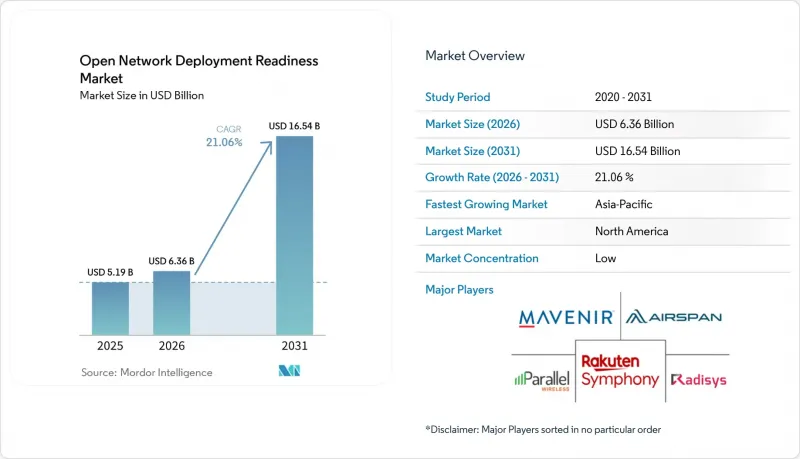
根據 Mordor Intelligence 預測,開放網路部署準備市場規模將從 2025 年的 51.9 億美元成長到 2026 年的 63.6 億美元,然後在 2031 年達到 165.4 億美元,2026 年至 2031 年的複合年成長率為 21.06%。
全球開放網路部署準備市場趨勢與洞察
利用 5G 和雲端原生技術實現網路現代化
雲端原生 5G 網路使軟體定義基地台無需現場存取即可接收配置變更,從而縮短了測試和準備多廠商部署所需的時間。 AT&T 報告稱,到 2026 年,其無線電設備更換計畫將完成 50% 以上,屆時開放硬體將處理其一半以上的網路流量。該公司還在兩個城市全面部署雲端無線存取網路 (Cloud RAN),展示了該技術向運作網路的過渡。 O2 Telefonica 於 2025 年在德國奧芬巴赫的商用 5G 獨立組網 (SA) 網路中部署了愛立信的雲端無線接取網路。 NTT Docomo 報告稱,將於 2026 年 3 月在結合本地部署和雲端的混合環境中推出其商用 5G 核心網路服務,並透過基於代理的 AI 自動化將部署時間縮短了 80%。這些措施正在提升自動化、編配和整合能力在開放網路部署準備市場的價值。
政府資助開放和安全的通訊供應鏈
公共資金正從政策承諾轉向津貼,用於支持測試、產品開發和系統整合。美國國家電訊資訊管理局 (NTIA) 透過其公共無線供應鏈創新基金的第一輪和第二輪提案徵集,向 35 個項目撥款超過 5.5 億美元。第三輪提案徵集撥款高達 4.5 億美元,用於多廠商開放式無線接取網路 (Open RAN) 部署的軟體和整合自動化。英國開放網路研發基金 (Open Network Research and Development Fund) 提供 2.5 億英鎊(約 3.2 億美元)用於測試基礎設施、產品開發和商業化前期活動,資金期限至 2026 年 3 月(以 2025 年平均外匯計算)。 2026 年 4 月,日本經濟產業省 (METI) 決定向樂天 Symphony 公司津貼高達 80 億美元(約 5,020 萬美元),用於在七個國家部署開放式無線接取網路和無線接取網路智慧控制器。這些措施透過扶持具有成熟互通性的供應商,支持了開放網路就緒市場的發展。
跨多個供應商的互通性和整合的複雜性
即使供應商遵守已發布的標準,多廠商整合仍然是商業部署的一大限制。 2025年,電訊研究所指出,即使設備符合3GPP和O-RAN聯盟規範,也可能出現互通性問題。這些問題包括定時器設定、訊息處理、位元率相容性以及標準版本差異。 ATIS的「Open RAN最小可行設定檔版本2」指出,解釋、配置和選用功能方面的差異使得互通性難以實現。電信營運商和系統整合商必須協調不同供應商之間的調試工作,這些供應商之間可能存在競爭關係。此外,每次組件更新可能需要重新啟動認證流程,從而增加開放網路部署準備市場的持續成本。
細分市場分析
到了2025年,硬體在開放網路部署準備方面佔48.37%的市場。當電信業者遷移到開放網路架構時,無線設備的採購通常是第一步。無線設備在無線接取網路(RAN)升級週期中也佔據了相當大的資本支出比例。在2025年的採購週期中,4G設備的更換與計畫在歐洲和北美擴展的5G覆蓋範圍密切相關。軟體提供容器化網路功能和雲端原生編配工具。這些產品擴大透過持續的授權合約進行銷售,而不是一次性購買。
預計2026年至2031年,服務市場將以22.32%的複合年成長率成長。系統整合、多廠商測試和託管編配可能會超過許多行動營運商的內部工程能力。 2026年7月,NTT DOCOMO完成了愛立信符合O-RAN聯盟標準的RAN處理器「6672」的商用部署,其容量效率比上一代產品提高了四倍,能耗降低了50%以上。此處理器還支援多廠商無線單元之間的互通性。 2026年6月,Mavenir宣布與Red Hat合作推出整合式AI平台,該平台採用憑證式的收費模式為營運商提供AI服務。在開放網路部署準備市場中,Airspan、Benetel和Baicells等無線單元專家與軟體和服務供應商展開了不同的競爭。
到2025年,無線單元將佔據網路架構層最大的佔有率,達到38.65%。由於它們是連接網路和頻寬的實體介面,電信業者需要在開放網路計畫的早期階段對其進行升級或更換。目前,多家供應商提供適用於不同頻段的符合O-RAN標準的無線單元。無線單元屬於資本密集型產品,並且在日常網路運作中非常顯眼。在軟體層,集中式單元和RAN智慧控制器正逐漸商業化。 RAN智慧控制器承載著用於人工智慧驅動的網路最佳化的xApp和rApp。
預計2026年至2031年間,分散式單元的市場規模將以21.84%的複合年成長率成長。電信業者正利用這一層將基頻處理分解為可在商用伺服器上運行的軟體可部署功能。這降低了每個站點的運算成本,並支援雲端原生生命週期管理。 2026年2月,樂天移動完成了RAN智慧控制器應用程式在全國的部署,其中包括來自AirHop Communications和Future Connections的第三方rApps。 2026年1月,樂天Symphony獲得了OTIC Japan頒發的O-RAN合規性和互通性認證。此認證可能會影響開放網路部署準備市場中的供應商選擇。
區域分析
2025年,北美地區佔據42.19%的市場。 AT&T的無線設備交換計畫鞏固了該地區的商業性地位,而美國國家電信和資訊管理局(NTIA)透過前兩輪融資,為35個測試和商業化項目提供了超過5.5億美元的資金。美國無線創新基金8.5億美元未分配承諾的撤回,減少了硬體和軟體開發商可獲得的短期公共共同投資。 NTIA也投資了5000萬美元,用於規劃探索人工智慧原生6G架構的新機會。在加拿大,開放科技的應用正在擴展,以改善農村和偏遠地區的網路連結。 2026年2月,Mavenir在雲端原生虛擬化無線存取網路(RAN)和封包核心網路網路上部署了Terrestar的混合衛星物聯網服務。雖然南美洲仍處於起步階段,但由經濟產業省支持的「樂天交響曲」舉措正在支持玻利維亞和巴拉圭從 2026 年 5 月到 2029 年 3 月的開放網路部署準備市場。
在歐洲,開放網路部署準備市場正從試點計畫轉向商業規模活動。電信業者面臨許多挑戰,例如供應商多元化以及如何管理舊有系統無線系統和開放無線系統的共存。沃達豐和三星於2025年啟動的一項計劃已在德國啟動,並計劃在五年內擴展到數千個地點。該部署將包括虛擬化無線存取網(RAN)軟體、O-RAN無線設備以及用於2G、4G和5G的基於人工智慧的自動化工具。包括德國電信、Orange、西班牙電信和沃達豐在內的更多電信業者已承諾部署開放式無線存取網路(Open RAN)。俄羅斯的貢獻仍然有限。這是因為制裁和地緣政治限制使該國與整個歐洲開放網路生態系統隔絕。在開放網路部署準備市場中,該地區的下一階段取決於將多供應商試點計畫發展成為可在各國市場複製的項目。
亞太地區預計將成為成長最快的地區,2026年至2031年的複合年成長率將達到22.48%。這項成長主要得益於日本開放式虛擬化無線接取網路(Open Virtualized RAN)的營運活動以及印度國內電信設備製造計畫。 NTT Docomo、KDDI、Softbank Corporation和樂天移動分別在不同階段推進開放式無線接取網路和虛擬化無線接取網路專案。樂天移動為該地區其他電信業者提供了寶貴的大規模營運經驗案例研究。據報道,NTT Docomo於2026年7月部署的處理器,其容量效率比上一代產品提升高達四倍,能耗降低超過50%。印度已根據生產連結獎勵計畫計劃批准了136個電信設備製造項目。中東和非洲地區正處於開放網路部署準備市場的成長階段,沙烏地阿拉伯、阿拉伯聯合大公國(阿拉伯聯合大公國)、土耳其、南非、奈及利亞和埃及正在評估或試行開放網路方案。
其他好處:
- Excel格式的市場預測(ME)表
- 3個月的分析師支持
目錄
第1章:引言
- 研究假設和市場定義
- 調查範圍
第2章:調查方法
第3章執行摘要
第4章 市場狀況
- 市場概覽
- 宏觀經濟因素對市場的影響
- 市場促進因素
- 利用 5G 和雲端原生技術實現網路現代化
- 政府資助開放和安全的通訊供應鏈
- 對供應商多樣性和網路彈性的需求。
- 5G網路在私人和企業用途的擴展
- 透過可重複使用的測試自動化縮短準備週期。
- 一個開放式無線存取網路(Open RAN)參考平台,可在實際環境中快速部署。
- 市場限制因素
- 跨多個供應商的互通性和整合的複雜性
- 商業規模尚不成熟,且缺乏過往業績紀錄。
- 時間、同步和能源效率的差異
- 缺乏開放網路整合技能
- 產業價值鏈分析
- 監理情勢
- 技術展望
- 波特五力分析
第5章 市場規模與成長預測
- 按組件
- 硬體
- 軟體
- 服務
- 依架構層
- 無線單元
- 分散式單元
- 中央單元
- RAN智慧型控制器
- 其他建築層
- 實施階段
- 待開發區實施
- 棕地現代化改造
- 試點和實地測試
- 其他實施階段
- 最終用戶
- 行動電信商
- 中立主機提供商
- 按公司和行業
- 政府和國防機構
- 按地區
- 北美洲
- 美國
- 加拿大
- 墨西哥
- 南美洲
- 巴西
- 阿根廷
- 其他南美國家
- 歐洲
- 德國
- 英國
- 法國
- 義大利
- 西班牙
- 俄羅斯
- 其他歐洲國家
- 亞太地區
- 中國
- 日本
- 印度
- 韓國
- 澳洲和紐西蘭
- 其他亞太國家
- 中東
- 沙烏地阿拉伯
- 阿拉伯聯合大公國
- 土耳其
- 其他中東國家
- 非洲
- 南非
- 奈及利亞
- 埃及
- 其他非洲國家
- 北美洲
第6章 競爭情勢
- 市場集中度
- 策略趨勢
- 市佔率分析
- 公司簡介
- Mavenir Systems, Inc.
- Parallel Wireless, Inc.
- Airspan Networks Holdings Inc.
- Radisys Corporation
- Rakuten Symphony, Inc.
- JMA Wireless, LLC
- ASOCS Ltd.
- Comba Telecom Systems Holdings Limited
- Picocom Technology Limited
- Azcom Technology Srl
- SOLiD, Inc.
- Baicells Technologies Co., Ltd.
- Benetel Limited
- Amarisoft, SAS
- Druid Software Limited
- Sercomm Corporation
- VVDN Technologies Private Limited
- AmpliTech Group, Inc.
第7章 市場機會與未來展望
According to Mordor Intelligence, the open network deployment readiness market size is expected to grow from USD 5.19 billion in 2025 to USD 6.36 billion in 2026 and is forecast to reach USD 16.54 billion by 2031 at 21.06% CAGR over 2026-2031.
Global Open Network Deployment Readiness Market Trends and Insights
5G and Cloud-Native Network Modernization
Cloud-native 5G networks allow software-defined base stations to receive configuration changes without physical site visits, reducing the time required to test and prepare multi-vendor deployments. AT&T reported that more than 50% of its radio replacement program had been completed by 2026, and open-capable hardware carried more than half of its network traffic. The company also progressed Cloud RAN live operations in 2 cities, which shows that the technology is moving into operational networks. O2 Telefonica deployed Ericsson Cloud RAN in a commercial 5G standalone network in Offenbach, Germany, in 2025. NTT DOCOMO launched commercial 5G Core services in a hybrid on-premises and cloud environment in March 2026 and reported an 80% reduction in deployment time through agentic AI automation. These programs raise the value of automation, orchestration, and integration capabilities in the open network deployment readiness market.
Government Funding for Open and Secure Telecom Supply Chains
Public funding has moved from policy commitments toward grants that support testing, product development, and system integration. The US National Telecommunications and Information Administration awarded more than USD 550 million across 35 projects through the first 2 rounds of its Public Wireless Supply Chain Innovation Fund. A third round made up to USD 450 million available for software and integration automation for multi-vendor Open RAN deployments. The UK Open Networks Research and Development Fund provided GBP 250 million (USD 320 million) at the 2025 average exchange rate, through March 2026, for test infrastructure, product development, and commercial readiness activities. In April 2026, Japan's METI selected Rakuten Symphony for a grant of up to JPY 8 billion (USD 50.2 million) for Open RAN and RAN Intelligent Controller deployments across 7 countries. These measures support the open network deployment readiness market by favoring suppliers with verified interoperability.
Multi-Vendor Interoperability and Integration Complexity
Multi-vendor integration remains a central constraint to commercial adoption, even when suppliers adhere to published standards. The Institute for Telecommunication Sciences found in 2025 that equipment compliant with 3GPP and O-RAN Alliance specifications could still produce interoperability events. The issues included timer configuration, message handling, bitrate compatibility, and differences between standard versions. The ATIS Open RAN Minimum Viable Profile Version 2 noted that differing interpretations, configurations, and optional features make interoperability difficult. Operators and system integrators must coordinate debugging work among suppliers that may compete with one another. Each update to an individual component can also restart elements of the qualification process and add continuing cost to the open network deployment readiness market.
Other drivers and restraints analyzed in the detailed report include:
- Demand for Vendor Diversity and Network Resilience
- Expansion of Private and Enterprise 5G Networks
- Immature Commercial Scale and Performance Evidence
For complete list of drivers and restraints, kindly check the Table Of Contents.
Segment Analysis
Hardware held 48.37% of the open network deployment readiness market share in 2025. Radio unit procurement is normally the starting point for an operator moving to an open network architecture. Radio equipment also represents a large share of capital spending during a RAN upgrade cycle. The 2025 procurement cycle aligned 4G equipment replacement with planned 5G coverage expansion across Europe and North America. Software provides containerized network functions and cloud-native orchestration tools. These products are increasingly sold through recurring license arrangements rather than single purchases.
Services are projected to expand at a 22.32% CAGR from 2026 to 2031. System integration, multi-vendor testing, and managed orchestration can exceed the internal engineering capacity available to many mobile operators. NTT DOCOMO completed a commercial deployment of Ericsson's O-RAN Alliance-compliant RAN Processor 6672 in July 2026, reporting up to 4 times higher capacity efficiency and more than 50% lower energy use than the prior generation. The processor also supported interoperability among multi-vendor radio units. In June 2026, Mavenir introduced an Integrated AI Platform with Red Hat that used token-based consumption for operator AI services. Within the open network deployment readiness market, radio-unit specialists, including Airspan, Benetel, and Baicells, compete separately from software and service providers.
The radio unit held the largest share of the architecture layer at 38.65% in 2025. It is the physical interface that connects the network to the spectrum, so operators must upgrade or replace it early in an open network program. Multiple suppliers now offer O-RAN-compliant radio units across frequency bands. Radio units are also capital-intensive and highly visible in daily network operations. Centralized units and RAN Intelligent Controllers are gaining commercial use as software layers. The RAN Intelligent Controller hosts xApps and rApps for AI-enabled network optimization.
Distributed unit is projected to grow at a 21.84% CAGR from 2026 to 2031. Operators use this layer to disaggregate baseband processing into software-deployable functions that can run on commercial off-the-shelf servers. This can reduce per-site compute costs and support cloud-native lifecycle management. Rakuten Mobile completed a nationwide deployment of RAN Intelligent Controller applications in February 2026, including third-party rApps from AirHop Communications and Future Connections. Rakuten Symphony also received O-RAN conformance and Interoperability Badge certifications from Japan OTIC in January 2026. Certification can shape supplier selection in the open network deployment readiness market.
Complete Report Scope:
- By Component
- Hardware
- Software
- Services
- By Architecture Layer
- Radio Unit
- Distributed Unit
- Centralized Unit
- RAN Intelligent Controller
- Other Architecture Layers
- By Deployment Phase
- Greenfield Deployment
- Brownfield Modernization
- Pilot and Field Trial
- Other Deployment Phases
- By End User
- Mobile Network Operators
- Neutral-Host Providers
- Enterprises and Industry Verticals
- Government and Defense Organizations
- By Geography
- North America
- United States
- Canada
- Mexico
- South America
- Brazil
- Argentina
- Rest of South America
- Europe
- Germany
- United Kingdom
- France
- Italy
- Spain
- Russia
- Rest of Europe
- Asia-Pacific
- China
- Japan
- India
- South Korea
- Australia and New Zealand
- Rest of Asia-Pacific
- Middle East
- Saudi Arabia
- United Arab Emirates
- Turkey
- Rest of Middle East
- Africa
- South Africa
- Nigeria
- Egypt
- Rest of Africa
- North America
Geography Analysis
North America held 42.19% share in 2025. AT&T's radio swap program supported the region's commercial position, while the NTIA funded more than USD 550 million across 35 testing and commercialization projects through the first 2 funding rounds. The rescission of USD 850 million in unallocated US Wireless Innovation Fund commitments reduced near-term public co-investment available to hardware and software developers. NTIA also planned a new opportunity using USD 50 million to explore AI-native 6G architecture. Canada is broadening the use of open technologies for rural and remote connectivity. Mavenir deployed Terrestar's hybrid satellite IoT service over a cloud-native virtualized RAN and packet core in February 2026. South America remains early stage, though the METI-backed Rakuten Symphony initiative supports the open network deployment readiness market in Bolivia and Paraguay from May 2026 through March 2029.
Europe is moving from trials toward commercial-scale activity in the open network deployment readiness market. Operators face pressure to diversify their supplier base and manage the coexistence of legacy and open radio systems. Vodafone's 2025 program with Samsung began in Germany and is scheduled to extend across thousands of sites over 5 years. The rollout includes virtualized RAN software supporting 2G, 4G, and 5G, O-RAN radios, and AI-based automation tools. A wider group of operators, including Deutsche Telekom, Orange, Telefonica, and Vodafone, has committed to Open RAN adoption. Russia's contribution remains limited because sanctions and geopolitical constraints isolate it from the wider European open network ecosystem. For the open network deployment readiness market, the region's next stage depends on turning multi-vendor trials into repeatable programs across national markets.
Asia-Pacific is projected to be the fastest-growing region at a 22.48% CAGR from 2026 to 2031. Japan's operational open virtualized RAN activity and India's domestic telecom equipment manufacturing program support this growth. NTT DOCOMO, KDDI, SoftBank, and Rakuten Mobile are advancing Open RAN and virtualized RAN programs at different stages. Rakuten Mobile provides a large operational reference for other regional operators. NTT DOCOMO's July 2026 processor deployment reported up to 4 times higher capacity efficiency and more than 50% lower energy consumption than the prior generation. India approved 136 telecom equipment manufacturing projects under its production-linked incentive scheme. The Middle East and Africa are growth-stage areas in the open network deployment readiness market, with Saudi Arabia, the UAE, Turkey, South Africa, Nigeria, and Egypt evaluating or piloting open network approaches.
- Mavenir Systems, Inc.
- Parallel Wireless, Inc.
- Airspan Networks Holdings Inc.
- Radisys Corporation
- Rakuten Symphony, Inc.
- JMA Wireless, LLC
- ASOCS Ltd.
- Comba Telecom Systems Holdings Limited
- Picocom Technology Limited
- Azcom Technology S.r.l.
- SOLiD, Inc.
- Baicells Technologies Co., Ltd.
- Benetel Limited
- Amarisoft, S.A.S.
- Druid Software Limited
- Sercomm Corporation
- VVDN Technologies Private Limited
- AmpliTech Group, Inc.
Additional Benefits:
- The market estimate (ME) sheet in Excel format
- 3 months of analyst support
TABLE OF CONTENTS
1 INTRODUCTION
- 1.1 Study Assumptions and Market Definition
- 1.2 Scope of the Study
2 RESEARCH METHODOLOGY
3 EXECUTIVE SUMMARY
4 MARKET LANDSCAPE
- 4.1 Market Overview
- 4.2 Impact of Macroeconomic Factors on the Market
- 4.3 Market Drivers
- 4.3.1 5G and Cloud-Native Network Modernization
- 4.3.2 Government Funding for Open and Secure Telecom Supply Chains
- 4.3.3 Demand for Vendor Diversity and Network Resilience
- 4.3.4 Expansion of Private and Enterprise 5G Networks
- 4.3.5 Reusable Test Automation Reducing Readiness-Cycle Time
- 4.3.6 Open RAN Reference Platforms for Rapid Field Replication
- 4.4 Market Restraints
- 4.4.1 Multi-Vendor Interoperability and Integration Complexity
- 4.4.2 Immature Commercial Scale and Performance Evidence
- 4.4.3 Timing, Synchronization, and Energy-Efficiency Gaps
- 4.4.4 Shortage of Open Network Integration Skills
- 4.5 Industry Value Chain Analysis
- 4.6 Regulatory Landscape
- 4.7 Technological Outlook
- 4.8 Porter's Five Forces Analysis
- 4.8.1 Bargaining Power of Suppliers
- 4.8.2 Bargaining Power of Buyers
- 4.8.3 Threat of New Entrants
- 4.8.4 Threat of Substitutes
- 4.8.5 Rivalry Among Existing Competitors
5 MARKET SIZE AND GROWTH FORECASTS (VALUE)
- 5.1 By Component
- 5.1.1 Hardware
- 5.1.2 Software
- 5.1.3 Services
- 5.2 By Architecture Layer
- 5.2.1 Radio Unit
- 5.2.2 Distributed Unit
- 5.2.3 Centralized Unit
- 5.2.4 RAN Intelligent Controller
- 5.2.5 Other Architecture Layers
- 5.3 By Deployment Phase
- 5.3.1 Greenfield Deployment
- 5.3.2 Brownfield Modernization
- 5.3.3 Pilot and Field Trial
- 5.3.4 Other Deployment Phases
- 5.4 By End User
- 5.4.1 Mobile Network Operators
- 5.4.2 Neutral-Host Providers
- 5.4.3 Enterprises and Industry Verticals
- 5.4.4 Government and Defense Organizations
- 5.5 By Geography
- 5.5.1 North America
- 5.5.1.1 United States
- 5.5.1.2 Canada
- 5.5.1.3 Mexico
- 5.5.2 South America
- 5.5.2.1 Brazil
- 5.5.2.2 Argentina
- 5.5.2.3 Rest of South America
- 5.5.3 Europe
- 5.5.3.1 Germany
- 5.5.3.2 United Kingdom
- 5.5.3.3 France
- 5.5.3.4 Italy
- 5.5.3.5 Spain
- 5.5.3.6 Russia
- 5.5.3.7 Rest of Europe
- 5.5.4 Asia-Pacific
- 5.5.4.1 China
- 5.5.4.2 Japan
- 5.5.4.3 India
- 5.5.4.4 South Korea
- 5.5.4.5 Australia and New Zealand
- 5.5.4.6 Rest of Asia-Pacific
- 5.5.5 Middle East
- 5.5.5.1 Saudi Arabia
- 5.5.5.2 United Arab Emirates
- 5.5.5.3 Turkey
- 5.5.5.4 Rest of Middle East
- 5.5.6 Africa
- 5.5.6.1 South Africa
- 5.5.6.2 Nigeria
- 5.5.6.3 Egypt
- 5.5.6.4 Rest of Africa
- 5.5.1 North America
6 COMPETITIVE LANDSCAPE
- 6.1 Market Concentration
- 6.2 Strategic Moves
- 6.3 Market Share Analysis
- 6.4 Company Profiles (includes Global Level Overview, Market Level Overview, Core Segments, Financials as available, Strategic Information, Market Rank/Share, Products and Services, Recent Developments)
- 6.4.1 Mavenir Systems, Inc.
- 6.4.2 Parallel Wireless, Inc.
- 6.4.3 Airspan Networks Holdings Inc.
- 6.4.4 Radisys Corporation
- 6.4.5 Rakuten Symphony, Inc.
- 6.4.6 JMA Wireless, LLC
- 6.4.7 ASOCS Ltd.
- 6.4.8 Comba Telecom Systems Holdings Limited
- 6.4.9 Picocom Technology Limited
- 6.4.10 Azcom Technology S.r.l.
- 6.4.11 SOLiD, Inc.
- 6.4.12 Baicells Technologies Co., Ltd.
- 6.4.13 Benetel Limited
- 6.4.14 Amarisoft, S.A.S.
- 6.4.15 Druid Software Limited
- 6.4.16 Sercomm Corporation
- 6.4.17 VVDN Technologies Private Limited
- 6.4.18 AmpliTech Group, Inc.
7 MARKET OPPORTUNITIES AND FUTURE OUTLOOK
- 7.1 White-Space and Unmet-Need Assessment

 5G核心網市場:全球市場預測,2026-2032年
 5G核心網路市場報告:趨勢、預測與競爭分析(至2035年)
 2026年全球政策控制功能(PCF)政策庫市場報告
 北美5G核心網路:市場佔有率分析、產業趨勢與統計及成長預測(2026-2031年)
 2026-2030年全球5G邊緣雲端網路服務市場中東地區5G核心網路:市場佔有率分析、產業趨勢與統計及成長預測(2026-2031年)亞太地區5G核心網路:市佔率分析、產業趨勢與統計及成長預測(2026-2031年)非洲5G核心網路:市場佔有率分析、產業趨勢與統計及成長預測(2026-2031年)南美洲5G核心網路:市場佔有率分析、產業趨勢與統計及成長預測(2026-2031年)歐洲 5G 核心網路:市場佔有率分析、產業趨勢和統計數據以及成長預測(2026-2031 年)