


 |
市場調查報告書
商品編碼
2119190
非洲5G核心網路:市場佔有率分析、產業趨勢與統計及成長預測(2026-2031年)Africa 5G Core Network - Market Share Analysis, Industry Trends & Statistics, Growth Forecasts (2026 - 2031) |
||||||

※ 本網頁內容可能與最新版本有所差異。詳細情況請與我們聯繫。
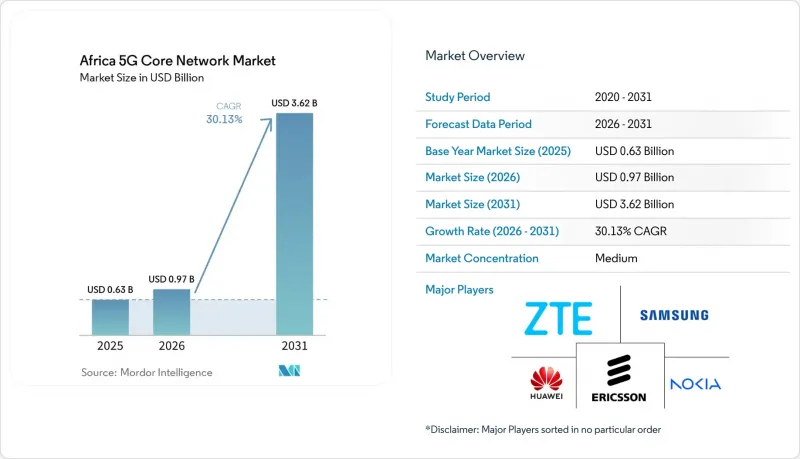
據 Mordor Intelligence 稱,非洲 5G 核心網路市場預計到 2025 年價值 6.3 億美元,到 2026 年成長至 9.7 億美元,到 2031 年將成長至 36.2 億美元,在預測期(2026-2031 年)內複合年成長率為 30.13%。
本報告按元件(解決方案、服務)、部署模式(本地/專用、公共雲端、混合雲和運營商邊緣雲端)、最終用戶(運營商、企業)、網路功能(網路開放功能、用戶平面功能、應用功能、整合資料管理等)和國家/地區進行細分。市場預測以美元(USD)為單位。
非洲5G核心網路市場趨勢與洞察
加快一級行動通訊業者。
2026年初,一級行動通訊業者已將其5G獨立網路部署計畫轉為全面採購和部署專案。隨著集團級營運商將通用雲端平台應用於多個國家的運營,非洲5G核心網路市場正從中受益。 MTN集團的MUNA框架已為南非、辛巴威、安哥拉和烏干達的雲端原生現代化計畫提供了支持。據愛立信稱,MTN南非於2025年完成了其運作中分組封包核心網路閘道器的自動化線上軟體升級,處理了252萬個活躍會話和40 Gbps的流量。這份營運記錄表明,當平台擁有大量活躍用戶時,營運商為何會優先選擇成熟的核心網路供應商。根據GSMA Intelligence的研究,到2026年中期,將有61家業者在37個非洲市場供應商用5G服務,為非洲5G核心網市場未來的獨立組網(SA)升級奠定更廣泛的基礎。
企業和工業連接對網路切片的需求日益成長。
網路切片技術允許電信業者將特定的網路效能分配給特定的企業或公共服務。由於這項功能依賴獨立核心網的部署,因此對網路切片的需求與核心網現代化改造的時機密切相關。根據GSMA Intelligence的報告,到2025年初,非洲將有32家公司採購專用網路設備,其中以南非、奈及利亞、安哥拉和加納的採購活動最為集中。採礦、製造、物流和公共安全等行業的使用者可能需要傳統消費者行動服務無法提供的服務等級。 2026年4月,Inwi與中國移動國際和華為合作,在納祖爾西地中海工業中心建置摩洛哥首個工業專用5G網路。該網路旨在支援自動化、即時監控、物聯網(IoT)應用和遙感探測。企業應用需要安全存取特定的網路功能,從而提升了網路開放能力(NEF)的價值。
網路現代化改造成本高昂,投資回收期長。
核心網路現代化需要營運商投入大量前期資金,才能從企業用戶中獲得可觀的新收入。在用戶平均收入(ARPU)較低且大部分行動數據需求仍由4G網路滿足的地區,這項挑戰尤其嚴峻。奈及利亞通訊委員會(NCC)的報告顯示,到2025年,產業投資將超過10億美元,但到2026年3月,5G行動連線僅達4.2%。這一差距可能會延長完全獨立核心網的投資回收期,尤其是在消費者使用集中在主要城市的情況下。託管核心網路服務可以減輕初始資本負擔,但需要強大的資料中心基礎設施和專業的維運支援。因此,小規模的營運商可能會繼續維持其現有核心網平台,直到企業需求和無線覆蓋範圍擴大。
細分市場分析
預計到2025年,解決方案將佔非洲5G核心網市場收入的58.91%。此領域涵蓋封包核心網路軟體、NFV基礎設施以及編配和管理平台。由於營運商需要為獨立組網5G建立技術基礎,這些產品佔據了初始投資的很大一部分。封包核心網路網路軟體包含存取、會話和使用者平面等關鍵功能。在非洲5G核心網路市場,這些功能對於管理行動會話、路由流量、執行用戶策略以及確保服務品質至關重要。 MTN南非預計2025年在其雲端原生基礎架構平台上部署愛立信的雲端原生封包核心網路和使用者管理功能。此次部署凸顯了軟體平台在該營運商多年現代化計畫中的重要角色。
預計2026年至2031年,服務市場將以34.11%的複合年成長率成長。此類別涵蓋整合和部署、諮詢和顧問以及支援和維護。隨著電信業者在不中斷運作中服務的情況下遷移用戶資料、策略控制和舊有系統,對服務的需求將會增加。此外,隨著電信業者將多個供應商整合到共用雲端環境中,需求也會增加。根據AMD的報告,39%的受訪電信服務供應商計劃建立統一的電信雲端團隊,以統籌其核心網路和虛擬無線接取網路(vRAN)的營運。這種營運整合將支援持續的整合工作和託管服務。在非洲的5G核心網路產業,當小規模的電信業者沒有自己的內部雲端運營團隊時,系統整合商可能會發揮更重要的作用。隨著升級工作從初始部署階段推進到後續階段,擁有完善的本地支援體系的供應商也可能從中受益。
預計到2025年,非洲5G核心網路市場中,本地部署和專用系統將佔總收入的49.99%。這反映了政府和安全關鍵型使用者對安全性、主權和營運方面的要求,同時也反映了許多國家大規模雲端區域的可用性有限。專用系統使營運商能夠更直接地控制資料處理、用戶平面部署和網路運營,並能更好地支援需要資料保留在特定管轄範圍內的工作負載。這種部署模式也滿足了企業對獨立、可審計核心環境的需求。儘管公共雲端選項日益增多,但這些因素確保了本地部署系統仍然至關重要。
預計從2026年到2031年,混合雲和營運商邊緣雲端的採用率將以32.19%的複合年成長率成長。營運商正在利用這些模型在集中式雲端環境中維護控制平面功能,同時將使用者平面處理部署在更靠近企業的位置。這種方法可以降低應用程式延遲,並最大限度地減少本地資料流中的回程傳輸流量。英特爾、諾基亞和戴爾科技預計在2026年世界行動通訊大會(MWC 2026)上推出小型遠端用戶平面功能設備,其效能比傳統解決方案高出30%。這些設備專為面積和基礎設施有限的企業和工業設施而設計。光纖和資料中心的進一步普及對於該模型在非洲5G核心網路市場擴展到主要城市以外的地區至關重要。該模型提供了一種無需將所有網路功能都部署在邊緣即可支援固定無線接入、專用5G和工業應用的方法。
其他好處
- Excel格式的市場預測(ME)表
- 3個月的分析師支持
目錄
第1章:引言
- 研究假設和市場定義
- 調查範圍
第2章:調查方法
第3章執行摘要
第4章 市場狀況
- 市場概覽
- 市場促進因素
- 加快一級行動通訊業者。
- 為了支援企業和產業之間的連接,網路切片的需求日益成長。
- 將核心系統遷移到雲端原生架構以降低長期營運成本
- 公共安全和智慧城市應用場景對低延遲連線的需求日益成長。
- 主要市場的頻率重新分配和核心網路現代化計劃
- 為融資的企業提供供應商主導的資金籌措和管理核心服務。
- 市場限制因素
- 網路現代化改造成本高昂,投資回收期長。
- 部分市場缺乏光纖回程回程傳輸和資料中心基礎設施
- 各國法規及許可環境存在差異
- 關於多廠商雲端部署的核心網路安全和主權問題,存在一些未被充分通報的擔憂。
- 價值鏈分析
- 監理情勢
- 技術展望
- PESTLE分析
- 波特五力分析
第5章 市場規模與成長預測
- 按組件
- 解決方案
- 封包核心網路軟體
- NFV基礎設施
- 編配與管理
- 服務
- 整合與部署
- 諮詢和顧問服務
- 支援與維護
- 解決方案
- 按部署模式
- 本地部署/專用
- 公共雲端
- 混合雲和運營商邊緣雲端
- 最終用戶
- 電信營運商
- 公司
- 製造業
- 能源與公共產業
- 運輸/物流
- 公共安全和緊急應變
- 智慧城市和地方政府
- 網路功能
- 網路暴露函數(NEF)
- 使用者平面功能(UPF)
- 應用功能(AF)
- 統一資料管理(UDM)
- 會話管理功能 (SMF)
- 網路切片選擇函數(NSSF)
- 策略控制功能(PCF)
- 網路儲存庫功能(NRF)
- 認證伺服器功能(AUSF)
- 存取和移動性管理功能 (AMF)
- 國家
- 南非
- 奈及利亞
- 其他非洲地區
第6章 競爭情勢
- 市場集中度
- 策略趨勢
- 市佔率分析
- 公司簡介
- Telefonaktiebolaget LM Ericsson(publ)
- Nokia Corporation
- Huawei Technologies Co., Ltd.
- ZTE Corporation
- Cisco Systems, Inc.
- Mavenir Systems, Inc.
- Oracle Corporation
- Samsung Electronics Co., Ltd.
- Dell Technologies Inc.
- Hewlett Packard Enterprise Development LP
- NEC Corporation
- Juniper Networks, Inc.
- Amdocs Limited
- Wind River Systems, Inc.
- Parallel Wireless, Inc.
- Athonet Srl
- Radisys Corporation
- Tech Mahindra Limited
第7章 市場機會與未來展望
According to Mordor Intelligence, the Africa 5G core network market size was valued at USD 0.63 billion in 2025 and is estimated to expand from USD 0.97 billion in 2026 to USD 3.62 billion by 2031, at a CAGR of 30.13% during the forecast period (2026-2031).
This report is Segmented by Component (Solutions, and Services), Deployment Model (On-Premises/Dedicated, Public Cloud, and Hybrid and Telco Edge Cloud), End-User (Telecom Operators, and Enterprises), Network Function (Network Exposure Function, User Plane Function, Application Function, Unified Data Management, and More), and Country. The Market Forecasts are Provided in Terms of Value (USD).
Africa 5G Core Network Market Trends and Insights
Accelerated 5G Standalone Core Deployments by Tier-1 Mobile Operators
Tier-1 operators entered 2026 with 5G standalone commitments moving into active procurement and deployment programs. The Africa 5G core network market benefits when group-level operators apply common cloud platforms across several national businesses. MTN Group's MUNA framework supported cloud-native modernization programs in South Africa, Zimbabwe, Angola, and Uganda. Ericsson reported that MTN South Africa completed an automated in-service software upgrade on a live Packet Core Gateway while it handled 2.52 million active sessions and 40 Gbps of traffic in 2025. That operational result shows why operators may favor an established core supplier when a platform carries a large live subscriber base. GSMA Intelligence recorded 61 operators offering commercial 5G services in 37 African markets by mid-2026, giving the Africa 5G core network market a wider base for later standalone upgrades.
Rising Need for Network Slicing for Enterprise and Industrial Connectivity
Network slicing enables operators to assign defined network performance to a specific enterprise or public service. This capability depends on a standalone core deployment, making slicing demand closely tied to the timing of core modernization. GSMA Intelligence reported that 32 companies across Africa were procuring private-network equipment in early 2025, with activity concentrated in South Africa, Nigeria, Angola, and Ghana. Mining, manufacturing, logistics, and public safety users can require service levels that conventional consumer mobile offers cannot provide. Inwi deployed Morocco's first private industrial 5G network at the Nador West Med industrial hub in April 2026, in partnership with China Mobile International and Huawei, to support automation, real-time monitoring, Internet of Things applications, and remote sensing. These projects increase the value of the Network Exposure Function, as enterprise applications require secure access to specific network capabilities.
High Network Modernization Cost and Long Payback Period
Core modernization requires substantial initial spending before operators can generate material new enterprise revenue. The challenge is most acute where average revenue per user is low, and 4G networks still meet much of the demand for mobile data. The Nigerian Communications Commission reported that industry investment exceeded USD 1 billion in 2025, while 5G accounted for 4.2% of mobile connections in March 2026. This gap can lengthen payback periods for a full standalone core, particularly where consumer adoption is concentrated in major cities. Managed core services can reduce the initial capital burden, but they require sufficient data center infrastructure and skilled operational support. Smaller operators may therefore retain existing core platforms until enterprise demand and radio coverage strengthen.
Other drivers and restraints analyzed in the detailed report include:
- Cloud-Native Core Migration to Reduce Long-Term Operating Costs
- Demand for Low-Latency Public Safety and Smart City Connectivity
- Limited Fiber Backhaul and Data Center Readiness
For complete list of drivers and restraints, kindly check the Table Of Contents.
Segment Analysis
Solutions are expected to account for 58.91% of Africa 5G core network market revenue in 2025. The segment includes packet-core software, network functions virtualization infrastructure, and orchestration and management platforms. These products represent a significant initial share of spending because operators must establish the core technical foundation for standalone 5G. Packet-core software includes essential access, session, and user-plane functions. The Africa 5G core network market relies on these functions to manage mobile sessions, route traffic, enforce subscriber policies, and ensure service quality. MTN South Africa is expected to deploy Ericsson's cloud-native packet core and user-management functions on a cloud-native infrastructure platform in 2025. This deployment highlights the role of software platforms in multi-year operator modernization plans.
Services are projected to expand at a CAGR of 34.11% from 2026 to 2031. The category includes integration and deployment, consulting, advisory services, support, and maintenance. Demand for services increases when operators migrate subscriber data, policy controls, and legacy systems without disrupting live services. It also rises when operators integrate multiple vendors into a shared cloud environment. AMD reported that 39% of surveyed communications service providers expected to create combined telecom cloud teams for core and virtual radio access network operations. This operational convergence supports recurring integration and managed-service work. The Africa 5G core network industry may see systems integrators play a larger role where smaller operators lack internal cloud operations teams. Vendors with established local support capabilities may also benefit as upgrades progress beyond the initial deployment stage.
On-premises and dedicated systems are expected to account for 49.99% of revenue in the Africa 5G core network market in 2025. This position reflects security, sovereignty, and operational requirements among government-related and security-sensitive users. It also reflects the limited availability of large cloud regions in many countries. Dedicated systems give operators greater direct control over data handling, user-plane placement, and network operations. They can better support workloads that require data to remain within a defined jurisdiction. This deployment model also supports enterprises that require a separate and auditable core environment. These factors keep on-premise systems important even as public cloud options become more available.
Hybrid and telco edge cloud deployments are projected to expand at a CAGR of 32.19% from 2026 to 2031. Operators use these models to place user-plane processing closer to enterprise locations while retaining control-plane functions in centralized cloud environments. This approach can reduce application latency and backhaul traffic for local data flows. Intel, Nokia, and Dell Technologies are expected to present a low-footprint far-edge User Plane Function device at MWC 2026, offering 30% higher performance than the preceding solution. The device is designed for enterprise and industrial locations with limited space and infrastructure. The Africa 5G core network market will depend on greater availability of fiber and data centers for this model to expand beyond primary cities. The model offers a way to support fixed wireless access, private 5G, and industrial applications without placing every network function at the edge.
Complete Report Scope:
- By Component
- Solutions
- Packet-Core Software
- NFV Infrastructure
- Orchestration and Management
- Services
- Integration and Deployment
- Consulting and Advisory
- Support and Maintenance
- Solutions
- By Deployment Model
- On-Premise/Dedicated
- Public Cloud
- Hybrid and Telco Edge Cloud
- By End-User
- Telecom Operators
- Enterprises
- Manufacturing
- Energy and Utilities
- Transportation and Logistics
- Public Safety and Emergency
- Smart Cities and Municipalities
- By Network Function
- Network Exposure Function (NEF)
- User Plane Function (UPF)
- Application Function (AF)
- Unified Data Management (UDM)
- Session Management Function (SMF)
- Network Slice Selection Function (NSSF)
- Policy Control Function (PCF)
- Network Repository Function (NRF)
- Authentication Server Function (AUSF)
- Access and Mobility Management Function (AMF)
- By Country
- South Africa
- Nigeria
- Rest of Africa
List of Companies Covered in this Report:
- Telefonaktiebolaget LM Ericsson (publ)
- Nokia Corporation
- Huawei Technologies Co., Ltd.
- ZTE Corporation
- Cisco Systems, Inc.
- Mavenir Systems, Inc.
- Oracle Corporation
- Samsung Electronics Co., Ltd.
- Dell Technologies Inc.
- Hewlett Packard Enterprise Development LP
- NEC Corporation
- Juniper Networks, Inc.
- Amdocs Limited
- Wind River Systems, Inc.
- Parallel Wireless, Inc.
- Athonet S.r.l.
- Radisys Corporation
- Tech Mahindra Limited
Additional Benefits:
- The market estimate (ME) sheet in Excel format
- 3 months of analyst support
TABLE OF CONTENTS
1 INTRODUCTION
- 1.1 Study Assumptions and Market Definition
- 1.2 Scope of the Study
2 RESEARCH METHODOLOGY
3 EXECUTIVE SUMMARY
4 MARKET LANDSCAPE
- 4.1 Market Overview
- 4.2 Market Drivers
- 4.2.1 Accelerated 5G Standalone Core Deployments by Tier-1 Mobile Operators
- 4.2.2 Rising Need for Network Slicing to Support Enterprise and Industrial Connectivity
- 4.2.3 Cloud-Native Core Migration to Reduce Long-Term Operating Cost
- 4.2.4 Growing Demand for Low-Latency Connectivity for Public Safety and Smart City Use Cases
- 4.2.5 Spectrum Refarming and Core Modernization Programs Across Leading Markets
- 4.2.6 Vendor-Led Financing and Managed Core Offerings for Capital-Constrained Operators
- 4.3 Market Restraints
- 4.3.1 High Network Modernization Cost and Long Payback Period
- 4.3.2 Limited Fiber Backhaul and Data Center Readiness in Several Markets
- 4.3.3 Fragmented Regulatory and Licensing Environments Across Countries
- 4.3.4 Under-Reported Core Security and Sovereignty Concerns Around Multi-Vendor Cloud Deployments
- 4.4 Value Chain Analysis
- 4.5 Regulatory Landscape
- 4.6 Technological Outlook
- 4.7 PESTLE Analysis
- 4.8 Porter's Five Forces Analysis
- 4.8.1 Threat of New Entrants
- 4.8.2 Bargaining Power of Buyers
- 4.8.3 Bargaining Power of Suppliers
- 4.8.4 Threat of Substitutes
- 4.8.5 Competitive Rivalry
5 MARKET SIZE AND GROWTH FORECASTS (VALUE)
- 5.1 By Component
- 5.1.1 Solutions
- 5.1.1.1 Packet-Core Software
- 5.1.1.2 NFV Infrastructure
- 5.1.1.3 Orchestration and Management
- 5.1.2 Services
- 5.1.2.1 Integration and Deployment
- 5.1.2.2 Consulting and Advisory
- 5.1.2.3 Support and Maintenance
- 5.1.1 Solutions
- 5.2 By Deployment Model
- 5.2.1 On-Premise/Dedicated
- 5.2.2 Public Cloud
- 5.2.3 Hybrid and Telco Edge Cloud
- 5.3 By End-User
- 5.3.1 Telecom Operators
- 5.3.2 Enterprises
- 5.3.2.1 Manufacturing
- 5.3.2.2 Energy and Utilities
- 5.3.2.3 Transportation and Logistics
- 5.3.2.4 Public Safety and Emergency
- 5.3.2.5 Smart Cities and Municipalities
- 5.4 By Network Function
- 5.4.1 Network Exposure Function (NEF)
- 5.4.2 User Plane Function (UPF)
- 5.4.3 Application Function (AF)
- 5.4.4 Unified Data Management (UDM)
- 5.4.5 Session Management Function (SMF)
- 5.4.6 Network Slice Selection Function (NSSF)
- 5.4.7 Policy Control Function (PCF)
- 5.4.8 Network Repository Function (NRF)
- 5.4.9 Authentication Server Function (AUSF)
- 5.4.10 Access and Mobility Management Function (AMF)
- 5.5 By Country
- 5.5.1 South Africa
- 5.5.2 Nigeria
- 5.5.3 Rest of Africa
6 COMPETITIVE LANDSCAPE
- 6.1 Market Concentration
- 6.2 Strategic Moves
- 6.3 Market Share Analysis
- 6.4 Company Profiles (includes Global Level Overview, Market Level Overview, Core Segments, Financials as available, Strategic Information, Market Rank/Share, Products and Services, Recent Developments)
- 6.4.1 Telefonaktiebolaget LM Ericsson (publ)
- 6.4.2 Nokia Corporation
- 6.4.3 Huawei Technologies Co., Ltd.
- 6.4.4 ZTE Corporation
- 6.4.5 Cisco Systems, Inc.
- 6.4.6 Mavenir Systems, Inc.
- 6.4.7 Oracle Corporation
- 6.4.8 Samsung Electronics Co., Ltd.
- 6.4.9 Dell Technologies Inc.
- 6.4.10 Hewlett Packard Enterprise Development LP
- 6.4.11 NEC Corporation
- 6.4.12 Juniper Networks, Inc.
- 6.4.13 Amdocs Limited
- 6.4.14 Wind River Systems, Inc.
- 6.4.15 Parallel Wireless, Inc.
- 6.4.16 Athonet S.r.l.
- 6.4.17 Radisys Corporation
- 6.4.18 Tech Mahindra Limited
7 MARKET OPPORTUNITIES AND FUTURE OUTLOOK
- 7.1 White-Space and Unmet-Need Assessment

 5G核心網市場:全球市場預測,2026-2032年
 5G核心網路市場報告:趨勢、預測與競爭分析(至2035年)
 2026年全球政策控制功能(PCF)政策庫市場報告
 2026-2030年全球5G邊緣雲端網路服務市場
 中東地區5G核心網路:市場佔有率分析、產業趨勢與統計及成長預測(2026-2031年)亞太地區5G核心網路:市佔率分析、產業趨勢與統計及成長預測(2026-2031年)南美洲5G核心網路:市場佔有率分析、產業趨勢與統計及成長預測(2026-2031年)歐洲 5G 核心網路:市場佔有率分析、產業趨勢和統計數據以及成長預測(2026-2031 年)
 2026 年 5G SA 核心網、SDM 和策略市場報告:全球分析及至 2031 年的預測
 5G網路基礎設施,全球市場,2026-2030年