


 |
市場調查報告書
商品編碼
2154964
北美5G核心網路:市場佔有率分析、產業趨勢與統計及成長預測(2026-2031年)North America 5G Core Network - Market Share Analysis, Industry Trends & Statistics, Growth Forecasts (2026 - 2031) |
||||||

※ 本網頁內容可能與最新版本有所差異。詳細情況請與我們聯繫。
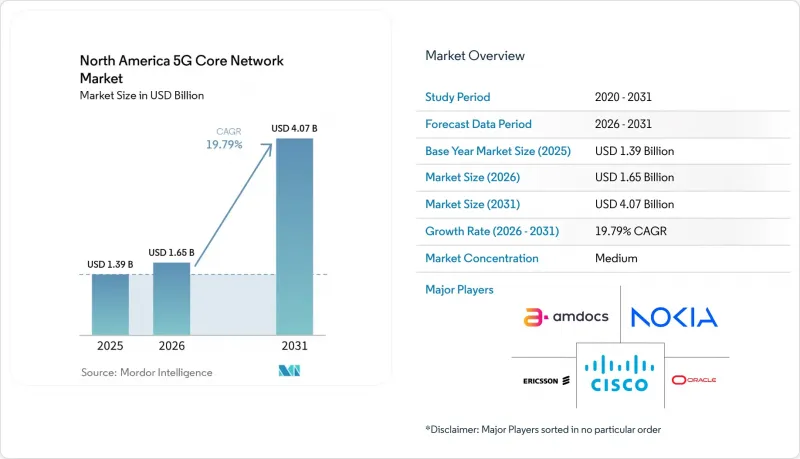
根據 Mordor Intelligence 預測,北美 5G 核心網路市場規模將從 2025 年的 13.9 億美元成長到 2026 年的 16.5 億美元,然後在 2031 年達到 40.7 億美元,2026 年至 2031 年的複合年成長率為 19.79%。
北美5G核心網路市場趨勢與洞察
獨立組網的5G部署正迎來轉捩點。
繼T-Mobile之後,AT&T和Verizon將於2025年下半年開始提供獨立組網(SA)核心網路,這意味著美國三大一級運營商都將提供具有商業性差異化的獨立組網服務。這一轉變加大了用戶遷移和業務開發向獨立組網架構過渡的壓力。 AT&T將其平台描述為一個開放的虛擬化架構,運作於微軟Azure和其自有資料中心之上。 2026年3月,VTel Wireless選擇愛立信作為其合作夥伴,共同建構支援端對端獨立組網VoNR(新空口語音)漫遊的雙模5G核心網和無線接取網路,服務遍及全美各地業者。這顯示北美5G核心網路市場正在向大型大都會圈業者以外的地區擴展。 ATIS指出,專用頻寬的稀缺以及從非獨立網路系統升級所帶來的經濟挑戰,是中小型業者面臨的重大障礙。
北美電信業者的雲端原生核心部署
對於主要區域營運商而言,雲端原生核心網路的採用正從策略目標逐步轉變為營運模式。該軟體可部署在與 Kubernetes 相容的基礎架構上,從而將軟體供應商、系統整合商和雲端平台供應商納入供應商體系。 2025 年 6 月,愛立信與Google雲端合作推出了「按需 5G 核心網路即服務」平台。 2025 年 3 月,Boost Mobile 在公共雲端上部署了諾基亞的雲端原生 5G 語音核心網,將多個 IMS 語音功能整合到單一的雲端原生網路功能中。 Mavenir 的一份報告顯示,82% 的受訪業者要不是已經在經營雲端原生核心網,就是計畫在 2026 年底前開始營運。因此,儘管北美 5G 核心網路市場存在更廣泛的部署模式,但營運商仍需要具備管理這些模式的技能。
核心網路現代化改造的初始成本很高
核心網路現代化正給所有電信業者(無論規模大小)帶來壓力,迫使其降低資本和營運成本。儘管本地和農村運營商的用戶較少,但他們往往面臨著與一級運營商相當的站點間整合成本。此外,在長達數年的過渡期內並行運行演進分組核心網 (EPCC) 和 5G 核心網協定棧,可能會推高遷移後的支援成本。墨西哥還面臨額外的不不確定性,因為國會正在製定年度頻率使用費。 AT&T 墨西哥公司已表示可能不會參與即將舉行的 5G 工業頻率競標。 Mavenir 的一項研究表明,獨立部署計劃取決於供應商能否提供可信賴的雲端原生核心網路遷移總擁有成本 (TCO) 證據。
細分市場分析
到2025年,解決方案將佔北美5G核心網路市場收入的63.55%。此領域包括封包核心網路軟體、網路功能虛擬化(NFV)基礎架構以及編配和管理平台。這一佔有率反映了AT&T、Verizon、T-Mobile、Bell、Rogers和Telus等公司在Tier 1獨立部署方面對軟體的投入。隨著營運商需要雲端原生網路功能來取代基於硬體的舊有系統,封包核心網路網路軟體仍然至關重要。
預計到2031年,北美5G核心網路服務市場將以21.21%的複合年成長率成長。此細分市場涵蓋整合與部署、諮詢與顧問以及支援與維護。儘管雲端原生獨立核心網路需要頻繁的軟體更新,但營運商在雲端原生運維方面仍面臨技能不足的問題。 2025年4月,愛立信同意為阿拉斯加的GCI通訊公司部署和營運雙模5G核心網,其中包括雲端核心技術、人工智慧工具和持續網路管理。隨著營運商逐步淘汰並行營運的演進分組核心網(EPC)系統,對支援和維護的需求預計將持續存在。
至2025年,本地部署/專用部署將佔北美5G核心網路市場收入的51.95%。營運商和企業在需要低延遲、資料處理合規性和基礎設施控制時,會選擇這種模式。專用部署在工廠環境中尤其重要,因為這些環境對服務等級要求非常嚴格。 Verizon的「智慧邊緣網路」策略體現了其對關鍵核心領域端到端所有權和L4級自主性的重視。
預計到2031年,北美5G核心網路市場的公共雲端將以24.76%的複合年成長率成長。 2025年10月,AT&T在微軟Azure部署了覆蓋全國的獨立核心網,為數億用戶運作了超過60個容器化網路功能。此次部署表明,公共雲端基礎設施能夠滿足一級運營商的規模和可靠性要求。愛立信的平台與Google雲端結合,為內部雲端工程能力有限的電信營運商提供了託管解決方案。混合雲和電信邊緣雲將本地編配與雲端原生編排相結合,已被證明對加拿大和墨西哥的中型電信業者非常有效,幫助他們取代傳統的封包核心網路系統。
其他好處:
- Excel格式的市場預測(ME)表
- 3個月的分析師支持
目錄
第1章:引言
- 研究假設和市場定義
- 調查範圍
第2章:調查方法
第3章執行摘要
第4章 市場狀況
- 市場概覽
- 市場促進因素
- 獨立組網5G的部署正迎來轉捩點。
- 北美電信營運商雲端原生核心採用情況
- 製造業和物流業對企業級專用 5G 的需求
- 關鍵任務服務的網路切片要求
- 開放式無線存取網和互通性計畫需要靈活的核心架構
- 實現人工智慧驅動的自動化和政策管理現代化
- 市場限制因素
- 初期階段對核心系統進行現代化改造的成本很高。
- 傳統EPC整合的複雜性
- 電信業雲端原生工程師短缺
- 安全、主權和合規性限制
- 產業價值鏈分析
- 監理情勢
- 技術展望
- PESTLE分析
- 波特五力分析
第5章 市場規模與成長預測
- 按組件
- 解決方案
- 封包核心網路軟體
- NFV基礎設施
- 編配與管理
- 服務
- 整合與部署
- 諮詢和顧問服務
- 支援與維護
- 解決方案
- 按部署模式
- 本地部署/專用
- 公共雲端
- 混合雲和運營商邊緣雲端
- 最終用戶
- 電信營運商
- 公司
- 製造業
- 能源公用事業
- 運輸/物流
- 公共安全和緊急情況
- 智慧城市和地方政府
- 網路功能
- 網路暴露函數(NEF)
- 使用者平面功能(UPF)
- 應用功能(AF)
- 統一資料管理(UDM)
- 會話管理功能 (SMF)
- 網路切片選擇函數(NSSF)
- 策略控制功能(PCF)
- 網路儲存庫功能(NRF)
- 認證伺服器功能(AUSF)
- 存取和移動性管理功能 (AMF)
- 國家
- 美國
- 加拿大
- 墨西哥
第6章 競爭情勢
- 市場集中度
- 策略趨勢
- 市佔率分析
- 公司簡介
- Telefonaktiebolaget LM Ericsson
- Nokia Corporation
- Microsoft Corporation
- Samsung Electronics Co. Ltd.
- Amdocs Limited
- Cisco Systems, Inc.
- Oracle Corporation
- Hewlett Packard Enterprise Company
- Mavenir Systems, Inc.
- NEC Corporation
- VMware, Inc.
- Juniper Networks, Inc.
- Ciena Corporation
- Ribbon Communications Inc.
- Casa Systems, Inc.
- Parallel Wireless, Inc.
- Druid Software Ltd.
- Intel Corporation
- F5, Inc.
第7章 市場機會與未來展望
According to Mordor Intelligence, the North America 5G core network market size is expected to grow from USD 1.39 billion in 2025 to USD 1.65 billion in 2026 and is forecast to reach USD 4.07 billion by 2031 at 19.79% CAGR over 2026-2031.
North America 5G Core Network Market Trends and Insights
Standalone 5G Rollouts Reach an Inflection Point
AT&T and Verizon launched standalone cores in late 2025, joining T-Mobile and giving all 3 United States Tier-1 carriers commercially differentiated standalone services. This shift increased pressure to move subscribers and service development onto standalone architectures. AT&T described its platform as an open, virtualized architecture that runs across Microsoft Azure and its own data centers. VTel Wireless selected Ericsson in March 2026 for a dual-mode 5G core and radio access network that supports end-to-end standalone Voice over New Radio roaming with nationwide providers. This demonstrates that the North America 5G core network market is extending beyond large urban carriers. ATIS identified limited dedicated spectrum and the remaining economics of non-standalone upgrades as important barriers for smaller carriers.
Cloud-Native Core Adoption Across North American Operators
Cloud-native core adoption has progressed from a strategic objective to an operating model among major regional operators. Software can be deployed on Kubernetes-compatible infrastructure, which broadens the supplier base to include software vendors, systems integrators, and cloud platform providers. Ericsson launched its On-Demand 5G Core-as-a-Service platform with Google Cloud in June 2025. Boost Mobile deployed Nokia's cloud-native 5G Voice Core on a public cloud in March 2025 and consolidated multiple IMS voice functions into 1 cloud-native network function. Mavenir reported that 82% of surveyed operators either operated cloud-native cores or planned to do so by the end of 2026. The North America 5G core network market, therefore, has a wider range of implementation models, but operators still need the skills to manage them.
High Upfront Core Modernization Costs
Core modernization places pressure on carriers of all sizes to reduce capital and operating costs. Regional and rural carriers often face similar per-site integration costs to those of Tier-1 operators, despite having smaller subscriber bases. Running Evolved Packet Core and 5G core stacks during a multi-year migration can also raise post-migration support costs. Mexico faces further uncertainty because Congress sets spectrum fees annually. AT&T Mexico indicated that it might not participate in the upcoming industrial 5G spectrum auction. Mavenir found that planned standalone adoption depends on vendors providing credible total cost of ownership evidence for cloud-native core migration.
Other drivers and restraints analyzed in the detailed report include:
- Enterprise Private 5G Demand in Manufacturing and Logistics
- Network Slicing Requirements for Mission-Critical Services
- Legacy EPC Integration Complexity
For complete list of drivers and restraints, kindly check the Table Of Contents.
Segment Analysis
Solutions accounted for 63.55% of the North America 5G core network market revenue in 2025. The segment includes packet-core software, network function virtualization infrastructure, and orchestration and management platforms. Its position reflected software-led spending on Tier-1 standalone buildouts by AT&T, Verizon, T-Mobile, Bell, Rogers, and Telus. Packet-core software remained central because operators need cloud-native network functions to replace hardware-based legacy systems.
Services in the North America 5G core network market are projected to expand at a 21.21% CAGR through 2031. The segment covers integration and deployment, consulting and advisory, and support and maintenance. Cloud-native standalone cores require frequent software updates, while operators continue to face a shortage of cloud-native operations skills. Ericsson agreed in April 2025 to deploy and operate a dual-mode 5G core for GCI Communication Corp in Alaska, including cloud-core technology, AI tools, and ongoing network management. Support and maintenance demand is expected to continue as operators retire parallel Evolved Packet Core systems.
On-Premise/Dedicated deployments accounted for 51.95% of North America's 5G core network market revenue in 2025. Operators and enterprises selected this model when they required low latency, data-handling compliance, and infrastructure control. Dedicated deployments are particularly relevant for factory environments with strict service-level requirements. Verizon's Intelligent Edge Network strategy reflects its preference for end-to-end ownership in critical core areas and Level 4 autonomy.
Public Cloud in the North America 5G core network market is projected to expand at a 24.76% CAGR through 2031. AT&T deployed its nationwide standalone core on Microsoft Azure in October 2025, running more than 60 containerized network functions for hundreds of millions of subscribers. This deployment demonstrated that public cloud infrastructure can meet Tier-1-scale and reliability requirements. Ericsson's platform with Google Cloud gives carriers a managed option when internal cloud engineering capacity is limited. Hybrid and Telco Edge Cloud combines local infrastructure with cloud-native orchestration and is relevant to mid-tier Canadian and Mexican operators, helping them replace legacy packet-core systems.
Complete Report Scope:
- By Component
- Solutions
- Packet-Core Software
- NFV Infrastructure
- Orchestration and Management
- Services
- Integration and Deployment
- Consulting and Advisory
- Support and Maintenance
- Solutions
- By Deployment Model
- On-Premise/Dedicated
- Public Cloud
- Hybrid and Telco Edge Cloud
- By End-User
- Telecom Operators
- Enterprises
- Manufacturing
- Energy and Utilities
- Transportation and Logistics
- Public Safety and Emergency
- Smart Cities and Municipalities
- By Network Function
- Network Exposure Function (NEF)
- User Plane Function (UPF)
- Application Function (AF)
- Unified Data Management (UDM)
- Session Management Function (SMF)
- Network Slice Selection Function (NSSF)
- Policy Control Function (PCF)
- Network Repository Function (NRF)
- Authentication Server Function (AUSF)
- Access and Mobility Management Function (AMF)
- By Country
- United States
- Canada
- Mexico
List of Companies Covered in this Report:
- Telefonaktiebolaget LM Ericsson
- Nokia Corporation
- Microsoft Corporation
- Samsung Electronics Co. Ltd.
- Amdocs Limited
- Cisco Systems, Inc.
- Oracle Corporation
- Hewlett Packard Enterprise Company
- Mavenir Systems, Inc.
- NEC Corporation
- VMware, Inc.
- Juniper Networks, Inc.
- Ciena Corporation
- Ribbon Communications Inc.
- Casa Systems, Inc.
- Parallel Wireless, Inc.
- Druid Software Ltd.
- Intel Corporation
- F5, Inc.
Additional Benefits:
- The market estimate (ME) sheet in Excel format
- 3 months of analyst support
TABLE OF CONTENTS
1 INTRODUCTION
- 1.1 Study Assumptions and Market Definition
- 1.2 Scope of the Study
2 RESEARCH METHODOLOGY
3 EXECUTIVE SUMMARY
4 MARKET LANDSCAPE
- 4.1 Market Overview
- 4.2 Market Drivers
- 4.2.1 Standalone 5G Rollouts Reaching Inflection Point
- 4.2.2 Cloud-Native Core Adoption Across North American Operators
- 4.2.3 Enterprise Private 5G Demand in Manufacturing and Logistics
- 4.2.4 Network Slicing Requirements for Mission-Critical Services
- 4.2.5 Open RAN and Interoperability Programs Requiring Flexible Core Architectures
- 4.2.6 AI-Driven Automation and Policy Control Modernization
- 4.3 Market Restraints
- 4.3.1 High Upfront Core Modernization Costs
- 4.3.2 Legacy EPC Integration Complexity
- 4.3.3 Cloud-Native Skills Shortage in Telecom Operations
- 4.3.4 Security, Sovereignty, and Compliance Constraints
- 4.4 Industry Value Chain Analysis
- 4.5 Regulatory Landscape
- 4.6 Technological Outlook
- 4.7 PESTLE Analysis
- 4.8 Porter's Five Forces Analysis
- 4.8.1 Threat of New Entrants
- 4.8.2 Bargaining Power of Buyers
- 4.8.3 Bargaining Power of Suppliers
- 4.8.4 Threat of Substitutes
- 4.8.5 Competitive Rivalry
5 MARKET SIZE AND GROWTH FORECASTS (VALUE)
- 5.1 By Component
- 5.1.1 Solutions
- 5.1.1.1 Packet-Core Software
- 5.1.1.2 NFV Infrastructure
- 5.1.1.3 Orchestration and Management
- 5.1.2 Services
- 5.1.2.1 Integration and Deployment
- 5.1.2.2 Consulting and Advisory
- 5.1.2.3 Support and Maintenance
- 5.1.1 Solutions
- 5.2 By Deployment Model
- 5.2.1 On-Premise/Dedicated
- 5.2.2 Public Cloud
- 5.2.3 Hybrid and Telco Edge Cloud
- 5.3 By End-User
- 5.3.1 Telecom Operators
- 5.3.2 Enterprises
- 5.3.2.1 Manufacturing
- 5.3.2.2 Energy and Utilities
- 5.3.2.3 Transportation and Logistics
- 5.3.2.4 Public Safety and Emergency
- 5.3.2.5 Smart Cities and Municipalities
- 5.4 By Network Function
- 5.4.1 Network Exposure Function (NEF)
- 5.4.2 User Plane Function (UPF)
- 5.4.3 Application Function (AF)
- 5.4.4 Unified Data Management (UDM)
- 5.4.5 Session Management Function (SMF)
- 5.4.6 Network Slice Selection Function (NSSF)
- 5.4.7 Policy Control Function (PCF)
- 5.4.8 Network Repository Function (NRF)
- 5.4.9 Authentication Server Function (AUSF)
- 5.4.10 Access and Mobility Management Function (AMF)
- 5.5 By Country
- 5.5.1 United States
- 5.5.2 Canada
- 5.5.3 Mexico
6 COMPETITIVE LANDSCAPE
- 6.1 Market Concentration
- 6.2 Strategic Moves
- 6.3 Market Share Analysis
- 6.4 Company Profiles (includes Global Level Overview, Market Level Overview, Core Segments, Financials as available, Strategic Information, Market Rank/Share, Products and Services, Recent Developments)
- 6.4.1 Telefonaktiebolaget LM Ericsson
- 6.4.2 Nokia Corporation
- 6.4.3 Microsoft Corporation
- 6.4.4 Samsung Electronics Co. Ltd.
- 6.4.5 Amdocs Limited
- 6.4.6 Cisco Systems, Inc.
- 6.4.7 Oracle Corporation
- 6.4.8 Hewlett Packard Enterprise Company
- 6.4.9 Mavenir Systems, Inc.
- 6.4.10 NEC Corporation
- 6.4.11 VMware, Inc.
- 6.4.12 Juniper Networks, Inc.
- 6.4.13 Ciena Corporation
- 6.4.14 Ribbon Communications Inc.
- 6.4.15 Casa Systems, Inc.
- 6.4.16 Parallel Wireless, Inc.
- 6.4.17 Druid Software Ltd.
- 6.4.18 Intel Corporation
- 6.4.19 F5, Inc.
7 MARKET OPPORTUNITIES AND FUTURE OUTLOOK
- 7.1 White-Space and Unmet-Need Assessment

 5G核心網市場:全球市場預測,2026-2032年
 5G核心網路市場報告:趨勢、預測與競爭分析(至2035年)
 開放網路部署準備:市場佔有率分析、產業趨勢與統計資料、成長預測(2026-2031 年)
 2026年全球政策控制功能(PCF)政策庫市場報告
 2026-2030年全球5G邊緣雲端網路服務市場中東地區5G核心網路:市場佔有率分析、產業趨勢與統計及成長預測(2026-2031年)亞太地區5G核心網路:市佔率分析、產業趨勢與統計及成長預測(2026-2031年)非洲5G核心網路:市場佔有率分析、產業趨勢與統計及成長預測(2026-2031年)南美洲5G核心網路:市場佔有率分析、產業趨勢與統計及成長預測(2026-2031年)歐洲 5G 核心網路:市場佔有率分析、產業趨勢和統計數據以及成長預測(2026-2031 年)