


 |
市場調查報告書
商品編碼
2119185
亞太地區5G核心網路:市佔率分析、產業趨勢與統計及成長預測(2026-2031年)Asia-Pacific 5G Core Network - Market Share Analysis, Industry Trends & Statistics, Growth Forecasts (2026 - 2031) |
||||||

※ 本網頁內容可能與最新版本有所差異。詳細情況請與我們聯繫。
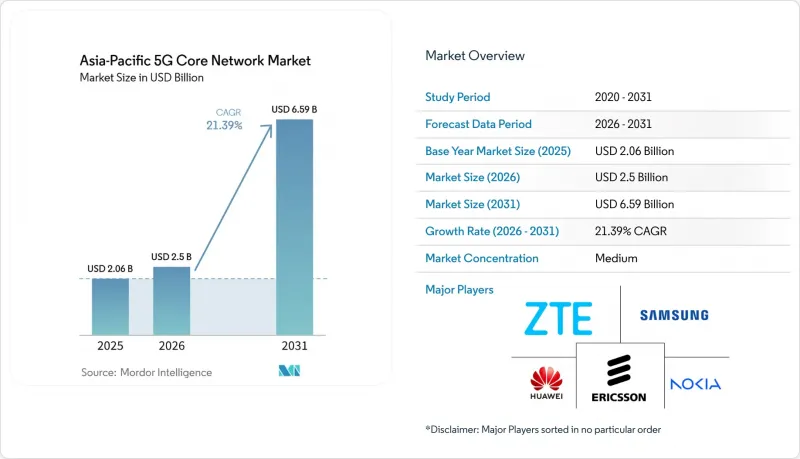
根據 Mordor Intelligence 預測,亞太地區的 5G 核心網路市場規模將從 2025 年的 20.6 億美元和 2026 年的 25 億美元成長到 2031 年的 65.9 億美元,2026 年至 2031 年的年複合成長率(CAGR)為 21.39%。
本報告按組件(解決方案和服務)、部署模式(本地/專用、公共雲端、混合雲和電信邊緣雲端)、最終用戶(電信運營商和企業)、網路功能(網路開放功能、用戶平面功能、應用功能、整合資料管理等)以及國家/地區進行細分。市場預測以價值(美元)表示。
亞太地區 5G 核心網路市場趨勢及洞察。
向 5G 獨立核心網的過渡正在加速。
在亞太地區的5G核心網路市場,營運商正從非獨立組網架構遷移到獨立組網架構,因為先進的5G服務需要獨立組網核心網。網路切片、私有網路和低延遲API等功能無法透過4G演進分組核心網路(EPC)得到充分利用。這項需求導致了大規模的軟體、基礎設施和整合專案遷移,需要在商用流量遷移之前,具備新的封包核心網路功能、生命週期管理工具、資料遷移、測試、安全檢驗和營運準備等條件。 NTT Docomo和NEC於2026年2月在AWS上推出了日本首個商用5G核心網。據兩家公司稱,人工智慧驅動的建設將部署時間縮短了80%,而採用AWS Graviton 2處理器則降低了70%的功耗。 Reliance Jio的獨立網路核心網將在2025年支援1.3億用戶,並處理該公司33%的總數據流量,這充分展現了遷移完成後所能達到的規模。
一級電信業者網路的雲端原生核心現代化
在亞太地區5G核心網路市場,雲端原生現代化已成為領先電信業者規劃未來網路營運的核心。容器化功能和自動化編配縮短了網路服務的部署和更新時間。 2026年3月,愛立信與Softbank Corporation簽署了一項多年協議,利用雲端原生雙模5G核心網路對其全國核心功能進行現代化改造。此專案涵蓋存取和行動管理、行動管理實體功能、語音閘道和策略控制。 2026年1月,TuneTalk與諾基亞合作完成了其雲端原生核心網路現代化改造的第一階段,成為東南亞首家大規模部署該架構的電信營運商。雖然這些部署鞏固了公共雲端供應商在核心網供應鏈中的地位,但從延遲、容錯或資料控制的角度來看,選擇哪些功能集中運作、哪些功能本地處理的責任仍然在於營運商。
前期整合成本高,投資回收期長。
一套完整的獨立核心系統方案需要投入資金用於軟體許可、雲端基礎設施、編配工具以及多年的整合服務。對於東南亞、亞太地區和南亞的小規模電信業者而言,這筆費用尤其沉重,因為它們的用戶平均收入(ARPU)較低,難以在正常的投資週期內承擔這些成本。涉及測試、多廠商編配以及真實流量遷移的整合工作可能占到專案成本的30%至40%。這些成本可能要到專案後期才會顯現,導致企業服務的上線延遲。託管服務和核心即服務(CoaaS)模式可以透過將部署和營運成本分攤到更長的周期來減輕這一負擔,但對於需要本地支援和可靠交付合作夥伴的營運商而言,這些模式在日本和澳洲以外的地區仍然難以獲得。
細分市場分析
預計到2025年,該解決方案將佔據亞太地區5G核心網市場61.19%的佔有率。此類別包括封包核心網路軟體、網路功能虛擬化(NFV)基礎架構以及編配和管理工具。封包核心網路軟體尤其重要,因為它允許營運商對單一功能進行許可,並在無需更換所有硬體層的情況下進行升級或擴展。存取和行動管理、會話管理以及使用者平面功能都是這些解耦功能的範例。商用伺服器和Kubernetes平台仍然是基礎設施堆疊的重要組成部分。然而,公共雲端合約正在將一些先前分配給本地平台的基礎設施投資轉移到公有雲。
在亞太地區5G核心網產業,服務市場預計到2031年將以23.44%的複合年成長率成長。此類別涵蓋整合和部署、諮詢和顧問服務以及支援和維護。整合仍然是印度新建獨立組網部署以及日本和韓國升級改造的主要服務活動。與傳統核心網的共存增加了這些項目的測試和流量切換工作。此外,缺乏內部先進雲端工程團隊的中型電信業者對諮詢服務的需求也不斷成長。因此,亞太地區5G核心網路市場的服務機會預計不僅在初始建設階段會擴大,而且隨著營運商管理和最佳化多廠商網路、調整自動化策略以及響應雲端原生環境中所需的定期軟體發布,服務機會也將持續成長。
預計到2025年,亞太地區5G核心網路市場規模中,本地部署和專用架構將佔51.69%。這一主導地位反映了中國一級電信營運商的規模以及他們對由國家主導的基礎設施項目管理的核心環境的偏好。中國移動、中國電信和中國聯通已在全國部署了獨立核心網路。華為和中興等國內廠商也為這些項目提供了支持。專用部署也適用於那些必須在自身環境中處理敏感資料和即時處理的電信業者。在主權要求嚴格且延遲保證對服務至關重要的情況下,這種模式仍然非常重要。
預計到2031年,公共雲端將以26.50%的複合年成長率成長。 NTT Docomo對AWS的商業部署,為該地區的同行提供了一個運營商級雲端託管核心功能的案例研究。 TuneTalk在馬來西亞使用AWS作為其控制平面,同時將其用戶平面保留在邊緣的AWS Outposts上。這種配置同時滿足了延遲和資料居住的要求。混合模式和營運商特定的邊緣模型在日本、韓國和澳洲也越來越受歡迎。這些模型使營運商能夠利用雲端容量來處理低延遲功能,同時保持企業服務的本地處理能力。
其他好處:
- Excel格式的市場預測(ME)表
- 3個月的分析師支持
目錄
第1章:引言
- 研究假設和市場定義
- 調查範圍
第2章:調查方法
第3章執行摘要
第4章 市場狀況
- 市場概覽
- 市場促進因素
- 向 5G 獨立核心網的過渡正在加速。
- 利用雲端原生核心對一級電信業者網路進行現代化改造
- 製造業和工業IoT。
- 透過專用網路和企業 API 擴大 5G 核心網路的商業化。
- 節能核心虛擬化和伺服器整合的需求日益成長
- 開放式無線接取網路和多廠商核心系統的採購趨勢
- 市場限制因素
- 前期整合成本高,投資回收期長。
- 由於與傳統EPC共存,導致延誤和遷移複雜性。
- 整體電信產業都面臨雲端原生人才短缺的問題。
- 跨境行動中與安全、主權和認證相關的摩擦
- 價值鏈分析
- 監理情勢
- 技術展望
- PESTLE分析
- 波特五力分析
第5章 市場規模與成長預測
- 按組件
- 解決方案
- 封包核心網路軟體
- NFV基礎設施
- 編配與管理
- 服務
- 整合與部署
- 諮詢和顧問服務
- 支援與維護
- 解決方案
- 按部署模式
- 本地部署/專用
- 公共雲端
- 混合雲和運營商邊緣雲端
- 最終用戶
- 電信營運商
- 公司
- 製造業
- 能源公用事業
- 運輸/物流
- 公共安全和緊急情況
- 智慧城市和地方政府
- 網路功能
- 網路暴露函數(NEF)
- 使用者平面功能(UPF)
- 應用功能(AF)
- 統一資料管理(UDM)
- 會話管理功能 (SMF)
- 網路切片選擇函數(NSSF)
- 策略控制功能(PCF)
- 網路儲存庫功能(NRF)
- 認證伺服器功能(AUSF)
- 存取和移動性管理 (AMF)
- 國家
- 中國
- 印度
- 日本
- 韓國
- 其他亞太國家
第6章 競爭情勢
- 市場集中度
- 策略趨勢
- 市佔率分析
- 公司簡介
- Telefonaktiebolaget LM Ericsson(publ)
- Huawei Technologies Co. Ltd.
- Nokia Corporation
- ZTE Corporation
- Samsung Electronics Co. Ltd.
- Mavenir Systems, Inc.
- Cisco Systems, Inc.
- Oracle Corporation
- NEC Corporation
- Hewlett Packard Enterprise Company
- Fujitsu Limited
- Druid Software Limited
- Athonet Srl
- Cumucore Oy
- Red Hat, Inc.
- Intel Corporation
- Ribbon Communications Inc.
- Radisys Corporation
第7章 市場機會與未來展望
According to Mordor Intelligence, the Asia-Pacific 5G core network market size is projected to expand from USD 2.06 billion in 2025 and USD 2.5 billion in 2026 to USD 6.59 billion by 2031, registering a CAGR of 21.39% between 2026 to 2031.
This report is Segmented by Component (Solutions, and Services), Deployment Model (On-Premises/Dedicated, Public Cloud, and Hybrid and Telco Edge Cloud), End-User (Telecom Operators, and Enterprises), Network Function (Network Exposure Function, User Plane Function, Application Function, Unified Data Management, and More), and Country. The Market Forecasts are Provided in Terms of Value (USD).
Asia-Pacific 5G Core Network Market Trends and Insights
Accelerated 5G Standalone Core Migration
Operators across the Asia-Pacific 5G core network market are moving away from non-standalone architecture because advanced 5G services require a standalone core. Network slicing, private networks, and low-latency APIs cannot offer their intended capabilities through a 4G Evolved Packet Core. This requirement turns migration into a broad software, infrastructure, and integration program, involving new packet-core functions, lifecycle tools, data migration, testing, security validation, and operational preparation before commercial traffic can be moved. NTT DOCOMO and NEC launched Japan's first commercial 5G core on AWS in February 2026. The companies said AI-based construction cut deployment time by 80%, and AWS Graviton2 processors reduced power consumption by 70%. Reliance Jio's standalone core supported 130 million users and carried 33% of its total data traffic in 2025, showing the scale available once a migration is complete.
Cloud-Native Core Modernization in Tier-1 Operator Networks
Cloud-native modernization has become central to how large operators in the Asia-Pacific 5G core network market plan future network operations. Containerized functions and automated orchestration can reduce the time required to deploy and update network services. Ericsson signed a multiyear agreement with SoftBank in March 2026 to modernize nationwide core functions with a cloud-native dual-mode 5G Core. The program covers access and mobility management, mobility management entity functions, voice gateways, and policy control. Tune Talk completed the first phase of its cloud-native core modernization with Nokia in January 2026, becoming the first Southeast Asian telecommunications operator to deploy the architecture at scale. These deployments place public cloud providers more firmly within the core network supply chain, while leaving operators responsible for selecting which functions can run centrally and which require local processing for latency, resilience, or data control.
High Upfront Integration Cost and Long Payback Cycles
Full standalone core programs require spending on software licenses, cloud infrastructure, orchestration tools, and multiyear integration services. This burden is particularly difficult for smaller operators in Southeast Asia, Pacific markets, and South Asia. Lower average revenue per user limits their ability to absorb the cost within normal investment cycles. Integration work for testing, multi-vendor orchestration, and live traffic migration can account for 30-40% of the project cost. These expenses can emerge late in the project and postpone the launch of enterprise services. Managed service and core-as-a-service models can reduce this pressure by spreading implementation and operating costs over a longer period, but availability outside Japan and Australia remains limited for operators that need local support and proven delivery partners.
Other drivers and restraints analyzed in the detailed report include:
- Network Slicing Demand from Manufacturing and Industrial IoT
- Private Networks and Enterprise API Monetization
- Legacy EPC Coexistence Delays and Migration Complexity
For complete list of drivers and restraints, kindly check the Table Of Contents.
Segment Analysis
Solutions are expected to hold 61.19% of the Asia-Pacific 5G core network market share in 2025. This category includes packet-core software, network functions virtualization infrastructure, and orchestration and management tools. Packet-core software is highly valuable because operators license separate functions that they can upgrade and scale without replacing every hardware layer. Access and mobility management, session management, and user plane functions are examples of these disaggregated functions. Commercial off-the-shelf servers and Kubernetes platforms remain important parts of the infrastructure stack. However, public-cloud contracts are taking on some infrastructure spending that previously went to owned platforms.
Services are projected to expand at a CAGR of 23.44% through 2031 within the Asia-Pacific 5G core network industry. This category covers integration and deployment, consulting and advisory work, and support and maintenance. Integration remains the main service activity for greenfield standalone deployments in India and upgrades in Japan and South Korea. Legacy core coexistence adds testing and traffic cutover work to these projects. Consulting demand is also rising among mid-tier operators that lack deep internal cloud engineering teams. Therefore, the service opportunity in the Asia-Pacific 5G core network market extends beyond the initial buildout, as operators manage and optimize multi-vendor networks, adjust automation policies, and handle regular software releases required in a cloud-native environment.
On-premises and dedicated architectures are expected to account for 51.69% of the Asia-Pacific 5G core network market size in 2025. Their lead reflects the scale of Chinese Tier-1 operators and the preference for controlled core environments under state-directed infrastructure programs. China Mobile, China Telecom, and China Unicom use standalone core deployments at a national scale. Domestic suppliers Huawei and ZTE have supported these programs. Dedicated installations also suit operators who must keep sensitive data and real-time processing within their own environments. This model remains important where sovereignty requirements are strict or latency guarantees are central to the service.
Public cloud is projected to expand at a CAGR of 26.50% through 2031. NTT DOCOMO's commercial AWS deployment gives regional peers a carrier-scale reference point for cloud-hosted core functions. Tune Talk uses AWS in Malaysia for its control plane while retaining its user plane locally on AWS Outposts at the edge. This arrangement addresses both latency and data residency requirements. Hybrid and telco edge models are also gaining traction in Japan, South Korea, and Australia. These models allow operators to use cloud capacity for less latency-sensitive functions while retaining local processing for enterprise services.
Complete Report Scope:
- By Component
- Solutions
- Packet-Core Software
- NFV Infrastructure
- Orchestration and Management
- Services
- Integration and Deployment
- Consulting and Advisory
- Support and Maintenance
- Solutions
- By Deployment Model
- On-Premise/Dedicated
- Public Cloud
- Hybrid and Telco Edge Cloud
- By End-User
- Telecom Operators
- Enterprises
- Manufacturing
- Energy and Utilities
- Transportation and Logistics
- Public Safety and Emergency
- Smart Cities and Municipalities
- By Network Function
- Network Exposure Function (NEF)
- User Plane Function (UPF)
- Application Function (AF)
- Unified Data Management (UDM)
- Session Management Function (SMF)
- Network Slice Selection Function (NSSF)
- Policy Control Function (PCF)
- Network Repository Function (NRF)
- Authentication Server Function (AUSF)
- Access and Mobility Management (AMF)
- By Country
- China
- India
- Japan
- South Korea
- Rest of Asia-Pacific
List of Companies Covered in this Report:
- Telefonaktiebolaget LM Ericsson (publ)
- Huawei Technologies Co. Ltd.
- Nokia Corporation
- ZTE Corporation
- Samsung Electronics Co. Ltd.
- Mavenir Systems, Inc.
- Cisco Systems, Inc.
- Oracle Corporation
- NEC Corporation
- Hewlett Packard Enterprise Company
- Fujitsu Limited
- Druid Software Limited
- Athonet S.r.l.
- Cumucore Oy
- Red Hat, Inc.
- Intel Corporation
- Ribbon Communications Inc.
- Radisys Corporation
Additional Benefits:
- The market estimate (ME) sheet in Excel format
- 3 months of analyst support
TABLE OF CONTENTS
1 INTRODUCTION
- 1.1 Study Assumptions and Market Definition
- 1.2 Scope of the Study
2 RESEARCH METHODOLOGY
3 EXECUTIVE SUMMARY
4 MARKET LANDSCAPE
- 4.1 Market Overview
- 4.2 Market Drivers
- 4.2.1 Accelerated 5G Standalone Core Migration
- 4.2.2 Cloud Native Core Modernization in Tier One Operator Networks
- 4.2.3 Deterministic Network Slicing Demand from Manufacturing and Industrial IoT
- 4.2.4 Rising 5G Core Monetization Through Private Networks and Enterprise APIs
- 4.2.5 Energy Efficient Core Virtualization and Server Consolidation Pressure
- 4.2.6 Open RAN and Multi-Vendor Core Procurement Shifts
- 4.3 Market Restraints
- 4.3.1 High Upfront Integration Cost and Long Payback Cycles
- 4.3.2 Legacy EPC Coexistence Delays and Migration Complexity
- 4.3.3 Cloud Native Talent Shortage Across Telecom Operations
- 4.3.4 Security, Sovereignty, and Certification Friction for Cross Border Deployments
- 4.4 Value Chain Analysis
- 4.5 Regulatory Landscape
- 4.6 Technological Outlook
- 4.7 PESTLE Analysis
- 4.8 Porter's Five Forces Analysis
- 4.8.1 Threat of New Entrants
- 4.8.2 Bargaining Power of Buyers
- 4.8.3 Bargaining Power of Suppliers
- 4.8.4 Threat of Substitutes
- 4.8.5 Competitive Rivalry
5 MARKET SIZE AND GROWTH FORECASTS (VALUE)
- 5.1 By Component
- 5.1.1 Solutions
- 5.1.1.1 Packet-Core Software
- 5.1.1.2 NFV Infrastructure
- 5.1.1.3 Orchestration and Management
- 5.1.2 Services
- 5.1.2.1 Integration and Deployment
- 5.1.2.2 Consulting and Advisory
- 5.1.2.3 Support and Maintenance
- 5.1.1 Solutions
- 5.2 By Deployment Model
- 5.2.1 On-Premise/Dedicated
- 5.2.2 Public Cloud
- 5.2.3 Hybrid and Telco Edge Cloud
- 5.3 By End-User
- 5.3.1 Telecom Operators
- 5.3.2 Enterprises
- 5.3.2.1 Manufacturing
- 5.3.2.2 Energy and Utilities
- 5.3.2.3 Transportation and Logistics
- 5.3.2.4 Public Safety and Emergency
- 5.3.2.5 Smart Cities and Municipalities
- 5.4 By Network Function
- 5.4.1 Network Exposure Function (NEF)
- 5.4.2 User Plane Function (UPF)
- 5.4.3 Application Function (AF)
- 5.4.4 Unified Data Management (UDM)
- 5.4.5 Session Management Function (SMF)
- 5.4.6 Network Slice Selection Function (NSSF)
- 5.4.7 Policy Control Function (PCF)
- 5.4.8 Network Repository Function (NRF)
- 5.4.9 Authentication Server Function (AUSF)
- 5.4.10 Access and Mobility Management (AMF)
- 5.5 By Country
- 5.5.1 China
- 5.5.2 India
- 5.5.3 Japan
- 5.5.4 South Korea
- 5.5.5 Rest of Asia-Pacific
6 COMPETITIVE LANDSCAPE
- 6.1 Market Concentration
- 6.2 Strategic Moves
- 6.3 Market Share Analysis
- 6.4 Company Profiles (includes Global Level Overview, Market Level Overview, Core Segments, Financials as available, Strategic Information, Market Rank/Share, Products and Services, Recent Developments)
- 6.4.1 Telefonaktiebolaget LM Ericsson (publ)
- 6.4.2 Huawei Technologies Co. Ltd.
- 6.4.3 Nokia Corporation
- 6.4.4 ZTE Corporation
- 6.4.5 Samsung Electronics Co. Ltd.
- 6.4.6 Mavenir Systems, Inc.
- 6.4.7 Cisco Systems, Inc.
- 6.4.8 Oracle Corporation
- 6.4.9 NEC Corporation
- 6.4.10 Hewlett Packard Enterprise Company
- 6.4.11 Fujitsu Limited
- 6.4.12 Druid Software Limited
- 6.4.13 Athonet S.r.l.
- 6.4.14 Cumucore Oy
- 6.4.15 Red Hat, Inc.
- 6.4.16 Intel Corporation
- 6.4.17 Ribbon Communications Inc.
- 6.4.18 Radisys Corporation
7 MARKET OPPORTUNITIES AND FUTURE OUTLOOK
- 7.1 White-Space and Unmet-Need Assessment

 5G核心網市場:全球市場預測,2026-2032年
 5G核心網路市場報告:趨勢、預測與競爭分析(至2035年)
 2026年全球政策控制功能(PCF)政策庫市場報告
 2026-2030年全球5G邊緣雲端網路服務市場
 中東地區5G核心網路:市場佔有率分析、產業趨勢與統計及成長預測(2026-2031年)非洲5G核心網路:市場佔有率分析、產業趨勢與統計及成長預測(2026-2031年)南美洲5G核心網路:市場佔有率分析、產業趨勢與統計及成長預測(2026-2031年)歐洲 5G 核心網路:市場佔有率分析、產業趨勢和統計數據以及成長預測(2026-2031 年)
 2026 年 5G SA 核心網、SDM 和策略市場報告:全球分析及至 2031 年的預測
 5G網路基礎設施,全球市場,2026-2030年