


 |
市場調查報告書
商品編碼
2119154
南美洲5G核心網路:市場佔有率分析、產業趨勢與統計及成長預測(2026-2031年)South America 5G Core Network - Market Share Analysis, Industry Trends & Statistics, Growth Forecasts (2026 - 2031) |
||||||

※ 本網頁內容可能與最新版本有所差異。詳細情況請與我們聯繫。
據 Mordor Intelligence 稱,南美 5G 核心網路市場預計到 2025 年價值 3.1011 億美元,高於 2026 年的 3.7014 億美元,預計到 2031 年將達到 9.0111 億美元,複合年成長率為 19.48%。
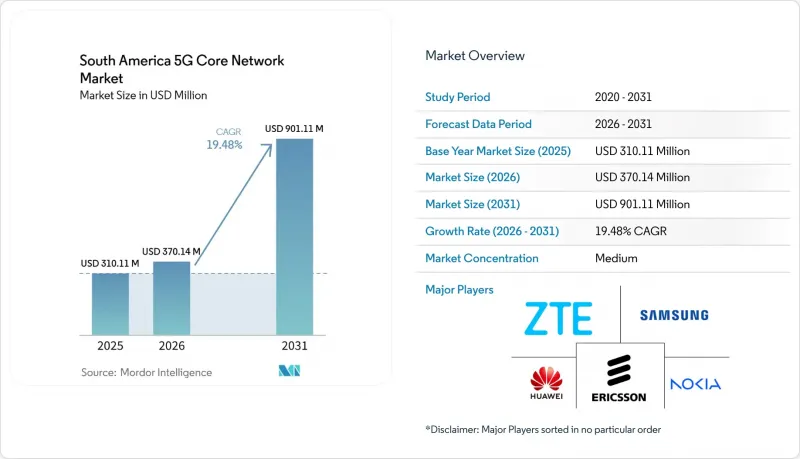
本報告按組件(解決方案和服務)、部署模式(本地/專用、公共雲端、混合雲和電信邊緣雲端)、最終用戶(電信運營商和企業)、網路功能(網路開放功能、用戶平面功能、應用功能、整合資料管理等)以及國家/地區進行細分。市場預測以價值(美元)表示。
南美洲5G核心網路市場趨勢與洞察
5G獨立組網部署的擴展正在推動南美5G核心網路市場的需求。
巴西獨立組網(SA)5G的部署進度領先於區域引進週期,是核心網路需求的主要來源。 2026年3月,巴西政府宣布,到2026年底,巴西80%的人口將接入5G網路,覆蓋範圍將擴展到超過2,220個城市。為實現此覆蓋率,電信業者需要不斷擴展獨立組網容量及相關軟體。因此,南美洲5G核心網路市場不僅受惠於消費者需求的短期變化,也受惠於與監理里程碑相關的採購活動。此外,部署速度本身也能為服務供應商帶來業務,因為終端可用性、認證以及企業用例的建立都需要時間。這些因素共同促成了對部署、測試、營運和維護的持續投資。
電信業者從傳統EPC架構向雲端原生核心架構的轉型
電信業者正從傳統的演進封包核心網路(EPC) 平台遷移到能夠支援 5G 獨立組網 (SA) 服務的雲端原生核心網路系統。 AMD 的報告顯示,到 2025 年,33% 的受訪業者已將其大部分 5G 核心網路功能遷移到雲端原生基礎設施,另有 30% 的營運商計劃在 2026 年底前完成遷移。這種遷移需要新的軟體、虛擬化基礎架構和能夠處理分散式網路功能的操作方法。西班牙電信 (Telefónica) 和 AWS 為 Vivo 展示了一種 5G 獨立組網核心網配置,該配置利用了 Mavenir、諾基亞和Oracle 的網路能力,涵蓋雲端和營運商的基礎設施。這種多廠商模式凸顯了整合能力在拉丁美洲 5G 核心網市場日益成長的重要性。它還允許營運商集中控制功能,同時將對效能要求較高的功能部署在更靠近使用者的位置。
5G獨立組網頻段準備工作的延遲和部署計劃的變更
除巴西以外,各國的頻段準備情況不盡相同,導致部分國家獨立組網(SA)核心網投資啟動延遲。在阿根廷,截至2026年3月底,雖然已部署約2,300個5G基地台,但企業對SA服務的商業化仍處於早期階段。南美洲5G核心網路市場受到影響,因為當無線網路部署、頻段存取和商業需求未能同步發展時,核心網路升級的合理性難以充分論證。玻利維亞直到2026年才開始5G頻段分配,顯示該國的投資週期仍處於早期階段。安第斯山脈和拉普拉塔河地區的一些市場也優先考慮在啟動大規模SA計畫之前提高4G基地台密度。這些差異導致該地區需求不平衡,使得短期機會集中在頻段條件較為明朗的國家。
細分市場分析
預計到2025年,該解決方案將佔據南美洲5G核心網市場61.45%的佔有率。這反映出營運商需要在擴展服務層之前部署底層獨立軟體。封包核心網路軟體已成為核心價值類別,因為它支援獨立架構所需的核心流量和控制功能。網路功能虛擬化(NFV)基礎架構也發揮著至關重要的作用,它為虛擬化功能提供運算環境。編配和管理工具可協助營運商協調這些功能在分散式位置的運作。 vivo的雲端部署概念驗證表明,來自Mavenir、諾基亞和Oracle的核心功能可以在公共雲端基礎設施和運營商資料中心運行。此類部署清楚地說明了為什麼在採購解決方案時通常會有多家基礎設施和軟體供應商參與。
獨立網路的部署基礎設施需要部署、整合、支援和維護,預計到2031年,服務市場將以21.39%的複合年成長率成長。電信業者在將功能從傳統平台遷移到虛擬化環境時需要整合和部署服務。核心網路上運作後,由於營運商必須維護網路的可用性、安全性和效能,支援合約變得日益重要。諮詢和顧問服務還有助於確保OSS和BSS的一致性、設計網路切片以及實現應用程式介面(API)的貨幣化。因此,即使在初始軟體部署之後,南美洲的5G核心網路市場也能持續產生業務收益。這一趨勢降低了對單一平台銷售初始投資的依賴,並提升了本地交付能力的價值。
電信業者需要資料控制、用戶平面低延遲以及符合特定產業要求,因此預計到2025年,本地部署和專用系統將佔總收入的52.21%。這種模式在能源、公共安全以及其他需要可預測本地效能的應用領域仍然至關重要。當雲端可用性仍然有限或資料居住要求阻礙了完全部署到公共雲端時,電信業者通常也會採用這種模式。本地部署使得使用者平面處理能夠靠近無線網路和企業應用。南美洲5G核心網路市場規模在此模式下反映了目前對可靠流量管理和營運控制的重視。這也反映出許多電信業者正在逐步部署雲端原生系統,而不是一次性替換現有平台。
在南美洲5G核心網路市場,混合雲和電信邊緣雲端的採用預計將在2031年前以20.27%的複合年成長率成長。混合雲和電信邊緣雲端結合了集中式雲端能力和基於邊緣的用戶平面容量。 vivo的概念驗證(PoC)表明,5G獨立組網(SA)核心網功能既可以在AWS基礎設施上運作,也可以在運營商自有資料中心運行。這種方法允許將對延遲敏感的處理任務保留在靠近工業現場的位置,而其他功能則可以利用集中式雲端資源。雖然公共雲端的採用也在不斷推進,但營運商仍在密切關注高容量用戶平面工作負載的相關成本。邊緣運算和網路切片標準為這些設計選擇提供了通用的技術基礎。隨著企業對低延遲、基於位置的連接的需求日益成長,這種部署模式的重要性也與日俱增。
其他好處:
- Excel格式的市場預測(ME)表
- 3個月的分析師支持
目錄
第1章:引言
- 研究假設和市場定義
- 調查範圍
第2章:調查方法
第3章執行摘要
第4章 市場狀況
- 市場概覽
- 市場促進因素
- 南美洲主要電信業者擴大5G獨立網路部署
- 電信業者從傳統EPC向雲端原生核心架構的轉型。
- 網路切片的需求源自於企業和公共部門的應用場景。
- 公共部門數位化計畫正在加速對 5G 核心網路的投資。
- 面向低延遲工業連接的多接入邊緣整合
- 以供應商為主導的策略,結合開放式無線接取網路和核心網路現代化。
- 市場限制因素
- 5G獨立組網頻段準備工作出現延誤,部署計畫也有差異。
- 與現有 4G 和傳統 OSS/BSS 協定棧整合的複雜度。
- 外匯波動對核心網路基礎設施的採購造成多年影響。
- 除一級業者外,其他電信業者的資本投資有限。
- 價值鏈分析
- 監理情勢
- 技術展望
- PESTLE分析
- 波特五力分析
第5章 市場規模與成長預測
- 按組件
- 解決方案
- 封包核心網路軟體
- NFV基礎設施
- 編配與管理
- 服務
- 整合與部署
- 諮詢和顧問服務
- 支援與維護
- 解決方案
- 按部署模式
- 本地部署/專用
- 公共雲端
- 混合雲和運營商邊緣雲端
- 最終用戶
- 電信營運商
- 公司
- 製造業
- 能源公用事業
- 運輸/物流
- 公共安全和緊急情況
- 智慧城市和地方政府
- 網路功能
- 網路暴露函數(NEF)
- 使用者平面功能(UPF)
- 應用功能(AF)
- 統一資料管理(UDM)
- 會話管理功能 (SMF)
- 網路切片選擇函數(NSSF)
- 策略控制功能(PCF)
- 網路儲存庫功能(NRF)
- 認證伺服器功能(AUSF)
- 存取和移動性管理 (AMF)
- 國家
- 巴西
- 阿根廷
- 其他南美國家
第6章 競爭情勢
- 市場集中度
- 策略趨勢
- 市佔率分析
- 公司簡介
- Ericsson
- Nokia
- Huawei Technologies Co., Ltd.
- ZTE Corporation
- Samsung Electronics Co., Ltd.
- Mavenir Systems, Inc.
- Oracle Corporation
- Cisco Systems, Inc.
- Hewlett Packard Enterprise Development LP
- Dell Technologies Inc.
- Red Hat, Inc.
- NEC Corporation
- Juniper Networks, Inc.
- Amdocs Limited
- Comarch SA
- IBM Corporation
- HCLTech
- Tech Mahindra Limited
第7章 市場機會與未來展望
According to Mordor Intelligence, the South America 5G core network market size was valued at USD 310.11 million in 2025 and is estimated to increase from USD 370.14 million in 2026 to reach USD 901.11 million by 2031, at a CAGR of 19.48% during the forecast period (2026-2031).
This report is Segmented by Component (Solutions, and Services), Deployment Model (On-Premises/Dedicated, Public Cloud, and Hybrid and Telco Edge Cloud), End-User (Telecom Operators, and Enterprises), Network Function (Network Exposure Function, User Plane Function, Application Function, Unified Data Management, and More), and Country. The Market Forecasts are Provided in Terms of Value (USD).
South America 5G Core Network Market Trends and Insights
Rising 5G Standalone Rollouts Driving South America 5G Core Network Market Demand
Brazil's standalone rollout has put it ahead of the regional deployment cycle and made it the primary source of core network demand. The government stated in March 2026 that 80% of Brazil's population is expected to have 5G access by the end of 2026, with coverage in more than 2,220 municipalities. These coverage commitments require operators to keep adding standalone capacity and related software. The South America 5G core network market, therefore, benefits from procurement that is tied to regulatory milestones, not only to short-term changes in consumer demand. The pace of rollout can also create work for service providers when device availability, certification, and enterprise use cases take longer to develop. This combination supports continued spending on deployment, testing, operations, and maintenance.
Operator Shift from Legacy EPC to Cloud-Native Core Architectures
Operators are moving from older evolved packet core platforms toward cloud-native core systems that can support 5G standalone services. AMD reported that 33% of surveyed operators had already placed most 5G core functions on cloud-native infrastructure in 2025, while another 30% targeted completion by the end of 2026. The change requires new software, virtualized infrastructure, and operating practices capable of handling distributed network functions. Telefonica and AWS demonstrated a 5G standalone core configuration for Vivo that used network functions from Mavenir, Nokia, and Oracle across cloud and operator facilities. This type of multi-vendor model raises the importance of integration skills in the South America 5G core network market. It also allows operators to centralize control functions while keeping performance-sensitive functions closer to users.
Delayed Spectrum Readiness and Uneven 5G Standalone Timelines
Spectrum readiness outside Brazil remains uneven, which slows the start of standalone core investment in several countries. Argentina had around 2,300 5G sites by the end of March 2026, but enterprise monetization of standalone services was still in its early stages. The South America 5G core network market is affected because a core upgrade becomes more difficult to justify when radio deployment, spectrum access, and business demand do not advance together. Bolivia began its 5G spectrum award process in 2026, indicating that its investment cycle is still in its early stages. Some Andean and River Plate markets are also focused on 4G densification before larger standalone programs begin. These differences make regional demand less uniform and concentrate near-term opportunities in countries with clearer spectrum conditions.
Other drivers and restraints analyzed in the detailed report include:
- Network Slicing Demand from Enterprise and Public Sector Use Cases
- Public Sector Digitalization Programs Accelerating 5G Core Investment
- High Integration Complexity with Existing 4G and Legacy OSS/BSS Stacks
For complete list of drivers and restraints, kindly check the Table Of Contents.
Segment Analysis
Solutions are expected to hold 61.45% of the South America 5G core network market share in 2025, reflecting the need to deploy foundational standalone software before operators expand service layers. Packet-core software represents the central value category because it supports the core traffic and control functions required for a standalone architecture. Network function virtualization infrastructure also plays an important role by providing the computing environment for virtualized functions. Orchestration and management tools help operators coordinate these functions across distributed locations. Vivo's cloud deployment demonstration showed that core functions from Mavenir, Nokia, and Oracle could operate across public cloud infrastructure and operator data centers. Such deployments show why solution purchases often involve multiple infrastructure and software suppliers.
Services are projected to expand at a 21.39% CAGR through 2031 as the installed base of standalone networks requires deployment, integration, support, and maintenance. Operators need integration and deployment services when they move functions from legacy platforms to virtualized environments. Support contracts become more important after a core goes live, as operators must maintain availability, security, and performance. Consulting and advisory services also support OSS and BSS alignment, network slice design, and application programming interface monetization. Therefore, the South America 5G core network market can generate recurring service revenue after the initial software implementation. This pattern reduces reliance on a single upfront platform sale and increases the value of local delivery capabilities.
On-premises and dedicated systems are expected to account for 52.21% of revenue in 2025, as operators require data control, low user-plane latency, and compliance with sector-specific requirements. This model remains relevant for energy, public safety, and other applications that require predictable local performance. Operators also commonly use this model when cloud availability remains limited, or data residency requirements discourage full public cloud deployment. Local deployments can keep user plane processing close to the radio network and enterprise applications. The South America 5G core network market size for this model reflects the current priority placed on reliable traffic management and operational control. It also reflects that many operators are gradually introducing cloud-native systems rather than replacing every existing platform at once.
Hybrid and telco edge cloud deployment is projected to expand at a 20.27% CAGR through 2031 in the South America 5G core network market, as it combines centralized cloud functions with edge-based user-plane capacity. Vivo's proof of concept showed that 5G standalone core functions could operate across AWS infrastructure and operator-owned data centers. This approach can keep latency-sensitive processing close to industrial sites while allowing other functions to use centralized cloud resources. Public cloud adoption is also advancing, although operators continue to assess costs for high-volume user-plane workloads. Standards covering edge computing and network slicing provide a common technical basis for these design choices. The deployment model is becoming increasingly important as enterprises seek low-latency, location-sensitive connectivity.
Complete Report Scope:
- By Component
- Solutions
- Packet-Core Software
- NFV Infrastructure
- Orchestration and Management
- Services
- Integration and Deployment
- Consulting and Advisory
- Support and Maintenance
- Solutions
- By Deployment Model
- On-Premise/Dedicated
- Public Cloud
- Hybrid and Telco Edge Cloud
- By End-User
- Telecom Operators
- Enterprises
- Manufacturing
- Energy and Utilities
- Transportation and Logistics
- Public Safety and Emergency
- Smart Cities and Municipalities
- By Network Function
- Network Exposure Function (NEF)
- User Plane Function (UPF)
- Application Function (AF)
- Unified Data Management (UDM)
- Session Management Function (SMF)
- Network Slice Selection Function (NSSF)
- Policy Control Function (PCF)
- Network Repository Function (NRF)
- Authentication Server Function (AUSF)
- Access and Mobility Management (AMF)
- By Country
- Brazil
- Argentina
- Rest of South America
List of Companies Covered in this Report:
- Ericsson
- Nokia
- Huawei Technologies Co., Ltd.
- ZTE Corporation
- Samsung Electronics Co., Ltd.
- Mavenir Systems, Inc.
- Oracle Corporation
- Cisco Systems, Inc.
- Hewlett Packard Enterprise Development LP
- Dell Technologies Inc.
- Red Hat, Inc.
- NEC Corporation
- Juniper Networks, Inc.
- Amdocs Limited
- Comarch SA
- IBM Corporation
- HCLTech
- Tech Mahindra Limited
Additional Benefits:
- The market estimate (ME) sheet in Excel format
- 3 months of analyst support
TABLE OF CONTENTS
1 INTRODUCTION
- 1.1 Study Assumptions and Market Definition
- 1.2 Scope of the Study
2 RESEARCH METHODOLOGY
3 EXECUTIVE SUMMARY
4 MARKET LANDSCAPE
- 4.1 Market Overview
- 4.2 Market Drivers
- 4.2.1 Rising 5G Standalone Rollouts Across Major South American Networks
- 4.2.2 Operator Shift From Legacy EPC to Cloud Native Core Architectures
- 4.2.3 Network Slicing Demand From Enterprise and Public Sector Use Cases
- 4.2.4 Public Sector Digitalization Programs Accelerating 5G Core Investment
- 4.2.5 Multi-Access Edge Integration for Low Latency Industrial Connectivity
- 4.2.6 Vendor Open RAN and Core Modernization Bundling Strategies
- 4.3 Market Restraints
- 4.3.1 Delayed Spectrum Readiness and Uneven 5G Standalone Timelines
- 4.3.2 High Integration Complexity With Existing 4G and Legacy OSS BSS Stacks
- 4.3.3 Currency Volatility Affecting Multi-Year Core Network Procurement
- 4.3.4 Limited Telecom Capex Outside Tier-1 Operators
- 4.4 Value Chain Analysis
- 4.5 Regulatory Landscape
- 4.6 Technological Outlook
- 4.7 PESTLE Analysis
- 4.8 Porter's Five Forces Analysis
- 4.8.1 Threat of New Entrants
- 4.8.2 Bargaining Power of Buyers
- 4.8.3 Bargaining Power of Suppliers
- 4.8.4 Threat of Substitutes
- 4.8.5 Competitive Rivalry
5 MARKET SIZE AND GROWTH FORECASTS (VALUE)
- 5.1 By Component
- 5.1.1 Solutions
- 5.1.1.1 Packet-Core Software
- 5.1.1.2 NFV Infrastructure
- 5.1.1.3 Orchestration and Management
- 5.1.2 Services
- 5.1.2.1 Integration and Deployment
- 5.1.2.2 Consulting and Advisory
- 5.1.2.3 Support and Maintenance
- 5.1.1 Solutions
- 5.2 By Deployment Model
- 5.2.1 On-Premise/Dedicated
- 5.2.2 Public Cloud
- 5.2.3 Hybrid and Telco Edge Cloud
- 5.3 By End-User
- 5.3.1 Telecom Operators
- 5.3.2 Enterprises
- 5.3.2.1 Manufacturing
- 5.3.2.2 Energy and Utilities
- 5.3.2.3 Transportation and Logistics
- 5.3.2.4 Public Safety and Emergency
- 5.3.2.5 Smart Cities and Municipalities
- 5.4 By Network Function
- 5.4.1 Network Exposure Function (NEF)
- 5.4.2 User Plane Function (UPF)
- 5.4.3 Application Function (AF)
- 5.4.4 Unified Data Management (UDM)
- 5.4.5 Session Management Function (SMF)
- 5.4.6 Network Slice Selection Function (NSSF)
- 5.4.7 Policy Control Function (PCF)
- 5.4.8 Network Repository Function (NRF)
- 5.4.9 Authentication Server Function (AUSF)
- 5.4.10 Access and Mobility Management (AMF)
- 5.5 By Country
- 5.5.1 Brazil
- 5.5.2 Argentina
- 5.5.3 Rest of South America
6 COMPETITIVE LANDSCAPE
- 6.1 Market Concentration
- 6.2 Strategic Moves
- 6.3 Market Share Analysis
- 6.4 Company Profiles (includes Global Level Overview, Market Level Overview, Core Segments, Financials as available, Strategic Information, Market Rank/Share, Products and Services, Recent Developments)
- 6.4.1 Ericsson
- 6.4.2 Nokia
- 6.4.3 Huawei Technologies Co., Ltd.
- 6.4.4 ZTE Corporation
- 6.4.5 Samsung Electronics Co., Ltd.
- 6.4.6 Mavenir Systems, Inc.
- 6.4.7 Oracle Corporation
- 6.4.8 Cisco Systems, Inc.
- 6.4.9 Hewlett Packard Enterprise Development LP
- 6.4.10 Dell Technologies Inc.
- 6.4.11 Red Hat, Inc.
- 6.4.12 NEC Corporation
- 6.4.13 Juniper Networks, Inc.
- 6.4.14 Amdocs Limited
- 6.4.15 Comarch SA
- 6.4.16 IBM Corporation
- 6.4.17 HCLTech
- 6.4.18 Tech Mahindra Limited
7 MARKET OPPORTUNITIES AND FUTURE OUTLOOK
- 7.1 White-Space and Unmet-Need Assessment

 5G核心網市場:全球市場預測,2026-2032年
 5G核心網路市場報告:趨勢、預測與競爭分析(至2035年)
 2026年全球政策控制功能(PCF)政策庫市場報告
 2026-2030年全球5G邊緣雲端網路服務市場
 中東地區5G核心網路:市場佔有率分析、產業趨勢與統計及成長預測(2026-2031年)亞太地區5G核心網路:市佔率分析、產業趨勢與統計及成長預測(2026-2031年)非洲5G核心網路:市場佔有率分析、產業趨勢與統計及成長預測(2026-2031年)歐洲 5G 核心網路:市場佔有率分析、產業趨勢和統計數據以及成長預測(2026-2031 年)
 2026 年 5G SA 核心網、SDM 和策略市場報告:全球分析及至 2031 年的預測
 5G網路基礎設施,全球市場,2026-2030年