


 |
市場調查報告書
商品編碼
2157047
歐洲基於AIOps的電信網路:市場佔有率分析、產業趨勢和統計數據以及成長預測(2026-2031年)Europe AIOps For Telecom Networks - Market Share Analysis, Industry Trends & Statistics, Growth Forecasts (2026 - 2031) |
||||||

※ 本網頁內容可能與最新版本有所差異。詳細情況請與我們聯繫。
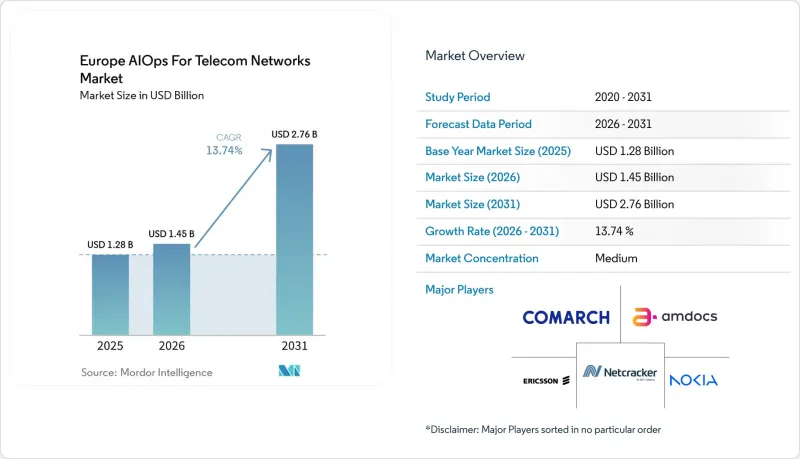
據 Mordor Intelligence 稱,2025 年歐洲電信網路 AIOps 市值為 12.8 億美元,預計到 2031 年將從 2026 年的 14.5 億美元成長至 27.6 億美元,預測期(2026-2031 年)複合年成長率為 13.74%。
歐洲電信網路AIOps市場的趨勢與洞察
5G 和多廠商網路的日益複雜化正在加速平台部署。
歐洲電信網路AIOps市場正受惠於5G獨立組網(SA)模式的部署,這導致需要管理的系統營運商數量增加。在大都會圈5G無線接取網路中,不同的供應商可能負責不同的無線存取、分散式網路、集中式網路和核心網路功能。每個系統產生的遙測資料都具有不同的模式、更新周期和運行優先權。傳統的營運支援系統是為更集中的單一供應商環境設計的。 AIOps平台能夠關聯跨網路域的這些資料流,幫助營運商更早辨識相關事件。雖然O-RAN聯盟規範(包括E2介面和xApp框架)提供了與第三方應用程式的整合點,但商業化的Open RAN部署仍需要大規模的系統整合來實現封閉回路型控制。
降低網路營運成本和平均恢復時間 (MTTR) 的壓力
隨著每用戶收入停滯不前,而5G相關支出卻不斷攀升,歐洲電信業者正優先考慮降低網路營運成本。德國電信於2025年11月在德國推出了“RAN Guardian Agent”,旨在支援關鍵事件管理。據該公司稱,該系統已將關鍵事件的處理時間從數小時縮短至一分鐘。此外,在營運的第一個月,該系統在聖誕節市場期間就執行了100多項糾正措施。這些營運成果表明,歐洲電信網路的AIOps市場正吸引那些尋求減少人工干預的營運商的注意。此外,NIS2報告要求凸顯了快速故障偵測的重要性,因為受影響的營運商必須在24小時內發布預警,並在72小時內提交最終報告。
傳統開源軟體的資料孤島和整合複雜性限制了跨領域人工智慧的有效性。
數據可用性仍然是歐洲電信網路AIOps市場面臨的根本性挑戰。許多歐洲業者使用過去10到20年間開發的、廠商特定且領域隔離的管理系統。這些系統並非設計用於在無線、傳輸、核心和服務層之間共用遙測資料。為AI準備數據需要先進行攝取、標準化和整合,模型才能提供可靠的結果。不完整或片段化的遙測資料會增加誤報成本和可觀測性,從而削弱部署的營運合理性。對於無法像一級營運商那樣分配足夠整合預算的中型營運商而言,這一負擔更為沉重,導致部署能力有明顯差距。
細分市場分析
到了2025年,該平台佔據歐洲電信網路AIOps市場64.88%的佔有率。領先的一級營運商已將平台授權整合到營運支援系統中多年。這些合約鞏固了該平台作為保障和自動化工作負載核心基礎設施的地位。預計到2031年,服務市場將以16.08%的複合年成長率成長。這一成長率反映了對託管服務、專業服務和系統整合日益成長的需求。區域運營商傾向於選擇將實施責任委託給經驗豐富的供應商的合約。
在歐洲電信網路AIOps市場,此趨勢在南歐和東歐最為顯著。這些市場的許多電信業者內部AI工程資源有限,同時也要管理傳統的營運系統。基於結果的交付模式可以降低大規模平台部署的風險,並為營運商提供專業的整合支援。它也免去了營運商自行組裝各種工具和服務的麻煩,並將部署工作與明確定義的營運成果掛鉤。諾基亞在2025年推出了「自主網路架構」(Autonomous Network Fabric),並透過與Google雲端的整合擴展了其雲端交付選項。這表明,供應商正在將軟體平台和營運服務結合起來,而不是將它們作為單獨的選項提供。在歐洲電信網路AIOps市場,這種交付方式可望使營運商在需要自動化軟體以外的技術支援時,也能順利完成部署。
至2025年,本地部署將佔歐洲電信網路AIOps市場58.25%的佔有率。數據主權要求是推動歐洲一級電信業者趨勢的主要因素。此外,某些閉合迴路無線電功能需要極低的延遲,而公共雲端點可能無法一致地滿足此要求。預計到2031年,基於雲端的部署將以17.21%的複合年成長率成長。成長最快的領域包括非即時網路分析、規劃、客戶體驗和能源管理功能。
公共雲端環境為時間限制相對靈活的用例提供可擴展的運算資源和現成的AI工具。諾基亞計畫於2026年9月在Google雲端市場以軟體即服務(SaaS)的形式推出其「保障中心」。愛立信於2026年2月在AWS市場發布了「代理應用即服務」。這些案例表明,主要的電信設備供應商將雲端交付視為實現新應用普及的關鍵途徑。同時,歐盟人工智慧法律法規和NIS2資料居住要求正在推動混合雲端和主權雲的設計。這些設計允許工作負載更靠近網路資料運作,同時保留雲端採用的部分優勢。這種平衡對於歐洲電信網路AIOps市場至關重要,因為即時控制要求會因網路能力和營運商環境的不同而存在顯著差異。
其他好處:
- Excel格式的市場預測(ME)表
- 3個月的分析師支持
目錄
第1章:引言
- 研究假設和市場定義
- 調查範圍
第2章:調查方法
第3章執行摘要
第4章 市場狀況
- 市場概覽
- 市場促進因素
- 5G和多廠商網路的複雜性
- 降低網路營運成本和縮短平均恢復時間的壓力。
- 對預測性網路保障和顧客體驗管理的需求
- 自主網路和閉合迴路標準的擴展
- 分散式開放式無線存取網路中的遙測到行動差距
- 考慮能源效率的封閉回路型網路最佳化
- 市場限制因素
- 遺留開源軟體造成的資料孤島與整合複雜性
- 網路安全、隱私和人工智慧管治要求
- 廠商特定網路條件下的模型漂移
- 自主恢復中的人為課責
- 產業價值鏈分析
- 監理情勢
- 技術展望
- 波特五力分析
- 宏觀經濟因素對市場的影響
第5章 市場規模與成長預測
- 報價
- 平台
- 服務
- 按部署模式
- 現場
- 基於雲端的
- 按組織規模
- 大公司
- 小型企業
- 透過使用
- 網路效能管理
- 事件和故障管理
- 網路安全管理
- 客戶體驗管理
- 基礎設施管理
- 應用效能分析
- 其他用途
- 最終用戶
- 行動電信商
- 固網和寬頻營運商
- 綜合電信服務供應商
- 其他最終用戶
- 國家
- 英國
- 德國
- 法國
- 西班牙
- 義大利
- 其他歐洲國家
第6章 競爭情勢
- 市場集中度
- 策略趨勢
- 市佔率分析
- 公司簡介
- Amdocs Limited
- Telefonaktiebolaget LM Ericsson
- Nokia Corporation
- Netcracker Technology Corporation
- International Business Machines Corporation
- ServiceNow, Inc.
- Infovista SAS
- OpenText Corporation
- Elisa Corporation(Polystar)
- Cisco Systems, Inc.
- Juniper Networking(Hewlett Packard Enterprise Company)
- RADCOM Ltd.
- MyCom OSI
- Google LLC(Google Cloud)
- Microsoft Corporation
- Oracle Corporation
- VIAVI Solutions Inc.
- Comarch SA
第7章 市場機會與未來展望
According to Mordor Intelligence, the Europe AIOps for Telecom Networks Market size was valued at USD 1.28 billion in 2025 and is estimated to grow from USD 1.45 billion in 2026 to reach USD 2.76 billion by 2031, at a CAGR of 13.74% during the forecast period (2026-2031).
Europe AIOps For Telecom Networks Market Trends and Insights
5G and Multi-Vendor Network Complexity Accelerates Platform Adoption
The Europe AIOps for telecom networks market is benefiting from 5G standalone deployments, which increase the number of system operators to be managed. A metropolitan 5G radio access network can use separate vendors for radio, distributed, centralized, and core network functions. Each system produces telemetry with different schemas, update cycles, and operational priorities. Older operations support systems were designed for more centralized and single-vendor environments. AIOps platforms can correlate these data streams across network domains and help operators identify related events sooner. O-RAN Alliance specifications, including the E2 interface and xApp framework, provide integration points for third-party applications, although commercial Open RAN deployments still require substantial systems integration for closed-loop control.
Pressure to Reduce Network Operations Costs and Mean Time to Resolution
European telecom operators are prioritizing lower network operating costs as revenue per user remains constrained and 5G expenses rise. Deutsche Telekom launched its RAN Guardian Agent in Germany in November 2025 to support major event management. The company reported that the system reduced major event management time from hours to 1 minute. It also triggered more than 100 remediation actions during Christmas market events in its first production month. These operating outcomes explain that the European AIOps for telecom networks market is attracting attention from operators seeking to reduce manual intervention. NIS2 reporting requirements also underscore the value of prompt fault detection, as affected operators must provide an early warning within 24 hours and a final report within 72 hours.
Legacy OSS Data Silos and Integration Complexity Constrain Cross-Domain AI Effectiveness
Data availability remains a fundamental challenge for the European AIOps market for telecom networks. Many European operators use vendor-specific and domain-isolated management systems developed over 10 to 20 years. These systems were not designed to share telemetry across radio, transport, core, and service layers. Preparing data for AI requires ingestion, normalization, and federation before models can provide dependable results. Incomplete or fragmented telemetry can increase false alarms and observability costs, weakening the operational case for deployment. This burden is greater for mid-sized operators that do not have the integration budgets available to Tier-1 peers, creating a clear difference in adoption capacity.
Other drivers and restraints analyzed in the detailed report include:
- Demand for Predictive Network Assurance and Customer Experience Management Reshapes Buying Criteria
- Expansion of Autonomous Network and Closed-Loop Standards Establishes Demand
- Cybersecurity, Privacy, and AI Governance Requirements Create Compliance Overhead
For complete list of drivers and restraints, kindly check the Table Of Contents.
Segment Analysis
Platforms held 64.88% of the European AIOps for telecom networks market in 2025. Large Tier-1 operators had embedded platform licenses in their operations support systems for several years. These agreements established platforms as core infrastructure for assurance and automation workloads. Services are projected to expand at a 16.08% CAGR through 2031. This rate indicates a stronger demand for managed services, professional services, and systems integration. Regional operators often prefer contracts that transfer implementation responsibility to an experienced provider.
The Europe AIOps for telecom networks market is seeing this preference most clearly in Southern and Eastern Europe. Many operators in these markets have limited in-house AI engineering resources and must manage legacy operations systems at the same time. Outcome-based delivery can reduce the risks associated with a major platform implementation and provide operators with access to specialized integration support. It can also connect implementation work with defined operational outcomes, rather than leaving the operator to assemble separate tools and services. Nokia introduced Autonomous Network Fabric in 2025 and expanded cloud delivery options with Google Cloud. It shows that vendors are combining software platforms with operational services rather than presenting them as separate choices. For the European AIOps for telecom networks market, this delivery approach can make adoption practical where operators need technical support alongside automation software.
On-Premises deployments accounted for 58.25% of the Europe AIOps for telecom networks market size in 2025. Data sovereignty requirements have supported this position among European Tier-1 operators. Certain closed-loop radio functions also require very low latency, which public cloud endpoints may not consistently provide. Cloud-Based deployments are projected to expand at a 17.21% CAGR through 2031. The fastest progress is occurring in non-real-time network analytics, planning, customer experience, and energy management functions.
Public cloud environments provide scalable computing resources and prebuilt AI tools for these less time-sensitive use cases. Nokia scheduled its Assurance Center as a software-as-a-service offering on Google Cloud Marketplace for September 2026. Ericsson launched Agentic rApp as a Service on AWS Marketplace in February 2026. Both offerings show that established telecom suppliers view cloud delivery as an important route for new deployments. At the same time, EU AI Act obligations and NIS2 data-residency expectations are supporting hybrid and sovereign cloud designs. These designs allow workloads to operate closer to network data while retaining some benefits of cloud deployment. This balance matters in the European AIOps for telecom networks market because real-time control requirements vary significantly across network functions and operator environments.
Complete Report Scope:
- By Offering
- Platforms
- Services
- By Deployment Model
- On-Premises
- Cloud-Based
- By Organization Size
- Large Enterprises
- Small and Medium-Sized Enterprises
- By Application
- Network Performance Management
- Fault and Incident Management
- Network Security Management
- Customer Experience Management
- Infrastructure Management
- Application Performance Analysis
- Other Applications
- By End-User
- Mobile Network Operators
- Fixed and Broadband Operators
- Integrated Communication Service Providers
- Other End-Users
- By Country
- United Kingdom
- Germany
- France
- Spain
- Italy
- Rest of Europe
List of Companies Covered in this Report:
- Amdocs Limited
- Telefonaktiebolaget LM Ericsson
- Nokia Corporation
- Netcracker Technology Corporation
- International Business Machines Corporation
- ServiceNow, Inc.
- Infovista SAS
- OpenText Corporation
- Elisa Corporation (Polystar)
- Cisco Systems, Inc.
- Juniper Networking (Hewlett Packard Enterprise Company)
- RADCOM Ltd.
- MyCom OSI
- Google LLC (Google Cloud)
- Microsoft Corporation
- Oracle Corporation
- VIAVI Solutions Inc.
- Comarch S.A.
Additional Benefits:
- The market estimate (ME) sheet in Excel format
- 3 months of analyst support
TABLE OF CONTENTS
1 INTRODUCTION
- 1.1 Study Assumptions and Market Definition
- 1.2 Scope of the Study
2 RESEARCH METHODOLOGY
3 EXECUTIVE SUMMARY
4 MARKET LANDSCAPE
- 4.1 Market Overview
- 4.2 Market Drivers
- 4.2.1 5G and Multi-Vendor Network Complexity
- 4.2.2 Pressure to Reduce Network Operations Costs and Mean Time to Resolution
- 4.2.3 Demand for Predictive Network Assurance and Customer Experience Management
- 4.2.4 Expansion of Autonomous Network and Closed-Loop Standards
- 4.2.5 Telemetry-to-Action Gaps in Disaggregated Open RAN
- 4.2.6 Energy-Aware Closed-Loop Network Optimization
- 4.3 Market Restraints
- 4.3.1 Legacy OSS Data Silos and Integration Complexity
- 4.3.2 Cybersecurity, Privacy and AI Governance Requirements
- 4.3.3 Model Drift Across Vendor-Specific Network States
- 4.3.4 Human Accountability for Autonomous Remediation
- 4.4 Industry Value-Chain Analysis
- 4.5 Regulatory Landscape
- 4.6 Technological Outlook
- 4.7 Porter's Five Forces Analysis
- 4.7.1 Bargaining Power of Suppliers
- 4.7.2 Bargaining Power of Buyers
- 4.7.3 Threat of New Entrants
- 4.7.4 Threat of Substitutes
- 4.7.5 Competitive Rivalry
- 4.8 Impact of Macroeconomic Factors on the Market
5 MARKET SIZE AND GROWTH FORECASTS (VALUE)
- 5.1 By Offering
- 5.1.1 Platforms
- 5.1.2 Services
- 5.2 By Deployment Model
- 5.2.1 On-Premises
- 5.2.2 Cloud-Based
- 5.3 By Organization Size
- 5.3.1 Large Enterprises
- 5.3.2 Small and Medium-Sized Enterprises
- 5.4 By Application
- 5.4.1 Network Performance Management
- 5.4.2 Fault and Incident Management
- 5.4.3 Network Security Management
- 5.4.4 Customer Experience Management
- 5.4.5 Infrastructure Management
- 5.4.6 Application Performance Analysis
- 5.4.7 Other Applications
- 5.5 By End-User
- 5.5.1 Mobile Network Operators
- 5.5.2 Fixed and Broadband Operators
- 5.5.3 Integrated Communication Service Providers
- 5.5.4 Other End-Users
- 5.6 By Country
- 5.6.1 United Kingdom
- 5.6.2 Germany
- 5.6.3 France
- 5.6.4 Spain
- 5.6.5 Italy
- 5.6.6 Rest of Europe
6 COMPETITIVE LANDSCAPE
- 6.1 Market Concentration
- 6.2 Strategic Moves
- 6.3 Market Share Analysis
- 6.4 Company Profiles (includes Global Level Overview, Market Level Overview, Core Segments, Financials as available, Strategic Information, Market Rank/Share, Products and Services, Recent Developments)
- 6.4.1 Amdocs Limited
- 6.4.2 Telefonaktiebolaget LM Ericsson
- 6.4.3 Nokia Corporation
- 6.4.4 Netcracker Technology Corporation
- 6.4.5 International Business Machines Corporation
- 6.4.6 ServiceNow, Inc.
- 6.4.7 Infovista SAS
- 6.4.8 OpenText Corporation
- 6.4.9 Elisa Corporation (Polystar)
- 6.4.10 Cisco Systems, Inc.
- 6.4.11 Juniper Networking (Hewlett Packard Enterprise Company)
- 6.4.12 RADCOM Ltd.
- 6.4.13 MyCom OSI
- 6.4.14 Google LLC (Google Cloud)
- 6.4.15 Microsoft Corporation
- 6.4.16 Oracle Corporation
- 6.4.17 VIAVI Solutions Inc.
- 6.4.18 Comarch S.A.
7 MARKET OPPORTUNITIES AND FUTURE OUTLOOK
- 7.1 White-Space and Unmet-Need Assessment

 2026-2034年全球人工智慧平台IT運維市場規模、佔有率、趨勢及成長分析報告
 2034年IT運維人工智慧(AI)市場預測:按組件、部署模式、組織規模、應用、最終用戶和地區分類的全球分析
 面向IT運維的全端自動化軟體市場:全球市場預測(2026-2032年)
 北美通訊網路AIOps:市佔率分析、產業趨勢與統計及成長預測(2026-2031年)面向通訊網路的AIOps:市場佔有率分析、產業趨勢與統計數據以及成長預測(2026-2031年)AIOps:市場佔有率分析、產業趨勢與統計、成長預測(2026-2031)AI維運平台市場預測至2034年-按組件、部署模式、組織規模、應用、產業、最終用戶和地區分類的全球分析自主IT維運:市場佔有率分析、產業趨勢與統計、成長預測(2026-2031年)AIOps平台市場預測至2034年-按交付類型、部署類型、組織規模、應用、最終用戶和地區分類的全球分析
 AIOps平台市場:按組件、組織規模、產業和地區分類