


 |
市場調查報告書
商品編碼
2157043
面向通訊網路的AIOps:市場佔有率分析、產業趨勢與統計數據以及成長預測(2026-2031年)AIOps For Telecom Networks - Market Share Analysis, Industry Trends & Statistics, Growth Forecasts (2026 - 2031) |
||||||

※ 本網頁內容可能與最新版本有所差異。詳細情況請與我們聯繫。
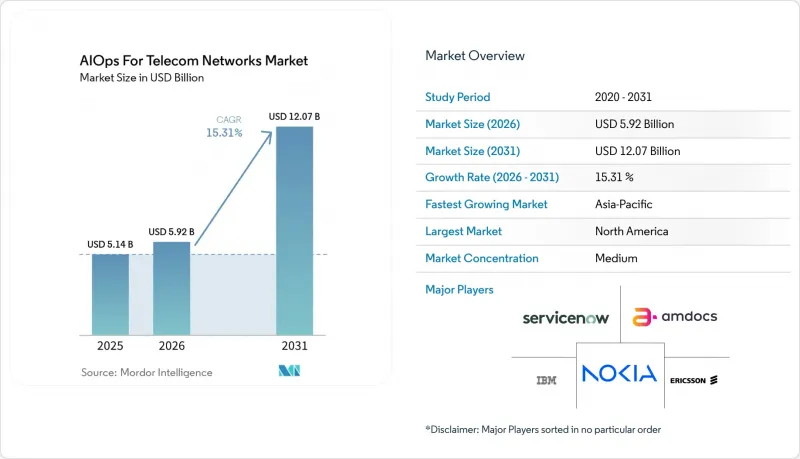
據 Mordor Intelligence 稱,2025 年電信網路 AIOps 市值為 51.4 億美元,預計到 2031 年將從 2026 年的 59.2 億美元成長至 120.7 億美元,預測期(2026-2031 年)的複合年成長率為 15.31%。
全球電信網路AIOps市場的趨勢與洞察
5G、網路切片以及多域架構日益複雜化正在重塑網路營運中心 (NOC) 架構。
在獨立組網的 5G 網路中,營運商必須管理跨無線、傳輸和核心網域的服務契約,而這些服務合約通常來自不同的供應商。網路切片增加了一個新的層面,需要針對每個切片的特定服務等級協定 (SLA) 客製化效能控制。 3GPP 的網路資料分析功能 (NDAF) 在 5G 核心網內提供了一個原生資料擷取和推理介面,而 O-RAN 聯盟的 RAN 智慧控制器則將基於人工智慧的決策支援擴展到了無線域。這些標準的結合為通訊網路 AIOps 市場的部署和供應商評估提供了更清晰的技術路徑。營運商的概念驗證專案已經證明,人工智慧代理可以跨眾多企業客戶管理切片策略,並在不到 50 毫秒的時間內調整資源,即使在流量高峰期也能做到。單一的跨域視圖減少了專業網路維運團隊之間的手動切換,而通訊業專用的基礎模型則改進了對無線、傳輸、核心網路和服務資料的整合解讀。
來自物聯網和邊緣遙測的資料量不斷增加,推動了對人工智慧原生資料處理的需求。
物聯網終端、邊緣節點和雲端原生網路功能正在產生遠超傳統網路團隊手動審查能力的運作資料。根據愛立信預測,到 2025 年底,寬頻和關鍵物聯網連線將達到 26 億,這將進一步增加持續網路遙測資料的量。因此,通訊網路的 AIOps 市場依賴能夠即時關聯來自多個網路層的訊號的系統。邊緣產生的資訊通常需要進行本地過濾和語義壓縮才能到達中央推理層。 AWS 展示了一個基於通訊的採用案例:在邊緣部署的小型語言模型將大規模的原始遙測流壓縮成更小的診斷訊號,供雲端 AI 代理程式使用。這種方法可以減少回程傳輸需求並縮短回應時間,尤其是在地理分佈廣泛、集中式處理不切實際的網路中。
整合傳統OSS和BSS的成本限制了人工智慧的普及速度。
傳統OSS和BSS系統通常針對各個運營商進行客製化,這使得與新型AI工具的整合變得困難。在多廠商網路中,這項挑戰尤其突出,因為需要資料適配器和標準化層來一致地解讀遙測資料。 2026年2月,Amdocs發布了“aOS”,這是一款旨在運行於現有BSS和OSS堆疊之上而非取代它們的作業系統。這種設計體現了營運商對系統整合過程中業務中斷的擔憂。在電信網路AIOps市場,大規模而言,採用速度可能會放緩。符合TM Forum開放數位架構的雲端原生OSS設計可以減輕未來的整合負擔。然而,在整個預測期內,傳統系統的部署規模將持續影響部署速度和廠商選擇。
細分市場分析
至2025年,平台將佔據電信網路AIOps市場65.72%的佔有率。電信業者持續青睞整合遙測資料擷取、模型管理、關聯分析和閉合迴路編配的平台。這一趨勢也反映了營運商對營運商級可靠性和通訊業特定營運知識的需求。平台可能包含網路本體和現有OSS連接器,而這些是典型企業級AIOps產品所缺乏的。這些功能使電信業者能夠跨多個網路網域管理大量警告和效能資料。 IBM的研究表明,與傳統方法相比,電信業專用基礎模型可以提高網路資料的預測精度。這鞏固了專用平台在電信網路AIOps產業的地位。這也解釋了為什麼電信業者通常將平台視為長期的架構選擇,而不是一次性的軟體購買。
預計2026年至2031年,服務市場將以17.24%的複合年成長率成長。此類別涵蓋部署、平台客製化、託管營運和資料準備支援。服務的需求與現有(棕地)網路環境的複雜性密切相關。為了確保人工智慧平台可靠運作,供應商通常需要繪製來自傳統OSS和BSS的資料結構。對於沒有專門人工智慧營運團隊的電信業者而言,託管AIOps模式非常有用。這些模式可以提供更可預測、基於結果的契約,並減少對內部基礎設施的投資需求。由於部署品質會影響平台部署的可靠性,因此電信網路AIOps市場對服務的需求將持續旺盛。此外,服務也有助於供應商與電信業者建立長期合作關係,超越平台的初始銷售。
至2025年,本地部署將佔電信網路AIOps市場佔有率的54.63%。這反映了資料主權要求、延遲問題以及電信業者長期以來對本地控制的偏好。在國家法規限制網路遙測資料雲處理的地區,本地系統仍然至關重要。這些地區對於亞太地區和部分中東地區的國有電信業者尤其重要。本地部署還能支援需要直接存取網路基礎架構的敏感工作負載。這些因素意味著,即使雲端功能不斷增強,本地部署仍然至關重要。因此,電信網路AIOps產業將持續支援本地部署和混合營運模式。混合設計使電信業者能夠在確保柔軟性的同時,保持對高風險和受監管資料的控制。
預計從2026年到2031年,基於雲端的採用率將以19.18%的複合年成長率成長。即使在短時間內流量模式快速變化的情況下,彈性雲端基礎設施也能支援大規模人工智慧推理。 2026年6月,諾基亞宣布其自治網路架構以及用於編配、保障和庫存管理的應用程式將在AWS基礎設施上提供。雲端交付還可以降低初始基礎設施需求並加快軟體更新。歐洲關於可審計性和資料居住的要求促使供應商在提供公共雲端。預計這將有助於許多電信業者維持混合架構。電信網路的AIOps市場正在向雲端利用轉型,但這並不意味著不再需要本地控制。
區域分析
預計到2025年,北美將佔據31.13%的收入佔有率,並繼續保持其在電信網路AIOps市場的領先地位。美國主要營運商一直在大力投資人工智慧驅動的網路運營,並積極推動其5G商業化專案。該地區還擁有強大的雲端AI供應商基礎,他們與電信廠商合作,提供整合解決方案。這種環境正在推動營運級自動化平台的發展。在加拿大,AIOps被用來管理本地和遠端網路。在墨西哥,該技術主要用於支援從LTE向5G過渡期間的自動化。在南美洲,巴西發揮主導作用,其營運商正在投資多頻段5G網路的故障關聯分析和預測性維護。南美洲的部署也反映出更有效率地管理光纖和海底基礎設施的需求。
歐洲仍是電信網路AIOps市場的重要營運環境。利用TM Forum框架的自主網路計畫正在英國、德國和法國穩步推進。德國電信於2025年11月在德國部署了“RAN Guardian Agent”,並正在將相關項目擴展到捷克和克羅埃西亞。歐盟的人工智慧法律提高了對管治、可審計性和文件化控制措施的需求。這些要求可能有利於那些能夠證明符合ETSI和3GPP標準的成熟供應商。沙烏地阿拉伯和阿拉伯聯合大公國正透過專注於智慧城市和關鍵連結的數位轉型項目,推動中東地區的AIOps應用。非洲仍處於起步階段,南非和奈及利亞主要專注於故障管理和性能最佳化。
預計亞太地區2026年至2031年的複合年成長率將達到17.78%。在中國、印度、韓國、日本、澳洲和紐西蘭,隨著5G網路的擴展,AIOps在電信網路市場的應用日益廣泛。在2026年世界行動通訊大會(MWC 2026)上,華為發布了搭載20多個AI代理的“AUTINOps”,並表示其風險識別準確率超過80%,診斷準確率超過90%。諾基亞正與NTT Docomo合作,透過「MantaRay SON」和「AutoPilot」的試點運營,推動基於SMO的自主運作。在印度,獨立組網(SA)5G網路覆蓋範圍不斷擴大,用戶基數大規模,為收集大量遙測資料創造了有利條件。澳洲和紐西蘭雖然市場規模較小,但技術先進,更傾向採用符合3GPP和TM Forum標準的雲端原生部署方案。
其他好處:
- Excel格式的市場預測(ME)表
- 3個月的分析師支持
目錄
第1章:引言
- 研究假設和市場定義
- 調查範圍
第2章:調查方法
第3章執行摘要
第4章 市場狀況
- 市場概覽
- 市場促進因素
- 5G、網路切片和多域複雜性
- 透過物聯網、邊緣運算和雲端原生基礎設施實現網路遙測的成長
- 降低網路營運中心成本和平均修復時間 (MTTR) 的壓力
- 對預測性服務保障和客戶體驗保護的需求日益成長
- 使用網路遙測資料訓練的通訊業專用平台模型。
- 考慮無線和邊緣基礎設施能效的封閉回路型最佳化
- 市場限制因素
- 傳統的OSS、BSS以及跨多廠商網路的高昂整合成本
- 與資料隱私、網路安全和自動糾正措施相關的營運風險。
- 警報、事件和配置資料標籤不清晰
- 運營商不願將控制權委託給基於代理的系統
- 產業價值鏈分析
- 監理情勢
- 技術展望
- 波特五力分析
- 宏觀經濟因素對市場的影響
第5章 市場規模與成長預測
- 報價
- 平台
- 服務
- 按部署模式
- 現場
- 基於雲端的
- 按組織規模
- 大公司
- 小型企業
- 透過使用
- 網路效能管理
- 事件和故障管理
- 網路安全管理
- 客戶體驗管理
- 基礎設施管理
- 應用效能分析
- 其他用途
- 最終用戶
- 行動電信商
- 固網和寬頻營運商
- 綜合電信服務供應商
- 其他最終用戶
- 按地區
- 北美洲
- 美國
- 加拿大
- 墨西哥
- 南美洲
- 巴西
- 阿根廷
- 其他南美國家
- 歐洲
- 英國
- 德國
- 法國
- 西班牙
- 義大利
- 其他歐洲國家
- 亞太地區
- 中國
- 日本
- 印度
- 韓國
- 澳洲和紐西蘭
- 其他亞太國家
- 中東
- 沙烏地阿拉伯
- 阿拉伯聯合大公國
- 其他中東國家
- 非洲
- 南非
- 奈及利亞
- 其他非洲國家
- 北美洲
第6章 競爭情勢
- 市場集中度
- 策略趨勢
- 市佔率分析
- 公司簡介
- International Business Machines Corporation
- Cisco Systems, Inc.
- Nokia Corporation
- Telefonaktiebolaget LM Ericsson
- Amdocs Limited
- ServiceNow, Inc.
- Huawei Technologies Co., Ltd.
- Ciena Corporation
- Netcracker Technology Corporation
- Oracle Corporation
- Microsoft Corporation
- Google LLC
- ZTE Corporation
- NEC Corporation
- Samsung Electronics Co., Ltd.
- Tech Mahindra Limited
- Tata Consultancy Services Limited
- Infosys Limited
- Wipro Limited
- Radcom Ltd.
- Grokstream, Inc.
第7章 市場機會與未來展望
According to Mordor Intelligence, the AIOps for Telecom Networks Market size was valued at USD 5.14 billion in 2025 and is estimated to grow from USD 5.92 billion in 2026 to reach USD 12.07 billion by 2031, at a CAGR of 15.31% during the forecast period (2026-2031).
Global AIOps For Telecom Networks Market Trends and Insights
5G, Network Slicing, and Multi-Domain Complexity Reshape NOC Architecture
Standalone 5G networks require operators to manage service commitments across the radio, transport, and core domains, which often use separate vendor systems. Network slicing adds another layer because each slice requires performance controls tailored to its specific service-level agreement. The 3GPP Network Data Analytics Function provides a native data collection and inference interface within the 5G core, while the O-RAN Alliance RAN Intelligent Controller extends AI-based decision support into the radio domain. Together, these standards give the AIOps for telecom networks market a clearer technical route for deployment and vendor assessment. Operator programs have shown that AI agents can manage slicing policies across many enterprise customers and adjust resources in less than 50 milliseconds during traffic surges. A single cross-domain view reduces manual transfers between specialist network operations teams, while telecom-specific foundation models can improve the interpretation of combined radio, transport, core, and service data.
IoT and Edge Telemetry Volumes Force AI-Native Data Processing
IoT endpoints, edge nodes, and cloud-native network functions are generating more operational data than traditional network teams can manually review. Ericsson reported 2.6 billion broadband and critical IoT connections at the end of 2025, which increased the volume of continuous network telemetry. The AIOps for telecom networks market, therefore, depends on systems that can correlate signals from many network layers in real time. Edge-generated information often requires local filtering and semantic compression before it reaches a central inference layer. AWS has described telecom deployments in which edge-deployed small language models condense large raw telemetry streams into smaller diagnostic signals for cloud AI agents. This approach can lower backhaul requirements and shorten response times, particularly in geographically dispersed networks where centralized processing is less practical.
Legacy OSS and BSS Integration Costs Constrain AI Deployment Velocity
Legacy OSS and BSS systems are often customized for individual operators and can be difficult to connect with new AI tools. This challenge is more severe in multivendor networks, which require data adapters and normalization layers before telemetry can be interpreted consistently. Amdocs introduced aOS in February 2026 as an operating system designed to run on top of existing BSS and OSS stacks rather than replace them. That design reflects operator concerns about disruption during system integration. The AIOps for telecom networks market may see slower adoption among mid-tier operators without large internal integration teams. Cloud-native OSS designs aligned with TM Forum Open Digital Architecture can reduce future integration burdens. However, the installed base of older systems will continue to affect deployment speed and vendor selection over the forecast period.
Other drivers and restraints analyzed in the detailed report include:
- NOC Cost Reduction and MTTR Improvement Define AIOps ROI
- Predictive Service Assurance Becomes a Commercial Necessity for Operators
- Automated Remediation Introduces New Cybersecurity and Operational Risk Vectors
For complete list of drivers and restraints, kindly check the Table Of Contents.
Segment Analysis
Platforms held 65.72% of the AIOps for telecom networks market share in 2025. Operators continue to favor integrated platforms that combine telemetry ingestion, model management, correlation, and closed-loop orchestration. This preference also reflects the need for carrier-grade reliability and telecom-specific operational knowledge. Platforms can include network ontologies and existing OSS connectors that general enterprise AIOps products lack. These capabilities help operators manage large volumes of alarms and performance data across several network domains. IBM Research demonstrated that telecom-focused foundation models can improve prediction accuracy for network data compared with conventional methods. This supports the position of specialized platforms within the AIOps industry for telecom networks. It also explains why operators often evaluate platforms as long-term architectural choices rather than isolated software purchases.
Services are projected to expand at a 17.24% CAGR from 2026 to 2031. This category includes implementation, platform customization, managed operations, and support for data preparation. Service demand remains closely tied to the complexity of brownfield network environments. Providers must often map legacy OSS and BSS data structures before an AI platform can operate reliably. Managed AIOps models are useful for operators that do not have dedicated AI operations teams. These models can offer more predictable outcome-based arrangements and reduce the need for internal infrastructure investment. The AIOps for telecom networks market will continue to require services, as implementation quality affects the reliability of any platform deployment. Services also help vendors build longer operator relationships after the initial platform sale.
On-premises deployment accounted for 54.63% of the AIOps market for telecom networks in 2025. This position reflected data sovereignty requirements, latency concerns, and long-standing operator preferences for local control. On-premises systems remain important where national rules limit cloud processing of network telemetry. They are especially relevant for state-affiliated operators in parts of the Asia-Pacific and the Middle East. Local deployment can also support highly sensitive workloads that require direct access to network infrastructure. These considerations sustain a meaningful installed base even as cloud options become more capable. The AIOps for telecom networks industry, therefore, continues to support both local and hybrid operating models. Hybrid designs can give operators flexibility while retaining control over high-risk or regulated data.
Cloud-based deployment is projected to expand at a 19.18% CAGR from 2026 to 2031. Elastic cloud infrastructure can support large-scale AI inference when traffic patterns change sharply within short periods. Nokia announced in June 2026 that its Autonomous Networks Fabric would be available on AWS infrastructure with applications for orchestration, assurance, and inventory management. Cloud delivery can also reduce upfront infrastructure requirements and speed software updates. European requirements around auditability and data residency are encouraging suppliers to provide sovereign cloud options alongside public cloud services. This is likely to preserve hybrid architectures for many operators. The AIOps for telecom networks market is moving toward cloud use without eliminating the need for on-premises control.
Complete Report Scope:
- By Offering
- Platforms
- Services
- By Deployment Model
- On-Premises
- Cloud-Based
- By Organization Size
- Large Enterprises
- Small and Medium-Sized Enterprises
- By Application
- Network Performance Management
- Fault and Incident Management
- Network Security Management
- Customer Experience Management
- Infrastructure Management
- Application Performance Analysis
- Other Applications
- By End-User
- Mobile Network Operators
- Fixed and Broadband Operators
- Integrated Communication Service Providers
- Other End-Users
- By Geography
- North America
- United States
- Canada
- Mexico
- South America
- Brazil
- Argentina
- Rest of South America
- Europe
- United Kingdom
- Germany
- France
- Spain
- Italy
- Rest of Europe
- Asia-Pacific
- China
- Japan
- India
- South Korea
- Australia and New Zealand
- Rest of Asia-Pacific
- Middle East
- Saudi Arabia
- United Arab Emirates
- Rest of Middle East
- Africa
- South Africa
- Nigeria
- Rest of Africa
- North America
Geography Analysis
North America held 31.13% revenue share in 2025, giving it the leading position in the AIOps for telecom networks market. Major United States operators have invested in AI-led network operations alongside wider 5G commercialization programs. The region also has a strong base of cloud AI providers that work with telecom vendors on integrated offerings. These conditions support the development of production-grade automation platforms. Canada is applying AIOps to rural and remote network management. Mexico is using the technology mainly to support automation during LTE-to-5G transitions. South America is led by Brazil, where operators are investing in fault correlation and predictive maintenance for multiband 5G networks. Adoption across South America also reflects the need to manage fiber and subsea infrastructure more efficiently.
Europe remains an important operating environment for the AIOps market in telecom networks. The United Kingdom, Germany, and France are advancing autonomous network programs using TM Forum frameworks. Deutsche Telekom deployed its RAN Guardian Agent in Germany during November 2025 and is expanding related programs to the Czech Republic and Croatia. The European Union AI Act has increased the need for governance, auditability, and documented controls. These requirements may favor established vendors that can show compliance with ETSI and 3GPP standards. Saudi Arabia and the United Arab Emirates are driving adoption in the Middle East through digital transformation programs focused on smart cities and critical connectivity. Africa remains at an earlier stage, with South Africa and Nigeria concentrating on fault management and performance optimization.
Asia-Pacific is projected to expand at a 17.78% CAGR from 2026 to 2031. China, India, South Korea, Japan, Australia, and New Zealand are increasing the use of AIOps for the telecom networks market as 5G networks scale. Huawei launched AUTINOps at MWC 2026 with more than 20 AI agents and reported over 80% risk-identification accuracy and above 90% diagnosis accuracy. Nokia is working with NTT DOCOMO on SMO-driven autonomy through MantaRay SON and AutoPilot trials. India offers high-volume telemetry conditions as standalone 5G coverage expands across a large mobile subscriber base. Australia and New Zealand are smaller but technically advanced markets that favor cloud-native deployments aligned with 3GPP and TM Forum standards.
- International Business Machines Corporation
- Cisco Systems, Inc.
- Nokia Corporation
- Telefonaktiebolaget LM Ericsson
- Amdocs Limited
- ServiceNow, Inc.
- Huawei Technologies Co., Ltd.
- Ciena Corporation
- Netcracker Technology Corporation
- Oracle Corporation
- Microsoft Corporation
- Google LLC
- ZTE Corporation
- NEC Corporation
- Samsung Electronics Co., Ltd.
- Tech Mahindra Limited
- Tata Consultancy Services Limited
- Infosys Limited
- Wipro Limited
- Radcom Ltd.
- Grokstream, Inc.
Additional Benefits:
- The market estimate (ME) sheet in Excel format
- 3 months of analyst support
TABLE OF CONTENTS
1 INTRODUCTION
- 1.1 Study Assumptions and Market Definition
- 1.2 Scope of the Study
2 RESEARCH METHODOLOGY
3 EXECUTIVE SUMMARY
4 MARKET LANDSCAPE
- 4.1 Market Overview
- 4.2 Market Drivers
- 4.2.1 5G, Network Slicing, and Multi-Domain Complexity
- 4.2.2 Growth in Network Telemetry From IoT, Edge, and Cloud-Native Infrastructure
- 4.2.3 Pressure to Reduce NOC Costs and Mean Time to Repair
- 4.2.4 Rising Demand for Predictive Service Assurance and Customer Experience Protection
- 4.2.5 Telecom-Specific Foundation Models Trained on Network Telemetry
- 4.2.6 Energy-Aware Closed-Loop Optimization for Radio and Edge Infrastructure
- 4.3 Market Restraints
- 4.3.1 High Integration Costs Across Legacy OSS, BSS, and Multivendor Networks
- 4.3.2 Data Privacy, Cybersecurity, and Operational Risk From Automated Remediation
- 4.3.3 Poorly Labeled Alarm, Incident, and Configuration Data
- 4.3.4 Operator Reluctance to Delegate Control to Agentic Systems
- 4.4 Industry Value-Chain Analysis
- 4.5 Regulatory Landscape
- 4.6 Technological Outlook
- 4.7 Porter's Five Forces Analysis
- 4.7.1 Bargaining Power of Suppliers
- 4.7.2 Bargaining Power of Buyers
- 4.7.3 Threat of New Entrants
- 4.7.4 Threat of Substitutes
- 4.7.5 Competitive Rivalry
- 4.8 Impact of Macroeconomic Factors on the Market
5 MARKET SIZE AND GROWTH FORECASTS (VALUE)
- 5.1 By Offering
- 5.1.1 Platforms
- 5.1.2 Services
- 5.2 By Deployment Model
- 5.2.1 On-Premises
- 5.2.2 Cloud-Based
- 5.3 By Organization Size
- 5.3.1 Large Enterprises
- 5.3.2 Small and Medium-Sized Enterprises
- 5.4 By Application
- 5.4.1 Network Performance Management
- 5.4.2 Fault and Incident Management
- 5.4.3 Network Security Management
- 5.4.4 Customer Experience Management
- 5.4.5 Infrastructure Management
- 5.4.6 Application Performance Analysis
- 5.4.7 Other Applications
- 5.5 By End-User
- 5.5.1 Mobile Network Operators
- 5.5.2 Fixed and Broadband Operators
- 5.5.3 Integrated Communication Service Providers
- 5.5.4 Other End-Users
- 5.6 By Geography
- 5.6.1 North America
- 5.6.1.1 United States
- 5.6.1.2 Canada
- 5.6.1.3 Mexico
- 5.6.2 South America
- 5.6.2.1 Brazil
- 5.6.2.2 Argentina
- 5.6.2.3 Rest of South America
- 5.6.3 Europe
- 5.6.3.1 United Kingdom
- 5.6.3.2 Germany
- 5.6.3.3 France
- 5.6.3.4 Spain
- 5.6.3.5 Italy
- 5.6.3.6 Rest of Europe
- 5.6.4 Asia-Pacific
- 5.6.4.1 China
- 5.6.4.2 Japan
- 5.6.4.3 India
- 5.6.4.4 South Korea
- 5.6.4.5 Australia and New Zealand
- 5.6.4.6 Rest of Asia-Pacific
- 5.6.5 Middle East
- 5.6.5.1 Saudi Arabia
- 5.6.5.2 United Arab Emirates
- 5.6.5.3 Rest of Middle East
- 5.6.6 Africa
- 5.6.6.1 South Africa
- 5.6.6.2 Nigeria
- 5.6.6.3 Rest of Africa
- 5.6.1 North America
6 COMPETITIVE LANDSCAPE
- 6.1 Market Concentration
- 6.2 Strategic Moves
- 6.3 Market Share Analysis
- 6.4 Company Profiles (includes Global Level Overview, Market Level Overview, Core Segments, Financials as available, Strategic Information, Market Rank/Share, Products and Services, Recent Developments)
- 6.4.1 International Business Machines Corporation
- 6.4.2 Cisco Systems, Inc.
- 6.4.3 Nokia Corporation
- 6.4.4 Telefonaktiebolaget LM Ericsson
- 6.4.5 Amdocs Limited
- 6.4.6 ServiceNow, Inc.
- 6.4.7 Huawei Technologies Co., Ltd.
- 6.4.8 Ciena Corporation
- 6.4.9 Netcracker Technology Corporation
- 6.4.10 Oracle Corporation
- 6.4.11 Microsoft Corporation
- 6.4.12 Google LLC
- 6.4.13 ZTE Corporation
- 6.4.14 NEC Corporation
- 6.4.15 Samsung Electronics Co., Ltd.
- 6.4.16 Tech Mahindra Limited
- 6.4.17 Tata Consultancy Services Limited
- 6.4.18 Infosys Limited
- 6.4.19 Wipro Limited
- 6.4.20 Radcom Ltd.
- 6.4.21 Grokstream, Inc.
7 MARKET OPPORTUNITIES AND FUTURE OUTLOOK
- 7.1 White-Space and Unmet-Need Assessment

 2026-2034年全球人工智慧平台IT運維市場規模、佔有率、趨勢及成長分析報告
 2034年IT運維人工智慧(AI)市場預測:按組件、部署模式、組織規模、應用、最終用戶和地區分類的全球分析
 面向IT運維的全端自動化軟體市場:全球市場預測(2026-2032年)
 北美通訊網路AIOps:市佔率分析、產業趨勢與統計及成長預測(2026-2031年)歐洲基於AIOps的電信網路:市場佔有率分析、產業趨勢和統計數據以及成長預測(2026-2031年)AIOps:市場佔有率分析、產業趨勢與統計、成長預測(2026-2031)AI維運平台市場預測至2034年-按組件、部署模式、組織規模、應用、產業、最終用戶和地區分類的全球分析自主IT維運:市場佔有率分析、產業趨勢與統計、成長預測(2026-2031年)AIOps平台市場預測至2034年-按交付類型、部署類型、組織規模、應用、最終用戶和地區分類的全球分析
 AIOps平台市場:按組件、組織規模、產業和地區分類