


 |
市場調查報告書
商品編碼
2063661
自主IT維運:市場佔有率分析、產業趨勢與統計、成長預測(2026-2031年)Autonomous IT Operations - Market Share Analysis, Industry Trends & Statistics, Growth Forecasts (2026 - 2031) |
||||||

※ 本網頁內容可能與最新版本有所差異。詳細情況請與我們聯繫。
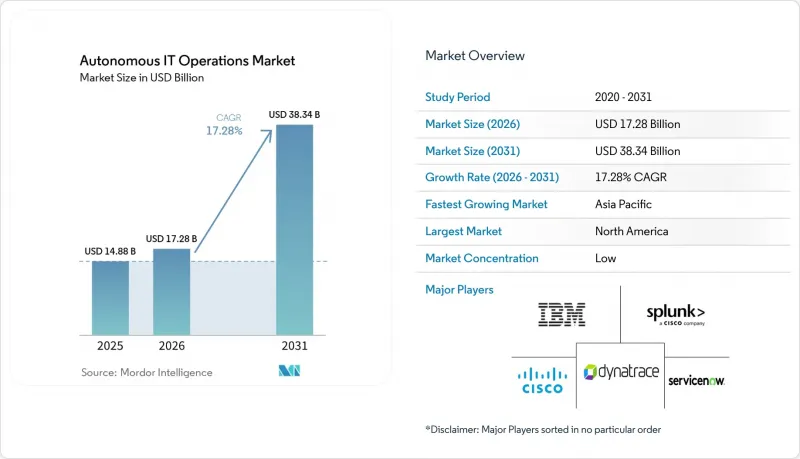
根據 Mordor Intelligence 預測,自主 IT 營運市場規模將從 2025 年的 148.8 億美元成長到 2026 年的 172.8 億美元,到 2031 年將達到 383.4 億美元,2026 年至 2031 年的複合年成長率為 17.28%。
本報告按元件(平台、服務(諮詢服務等))、部署類型(本地部署、雲端部署、混合部署)、組織規模(大型企業、中小企業)、應用程式(應用效能管理等)、產業(IT與電信、銀行、金融服務和保險等)以及地區進行細分。市場預測以價值(美元)表示。
全球自主IT營運市場趨勢與洞察
IT遙測資料的爆炸性成長正在推動人工智慧相關性分析。
雲端原生微服務每次事務都會產生數千個事件,從而建構出Petabyte級可觀測性管道,這是傳統基於規則的監控系統無法處理的。這些管道會產生大量數據,而使用傳統方法難以有效管理和分析這些數據。為了因應這項挑戰,人工智慧驅動的關聯引擎應運而生,成為關鍵解決方案。這些引擎能夠在幾秒鐘內將大量資料流提煉成可操作的根本原因洞察。這些先進的平台旨在每天處理數兆個依賴關係,確保快速識別和解決問題。例如,零售商和電子商務企業正擴大利用這些人工智慧引擎來預測和緩解高峰期(例如季節性銷售高峰期)的延遲高峰。透過從被動式警報轉向主動糾正措施,企業可以提高營運效率,提升客戶體驗,即使在緊急情況下也能保持無縫的服務交付。
混合雲和多重雲端架構的廣泛應用
工作負載跨越本地資料中心、公共雲端和邊緣位置,造成了顯著的可見性缺口,而手動運行手冊和傳統監控工具無法有效彌補這些缺口。這些缺口源自於現代 IT 環境的複雜性和多樣性,工作負載運行在多個平台和基礎架構上。自主 IT 維運平台透過整合跨異質環境的遙測資料來應對這項挑戰,從而實現無縫且統一的策略執行,而無需考慮工作負載的位置。這種能力確保了本地、雲端和邊緣環境的一致管理和合規性。此外,歐洲和中東等地區的自主雲端計畫正在推動自主邊緣運維的普及。這些計劃優先考慮資料主權和安全,促進了邊緣解決方案的部署,從而在保持營運效率和符合區域法規的同時,最大限度地減少資料遺失。
與傳統IT架構整合的複雜性
大型主機、專有資料庫和客製化中間件通常缺乏現代化的監控功能,迫使企業部署額外的代理程式來實現監控和資料收集。然而,這些代理程序會增加延遲和維護成本,導致營運效率低落。在以舊有系統為主的棕地環境中,引進週期可能長達一年以上。造成這種延遲的原因在於團隊需要處理修改遙測連接器、整合舊有系統以及標準化異質資料格式以確保相容性等諸多工作。提供混合發現引擎的供應商為應對這些挑戰提供了解決方案。這些引擎可以將基於 SNMP 的設備映射到 Kubernetes叢集,透過自動化資產發現和減少整合過程中的人工操作來簡化流程。
細分市場分析
到了2025年,平台細分市場佔據自主IT運維市場佔有率的73.12%。這主要得益於企業將各種獨立工具整合到一個統一的引擎中,該引擎能夠捕獲日誌、指標、追蹤資訊和事件。服務細分市場也獲得了強勁成長,這主要得益於諮詢、整合和託管維運服務包的出現,這些服務包簡化了複雜的部署流程。預計從2026年到2031年,隨著企業尋求透過外部專業知識更快實現價值,服務細分市場的複合年成長率將超過平台細分市場,達到18.28%。供應商擴大將平台許可和託管服務打包銷售,從而縮短採購週期並緩解使用高峰。
在持續最佳化需求不斷成長的推動下,維護合約正演變為主動協議,供應商會根據季節性流量模式調整相關演算法。自從主要基礎設施供應商將AIOps整合到現有環境中以來,交叉銷售機會加倍,從而提高了平台採用率和業務收益。對於希望在不中斷關鍵任務工作負載的情況下實現現代化的現有設施的製造商和公共部門組織而言,由顧問主導的遙測設計正變得至關重要。
截至2025年,本地部署仍佔自主IT維運市場佔有率的大部分(52.24%)。這主要是由於醫療保健和金融服務業對資料居住和合規性有嚴格的要求。這些行業優先選擇本地解決方案,以確保敏感資料處於受控環境中,並符合嚴格的法規結構。然而,隨著中小企業(SME)擴大採用無需大量前期投資的訂閱模式,預計到2031年,雲端採用率將以17.88%的複合年成長率成長。這種轉變將使中小企業能夠在無需承擔維護實體基礎設施相關財務負擔的情況下,獲得先進的IT維運能力。混合拓撲結構正逐漸成為一種首選解決方案,它允許企業在本地維護敏感的關聯分析工作負載,同時利用公共雲端平台的擴充性和成本效益進行突發分析。
邊緣運算透過將輕量級關聯分析引擎整合到工廠和零售店等營運環境中,為這個生態系統增添了新的層面。在這些環境中,毫秒級的超低延遲對於即時決策至關重要。近期平台更新引入了分層儲存解決方案,將熱資料儲存在本地以便即時訪問,並將溫資料儲存在雲端物件儲存中以提高成本效益,從而幫助企業最佳化效能和成本。此外,ISO/IEC 27001 等認證架構正在擴展其適用範圍,涵蓋整個混合環境,鼓勵企業在本地、雲端和邊緣環境中採用統一的安全方法。這種全面的觀點使企業能夠在利用混合和邊緣運算解決方案的柔軟性和可擴展性的同時,保持強大的安全標準。
區域分析
到2025年,北美將佔據32.78%的自主IT維運市場。這主要得益於該地區超大規模資料中心業者的高度集中以及強大的DevOps人才儲備。美國憑藉其先進的IT基礎設施和自動化技術的廣泛應用,在市場中處於領先地位。同時,加拿大對數位轉型的重視以及墨西哥對雲端平台在提升營運效率方面日益成長的依賴,進一步鞏固了該地區的領先地位。然而,亞太地區預計將成為成長最快的地區,複合年成長率(CAGR)將達到19.21%。中國、印度和東南亞國家等正在採用待開發區的雲端架構,跳過舊有系統。在中國,嚴格的資料本地化法規迫使國內供應商開發針對自主雲端最佳化的解決方案。同時,印度主要的IT服務供應商正在將AIOps整合到其託管服務組合中,以提高營運效率。
在GDPR和歐盟人工智慧法等嚴格法規結構的支持下,歐洲自主IT維運市場正經歷強勁成長。這些法規要求供應商整合模型沿襲和透明度等功能,從而確保合規性並增強企業間的信任。在中東,智慧城市平台的大量投資高度依賴自主IT維運來維持嚴格的服務水準目標。同樣,南美洲正在推動電信網路現代化,並部署AIOps來管理5G網路切片的複雜性。這些進步正在提升該地區的網路效率並降低營運成本。
非洲雖然在採用自主IT營運方面仍處於起步階段,但蘊藏著巨大的成長潛力。該地區的行動通訊業者正致力於推進其覆蓋偏遠和低度開發地區的龐大基地台網路的自動化,以最大限度地減少對現場工作人員的依賴。這種向自動化的轉變有望解決營運難題,並提升該地區的服務水準。隨著全球對自主IT營運的需求持續成長,像非洲這樣的地區將在未來市場成長中扮演日益重要的角色。
其他好處:
- Excel格式的市場預測(ME)表
- 3個月的分析師支持
目錄
第1章:引言
- 研究假設和市場定義
- 調查範圍
第2章:調查方法
第3章執行摘要
第4章 市場狀況
- 市場概覽
- 市場促進因素
- IT遙測資料的爆炸性成長正在推動人工智慧相關性分析的發展。
- 混合雲和多重雲端架構的採用率不斷提高
- 需要減少平均故障修復時間 (MTTR) 和停機成本。
- 利用生成式人工智慧副駕駛提升AIOps的可用性
- 數據主權相關法規正在推動自主邊緣運算的發展。
- 強制性ESG掛鉤綠色運營,以最佳化能源利用
- 市場限制因素
- 與傳統IT系統整合的複雜性
- 具備AIOps技能的專業人員短缺
- 新規下人工智慧模型的可審計性
- 透過專有關聯引擎實現供應商鎖定
- 宏觀經濟因素對市場的影響
- 產業價值鏈分析
- 監理情勢
- 技術展望
- 波特五力分析
第5章 市場規模與成長預測
- 按組件
- 平台
- 服務
- 諮詢服務
- 整合和實施服務
- 支援和維護服務
- 部署模式
- 現場
- 雲
- 混合
- 按組織規模
- 大公司
- 小型企業
- 透過使用
- 應用效能管理
- 基礎設施管理
- 網路和安全管理
- 即時分析和事件關聯
- IT服務管理自動化
- 按行業分類
- 資訊科技/通訊
- BFSI
- 醫療保健和生命科學
- 零售與電子商務
- 製造業
- 政府/公共部門
- 其他工業部門
- 按地區
- 北美洲
- 美國
- 加拿大
- 墨西哥
- 南美洲
- 巴西
- 阿根廷
- 其他南美國家
- 歐洲
- 英國
- 德國
- 法國
- 義大利
- 西班牙
- 其他歐洲國家
- 亞太地區
- 中國
- 日本
- 印度
- 韓國
- 其他亞太國家
- 中東和非洲
- 中東
- 阿拉伯聯合大公國
- 沙烏地阿拉伯
- 其他中東國家
- 非洲
- 南非
- 埃及
- 其他非洲國家
- 中東
- 北美洲
第6章 競爭情勢
- 市場集中度
- 策略趨勢
- 市佔率分析
- 公司簡介
- International Business Machines Corporation
- Dynatrace, Inc.
- Splunk Inc.
- Cisco Systems, Inc.
- Datadog, Inc.
- Broadcom Inc.
- ServiceNow, Inc.
- BMC Software, Inc.
- Micro Focus International plc
- Elastic NV
- ScienceLogic, Inc.
- Moogsoft, Inc.
- BigPanda, Inc.
- LogicMonitor, Inc.
- SolarWinds Corporation
- New Relic, Inc.
- PagerDuty, Inc.
- Aisera, Inc.
- Resolve Systems, LLC
- OpsRamp, Inc.
第7章 市場機會與未來展望
According to Mordor Intelligence, the autonomous IT operations market size is expected to grow from USD 14.88 billion in 2025 to USD 17.28 billion in 2026 and is forecast to reach USD 38.34 billion by 2031 at 17.28% CAGR over 2026-2031.
This report is Segmented by Component (Platform, and Services (Advisory Services, and More)), Deployment Mode (On-Premise, Cloud, and Hybrid), Organization Size (Large Enterprises, and Small and Medium Enterprises), Application (Application Performance Management, and More), Industry Vertical (IT and Telecom, BFSI, and More), and Geography. The Market Forecasts are Provided in Terms of Value (USD).
Global Autonomous IT Operations Market Trends and Insights
Explosion of IT Telemetry Volumes Driving AI Correlation
Cloud-native microservices generate thousands of events per transaction, creating petabyte-scale observability pipelines that overwhelm traditional rules-based monitoring systems. These pipelines produce an immense volume of data that is challenging to manage and analyze effectively using conventional methods. To address this, AI-driven correlation engines have emerged as a critical solution, capable of condensing this overwhelming data torrent into actionable root-cause insights within seconds. These advanced platforms are designed to process trillions of dependencies daily, ensuring rapid identification and resolution of issues. For instance, retail and e-commerce operators increasingly rely on these AI-powered engines to anticipate and mitigate latency spikes during high-demand periods, such as seasonal sales peaks. By transitioning from reactive alerting to predictive remediation, businesses can enhance operational efficiency, improve customer experiences, and maintain seamless service delivery during critical times.
Rising Adoption of Hybrid and Multi-Cloud Architectures
Workloads span on-premise data centers, public clouds, and edge locations, creating significant visibility gaps that manual runbooks and traditional monitoring tools cannot effectively bridge. These gaps arise from the complexity and diversity of modern IT environments, where workloads run across multiple platforms and infrastructures. Autonomous IT operations platforms address this challenge by federating telemetry across heterogeneous estates, enabling seamless, unified policy enforcement regardless of workload location. This capability ensures consistent management and compliance across all environments, whether on-premise, in the cloud, or at the edge. Additionally, sovereign-cloud initiatives in regions such as Europe and the Middle East are driving the adoption of autonomous edge operations. These initiatives prioritize data sovereignty and security, encouraging the implementation of edge solutions that minimize data egress while maintaining operational efficiency and compliance with regional regulations.
Integration Complexity with Legacy IT Stacks
Mainframes, proprietary databases, and custom middleware often lack modern instrumentation, which forces enterprises to deploy additional agents to enable monitoring and data collection. These agents, however, increase latency and add to maintenance costs, creating operational inefficiencies. In brownfield environments, where legacy systems dominate, adoption cycles for modern solutions can extend beyond a year. This delay occurs as teams work to retrofit telemetry connectors, integrate legacy systems, and normalize disparate data formats to ensure compatibility. Vendors offering hybrid discovery engines provide a solution to these challenges. These engines can map SNMP-based devices alongside Kubernetes clusters, streamlining the process by automating asset discovery and reducing manual effort during integration.
Other drivers and restraints analyzed in the detailed report include:
- Need to Reduce Mean Time to Resolution and Downtime Costs
- Generative AI Copilots Improving AIOps Usability
- Shortage of AIOps-Skilled Professionals
For complete list of drivers and restraints, kindly check the Table Of Contents.
Segment Analysis
The platform segment accounted for 73.12% of the autonomous IT operations market share in 2025, as organizations consolidated point tools into unified engines capable of ingesting logs, metrics, traces, and events. The services segment is gaining momentum, driven by advisory, integration, and managed-operations packages that simplify complex deployments. During 2026-2031, services are projected to outpace platforms at 18.28% CAGR as enterprises seek faster time-to-value through external expertise. Vendors increasingly bundle platform licenses with managed services, shortening procurement cycles and smoothing consumption spikes.
The growing demand for continuous optimization is reshaping maintenance contracts into proactive engagements in which vendors retune correlation algorithms based on seasonal traffic patterns. Cross-selling opportunities have multiplied since large infrastructure providers integrated AIOps into existing estates, reinforcing platform stickiness while boosting services revenue. Consultant-led telemetry design has become pivotal for brownfield manufacturers and public agencies looking to modernize without disrupting mission-critical workloads.
On-premises installations accounted for the majority of the autonomous IT operations market share, at 52.24%, in 2025, due to strict data-residency and compliance requirements in healthcare and financial services. These industries prioritize on-premises solutions to ensure sensitive data remains within controlled environments and to adhere to stringent regulatory frameworks. Cloud deployments, however, are forecast to expand at a compound annual growth rate (CAGR) of 17.88% through 2031, as small and medium-sized enterprises (SMEs) increasingly adopt subscription-based models that eliminate the need for significant upfront capital expenditure. This shift allows SMEs to access advanced IT operations capabilities without the financial burden of maintaining physical infrastructure. Hybrid topologies are emerging as a preferred solution, enabling organizations to keep sensitive correlation workloads on-premises while leveraging the scalability and cost-efficiency of public cloud platforms for burst analytics.
Edge computing introduces an additional layer to this ecosystem by embedding lightweight correlation engines within operational environments such as factories and retail stores, where ultra-low latency, often measured in milliseconds, is critical for real-time decision-making. Recent platform updates that incorporate tiered storage solutions, storing hot data locally for immediate access and warm data in cloud object stores for cost efficiency, are helping organizations optimize both performance and expenses. Furthermore, certification frameworks like ISO/IEC 27001 are increasingly expanding their coverage to encompass entire hybrid estates, encouraging businesses to adopt a unified security approach across on-premises, cloud, and edge environments. This holistic view ensures that organizations can maintain robust security standards while benefiting from the flexibility and scalability of hybrid and edge computing solutions.
Geography Analysis
North America accounted for 32.78% of the autonomous IT operations market share in 2025, driven by the region's high concentration of hyperscalers and a robust DevOps talent pool. The United States leads the market with its advanced IT infrastructure and widespread adoption of automation technologies. Meanwhile, Canada's focus on digital transformation and Mexico's growing reliance on cloud platforms for operational efficiency further bolsters the region's dominance. Despite this, the Asia-Pacific region is expected to be the fastest-growing region, with a projected CAGR of 19.21%. Countries like China, India, and those in Southeast Asia are bypassing legacy systems and adopting greenfield cloud builds. In China, stringent data-localization laws are pushing domestic vendors to develop solutions optimized for sovereign clouds, while India's IT services giants are integrating AIOps into their managed services portfolios to enhance operational efficiency.
Europe's growth in the autonomous IT operations market remains steady, supported by strict regulatory frameworks such as GDPR and the EU AI Act. These regulations require vendors to incorporate features such as model lineage and transparency, thereby ensuring compliance and fostering trust among enterprises. The Middle East is making significant investments in smart-city platforms, which rely heavily on autonomous IT operations to maintain stringent service-level objectives. Similarly, South America is witnessing modernization in its telecom networks, with AIOps being adopted to manage the complexities of 5G network slicing. These advancements are enabling the region to improve network efficiency and reduce operational costs.
Africa, while still in the early stages of adopting autonomous IT operations, has considerable growth potential. The region's mobile operators are increasingly automating their extensive tower estates, which often span remote and underserved areas, to minimize the need for on-site staff. This shift toward automation is expected to address operational challenges and improve service delivery in the region. As global demand for autonomous IT operations continues to rise, regionssuch ase Africa are likely to play a more significant role in the market's future growth.
- International Business Machines Corporation
- Dynatrace, Inc.
- Splunk Inc.
- Cisco Systems, Inc.
- Datadog, Inc.
- Broadcom Inc.
- ServiceNow, Inc.
- BMC Software, Inc.
- Micro Focus International plc
- Elastic N.V.
- ScienceLogic, Inc.
- Moogsoft, Inc.
- BigPanda, Inc.
- LogicMonitor, Inc.
- SolarWinds Corporation
- New Relic, Inc.
- PagerDuty, Inc.
- Aisera, Inc.
- Resolve Systems, LLC
- OpsRamp, Inc.
Additional Benefits:
- The market estimate (ME) sheet in Excel format
- 3 months of analyst support
TABLE OF CONTENTS
1 INTRODUCTION
- 1.1 Study Assumptions and Market Definition
- 1.2 Scope of the Study
2 RESEARCH METHODOLOGY
3 EXECUTIVE SUMMARY
4 MARKET LANDSCAPE
- 4.1 Market Overview
- 4.2 Market Drivers
- 4.2.1 Explosion of IT Telemetry Volumes Driving AI Correlation
- 4.2.2 Rising Adoption of Hybrid and Multi-Cloud Architectures
- 4.2.3 Need to Reduce Mean Time to Resolution and Downtime Costs
- 4.2.4 Generative AI Copilots Improving AIOps Usability
- 4.2.5 Data-Sovereignty Rules Fueling Autonomous Edge Operations
- 4.2.6 ESG-Linked Green Ops Mandates for Energy Optimisation
- 4.3 Market Restraints
- 4.3.1 Integration Complexity with Legacy IT Stacks
- 4.3.2 Shortage of AIOps-Skilled Professionals
- 4.3.3 AI Model Auditability under Emerging Regulations
- 4.3.4 Vendor Lock-In from Proprietary Correlation Engines
- 4.4 Impact of Macroeconomic Factors on the Market
- 4.5 Industry Value Chain Analysis
- 4.6 Regulatory Landscape
- 4.7 Technological Outlook
- 4.8 Porter's Five Forces Analysis
- 4.8.1 Bargaining Power of Suppliers
- 4.8.2 Bargaining Power of Buyers
- 4.8.3 Threat of New Entrants
- 4.8.4 Threat of Substitutes
- 4.8.5 Intensity of Competitive Rivalry
5 MARKET SIZE AND GROWTH FORECASTS (VALUE)
- 5.1 By Component
- 5.1.1 Platform
- 5.1.2 Services
- 5.1.2.1 Advisory Services
- 5.1.2.2 Integration and Implementation Services
- 5.1.2.3 Support and Maintenance Services
- 5.2 By Deployment Mode
- 5.2.1 On-Premise
- 5.2.2 Cloud
- 5.2.3 Hybrid
- 5.3 By Organization Size
- 5.3.1 Large Enterprises
- 5.3.2 Small and Medium Enterprises
- 5.4 By Application
- 5.4.1 Application Performance Management
- 5.4.2 Infrastructure Management
- 5.4.3 Network and Security Management
- 5.4.4 Real-Time Analytics and Event Correlation
- 5.4.5 IT Service Management Automation
- 5.5 By Industry Vertical
- 5.5.1 IT and Telecom
- 5.5.2 BFSI
- 5.5.3 Healthcare and Life Sciences
- 5.5.4 Retail and eCommerce
- 5.5.5 Manufacturing
- 5.5.6 Government and Public Sector
- 5.5.7 Other Industry Verticals
- 5.6 By Geography
- 5.6.1 North America
- 5.6.1.1 United States
- 5.6.1.2 Canada
- 5.6.1.3 Mexico
- 5.6.2 South America
- 5.6.2.1 Brazil
- 5.6.2.2 Argentina
- 5.6.2.3 Rest of South America
- 5.6.3 Europe
- 5.6.3.1 United Kingdom
- 5.6.3.2 Germany
- 5.6.3.3 France
- 5.6.3.4 Italy
- 5.6.3.5 Spain
- 5.6.3.6 Rest of Europe
- 5.6.4 Asia-Pacific
- 5.6.4.1 China
- 5.6.4.2 Japan
- 5.6.4.3 India
- 5.6.4.4 South Korea
- 5.6.4.5 Rest of Asia-Pacific
- 5.6.5 Middle East and Africa
- 5.6.5.1 Middle East
- 5.6.5.1.1 United Arab Emirates
- 5.6.5.1.2 Saudi Arabia
- 5.6.5.1.3 Rest of Middle East
- 5.6.5.2 Africa
- 5.6.5.2.1 South Africa
- 5.6.5.2.2 Egypt
- 5.6.5.2.3 Rest of Africa
- 5.6.5.1 Middle East
- 5.6.1 North America
6 COMPETITIVE LANDSCAPE
- 6.1 Market Concentration
- 6.2 Strategic Moves
- 6.3 Market Share Analysis
- 6.4 Company Profiles (includes Global Level Overview, Market Level Overview, Core Segments, Financials as available, Strategic Information, Market Rank/Share, Products and Services, Recent Developments)
- 6.4.1 International Business Machines Corporation
- 6.4.2 Dynatrace, Inc.
- 6.4.3 Splunk Inc.
- 6.4.4 Cisco Systems, Inc.
- 6.4.5 Datadog, Inc.
- 6.4.6 Broadcom Inc.
- 6.4.7 ServiceNow, Inc.
- 6.4.8 BMC Software, Inc.
- 6.4.9 Micro Focus International plc
- 6.4.10 Elastic N.V.
- 6.4.11 ScienceLogic, Inc.
- 6.4.12 Moogsoft, Inc.
- 6.4.13 BigPanda, Inc.
- 6.4.14 LogicMonitor, Inc.
- 6.4.15 SolarWinds Corporation
- 6.4.16 New Relic, Inc.
- 6.4.17 PagerDuty, Inc.
- 6.4.18 Aisera, Inc.
- 6.4.19 Resolve Systems, LLC
- 6.4.20 OpsRamp, Inc.
7 MARKET OPPORTUNITIES AND FUTURE OUTLOOK
- 7.1 White-Space and Unmet-Need Assessment

 AIOps:市場佔有率分析、產業趨勢與統計、成長預測(2026-2031)
 IT維運人工智慧市場:按組件、技術、資料來源、部署類型、企業規模和最終用戶分類-2026-2032年全球市場預測
 AI維運平台市場預測至2034年-按組件、部署模式、組織規模、應用、產業、最終用戶和地區分類的全球分析面向通訊領域的AI運維(AIOps)市場預測至2034年-按組件、部署模式、功能、組織規模、應用、最終用戶和地區分類的全球分析AIOps平台市場預測至2034年-按交付類型、部署類型、組織規模、應用、最終用戶和地區分類的全球分析
 AIOps平台市場:按組件、組織規模、產業和地區分類
 2026年全球演算法IT運維(AIOps)市場報告AIOps平台市場:按組件、組織規模、應用、產業和部署類型分類 - 2026-2032年全球預測2026年全球人工智慧在IT運維平台市場報告2026年通訊業資訊科技營運人工智慧(AIOps)全球市場報告