


 |
市場調查報告書
商品編碼
2157045
北美通訊網路AIOps:市佔率分析、產業趨勢與統計及成長預測(2026-2031年)North America AIOps For Telecom Networks - Market Share Analysis, Industry Trends & Statistics, Growth Forecasts (2026 - 2031) |
||||||

※ 本網頁內容可能與最新版本有所差異。詳細情況請與我們聯繫。
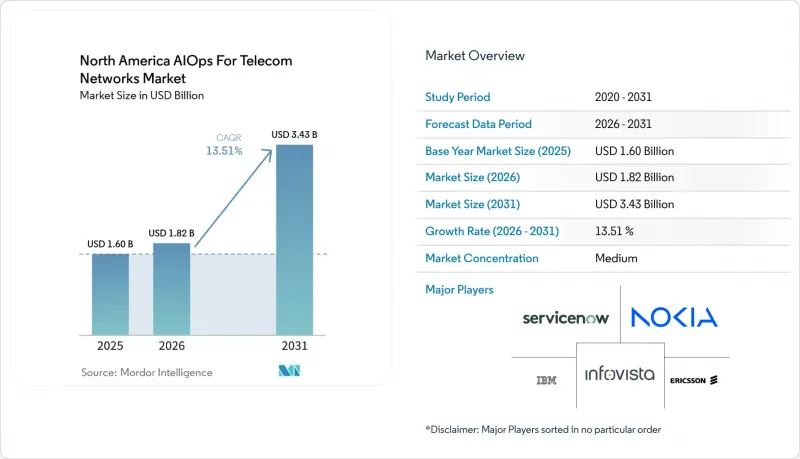
根據 Mordor Intelligence 預測,北美電信網路 AIOps 市場規模將從 2025 年的 16 億美元成長到 2026 年的 18.2 億美元,到 2031 年將達到 34.3 億美元,2026 年至 2031 年的複合年成長率為 13.51%。
北美電信網路AIOps市場的趨勢與洞察
5G、邊緣運算和網路切片技術的日益複雜化。
5G獨立組網(SA)網路帶來了以往網路所不具備的維運複雜性。每個活動切片都可以擁有各自的服務等級閾值、效能指標和故障隔離邊界。此外,切片感知拓樸結構改變了無線接取網、傳輸網和核心網事件之間的關係。這使得主要基於扁平網路資料訓練的平台在事件關聯方面面臨更大的挑戰。 NGMN聯盟致力於為自主行動網路開發基於代理的人工智慧,並建議使用專為這些環境設計的推理代理。在2026年世界行動通訊大會(MWC 2026)上,諾基亞與AWS合作發布了一款基於代理的AI驅動的5G-Advanced網路切片解決方案,該方案將MantaRay SMO與雲端AI功能整合,以支援運作中環境的網路運維。
對即時網路可視性和預測性保證的需求
北美電信業者不再只專注於單一性能指標。他們越來越需要結合控制平面和使用者平面遙測資料來評估對客戶體驗的影響。 TM Forum框架將使用者體驗下降置於封閉回路型修復的核心位置。這種方法需要一個能夠以極低延遲從眾多網路元素擷取資訊的資料擷取系統。德國電信報告稱,其基於谷歌雲端技術建構的MINDR平台在2025年11月發布後的第一個月就觸發了100多項自主修復措施。該平台還報告稱,對關鍵事件的回應時間從數小時縮短至數分鐘。
傳統OSS、BSS和網路域之間的高昂整合成本
傳統營運和業務支援系統是AIOps廣泛應用的一大障礙。許多電信業者仍然依賴點對點整合,隨著產品、系統或收購資產的增加,管理這些系統變得越來越困難。此外,遷移關鍵的客戶和網路資料也引發了人們對服務連續性的擔憂。儘管TM論壇的「開放數位架構」提供了通用的方向,但從專有資料模型遷移需要時間和周詳的規劃。因此,AIOps專案可能需要較長的準備期,才能獲得用於模型訓練的統一遙測流。由此造成的延誤對缺乏廣泛系統整合能力的供應商而言尤其具有挑戰性。
細分市場分析
2025年,該平台貢獻了67.21%的區域收入。這一主導地位反映了主要電信業者對整合資料擷取、事件關聯、拓樸感知和封閉回路型自動化的需求。替換多年來使用運營商特定遙測資料訓練的關聯引擎可能極具挑戰性。這些累積的訓練資料增加了現有供應商的轉換成本。該平台還整合了典型IT運維工具本身不具備的網路特定運作邏輯。在2026年6月的DTW26大會上,諾基亞更新了自主網路套件並發布了自主網路代理程式庫。
預計2026年至2031年,服務市場將以16.19%的複合年成長率成長。這代表著北美電信網路AIOps市場中成長最快的服務領域。營運商正擴大採用託管支援來處理特定活動,例如5G獨立組網核心網路中的故障排查和預測性射頻最佳化。這種模式使營運商能夠在利用專家支援進行模型開發和維護的同時,保持對平台的全面控制。它也有助於企業保留對敏感營運資料的控制權。 2026年6月,IBM和ServiceNow擴大了合作夥伴關係,旨在整合人工智慧、資料和自動化功能,以支援企業營運。此次合作反映了市場對整合營運工具的服務的需求,而無需營運商自行建立全部功能。
預計到2025年,基於雲端的採用將佔區域收入的51.59%,並在2026年至2031年間以16.70%的複合年成長率成長。這將使電信業者能夠在5G網路密度增加導致遙測資料量成長的情況下,擴展模型訓練和推理能力。因此,為每個工作負載建置和維護專用本地運算資源的需求得以降低。雲端環境也支援分散式資料採集和更快的軟體更新。這些功能使得對監控的網路事件進行近乎即時的決策成為可能。北美電信網路AIOps市場將受惠於將雲端工具與現有的營運管理系統並行使用。
對於聯邦網路和受監管的電信業者而言,本地部署仍然至關重要,因為它們滿足資料居住和網路隔離的要求。混合設計允許在本地維護敏感的處理和推理,同時將相應的管理功能連接到託管環境。這種方法有助於營運商避免從現有系統進行突兀的遷移。 2026年1月,Infovista發表了VistaAI,這是一款自動化保障和測試產品,提供雲端託管和本地部署選項。這種柔軟性將使北美電信網路AIOps市場能夠同時滿足以雲端為中心和以合規性為導向的需求。
其他好處:
- Excel格式的市場預測(ME)表
- 三個月的分析師支持
目錄
第1章:引言
- 研究假設和市場定義
- 調查範圍
第2章:調查方法
第3章執行摘要
第4章 市場狀況
- 市場概覽
- 市場促進因素
- 5G、邊緣運算和網路切片的複雜性日益增加。
- 對即時網路可視性和預測性保證的需求
- 降低網路營運中心營運成本 (OPEX) 和平均故障解決時間 (MTTR) 的壓力。
- 雲端原生、多廠商和混合通訊基礎設施的成長。
- 通訊業專用數位孿生:容量與事件回應決策
- 基於確定性圖的警報風暴根本原因分析
- 市場限制因素
- 傳統OSS、BSS和網路領域的高昂整合成本
- 數據品質、互通性和遙測標準化方面的挑戰。
- 通訊產業缺乏人工智慧運作、數據工程和自動化技能人才。
- 與相互依賴的網路層之間變更自動傳播相關的風險
- 產業價值鏈分析
- 監理情勢
- 技術展望
- 波特五力分析
- 宏觀經濟因素對市場的影響
第5章 市場規模與成長預測
- 報價
- 平台
- 服務
- 按部署模式
- 現場
- 基於雲端的
- 按組織規模
- 大公司
- 小型企業
- 透過使用
- 網路效能管理
- 事件和故障管理
- 網路安全管理
- 客戶體驗管理
- 基礎設施管理
- 應用效能分析
- 其他用途
- 最終用戶
- 行動電信商
- 固網和寬頻營運商
- 綜合電信服務供應商
- 其他最終用戶
- 國家
- 美國
- 加拿大
- 墨西哥
第6章 競爭情勢
- 市場集中度
- 策略趨勢
- 市佔率分析
- 公司簡介
- Nokia Corporation
- Telefonaktiebolaget LM Ericsson
- Cisco Systems, Inc.
- Broadcom Inc.
- Juniper Networks, Inc.
- Hewlett Packard Enterprise Company
- IBM Corporation
- VIAVI Solutions Inc.
- NETSCOUT SYSTEMS, INC.
- Infovista SAS
- RADCOM Ltd.
- Infosys Limited
- ServiceNow, Inc.
- NVIDIA Corporation
- Amdocs Limited
- Netcracker Technology Corporation
- Mavenir Systems, Inc.
- Selector Software, Inc.(Selector AI)
- NetAI Inc.
- Spirent Communications plc
第7章 市場機會與未來展望
According to Mordor Intelligence, the North America AIOps for Telecom Networks Market size is expected to grow from USD 1.60 billion in 2025 to USD 1.82 billion in 2026, and is forecast to reach USD 3.43 billion by 2031, at a 13.51% CAGR over 2026-2031.
North America AIOps For Telecom Networks Market Trends and Insights
Rising 5G, Edge, and Network-Slicing Complexity
5G standalone networks add operational complexity that was not present in earlier network generations. Each active slice can carry separate service-level thresholds, performance indicators, and fault-isolation boundaries. A slice-aware topology also changes the relationship between radio, transport, and core events. This makes event correlation more difficult for platforms trained mainly on flat-network data. The NGMN Alliance has recommended purpose-built reasoning agents for these environments in its work on agentic AI for autonomous mobile networks. Nokia presented an agentic AI-powered 5G-Advanced network slicing solution with AWS at MWC 2026, linking MantaRay SMO to cloud-based AI capabilities for live network operations.
Demand for Real-Time Network Visibility and Predictive Assurance
North American operators are moving beyond monitoring isolated performance indicators. They increasingly need to assess customer experience outcomes alongside control-plane and user-plane telemetry. The TM Forum framework places user experience degradation at the center of closed-loop remediation. That approach requires data collection systems that can ingest information from many network elements with limited delay. Deutsche Telekom reported that its MINDR platform, built with Google Cloud technologies, triggered more than 100 autonomous remediation actions in its first month of live operations after its November 2025 launch. The company also reported that the platform reduced management time for major events from hours to 1 minute.
High Integration Costs Across Legacy OSS, BSS, and Network Domains
Legacy operations and business support systems remain a major obstacle to wider AIOps adoption. Many operators still rely on point-to-point integrations that become harder to manage when products, systems, or acquired assets are added. Migrating critical customer and network data also raises service continuity concerns. The TM Forum Open Digital Architecture provides a common direction, but moving from proprietary data models takes time and careful planning. AIOps projects can therefore face lengthy preparation before a unified telemetry stream is available for model training. The resulting delay is especially difficult for vendors that lack broad systems integration capabilities.
Other drivers and restraints analyzed in the detailed report include:
- Pressure to Reduce NOC OPEX and Mean Time to Resolution
- Growth of Cloud-Native, Multi-Vendor, and Hybrid Telecom Infrastructure
- Data Quality, Interoperability, and Telemetry Standardization Gaps
For complete list of drivers and restraints, kindly check the Table Of Contents.
Segment Analysis
Platforms held 67.21% of regional revenue in 2025. Their lead reflects the needs of large carriers that require integrated ingestion, event correlation, topology awareness, and closed-loop automation. Replacing a correlation engine can be difficult when it has been trained on years of carrier-specific telemetry. That accumulated training data can reinforce switching costs for established providers. Platforms also include network-specific operating logic that general IT operations tools do not inherently provide. Nokia updated its Autonomous Networks Suite at DTW26 in June 2026 and released an Autonomous Networks Agent Library.
Services are projected to expand at a 16.19% CAGR from 2026 to 2031. It is the fastest-expanding offering type in the North America AIOps for Telecom Networks market. Operators increasingly procure managed support for defined activities such as fault resolution in 5G standalone core networks or predictive radio-frequency optimization. This model allows carriers to retain broader platform control while drawing on specialist support for model development and maintenance. It can also help organizations keep control of sensitive operational data. IBM and ServiceNow expanded their collaboration in June 2026 to combine AI, data, and automation capabilities for enterprise operations. The arrangement reflects demand for services that bring operational tools together without requiring every operator to build the full capability internally.
Cloud-based deployment accounted for 51.59% of regional revenue in 2025 and is projected to expand at a 16.70% CAGR from 2026 to 2031. It allows operators to scale model training and inference as telemetry volumes rise with denser 5G networks. This reduces the need to build and maintain dedicated on-premises computing capacity for every workload. Cloud environments can also support distributed data collection and faster software updates. These capabilities support near-real-time decisions for monitored network events. The North America AIOps for Telecom Networks market benefits when cloud tools can be used alongside established operational controls.
On-premises deployment remains relevant for federal networks and regulated carriers with data residency or network isolation requirements. Hybrid designs can keep sensitive processing and inference local while connecting suitable management functions to hosted environments. This approach helps operators avoid a hard transition from existing systems. Infovista introduced VistAI in January 2026 with cloud-hosted and on-premises deployment options for automated assurance and testing products. This flexibility allows the North America AIOps for Telecom Networks market to serve both cloud-focused and compliance-led deployment needs.
Complete Report Scope:
- By Offering
- Platforms
- Services
- By Deployment Model
- On-Premises
- Cloud-Based
- By Organization Size
- Large Enterprises
- Small and Medium-Sized Enterprises
- By Application
- Network Performance Management
- Fault and Incident Management
- Network Security Management
- Customer Experience Management
- Infrastructure Management
- Application Performance Analysis
- Other Applications
- By End-User
- Mobile Network Operators
- Fixed and Broadband Operators
- Integrated Communication Service Providers
- Other End-Users
- By Country
- United States
- Canada
- Mexico
List of Companies Covered in this Report:
- Nokia Corporation
- Telefonaktiebolaget LM Ericsson
- Cisco Systems, Inc.
- Broadcom Inc.
- Juniper Networks, Inc.
- Hewlett Packard Enterprise Company
- IBM Corporation
- VIAVI Solutions Inc.
- NETSCOUT SYSTEMS, INC.
- Infovista SAS
- RADCOM Ltd.
- Infosys Limited
- ServiceNow, Inc.
- NVIDIA Corporation
- Amdocs Limited
- Netcracker Technology Corporation
- Mavenir Systems, Inc.
- Selector Software, Inc. (Selector AI)
- NetAI Inc.
- Spirent Communications plc
Additional Benefits:
- The market estimate (ME) sheet in Excel format
- 3 months of analyst support
TABLE OF CONTENTS
1 INTRODUCTION
- 1.1 Study Assumptions and Market Definition
- 1.2 Scope of the Study
2 RESEARCH METHODOLOGY
3 EXECUTIVE SUMMARY
4 MARKET LANDSCAPE
- 4.1 Market Overview
- 4.2 Market Drivers
- 4.2.1 Rising 5G, Edge, and Network-Slicing Complexity
- 4.2.2 Demand for Real-Time Network Visibility and Predictive Assurance
- 4.2.3 Pressure to Reduce NOC OPEX and Mean Time to Resolution
- 4.2.4 Growth of Cloud-Native, Multi-Vendor, and Hybrid Telecom Infrastructure
- 4.2.5 Telecom-Specific Digital Twins for Capacity and Incident Decisions
- 4.2.6 Deterministic Graph-Based Root-Cause Analysis for Alarm Storms
- 4.3 Market Restraints
- 4.3.1 High Integration Costs Across Legacy OSS, BSS, and Network Domains
- 4.3.2 Data Quality, Interoperability, and Telemetry Standardization Gaps
- 4.3.3 Shortage of Telecom AIOps, Data Engineering, and Automation Skills
- 4.3.4 Risk of Automated Change Propagation Across Interdependent Network Layers
- 4.4 Industry Value-Chain Analysis
- 4.5 Regulatory Landscape
- 4.6 Technological Outlook
- 4.7 Porter's Five Forces Analysis
- 4.7.1 Bargaining Power of Suppliers
- 4.7.2 Bargaining Power of Buyers
- 4.7.3 Threat of New Entrants
- 4.7.4 Threat of Substitutes
- 4.7.5 Competitive Rivalry
- 4.8 Impact of Macroeconomic Factors on the Market
5 MARKET SIZE AND GROWTH FORECASTS (VALUE)
- 5.1 By Offering
- 5.1.1 Platforms
- 5.1.2 Services
- 5.2 By Deployment Model
- 5.2.1 On-Premises
- 5.2.2 Cloud-Based
- 5.3 By Organization Size
- 5.3.1 Large Enterprises
- 5.3.2 Small and Medium-Sized Enterprises
- 5.4 By Application
- 5.4.1 Network Performance Management
- 5.4.2 Fault and Incident Management
- 5.4.3 Network Security Management
- 5.4.4 Customer Experience Management
- 5.4.5 Infrastructure Management
- 5.4.6 Application Performance Analysis
- 5.4.7 Other Applications
- 5.5 By End-User
- 5.5.1 Mobile Network Operators
- 5.5.2 Fixed and Broadband Operators
- 5.5.3 Integrated Communication Service Providers
- 5.5.4 Other End-Users
- 5.6 By Country
- 5.6.1 United States
- 5.6.2 Canada
- 5.6.3 Mexico
6 COMPETITIVE LANDSCAPE
- 6.1 Market Concentration
- 6.2 Strategic Moves
- 6.3 Market Share Analysis
- 6.4 Company Profiles (includes Global Level Overview, Market Level Overview, Core Segments, Financials as available, Strategic Information, Market Rank/Share, Products and Services, Recent Developments)
- 6.4.1 Nokia Corporation
- 6.4.2 Telefonaktiebolaget LM Ericsson
- 6.4.3 Cisco Systems, Inc.
- 6.4.4 Broadcom Inc.
- 6.4.5 Juniper Networks, Inc.
- 6.4.6 Hewlett Packard Enterprise Company
- 6.4.7 IBM Corporation
- 6.4.8 VIAVI Solutions Inc.
- 6.4.9 NETSCOUT SYSTEMS, INC.
- 6.4.10 Infovista SAS
- 6.4.11 RADCOM Ltd.
- 6.4.12 Infosys Limited
- 6.4.13 ServiceNow, Inc.
- 6.4.14 NVIDIA Corporation
- 6.4.15 Amdocs Limited
- 6.4.16 Netcracker Technology Corporation
- 6.4.17 Mavenir Systems, Inc.
- 6.4.18 Selector Software, Inc. (Selector AI)
- 6.4.19 NetAI Inc.
- 6.4.20 Spirent Communications plc
7 MARKET OPPORTUNITIES AND FUTURE OUTLOOK
- 7.1 White-Space and Unmet-Need Assessment

 2026-2034年全球人工智慧平台IT運維市場規模、佔有率、趨勢及成長分析報告
 2034年IT運維人工智慧(AI)市場預測:按組件、部署模式、組織規模、應用、最終用戶和地區分類的全球分析
 面向IT運維的全端自動化軟體市場:全球市場預測(2026-2032年)
 歐洲基於AIOps的電信網路:市場佔有率分析、產業趨勢和統計數據以及成長預測(2026-2031年)面向通訊網路的AIOps:市場佔有率分析、產業趨勢與統計數據以及成長預測(2026-2031年)AIOps:市場佔有率分析、產業趨勢與統計、成長預測(2026-2031)AI維運平台市場預測至2034年-按組件、部署模式、組織規模、應用、產業、最終用戶和地區分類的全球分析自主IT維運:市場佔有率分析、產業趨勢與統計、成長預測(2026-2031年)AIOps平台市場預測至2034年-按交付類型、部署類型、組織規模、應用、最終用戶和地區分類的全球分析
 AIOps平台市場:按組件、組織規模、產業和地區分類