


 |
市場調查報告書
商品編碼
2157033
歐洲光轉發器:市場佔有率分析、行業趨勢和統計數據以及成長預測(2026-2031 年)Europe Optical Transponder - Market Share Analysis, Industry Trends & Statistics, Growth Forecasts (2026 - 2031) |
||||||

※ 本網頁內容可能與最新版本有所差異。詳細情況請與我們聯繫。
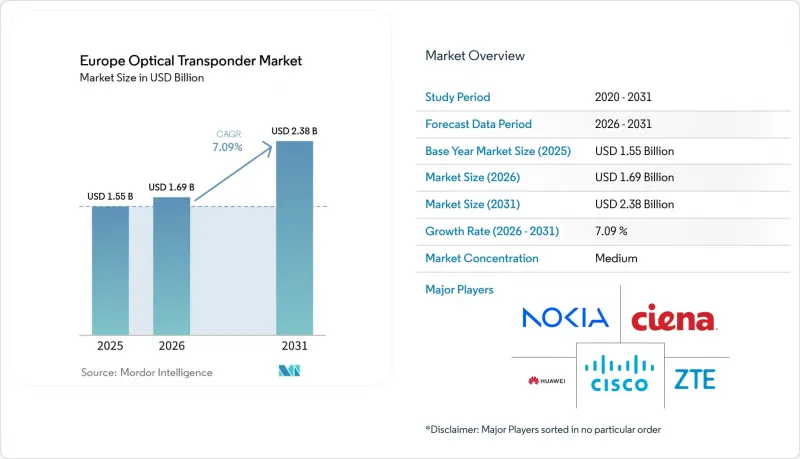
根據 Mordor Intelligence 預測,歐洲光轉發器市場規模將從 2025 年的 15.5 億美元成長到 2026 年的 16.9 億美元,到 2031 年將達到 23.8 億美元,2026 年至 2031 年的複合年成長率為 7.09%。
歐洲光轉發器市場的趨勢與洞察
透過人工智慧和超大規模資料中心業者資料中心擴展資料中心互聯性
人工智慧訓練系統擴大利用多個資料中心而非單一站點,這使得設施間高速、直接連接的需求日益成長。這些分散式工作負載需要高容量連貫轉發器,以便在園區、都會區和區域線路之間以低延遲傳輸資料。諾基亞報告稱,2026 年第一季光纖網路銷售額達 8.21 億歐元(9.59 億美元),主要得益於超大規模資料中心客戶的需求。這種需求使得供應商能夠獲得大規模的直接基本客群,因為雲端服務供應商無需透過營運商主導的競標即可採購光系統。隨著營運商在法蘭克福、阿姆斯特丹、巴黎、都柏林和其他互聯地點擴展其主要資料中心叢集,歐洲光轉發器市場將從中受益。
提升 5G 獨立回程傳輸與中傳的容量
獨立組網的5G網路需要無線基地台、邊緣系統和核心網路之間穩定、低延遲的傳輸。傳統的SDH和多業務傳輸平台並非為滿足這些連結的時序和容量要求而設計。高密度都市區光纖網路可以在共用路由上同時支援固定寬頻和行動回程,從而提高現有基礎設施的利用效率。這提升了連貫波長系統對於同時升級光纖接取和5G傳輸的電信營運商的效用。歐洲光轉發器市場正受益於這種協同效應,因為每次傳輸升級都可以支援多種網路業務。
對專用連貫DSP和光子封裝的依賴
先進的連貫系統依賴專用數位訊號處理器、磷化銦光子元件和高產能製造製程。即使營運商承諾為新線路資金籌措,供貨限制也可能導致設備交付延遲。這種限制在800G和未來的1.6Tbps產品中尤其突出,因為這些產品需要先進的組件和封裝技術。 2025年2月28日,諾基亞以23億美元完成了對Infinera的收購,將Infinera的磷化銦光子積體電路技術整合到其光纖網路業務中。歐洲光轉發器市場持續受到供應狀況的影響,而這些供應狀況的成因遠超過該地區網路營運商的控制範圍。
細分市場分析
到2025年,連貫技術將佔據歐洲光轉發器市場82.34%的佔有率,這反映出其在城域網路、長途網路和海底鏈路等廣泛應用中的普及。該技術允許每對光纖傳輸更多數據,因此適用於對容量和傳輸距離要求極高的線路。 2026年7月,RETN宣布其50%的IP/MPLS骨幹網路流量將透過400G連貫ZR和ZR+基礎設施傳輸。此次部署涵蓋了300公里至950公里的骨幹網路鏈路,顯示連貫可插拔設備已從測試階段過渡到標準網路設計。非連貫設備在短距離連接和傳統接取網路中仍然發揮著重要作用,因為這些網路不需要連貫系統額外的處理能力。然而,隨著越來越多的接取網路和都會區網路向高容量架構遷移,非相干設備的角色正逐漸受到限制。
預計到2031年,該細分市場將以7.72%的複合年成長率成長,成為該技術領域中成長最快的細分市場。 2025年9月,相干公司(Coherent Corp.)發布了交互應用的雙雷射100G ZR QSFP28模組,進一步拓展了連貫技術在接取環境中的應用。此舉表明,連貫和直接檢測設備之間的經濟界限正向短距離鏈路轉移。在2026年光纖通訊展(OFC 2026)上,諾基亞發表了一系列全新的連貫產品,適用於園區、城域、資料中心連接、長途和海底應用。該產品組合旨在滿足不同的距離和容量需求,而非依賴單一的系統設計。在歐洲光轉發器市場,由於電信業者尋求跨多個網路層的通用傳輸方案,預計連貫技術仍將佔據主導地位。
2025年,頻寬超過100 Gbps至400 Gbps的光纖收發器產品佔據了歐洲光纖收發器市場45.19%的佔有率。隨著400G設備的廣泛部署和營運商的熟悉度不斷提高,該頻寬繼續保持其作為現有長途和大型城域網路實用骨幹網路的地位。同時,高達100 Gbps的頻寬持續支援傳統接入線路、企業邊緣和低容量連線。頻寬超過400 Gbps至800 Gbps的客戶則需要升級,但尚未準備好圍繞原生800G連結重新設計其網路。 2025年2月,Arelion完成了在斯德哥爾摩和漢堡之間1069公里範圍內傳輸800G ZR+IP流量的現場試驗。試驗結果表明,與先前在同一線路上使用的技術相比,資本支出降低了66%,營運成本降低了95%。
上述800 Gbps頻寬預計到2031年將以12.81%的複合年成長率成長,成為數據速率市場中成長最快的細分市場。隨著人工智慧工作負載對資料中心和區域樞紐之間更大容量的需求,更高速度的設備正在部署。 2026年3月,Marvell發布了COLORZ 1600,這是一款1.6T ZR和ZR+相容的插件模組,以及一款新的800G插件模組。這些產品專為城域人工智慧互連而設計,支援800G速率下最遠1000公里的互連,以及600G速率下最遠2000公里的區域間互連。歐洲高速光轉發器的市場規模受資料中心架構、能源效率和現有光纖系統效能的影響。對800G+系統的需求將取決於相容路由器、線路系統和光元件的可用性。
其他好處:
- Excel格式的市場預測(ME)表
- 3個月的分析師支持
目錄
第1章:引言
- 研究假設和市場定義
- 調查範圍
第2章:調查方法
第3章執行摘要
第4章 市場狀況
- 市場概覽
- 市場促進因素
- 透過人工智慧和超大規模資料中心業者資料中心擴展資料中心互聯性
- 5G獨立組網系統中回程傳輸和中程鏈路的容量增強
- 從傳統SDH/SONET遷移到靈活網格連貫OTN
- 對跨境光纖和海底電纜的容錯能力進行投資
- 分散式人工智慧基礎設施需要 800ZR 或更高的互連性。
- 歐洲數位主權和安全光基礎設施計劃
- 市場限制因素
- 對特殊連貫數位訊號處理器和光子封裝的依賴
- 各國資格和安全評估存在差異
- 傳統光網路和開放式光纖網路之間的高整合成本。
- 光纖電纜安裝技術純熟勞工短缺
- 產業價值鏈分析
- 監理情勢
- 波特五力分析
- 宏觀經濟因素對市場的影響
第5章 市場規模與成長預測
- 透過傳輸技術
- 連貫
- 非連貫
- 按數據速率
- 最高可達 100 Gbps
- 超過 100 Gbps 至 400 Gbps
- 超過 400 Gbps 至 800 Gbps
- 800 Gbps 或更高
- 透過網路應用
- 捷運
- 長途
- 資料中心之間的互連
- 海底
- 其他網路應用
- 最終用戶
- 電信服務供應商
- 雲端和超大規模資料中心營運商
- 公司
- 政府/國防
- 其他最終用戶
- 國家
- 德國
- 英國
- 法國
- 義大利
- 西班牙
- 其他歐洲國家
第6章 競爭情勢
- 市場集中度
- 策略趨勢
- 市佔率分析
- 公司簡介
- Nokia Corporation
- Huawei Technologies Co., Ltd.
- Ciena Corporation
- Cisco Systems, Inc.
- ADTRAN Holdings, Inc.
- Ekinops SA
- ZTE Corporation
- Fujitsu Limited
- NEC Corporation
- Ribbon Communications Inc.
- Coherent Corp.
- Lumentum Holdings Inc.
- Marvell Technology, Inc.
- Broadcom Inc.
- Sumitomo Electric Industries, Ltd.
- Mitsubishi Electric Corporation
- FiberHome Telecommunication Technologies Co., Ltd.
- UfiSpace Co., Ltd.
- Edgecore Networks Corporation
- Smartoptics Group ASA
第7章 市場機會與未來展望
According to Mordor Intelligence, the Europe optical transponder market size is expected to grow from USD 1.55 billion in 2025 to USD 1.69 billion in 2026, and is forecast to reach USD 2.38 billion by 2031, at a 7.09% CAGR over 2026-2031.
Europe Optical Transponder Market Trends and Insights
AI and Hyperscaler Data Center Interconnect Expansion
AI training systems increasingly use multiple data centers rather than a single site, increasing the need for fast, direct connections between facilities. These distributed workloads require high-capacity, coherent transponders that can transport data across campus, metro, and regional routes with low delay. Nokia reported optical network revenue of EUR 821 million (USD 959 million) in the first quarter of 2026, with demand from hyperscale data center customers supporting performance. This demand gives equipment vendors a larger direct customer base, since cloud providers can procure optical systems without using a carrier-led tender. The European optical transponder market benefits when operators expand major data center clusters in Frankfurt, Amsterdam, Paris, Dublin, and other connected locations.
5G Standalone Backhaul and Mid-Haul Capacity Upgrades
Standalone 5G networks require stable, low-latency transport between radio sites, edge systems, and core networks. Older SDH and multiservice transport platforms were not designed to meet the timing and capacity requirements of these links. Dense urban fiber networks can support fixed broadband and mobile backhaul on shared routes, improving the use of existing infrastructure. This makes coherent wavelength systems more useful for operators upgrading both fiber access and 5G transport simultaneously. The Europe optical transponder market gains from this overlap because each transport upgrade can support more than one network service.
Specialized Coherent DSP and Photonic Packaging Dependence
Advanced coherent systems rely on specialized digital signal processors, indium phosphide photonic components, and high-capacity manufacturing processes. Availability constraints can delay equipment deliveries even when operators have committed funding for new routes. The constraint is most visible for 800G and future 1.6 Tbps products, which need advanced components and packaging. Nokia completed its USD 2.3 billion acquisition of Infinera on February 28, 2025, adding Infinera's indium phosphide photonic integrated circuit capability to its optical networking business. The European optical transponder market remains exposed to supply conditions that are determined well beyond the region's network operators.
Other drivers and restraints analyzed in the detailed report include:
- Legacy SDH and SONET Replacement by Flexible-Grid Coherent OTN
- Cross-Border Fiber and Submarine Cable Resilience Investment
- Fragmented National Qualification and Security Reviews
For complete list of drivers and restraints, kindly check the Table Of Contents.
Segment Analysis
Coherent technology held 82.34% of the Europe optical transponder market share in 2025, reflecting its broad use across metro, long-haul, and submarine routes. The technology carries more data over each fiber pair and is suited to routes where capacity and reach matter most. RETN stated in July 2026 that 50% of its IP/MPLS backbone traffic was carried over 400G coherent ZR and ZR+ infrastructure. The deployment covered backbone links from 300 km to 950 km and showed that coherent pluggables had moved from trials into standard network design. Non-coherent equipment remained relevant for short connections and legacy access networks where the additional processing of coherent systems was not needed. Its role was narrower because more access and metro networks were also moving toward higher-capacity architectures.
The segment is projected to expand at a 7.72% CAGR through 2031, the fastest rate within this technology grouping. Coherent Corp. introduced a dual-laser 100G ZR QSFP28 module for bidirectional applications in September 2025, extending coherent options into access environments. This development suggested that the economic boundary between coherent and direct-detect equipment was moving toward shorter links. Nokia presented new coherent product families at OFC 2026 for campus, metro, data center interconnect, long-haul, and subsea use. The product range addressed different distances and capacity needs rather than relying on one system design. The European optical transponder market will continue to favor coherent technology as operators seek a common transport approach across several network layers.
The above-100 Gbps to 400 Gbps tier accounted for 45.19% of the European optical transponder market in 2025. This tier remained the practical backbone for established long-haul and large metro routes because 400G equipment is widely deployed and familiar to operators. The up to 100 Gbps range continued to serve legacy access, enterprise edge, and lower-capacity connections. The above 400 Gbps to 800 Gbps tier supported customers that needed an upgrade but were not yet ready to redesign their networks around native 800G links. Arelion completed a field trial in February 2025 that carried 800G ZR+ IP traffic across 1,069 km between Stockholm and Hamburg. The trial reported a 66% reduction in capital expenditure and a 95% reduction in operating expenditure compared with the earlier technology used on that route.
The above 800 Gbps tier is projected to grow at a 12.81% CAGR through 2031, making it the fastest-growing data-rate segment. Higher-speed equipment is being adopted where AI workloads require more capacity among data centers and between regional hubs. Marvell introduced the COLORZ 1600, a 1.6T ZR and ZR+ pluggable, and a new 800G pluggable in March 2026. The products were designed for metro AI interconnects up to 1,000 km at 800G and regional links up to 2,000 km at 600G. The European optical transponder market size for higher-rate equipment is being shaped by data center architecture, power efficiency, and the readiness of existing fiber systems. Demand for 800G+ systems will depend on the availability of compatible routers, line systems, and optical components.
Complete Report Scope:
- By Transmission Technology
- Coherent
- Non-Coherent
- By Data Rate
- Up to 100 Gbps
- Above 100 Gbps to 400 Gbps
- Above 400 Gbps to 800 Gbps
- Above 800 Gbps
- By Network Application
- Metro
- Long-Haul
- Data Center Interconnect
- Submarine
- Other Network Applications
- By End-User
- Telecommunication Service Providers
- Cloud and Hyperscale Data Center Operators
- Enterprises
- Government and Defense
- Other End-Users
- By Country
- Germany
- United Kingdom
- France
- Italy
- Spain
- Rest of Europe
List of Companies Covered in this Report:
- Nokia Corporation
- Huawei Technologies Co., Ltd.
- Ciena Corporation
- Cisco Systems, Inc.
- ADTRAN Holdings, Inc.
- Ekinops S.A.
- ZTE Corporation
- Fujitsu Limited
- NEC Corporation
- Ribbon Communications Inc.
- Coherent Corp.
- Lumentum Holdings Inc.
- Marvell Technology, Inc.
- Broadcom Inc.
- Sumitomo Electric Industries, Ltd.
- Mitsubishi Electric Corporation
- FiberHome Telecommunication Technologies Co., Ltd.
- UfiSpace Co., Ltd.
- Edgecore Networks Corporation
- Smartoptics Group ASA
Additional Benefits:
- The market estimate (ME) sheet in Excel format
- 3 months of analyst support
TABLE OF CONTENTS
1 INTRODUCTION
- 1.1 Study Assumptions and Market Definition
- 1.2 Scope of the Study
2 RESEARCH METHODOLOGY
3 EXECUTIVE SUMMARY
4 MARKET LANDSCAPE
- 4.1 Market Overview
- 4.2 Market Drivers
- 4.2.1 AI and Hyperscaler Data Center Interconnect Expansion
- 4.2.2 5G Standalone Backhaul and Mid-Haul Capacity Upgrades
- 4.2.3 Legacy SDH/SONET Replacement by Flexible-Grid Coherent OTN
- 4.2.4 Cross-Border Fiber and Submarine Cable Resilience Investment
- 4.2.5 Distributed AI Infrastructure Requiring 800ZR+ Interconnects
- 4.2.6 European Digital Sovereignty and Secure Optical Infrastructure Programs
- 4.3 Market Restraints
- 4.3.1 Specialized Coherent DSP and Photonic Packaging Dependence
- 4.3.2 Fragmented National Qualification and Security Reviews
- 4.3.3 High Integration Cost Across Legacy and Open Optical Networks
- 4.3.4 Skilled Fiber-Deployment Labor Shortages
- 4.4 Industry Value Chain Analysis
- 4.5 Regulatory Landscape
- 4.6 Porter's Five Forces Analysis
- 4.6.1 Threat of New Entrants
- 4.6.2 Bargaining Power of Suppliers
- 4.6.3 Bargaining Power of Buyers
- 4.6.4 Threat of Substitutes
- 4.6.5 Competitive Rivalry
- 4.7 Impact of Macroeconomic Factors on the Market
5 MARKET SIZE AND GROWTH FORECASTS (VALUE)
- 5.1 By Transmission Technology
- 5.1.1 Coherent
- 5.1.2 Non-Coherent
- 5.2 By Data Rate
- 5.2.1 Up to 100 Gbps
- 5.2.2 Above 100 Gbps to 400 Gbps
- 5.2.3 Above 400 Gbps to 800 Gbps
- 5.2.4 Above 800 Gbps
- 5.3 By Network Application
- 5.3.1 Metro
- 5.3.2 Long-Haul
- 5.3.3 Data Center Interconnect
- 5.3.4 Submarine
- 5.3.5 Other Network Applications
- 5.4 By End-User
- 5.4.1 Telecommunication Service Providers
- 5.4.2 Cloud and Hyperscale Data Center Operators
- 5.4.3 Enterprises
- 5.4.4 Government and Defense
- 5.4.5 Other End-Users
- 5.5 By Country
- 5.5.1 Germany
- 5.5.2 United Kingdom
- 5.5.3 France
- 5.5.4 Italy
- 5.5.5 Spain
- 5.5.6 Rest of Europe
6 COMPETITIVE LANDSCAPE
- 6.1 Market Concentration
- 6.2 Strategic Moves
- 6.3 Market Share Analysis
- 6.4 Company Profiles (includes Global Level Overview, Market Level Overview, Core Segments, Financials as available, Strategic Information, Market Rank/Share, Products and Services, Recent Developments)
- 6.4.1 Nokia Corporation
- 6.4.2 Huawei Technologies Co., Ltd.
- 6.4.3 Ciena Corporation
- 6.4.4 Cisco Systems, Inc.
- 6.4.5 ADTRAN Holdings, Inc.
- 6.4.6 Ekinops S.A.
- 6.4.7 ZTE Corporation
- 6.4.8 Fujitsu Limited
- 6.4.9 NEC Corporation
- 6.4.10 Ribbon Communications Inc.
- 6.4.11 Coherent Corp.
- 6.4.12 Lumentum Holdings Inc.
- 6.4.13 Marvell Technology, Inc.
- 6.4.14 Broadcom Inc.
- 6.4.15 Sumitomo Electric Industries, Ltd.
- 6.4.16 Mitsubishi Electric Corporation
- 6.4.17 FiberHome Telecommunication Technologies Co., Ltd.
- 6.4.18 UfiSpace Co., Ltd.
- 6.4.19 Edgecore Networks Corporation
- 6.4.20 Smartoptics Group ASA
7 MARKET OPPORTUNITIES AND FUTURE OUTLOOK
- 7.1 White-Space and Unmet-Need Assessment

 衛星轉頻器市場規模、佔有率、成長、全球產業分析、區域趨勢及2026年至2034年預測
 Ku波段衛星轉發器市場規模、佔有率和成長分析:按應用程式類型、服務概況、最終用戶產業和地區分類-2026-2033年產業預測
 光收發器:市場佔有率分析、產業趨勢與統計、成長預測(2026-2031)北美光轉發器市場:市場佔有率分析、產業趨勢與統計及成長預測(2026-2031 年)亞太地區光收發器:市佔率分析、產業趨勢與統計及成長預測(2026-2031)南美洲光轉發器:市場佔有率分析、產業趨勢與統計及成長預測(2026-2031 年)
 衛星轉發器租賃市場分析與預測(至2035年):類型、產品類型、服務、技術、組件、應用、部署狀態、最終用戶、解決方案
 2026年全球衛星轉發器市場報告
 衛星轉發器市場規模、佔有率和成長分析(按轉發器類型、放大器類型、服務、頻寬、頻率和地區分類)—產業預測(2026-2033 年)
 衛星轉發器市場規模、佔有率、趨勢分析報告:按頻段、服務、衛星平台、應用、地區和細分市場預測,2025 年至 2033 年