


 |
市場調查報告書
商品編碼
2155592
南美洲光轉發器:市場佔有率分析、產業趨勢與統計及成長預測(2026-2031 年)South America Optical Transponder - Market Share Analysis, Industry Trends & Statistics, Growth Forecasts (2026 - 2031) |
||||||

※ 本網頁內容可能與最新版本有所差異。詳細情況請與我們聯繫。
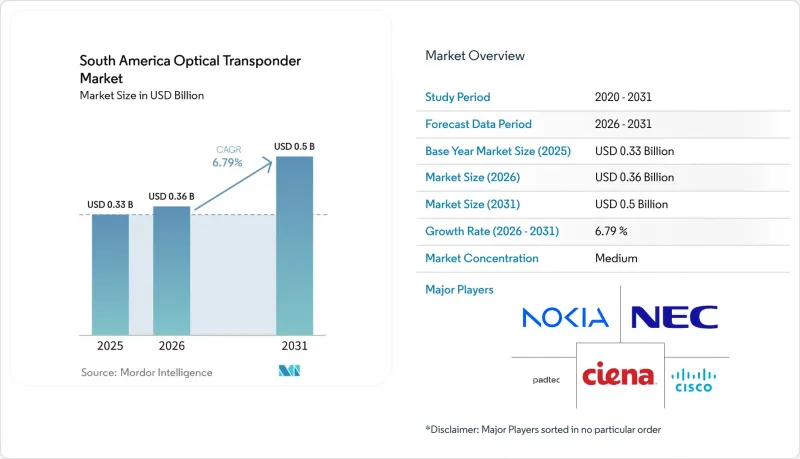
根據 Mordor Intelligence 預測,南美光轉發器市場規模預計在 2025 年達到 3.3 億美元,2026 年達到 3.6 億美元,到 2031 年達到 5 億美元,2026 年至 2031 年的複合年成長率為 6.79%。
南美洲光轉發器市場趨勢與分析
5G 和光纖回程傳輸容量擴展
5G中頻段的部署提高了匯聚節點回程傳輸鏈路的頻譜需求。每個扇區的需求可能達到4G匯聚的10倍,而微波鏈路無法提供高密度流量負載所需的容量。阿根廷電信的目標是到2025年底運作1,000個5G基地台,到2026年底營運2,000多個基地台,而Claro Argentina已宣佈在2026年投資5億美元用於光纖和5G建設。 「OpenRAN@Brasil」計畫正在將RNP網路從MPLS架構升級到SRv6協議,以支援更開放的無線存取部署的傳輸方案。這些部署即使在以前由於流量密度較低而限制高容量光纖通訊投資的農村城市,也對穩定的傳輸提出了需求。因此,南美洲光纖轉發器市場的需求不僅來自現有的長途線路,也來自接取網路和匯聚網路。
雲端、人工智慧和資料中心連接流量的成長
人工智慧工作負載會產生突發性流量,因此資料中心之間需要低延遲且可預測的光纖通訊容量。 Equinix 投資 1.14 億美元,於 2026 年 4 月在巴西聖塔安娜-德帕爾奈巴開設了其支援人工智慧的 SP6 資料中心。 Tecto 資料中心也宣布了一項 20 億美元的擴建計劃,計劃到 2028 年在巴西的五個資料中心完成擴建。 Brasscom 預測,到 2025 年,巴西的資料中心投資將達到 90 億美元(其中 70 億美元為資本支出),預計到 2031 年,累積投資將達到 920 億美元(其中 690 億美元為資本支出)。這將為互聯容量奠定堅實的基礎。 Cirion 透過其「DC Connect」服務部署了 Ciena 的 WaveLogic 6 Extreme 技術,該技術支援 1.6 Tb/s 的單載波波長,連接了巴西各地 70 多個資料中心。因此,南美光轉發器市場正在向更高容量的互聯服務轉型,這些服務能夠全面評估容量、範圍和延遲。
貨幣貶值與進口設備成本上升
由於超過90%的連貫光轉發器設備依賴海外採購,巴西幣貶值可能導致以該地貨幣的設備成本上漲10%至15%。這種壓力可能會削弱小規模網路服務供應商的資本支出能力,並延長其設備更換週期。阿根廷電信透過大幅增加2025年的資本支出來應對相關壓力,但小規模的區域業者在應對外匯波動方面選擇有限。大型電信公司可以利用對沖交易和美元計價的採購契約,而區域性業者通常需要直接承擔增加的本地成本。因此,南美光轉發器市場的大型營運商與中小型業者在採購條款方面存在差異。
細分市場分析
預計到2025年,連貫傳輸技術將佔區域銷售額的80.39%,並將在2031年之前以7.45%的複合年成長率成長。在南美光轉發器市場,其市場地位反映了數位訊號處理(DSP)平台在長途網路中提供頻譜效率和可適應的傳輸距離的能力。隨機衛星群整形技術透過幫助營運商根據連結狀況調整容量來滿足這些性能要求。當固定傳輸配置因長距離和流量波動而不再適用時,網路營運商會利用這些功能。此外,連貫平台還能滿足骨幹網現代化和資料中心互連所需的高通道速率。
在80公里以下的校內和城域鏈路中,非連貫系統仍然發揮著至關重要的作用,因為在這些鏈路中,連貫數位訊號處理器的成本相對於流量和距離而言並不划算。然而,隨著連貫可插拔模組的每個位元成本接近連貫系統在高容量部署中的作用正在逐漸減弱。 Eletronet公司採用了諾基亞的1830 PSS和1830 GX平台對其骨幹網路進行了現代化改造,實現了高達1.2 Tb/s的頻道速度。該項目表明,在巴西,超過800 Gbps的連貫容量正成為長途線路可行的採購方案。這項技術變革將使電信營運商、網際服務供應商和資料中心能夠採用更統一的設備部署方式。
到2025年,100 Gbps至400 Gbps頻寬層級將佔全部區域收入的49.16%。在南美光轉發器市場,這個頻寬層級已成為電信業者和網路服務供應商的首選商業方案,取代了老舊的100G設備。 Padtec報告稱,其在南美洲已售出1000台TMD400G設備,顯示這項轉型正在擴展到區域網路服務供應商的網路。靈活速率的400G系統允許營運商提高現有頻道速率,從而減少了單獨採購單速率100G設備的需求。這種特性使得此頻寬非常適合大規模的網路升級。
隨著營運商傾向於選擇能夠應對更高速度、更靈活的平台以應對日益成長的流量,頻寬高達 100 Gbps 的產品正在失去市場佔有率。 400 Gbps 至 800 Gbps 的頻寬正處於國內骨幹網路升級的過渡階段,此時容量需求不斷成長,部署條件也各不相同。預計到 2031 年,800 Gbps 以上的頻寬將以 11.60% 的複合年成長率成長,這主要得益於海底光纜終端、超大規模互連以及下一代骨幹網路專案的發展。 Eletronet 的現代化改造計畫實現了單通道高達 1.2 Tb/s 的傳輸速度,顯示市場正轉向採購高容量骨幹網路。因此,在南美光轉發器市場,高容量平台的應用正在不斷擴展,而 400G 仍然是銷售的基準。
其他好處:
- Excel格式的市場預測(ME)表
- 3個月的分析師支持
目錄
第1章:引言
- 研究假設和市場定義
- 調查範圍
第2章:調查方法
第3章執行摘要
第4章 市場狀況
- 市場概覽
- 市場促進因素
- 擴充 5G 和光纖回程傳輸容量
- 雲端運算、人工智慧和資料中心連接流量正在增加。
- 超大規模企業和電信業者對高容量海底網路的投資
- 區域內從100G到400G和800G連貫波長的過渡
- 基於巴西OPGW的骨幹網路和邊緣資料中心的擴展
- 區域網際網路服務供應商採用開放式光網路技術的現狀
- 市場限制因素
- 貨幣貶值與進口設備成本上升
- 認證和型式認可要求的差異
- 缺乏連貫光學和現場服務方面的技能。
- 在主要樞紐以外的地區,傳統光纖網路的覆蓋範圍、功率和安裝成本都受到限制。
- 產業價值鏈分析
- 監理情勢
- 波特五力分析
- 宏觀經濟因素對市場的影響
第5章 市場規模與成長預測
- 透過傳輸技術
- 連貫
- 非連貫
- 按數據速率
- 最高可達 100 Gbps
- 超過 100 Gbps 至 400 Gbps
- 超過 400 Gbps 至 800 Gbps
- 800 Gbps 或更高
- 透過網路應用
- 捷運
- 長途
- 資料中心之間的互連
- 海底
- 其他網路應用
- 最終用戶
- 電信服務供應商
- 雲端和超大規模資料中心營運商
- 公司
- 政府/國防
- 其他最終用戶
- 國家
- 巴西
- 阿根廷
- 其他南美國家
第6章 競爭情勢
- 市場集中度
- 策略趨勢
- 市佔率分析
- 公司簡介
- Ciena Corporation
- Nokia Corporation
- Huawei Technologies Co., Ltd.
- Cisco Systems, Inc.
- ZTE Corporation
- NEC Corporation
- Padtec SA
- Datacom SA(Intelbras SA)
- Ribbon Communications Inc.
- Juniper Networks, Inc.
- Coherent Corp.
- Lumentum Holdings Inc.
- FiberHome Telecommunication Technologies Co., Ltd.
第7章 市場機會與未來展望
According to Mordor Intelligence, the South America optical transponder market size is projected to be USD 0.33 billion in 2025, USD 0.36 billion in 2026, and reach USD 0.5 billion by 2031, growing at a CAGR of 6.79% from 2026 to 2031.
South America Optical Transponder Market Trends and Insights
5G and Fiber-Backhaul Capacity Expansion
5G mid-band deployment is increasing backhaul spectral requirements at aggregation nodes, where demand can be 10 times greater per sector than for 4G aggregation, and microwave links do not provide the capacity needed for denser traffic loads. Telecom Argentina closed 2025 with 1,000 5G sites and targets more than 2,000 sites by the end of 2026, while Claro Argentina committed USD 500 million to fiber and 5G during 2026. The "OpenRAN@Brasil" program is modernizing the RNP network from an MPLS architecture to SRv6 protocols, thereby supporting transport planning for more open radio access deployments. These deployments bring coherent transport requirements to secondary cities, where historically lower traffic density has supported fewer high-capacity optical investments. The South America optical transponder market, therefore, gains demand from access and aggregation networks as well as from established long-haul corridors.
Cloud, AI, and Data Center Interconnect Traffic Growth
AI workloads generate bursty traffic that requires low-latency, predictable optical capacity between data center locations. Equinix opened the AI-ready SP6 site in Santana de Parnaiba in April 2026 after investing USD 114 million, and Tecto Data Centers announced a USD 2 billion expansion plan for 5 facilities in Brazil through 2028. Brasscom projected USD 9 billion in Brazilian data center investment in 2025, including USD 7 billion for equipment, and a cumulative investment of USD 92 billion through 2031, including USD 69 billion in equipment, which establishes a strong base for interconnection capacity. Cirion is deploying Ciena WaveLogic 6 Extreme technology for 1.6 Tb/s single-carrier wavelengths through its DC Connect service, which connects more than 70 data centers in Brazil. The South America optical transponder market is consequently moving toward higher-capacity interconnection services, in which capacity, reach, and latency are assessed together.
Currency Depreciation and Imported Equipment Cost Inflation
More than 90% of coherent optical transponder equipment is sourced internationally, so depreciation of the Brazilian real can increase local-currency equipment costs by 10% to 15%. This pressure reduces available capital expenditure at smaller internet service providers and can lengthen their equipment replacement cycles. Telecom Argentina absorbed related pressure through a major increase in capital expenditure in 2025, but smaller regional providers have fewer options for managing currency volatility. Large carriers can use hedging arrangements or U.S.-dollar procurement contracts, whereas regional providers generally face the local cost increase directly. The South America optical transponder market, therefore, has uneven purchasing conditions between large operators and smaller providers.
Other drivers and restraints analyzed in the detailed report include:
- Hyperscale And Carrier Investment In High-Capacity Subsea Routes
- Regional Migration From 100G To 400G And 800G Coherent Wavelengths
- Fragmented Certification And Type-Approval Requirements
For complete list of drivers and restraints, kindly check the Table Of Contents.
Segment Analysis
Coherent transmission technology accounted for 80.39% of regional revenue in 2025 and is projected to expand at a 7.45% CAGR through 2031. In the South America optical transponder market, the market position reflects the ability of digital signal processor platforms to provide spectral efficiency and adaptable reach over long network spans. Probabilistic constellation shaping supports these performance requirements by helping operators adjust capacity to link conditions. Network operators use these features where long distances and changing traffic patterns make fixed transmission settings less suitable. Coherent platforms also support the higher channel rates needed for backbone modernization and data center interconnection.
Non-coherent systems remain relevant for campus and intra-metro links below 80 km, where traffic volumes and distances do not always justify the costs of coherent digital signal processors. Their role is narrowing as coherent pluggable modules move closer to cost parity on a per-bit basis for capacity-intensive deployments. Eletronet selected Nokia 1830 PSS and 1830 GX platforms for its backbone modernization, enabling channel speeds of up to 1.2 Tb/s. The project shows that coherent capacity above 800 Gbps is becoming a practical procurement option for Brazilian long-haul routes. This technology shift supports a more consistent equipment approach across carrier, internet service provider, and data center networks.
The above 100 Gbps to 400 Gbps tier held 49.16% of regional revenue in 2025. Within the South America optical transponder market, this tier is the main commercial choice for carriers and internet service providers, replacing older 100G equipment. Padtec reported sales of 1,000 TMD400G units across South America, which indicates that the transition has reached regional internet service provider networks. Flexible-rate 400G systems allow operators to increase channel rates in place, reducing the need to procure separate single-rate 100G equipment. This capability makes the tier suitable for broad network refresh programs.
The up to 100 Gbps tier is losing value share as operators favor flexible platforms that can support higher rates when traffic rises. The above 400 Gbps to 800 Gbps tier serves as a transition stage for national backbone upgrades where capacity needs are rising, but deployment conditions vary. The above 800 Gbps tier is projected to record an 11.60% CAGR through 2031, supported by subsea terminations, hyperscale interconnection, and next-generation backbone projects. Eletronet's modernization program enables up to 1.2 Tb/s per channel, indicating a shift toward higher-capacity backbone procurement. The South America optical transponder market has therefore retained 400G as its volume base while increasing adoption of higher-capacity platforms.
Complete Report Scope:
- By Transmission Technology
- Coherent
- Non-Coherent
- By Data Rate
- Up to 100 Gbps
- Above 100 Gbps to 400 Gbps
- Above 400 Gbps to 800 Gbps
- Above 800 Gbps
- By Network Application
- Metro
- Long-Haul
- Data Center Interconnect
- Submarine
- Other Network Applications
- By End-User
- Telecommunication Service Providers
- Cloud and Hyperscale Data Center Operators
- Enterprises
- Government and Defense
- Other End-Users
- By Country
- Brazil
- Argentina
- Rest of South America
List of Companies Covered in this Report:
- Ciena Corporation
- Nokia Corporation
- Huawei Technologies Co., Ltd.
- Cisco Systems, Inc.
- ZTE Corporation
- NEC Corporation
- Padtec S.A.
- Datacom S.A. (Intelbras S.A.)
- Ribbon Communications Inc.
- Juniper Networks, Inc.
- Coherent Corp.
- Lumentum Holdings Inc.
- FiberHome Telecommunication Technologies Co., Ltd.
Additional Benefits:
- The market estimate (ME) sheet in Excel format
- 3 months of analyst support
TABLE OF CONTENTS
1 INTRODUCTION
- 1.1 Study Assumptions and Market Definition
- 1.2 Scope of the Study
2 RESEARCH METHODOLOGY
3 EXECUTIVE SUMMARY
4 MARKET LANDSCAPE
- 4.1 Market Overview
- 4.2 Market Drivers
- 4.2.1 5G and Fiber-Backhaul Capacity Expansion
- 4.2.2 Cloud, AI, and Data-Center Interconnect Traffic Growth
- 4.2.3 Hyperscale and Carrier Investment in High-Capacity Subsea Routes
- 4.2.4 Regional Migration From 100G to 400G and 800G Coherent Wavelengths
- 4.2.5 Brazil's OPGW-Based Backbone and Edge-Data-Center Expansion
- 4.2.6 Open Optical Networking Adoption Among Regional ISPs
- 4.3 Market Restraints
- 4.3.1 Currency Depreciation and Imported-Equipment Cost Inflation
- 4.3.2 Fragmented Certification and Type-Approval Requirements
- 4.3.3 Shortage of Coherent-Optics Engineering and Field-Service Skills
- 4.3.4 Legacy-Fiber Reach, Power, and Site-Economics Constraints Outside Major Hubs
- 4.4 Industry Value Chain Analysis
- 4.5 Regulatory Landscape
- 4.6 Porter's Five Forces Analysis
- 4.6.1 Threat of New Entrants
- 4.6.2 Bargaining Power of Suppliers
- 4.6.3 Bargaining Power of Buyers
- 4.6.4 Threat of Substitutes
- 4.6.5 Competitive Rivalry
- 4.7 Impact of Macroeconomic Factors on the Market
5 MARKET SIZE AND GROWTH FORECASTS (VALUE)
- 5.1 By Transmission Technology
- 5.1.1 Coherent
- 5.1.2 Non-Coherent
- 5.2 By Data Rate
- 5.2.1 Up to 100 Gbps
- 5.2.2 Above 100 Gbps to 400 Gbps
- 5.2.3 Above 400 Gbps to 800 Gbps
- 5.2.4 Above 800 Gbps
- 5.3 By Network Application
- 5.3.1 Metro
- 5.3.2 Long-Haul
- 5.3.3 Data Center Interconnect
- 5.3.4 Submarine
- 5.3.5 Other Network Applications
- 5.4 By End-User
- 5.4.1 Telecommunication Service Providers
- 5.4.2 Cloud and Hyperscale Data Center Operators
- 5.4.3 Enterprises
- 5.4.4 Government and Defense
- 5.4.5 Other End-Users
- 5.5 By Country
- 5.5.1 Brazil
- 5.5.2 Argentina
- 5.5.3 Rest of South America
6 COMPETITIVE LANDSCAPE
- 6.1 Market Concentration
- 6.2 Strategic Moves
- 6.3 Market Share Analysis
- 6.4 Company Profiles (includes Global Level Overview, Market Level Overview, Core Segments, Financials as available, Strategic Information, Market Rank/Share, Products and Services, Recent Developments)
- 6.4.1 Ciena Corporation
- 6.4.2 Nokia Corporation
- 6.4.3 Huawei Technologies Co., Ltd.
- 6.4.4 Cisco Systems, Inc.
- 6.4.5 ZTE Corporation
- 6.4.6 NEC Corporation
- 6.4.7 Padtec S.A.
- 6.4.8 Datacom S.A. (Intelbras S.A.)
- 6.4.9 Ribbon Communications Inc.
- 6.4.10 Juniper Networks, Inc.
- 6.4.11 Coherent Corp.
- 6.4.12 Lumentum Holdings Inc.
- 6.4.13 FiberHome Telecommunication Technologies Co., Ltd.
7 MARKET OPPORTUNITIES AND FUTURE OUTLOOK
- 7.1 White-Space and Unmet-Need Assessment

 衛星轉頻器市場規模、佔有率、成長、全球產業分析、區域趨勢及2026年至2034年預測
 Ku波段衛星轉發器市場規模、佔有率和成長分析:按應用程式類型、服務概況、最終用戶產業和地區分類-2026-2033年產業預測
 光收發器:市場佔有率分析、產業趨勢與統計、成長預測(2026-2031)北美光轉發器市場:市場佔有率分析、產業趨勢與統計及成長預測(2026-2031 年)歐洲光轉發器:市場佔有率分析、行業趨勢和統計數據以及成長預測(2026-2031 年)亞太地區光收發器:市佔率分析、產業趨勢與統計及成長預測(2026-2031)
 衛星轉發器租賃市場分析與預測(至2035年):類型、產品類型、服務、技術、組件、應用、部署狀態、最終用戶、解決方案
 2026年全球衛星轉發器市場報告
 衛星轉發器市場規模、佔有率和成長分析(按轉發器類型、放大器類型、服務、頻寬、頻率和地區分類)—產業預測(2026-2033 年)
 衛星轉發器市場規模、佔有率、趨勢分析報告:按頻段、服務、衛星平台、應用、地區和細分市場預測,2025 年至 2033 年