


 |
市場調查報告書
商品編碼
2157031
光收發器:市場佔有率分析、產業趨勢與統計、成長預測(2026-2031)Optical Transponder - Market Share Analysis, Industry Trends & Statistics, Growth Forecasts (2026 - 2031) |
||||||

※ 本網頁內容可能與最新版本有所差異。詳細情況請與我們聯繫。
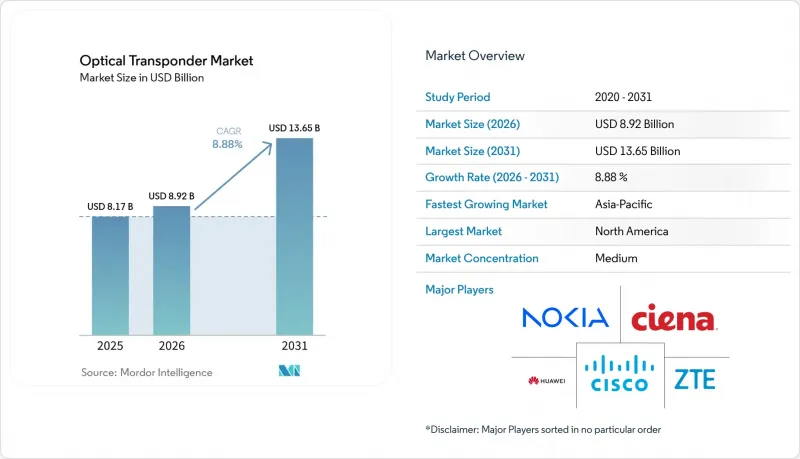
根據 Mordor Intelligence 預測,光轉發器市場規模將從 2025 年的 81.7 億美元成長到 2026 年的 89.2 億美元,然後在 2031 年達到 136.5 億美元,2026 年至 2031 年的複合年成長率為 8.88%。
全球光收發器市場趨勢與洞察
擴展人工智慧叢集和超大規模資料中心的互聯互通
人工智慧訓練和推理工作負載需要大量的GPU間連接才能以全線速運作。銅纜方案無法滿足短距離鏈路以外的距離、吞吐量和延遲要求。雲端服務供應商正在重新設計園區區間鏈路,並採用400G ZR和800G ZR+連貫可插拔光模組,而不是簡單地在為以往流量模式設計的傳統傳輸架構上添加連接埠。這在光轉發器市場中創造了一種獨特的需求類別,因為這些買家直接採購設備,提出嚴格的技術要求,並期望供應商交付能夠滿足快速部署計劃的平台。 Alphabet、亞馬遜、Meta和微軟都將在2026年投入大量基礎設施資金來擴展其人工智慧能力。 2026年3月,NVIDIA宣布與Coherent公司達成多年協議,其中包括20億美元的股權投資以及採購先進光產品的承諾。
從 100GB 過渡到 400GB、800GB 和 1.6TB
隨著向更高線路速率的過渡不斷推進,這將是一次廣泛的架構變革,而不僅僅是週期性的設備升級。因為每一代產品都將涉及數位訊號處理器、調變方案、頻譜效率目標和系統整合方法等方面的改進。 IEEE Std 802.3df-2024 於 2024 年 2 月獲得批准,為 800G 乙太網路建立了框架,並支援廠商認證至 2025 年。首批 1.6T OSFP224 模組將於 2026 年開始量產出貨,早於 IEEE P802.3dj 的完成。每一代新型連貫DSP 在開始商業量產之前,都需要經過 12-24 個月的營運商和超大規模資料中心業者資料中心認證,以便買家評估其可靠性、互通性、功耗和運作條件下的效能。這項時間表表明,在技術部署後的 2-3 年內即可實現可觀的收益。 Marvell 發布了採用其 Electra 2 奈米連貫DSP 的 COLORZ 1600,而 Ciena 發布了採用 2 奈米矽設計的 1600ZR/ZR+ 插件模組,計劃於 2026 年發布。
連貫數位訊號處理器、光子引擎和認證相關的高成本限制了其普及應用。
部署新一代連貫轉發器的成本遠遠超過DSP本身。 400G或800G系統還需要基於InP的光子前端、高精度光學子組件以及大量的系統測試。一級營運商和超大規模資料中心業者的認證可能需要12到24個月才能開始商業化量產。 Ciena的2nm平台和諾基亞在OFC 2026上發布的四款新型DSP預計將於2027年中期提供樣品。這意味著,開發連貫產品可能需要3到4年才能透過量產來獲利,這將增加資金需求,並進一步增加中小型技術供應商的執行風險。對於連貫解決方案仍然昂貴且流量不足以支撐全連貫光纖傳輸高昂成本的短距離連接,小規模和大型營運商可能仍會選擇灰光方案。
細分市場分析
在光轉發器市場,連貫轉發器在2025年佔83.22%的銷售額,預計2026年至2031年將以9.65%的複合年成長率成長。其領先地位的確立,源自於電信業者與超大規模資料中心業者資料中心之間連結距離超過80公里的案例日益增多,在這些距離上,連貫檢測已成為商業性必要。連貫系統中的光轉發器市場規模的擴大,得益於傳統100G設備被400G和800G平台取代。新型資料中心互連和海底光纜的鋪設也推動了市場擴張。連貫檢測技術能夠實現遠距離傳輸、更高的頻譜效率和高容量傳輸。這些優勢使得該技術在高階網路部署中繼續發揮核心作用。在這種環境下,電信業者即使在高負載路由上也需要可預測的效能,並尋求更有效地利用有限的光纖容量。在預測期內,連貫轉發器仍將是規模最大、成長最快的傳輸類別。
在2026年光纖通訊展(OFC 2026)上,Coherent公司、Ciena公司、思科公司和諾基亞公司發布了多軌光線路系統。這些公司表示,與傳統的線上放大單元相比,這些系統可以將轉發器密度提高高達75%。密度正成為與線路速率容量並駕齊驅的重要競爭因素。非連貫轉發器仍廣泛應用於資料中心、園區網路和10-40公里距離的存取連結。在這些應用中,較低的成本往往使強度調製直接檢測(IMDD)設計更具優勢。 Nokia也在OFC 2026上發布了一款用於低功耗短距離應用的3.2T連貫光插拔模組。隨著800G OSFP和1.6T OSFP224模組的日益普及,預計短距離應用的需求將進一步轉向連貫或混合配置。
在光轉發器市場,預計到2025年,100-400 Gbps頻寬將佔總銷售額的44.98%。這項部署基數反映了2019年至2025年間完成的100G、200G和400G部署。電信業者正在維護這些現有設施,並採購設備以升級和規劃中的容量成長。預計從2026年到2031年,超過800 Gbps的細分市場將以12.21%的複合年成長率成長。 800G ZR和ZR+連貫在超大規模資料中心互連網路中的部署日益增加。人工智慧基礎設施中1.6T模組的初步部署推動了這一需求,因為GPU密集型設施需要在每個運算站點上獲得更大的容量,而無需成比例地增加光纖對的數量。
預計到2025年,800G以上速度的光收發器出貨量將達到2,400萬片。隨著人工智慧叢集部署進入量產階段,預計到2026年,出貨量將接近6,300萬片。 IEEE 802.3df-2024標準支援800G模組在2025年進行認證和運營商驗收測試。 IEEE P802.3dj標準預計將於2026年下半年完成,但1.6T OSFP224模組的初始出貨量已經開始。上文提到的400Gbps至800Gbps頻寬可作為營運商升級其繁忙線路的過渡層。頻寬雖然市佔率有所下降,但在接入線路和企業連線領域仍佔據重要地位。 Marvell 的 COLORZ 1600 支援 1.6T 連結,傳輸距離可達 1,000 公里;支援 800G 區域間鏈路,傳輸距離可達 2,000 公里。
區域分析
2025年,北美地區佔據了35.98%的光轉發器市場。該地區正集中投資於超大規模人工智慧基礎設施和資料中心互聯,推動了對附近設施間高容量鏈路的需求。美國佔據了該地區的大部分需求,主要集中在維吉尼亞北部、矽谷和達拉斯-沃斯堡地區的園區。這些地區需要高容量連貫鏈路來連接各個設施。由於電信業者骨幹網路的現代化和跨境連接的改善,加拿大和墨西哥的需求也有所成長。
在整個光轉發器市場中,亞太地區預計將在2026年至2031年間以10.58%的複合年成長率成長。中國是關鍵的需求中心,阿里巴巴、騰訊、百度以及國營電信業者都在大力支持資料中心的建置。印度正透過Reliance Jio的光纖網路擴建、Bharti Airtel和Bharatnet的5G傳輸網路升級等措施推動網路現代化。日本和韓國的需求也在不斷成長,這得益於OpenROADM標準的採用以及正在進行的5G傳輸容量擴容項目。東南亞國家則受惠於邊緣資料中心和區域內光纜的登陸。
在光轉發器市場,歐洲仍然是一個穩定且技術先進的需求基地,這主要得益於電信業者對其800G骨幹網路現代化的投資。 Proximus選擇Equinops為其「NEURON」專案提供設備,該專案將在比利時更換700個光節點和600多個DWDM站點。在德國、英國、法國和荷蘭,電信業者升級設備並為企業部署暗纖線路,支撐了區域需求。南美洲正在崛起為一個新的投資區域,巴西1.57億雷亞爾(約3040萬美元)的「Electronet」現代化計畫引領了這一趨勢。中東和非洲的市場規模仍然較小,但沙烏地阿拉伯和阿拉伯聯合大公國的資料中心和陸上光纖線路建設正在穩步推進。
其他好處:
- Excel格式的市場預測(ME)表
- 3個月的分析師支持
目錄
第1章:引言
- 研究假設和市場定義
- 調查範圍
第2章:調查方法
第3章執行摘要
第4章 市場狀況
- 市場概覽
- 市場促進因素
- 擴大人工智慧叢集與超大規模資料中心之間的互聯互通
- 從 100GB 過渡到 400GB、800GB 和 1.6TB
- 5G回程傳輸和寬頻光纖現代化
- 部署開放式和去中心化光纖網路
- 鋪設海底電纜和跨洋通訊能力的需求
- 每對光纖的節能容量擴展
- 市場限制因素
- 與連貫數位訊號處理器、光子引擎和認證相關的高成本。
- InP、矽光電和先進封裝的產能受限。
- 網路層間的互通性和MSA的碎片化
- 透過超大規模資料中心業者實現垂直整合,並取代短距離光纖通訊
- 產業價值鏈分析
- 監理情勢
- 波特五力分析
- 宏觀經濟因素對市場的影響
第5章 市場規模與成長預測
- 透過傳輸技術
- 連貫
- 非連貫
- 按數據速率
- 最高可達 100 Gbps
- 超過 100 Gbps 至 400 Gbps
- 超過 400 Gbps 至 800 Gbps
- 800 Gbps 或更高
- 透過網路應用
- 捷運
- 長途
- 資料中心之間的互連
- 海底
- 其他網路應用
- 最終用戶
- 電信服務供應商
- 雲端和超大規模資料中心營運商
- 公司
- 政府/國防
- 其他最終用戶
- 按地區
- 北美洲
- 美國
- 加拿大
- 墨西哥
- 南美洲
- 巴西
- 阿根廷
- 其他南美國家
- 歐洲
- 德國
- 英國
- 法國
- 義大利
- 西班牙
- 其他歐洲國家
- 亞太地區
- 中國
- 日本
- 印度
- 韓國
- 澳洲和紐西蘭
- 其他亞太國家
- 中東
- 沙烏地阿拉伯
- 阿拉伯聯合大公國
- 其他中東國家
- 非洲
- 南非
- 奈及利亞
- 其他非洲國家
- 北美洲
第6章 競爭情勢
- 市場集中度
- 策略趨勢
- 市佔率分析
- 公司簡介
- Huawei Technologies Co., Ltd.
- Ciena Corporation
- Nokia Corporation
- ZTE Corporation
- Cisco Systems, Inc.
- Coherent Corp.
- Lumentum Holdings Inc.
- Ekinops SA
- Fujitsu Limited
- NEC Corporation
- Adtran Networks SE
- Ribbon Communications Inc.
- Juniper Networks, Inc.
- Marvell Technology, Inc.
- Broadcom Inc.
- Accelink Technologies Co., Ltd.
- Eoptolink Technology Inc., Ltd.
- Source Photonics, Inc.
- Sumitomo Electric Industries, Ltd.
- Padtec Holding SA
第7章 市場機會與未來展望
According to Mordor Intelligence, the optical transponder market size is expected to grow from USD 8.17 billion in 2025 to USD 8.92 billion in 2026, and is forecast to reach USD 13.65 billion by 2031, at an 8.88% CAGR over 2026-2031.
Global Optical Transponder Market Trends and Insights
AI Cluster and Hyperscale Data Center Interconnect Expansion
AI training and inference workloads require many GPU-to-GPU connections to operate at full line rates. Copper alternatives cannot meet the required distance, throughput, and latency needs beyond short links. Cloud providers are redesigning links between nearby campuses to use 400G ZR and 800G ZR+ coherent pluggables, rather than simply adding ports to conventional transport architectures designed for earlier traffic patterns. This is creating a distinct demand category for the optical transponder market because these buyers procure equipment directly, set demanding technical requirements, and expect suppliers to align platforms with fast deployment schedules. Alphabet, Amazon, Meta, and Microsoft are directing major 2026 infrastructure spending toward AI capacity. NVIDIA announced a multiyear agreement with Coherent Corp. in March 2026, including a USD 2 billion equity investment and a purchase commitment for advanced optical products.
Migration From 100G to 400G, 800G, and 1.6T
The transition to higher line rates changes the digital signal processor, modulation format, spectral efficiency target, and system integration approach at each generation, making it a broad architectural change rather than a routine equipment refresh. IEEE Std 802.3df-2024, approved in February 2024, established an 800G Ethernet framework that supported vendor qualification through 2025. Early 1.6T OSFP224 modules are shipping in volume in 2026 before the completion of IEEE P802.3dj. Each new coherent DSP generation requires 12-24 months of carrier and hyperscaler qualification before commercial volumes begin, as buyers evaluate reliability, interoperability, power use, and performance under operating conditions. This timeline means that technical introductions can produce meaningful revenue two to three years later. Marvell introduced COLORZ 1600 using its Electra 2 nm coherent DSP, while Ciena introduced a 2 nm silicon-designed 1600ZR/ZR+ pluggable in 2026.
High Cost of Coherent DSPs, Photonic Engines, and Qualification Limits Adoption
Deploying a next-generation coherent transponder involves more than the cost of its DSP. A 400G or 800G system also requires an InP-based photonic front end, a precise optical subassembly, and extensive system testing. Qualification with tier-1 carriers and hyperscalers can take 12-24 months before commercial volume begins. Ciena's 2 nm platform and Nokia's four new DSPs announced at OFC 2026 are scheduled to begin sampling in mid-2027. This indicates that coherent product development can require three to four years before volume revenue, which raises funding needs and creates greater execution risk for smaller technology suppliers. Smaller carriers and enterprise operators may continue to select gray optics for short-reach connections where coherent solutions remain expensive, and traffic volumes do not yet justify the capital intensity of full coherent optical transport.
Other drivers and restraints analyzed in the detailed report include:
- 5G Backhaul and Broadband Fiber Modernization
- Open and Disaggregated Optical Networking Adoption
- InP, Silicon Photonics, and Advanced Packaging Capacity Constraints
For complete list of drivers and restraints, kindly check the Table Of Contents.
Segment Analysis
In the optical transponder market, coherent transponders accounted for 83.22% of revenue in 2025 and are expected to grow at a 9.65% CAGR from 2026 to 2031. This leading position developed as carrier and hyperscaler links increasingly exceeded 80 km, at which point coherent detection becomes commercially necessary. The optical transponder market size for coherent systems benefits from the replacement of older 100G equipment with 400G and 800G platforms. It also benefits from new data center interconnect and submarine cable installations. Coherent detection enables long-distance transmission, higher spectral efficiency, and large transport capacities. These functions keep the technology central to premium network deployments, where operators need predictable performance across demanding routes and seek to use scarce fiber capacity more efficiently. Coherent transponders remain the largest and fastest-expanding transmission category in the forecast period.
Coherent Corp., Ciena, Cisco, and Nokia introduced multi-rail photonic line systems at OFC 2026. The companies stated that these systems can increase transponder density by up to 75% compared with previous inline amplifier units. Density is becoming a key competitive factor alongside line-rate capacity. Non-coherent transponders continue to serve data center, campus, and access links over distances of 10-40 km. These applications often favor intensity-modulated direct-detection, IMDD, designs because of their lower cost. Nokia introduced a 3.2T coherent lite pluggable at OFC 2026 for lower-power short-reach use. Wider availability of 800G OSFP and 1.6T OSFP224 modules is expected to shift further short-reach demand toward coherent or hybrid designs.
Within the optical transponder market, the 100-400 Gbps tier accounted for 44.98% of revenue in 2025. This installed base reflects 100G, 200G, and 400G deployments completed from 2019 through 2025. Operators continue to maintain these fleets and purchase equipment for replacement and targeted capacity additions. The above 800 Gbps segment is projected to expand at a 12.21% CAGR between 2026 and 2031. 800G ZR and ZR+ coherent pluggables are being deployed in hyperscale data center interconnect networks. Early 1.6T module deployments in AI infrastructure reinforce this demand, as GPU-dense facilities require greater capacity across computing sites without a proportional increase in fiber pairs.
Shipments of 800G- and higher-speed optical transceivers were projected to reach 24 million units in 2025. They were expected to reach nearly 63 million units in 2026 as AI cluster deployments moved into volume implementation. IEEE 802.3df-2024 supported qualification and carrier acceptance testing for 800G modules in 2025. IEEE P802.3dj is expected to be completed in late 2026, while initial shipments of 1.6T OSFP224 are already underway. The above 400 Gbps to 800 Gbps tier serves as a transition layer for operators updating their highest-traffic routes. The up to 100 Gbps tier remains relevant to access and enterprise connections, although its share is declining. Marvell's COLORZ 1600 supports 1.6T links up to 1,000 km and 800G regional links up to 2,000 km.
Complete Report Scope:
- By Transmission Technology
- Coherent
- Non-Coherent
- By Data Rate
- Up to 100 Gbps
- Above 100 Gbps to 400 Gbps
- Above 400 Gbps to 800 Gbps
- Above 800 Gbps
- By Network Application
- Metro
- Long-Haul
- Data Center Interconnect
- Submarine
- Other Network Applications
- By End-User
- Telecommunication Service Providers
- Cloud and Hyperscale Data Center Operators
- Enterprises
- Government and Defense
- Other End-Users
- By Geography
- North America
- United States
- Canada
- Mexico
- South America
- Brazil
- Argentina
- Rest of South America
- Europe
- Germany
- United Kingdom
- France
- Italy
- Spain
- Rest of Europe
- Asia-Pacific
- China
- Japan
- India
- South Korea
- Australia and New Zealand
- Rest of Asia-Pacific
- Middle East
- Saudi Arabia
- United Arab Emirates
- Rest of Middle East
- Africa
- South Africa
- Nigeria
- Rest of Africa
- North America
Geography Analysis
North America held 35.98% of the optical transponder market in 2025. The region has a high concentration of hyperscale AI infrastructure and data center interconnect spending, which supports demand for higher-capacity links between closely located facilities. The United States accounted for most regional demand through campuses in Northern Virginia, Silicon Valley, and Dallas-Fort Worth. These sites require high-capacity coherent links between facilities. Canada and Mexico added demand through carrier backbone modernization and cross-border connectivity.
Across the optical transponder market, Asia-Pacific is projected to expand at a 10.58% CAGR from 2026 to 2031. China is an important volume center because Alibaba, Tencent, Baidu, and state-owned telecom operators have supported data center construction. India is advancing network modernization through Reliance Jio fiber expansion, Bharti Airtel 5G transport upgrades, and BharatNet. Japan and South Korea add demand through OpenROADM-compliant deployments and continued 5G transport capacity programs. Southeast Asian countries are benefiting from edge data centers and intra-regional cable landings.
In the optical transponder market, Europe remains a stable, technically advanced demand base with carrier investment in 800G backbone modernization. Proximus selected Ekinops for its NEURON program, which will replace 700 optical nodes and more than 600 DWDM sites in Belgium. Germany, the United Kingdom, France, and the Netherlands support regional demand by upgrading carriers and deploying enterprise dark-fiber links. South America is emerging as an investment area, led by Brazil's BRL 157 million (USD 30.4 million) Eletronet modernization program. The Middle East and Africa remain smaller but are adding data centers and terrestrial fiber routes in Saudi Arabia and the UAE.
- Huawei Technologies Co., Ltd.
- Ciena Corporation
- Nokia Corporation
- ZTE Corporation
- Cisco Systems, Inc.
- Coherent Corp.
- Lumentum Holdings Inc.
- Ekinops S.A.
- Fujitsu Limited
- NEC Corporation
- Adtran Networks SE
- Ribbon Communications Inc.
- Juniper Networks, Inc.
- Marvell Technology, Inc.
- Broadcom Inc.
- Accelink Technologies Co., Ltd.
- Eoptolink Technology Inc., Ltd.
- Source Photonics, Inc.
- Sumitomo Electric Industries, Ltd.
- Padtec Holding S.A.
Additional Benefits:
- The market estimate (ME) sheet in Excel format
- 3 months of analyst support
TABLE OF CONTENTS
1 INTRODUCTION
- 1.1 Study Assumptions and Market Definition
- 1.2 Scope of the Study
2 RESEARCH METHODOLOGY
3 EXECUTIVE SUMMARY
4 MARKET LANDSCAPE
- 4.1 Market Overview
- 4.2 Market Drivers
- 4.2.1 AI Cluster and Hyperscale Data Center Interconnect Expansion
- 4.2.2 Migration from 100G to 400G, 800G, and 1.6T
- 4.2.3 5G Backhaul and Broadband Fiber Modernization
- 4.2.4 Open and Disaggregated Optical Networking Adoption
- 4.2.5 Submarine Cable Buildout and Transoceanic Capacity Demand
- 4.2.6 Energy-Efficient Capacity Scaling per Fiber Pair
- 4.3 Market Restraints
- 4.3.1 High Cost of Coherent DSPs, Photonic Engines, and Qualification
- 4.3.2 InP, Silicon Photonics, and Advanced Packaging Capacity Constraints
- 4.3.3 Interoperability and MSA Fragmentation Across Network Layers
- 4.3.4 Hyperscaler Vertical Integration and Short-Reach Optical Substitution
- 4.4 Industry Value Chain Analysis
- 4.5 Regulatory Landscape
- 4.6 Porter's Five Forces Analysis
- 4.6.1 Threat of New Entrants
- 4.6.2 Bargaining Power of Suppliers
- 4.6.3 Bargaining Power of Buyers
- 4.6.4 Threat of Substitutes
- 4.6.5 Competitive Rivalry
- 4.7 Impact of Macroeconomic Factors on the Market
5 MARKET SIZE AND GROWTH FORECASTS (VALUE)
- 5.1 By Transmission Technology
- 5.1.1 Coherent
- 5.1.2 Non-Coherent
- 5.2 By Data Rate
- 5.2.1 Up to 100 Gbps
- 5.2.2 Above 100 Gbps to 400 Gbps
- 5.2.3 Above 400 Gbps to 800 Gbps
- 5.2.4 Above 800 Gbps
- 5.3 By Network Application
- 5.3.1 Metro
- 5.3.2 Long-Haul
- 5.3.3 Data Center Interconnect
- 5.3.4 Submarine
- 5.3.5 Other Network Applications
- 5.4 By End-User
- 5.4.1 Telecommunication Service Providers
- 5.4.2 Cloud and Hyperscale Data Center Operators
- 5.4.3 Enterprises
- 5.4.4 Government and Defense
- 5.4.5 Other End-Users
- 5.5 By Geography
- 5.5.1 North America
- 5.5.1.1 United States
- 5.5.1.2 Canada
- 5.5.1.3 Mexico
- 5.5.2 South America
- 5.5.2.1 Brazil
- 5.5.2.2 Argentina
- 5.5.2.3 Rest of South America
- 5.5.3 Europe
- 5.5.3.1 Germany
- 5.5.3.2 United Kingdom
- 5.5.3.3 France
- 5.5.3.4 Italy
- 5.5.3.5 Spain
- 5.5.3.6 Rest of Europe
- 5.5.4 Asia-Pacific
- 5.5.4.1 China
- 5.5.4.2 Japan
- 5.5.4.3 India
- 5.5.4.4 South Korea
- 5.5.4.5 Australia and New Zealand
- 5.5.4.6 Rest of Asia-Pacific
- 5.5.5 Middle East
- 5.5.5.1 Saudi Arabia
- 5.5.5.2 United Arab Emirates
- 5.5.5.3 Rest of Middle East
- 5.5.6 Africa
- 5.5.6.1 South Africa
- 5.5.6.2 Nigeria
- 5.5.6.3 Rest of Africa
- 5.5.1 North America
6 COMPETITIVE LANDSCAPE
- 6.1 Market Concentration
- 6.2 Strategic Moves
- 6.3 Market Share Analysis
- 6.4 Company Profiles (includes Global Level Overview, Market Level Overview, Core Segments, Financials as available, Strategic Information, Market Rank/Share, Products and Services, Recent Developments)
- 6.4.1 Huawei Technologies Co., Ltd.
- 6.4.2 Ciena Corporation
- 6.4.3 Nokia Corporation
- 6.4.4 ZTE Corporation
- 6.4.5 Cisco Systems, Inc.
- 6.4.6 Coherent Corp.
- 6.4.7 Lumentum Holdings Inc.
- 6.4.8 Ekinops S.A.
- 6.4.9 Fujitsu Limited
- 6.4.10 NEC Corporation
- 6.4.11 Adtran Networks SE
- 6.4.12 Ribbon Communications Inc.
- 6.4.13 Juniper Networks, Inc.
- 6.4.14 Marvell Technology, Inc.
- 6.4.15 Broadcom Inc.
- 6.4.16 Accelink Technologies Co., Ltd.
- 6.4.17 Eoptolink Technology Inc., Ltd.
- 6.4.18 Source Photonics, Inc.
- 6.4.19 Sumitomo Electric Industries, Ltd.
- 6.4.20 Padtec Holding S.A.
7 MARKET OPPORTUNITIES AND FUTURE OUTLOOK
- 7.1 White-Space and Unmet-Need Assessment

 衛星轉頻器市場規模、佔有率、成長、全球產業分析、區域趨勢及2026年至2034年預測
 Ku波段衛星轉發器市場規模、佔有率和成長分析:按應用程式類型、服務概況、最終用戶產業和地區分類-2026-2033年產業預測
 北美光轉發器市場:市場佔有率分析、產業趨勢與統計及成長預測(2026-2031 年)歐洲光轉發器:市場佔有率分析、行業趨勢和統計數據以及成長預測(2026-2031 年)亞太地區光收發器:市佔率分析、產業趨勢與統計及成長預測(2026-2031)南美洲光轉發器:市場佔有率分析、產業趨勢與統計及成長預測(2026-2031 年)
 衛星轉發器租賃市場分析與預測(至2035年):類型、產品類型、服務、技術、組件、應用、部署狀態、最終用戶、解決方案
 2026年全球衛星轉發器市場報告
 衛星轉發器市場規模、佔有率和成長分析(按轉發器類型、放大器類型、服務、頻寬、頻率和地區分類)—產業預測(2026-2033 年)
 衛星轉發器市場規模、佔有率、趨勢分析報告:按頻段、服務、衛星平台、應用、地區和細分市場預測,2025 年至 2033 年