


 |
市場調查報告書
商品編碼
2157032
北美光轉發器市場:市場佔有率分析、產業趨勢與統計及成長預測(2026-2031 年)North America Optical Transponder - Market Share Analysis, Industry Trends & Statistics, Growth Forecasts (2026 - 2031) |
||||||

※ 本網頁內容可能與最新版本有所差異。詳細情況請與我們聯繫。
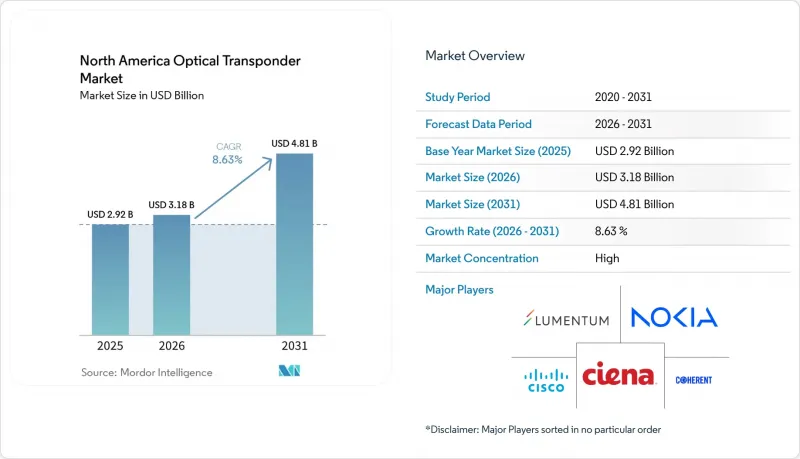
據 Mordor Intelligence 稱,2025 年北美光轉發器市值為 29.2 億美元,預計到 2031 年將從 2026 年的 31.8 億美元成長至 48.1 億美元,預測期(2026-2031 年)複合年成長率為 8.63%。
北美光轉發器市場趨勢與洞察
超大規模資料中心業者中心正在擴展人工智慧和雲端資料中心之間的互聯互通。
北美主要雲端服務供應商對人工智慧基礎設施的投資正在改變北美地區光纖通訊的需求。訓練叢集通常跨多個園區運行,這推動了計算站點之間高容量鏈路的需求成長。這種需求促使連貫光纖通訊設備滿足嚴格的頻寬和傳輸距離要求。 2026年3月,NVIDIA宣布向Coherent公司投資20億美元,並簽署了多年期採購協議,採購共封裝光學元件、連續波雷射和先進網路產品。隨著這些項目從規劃階段進入建設階段,北美光轉發器市場將受益,因為園區之間的連接需要更大的光纖通訊容量。此外,直接採購將使供應商的早期認證變得更加重要,尤其對於先進的連貫模組而言。
400G、800G 和 1.6T連貫升級
從獨立式轉發器機架到連貫可插拔模組的轉變正在改變網路設計方案。可插拔模組降低了每位元成本,並為營運商在擴展容量時提供了更大的柔軟性。 OIF 於 2024 年底發布了 800ZR 實施協議,800G連貫可插拔模組於 2025 年進入市場。 Ciena、Marvell 和諾基亞在 2026 年光纖通訊展 (OFC 2026) 上公佈了 1.6T連貫產品的藍圖,預計將於 2027 年底實現商業化。因此,北美光轉發器市場正朝著更短的產品週期發展,1.6T 認證已成為供應商選擇的關鍵標準。思科也發布了 1.6T光學模組,以及用於人工智慧資料中心網路的 Silicon One G300 平台。
InP和矽光電產能的限制
InP基板是許多高性能光學元件的關鍵材料。其供應有限會延緩連貫模組和共封裝光學元件的生產。由於人工智慧產品大量使用先進的光子元件,北美光轉發器市場也面臨同樣的壓力。儘管製造商正透過產能規劃和製程改進來應對,但快速擴大先進元件的供應仍面臨挑戰。矽光電的應用並不能取代許多共封裝光學設計中對InP雷射的需求。因此,供應商必須同時兼顧元件產能、認證進度和對客戶的交付承諾。由此產生的種種限制可能會增加供應商和大規模光學設備採購商的採購風險。
細分市場分析
預計到2025年,連貫技術將佔86.21%的銷售佔有率,並將在2031年之前以9.12%的複合年成長率成長。此地位反映了相干技術在運轉速度達100G及以上的城域網路、長途網路和資料中心互連網路的廣泛應用。連貫處理能夠滿足這些網路的傳輸距離和容量需求。在北美光轉發器產業,當營運商需要更高的頻譜效率和更靈活的調變方式時,就會採用連貫平台。同時,非連貫技術在接取邊緣連接和鏈路距離較短的企業園區中仍扮演著重要角色。在這些部署環境中,更簡單的接收器設計和更低的連接埠成本可能會超過連貫數位訊號處理的優勢。
在2026年光纖通訊展(OFC 2026)上,諾基亞發表了採用磷化銦(InP)和矽光電元件的應用最佳化型連貫解決方案。該公司介紹了四款全新數位訊號處理器系列,旨在滿足多樣化的網路需求。 Ciena的WaveLogic 6平台專為支援單載波1.6T連貫全光譜轉發器而設計。諾基亞也與Aureon和t3 Broadband合作,在中西部資料中心走廊部署ICE7技術。這些產品發展表明,連貫技術在北美光轉發器市場仍然佔據核心地位。
2025年,100Gbps至400Gbps細分市場佔北美光轉發器市場的41.67%。此細分市場反映了100G、200G和400G連貫系統在營運商、城域網路和5G傳輸網路中的部署。預計到2031年,800Gbps以上的細分市場將以12.45%的複合年成長率成長。這一高速細分市場的發展得益於超大規模園區區間連結以及預計從2027年底開始的1.6T商用部署。低於100Gbps的產品將繼續支援傳統營運商服務和企業間鏈路,因為在短期內連貫升級到相干系統在經濟上不可行。
在目前的升級週期中,400Gbps 至 800Gbps 的速度範圍是出貨量最高的細分市場。 OIF 的 800ZR 標準的製定,為 800G連貫可插拔產品建立了一個通用框架。這些產品正被應用於新型資料中心互連 (DCI) 部署中,在這些部署中,容量和部署柔軟性至關重要。思科推出了 Open Transport 3000 系列和 1.6T OSFP光學模組,用於實現跨資料中心和長距離連線。在北美光轉發器市場,儘管各業者的遷移速度不盡相同,但預計各個速度範圍的需求都將保持強勁。產品供應情況和認證時間預計將影響客戶遷移到 800G 以上的速度。
其他好處:
- Excel格式的市場預測(ME)表
- 3個月的分析師支持
目錄
第1章:引言
- 研究假設和市場定義
- 調查範圍
第2章:調查方法
第3章執行摘要
第4章 市場狀況
- 市場概覽
- 市場促進因素
- 超大規模資料中心業者正在擴展人工智慧和雲端資料中心之間的互聯互通。
- 使用連貫可插拔方法進行 400G、800G 和 1.6T 的升級。
- 5G通訊網路和光纖骨幹網路的現代化
- BEAD 為農村地區光纖和骨幹網路的發展提供資金。
- 開放式線路系統和分散式網路的引入
- 利用超大規模資料中心業者直接採購連貫光學元件
- 市場限制因素
- InP和矽光電產能的限制
- 超大規模資料中心業者認證週期和供應商面臨的價格壓力
- 出口限制與支離破碎、缺乏連貫性的數位訊號處理藍圖
- 人工智慧設施中光纖密度、功率和機架整合的局限性
- 產業價值鏈分析
- 監理情勢
- 波特五力分析
- 宏觀經濟因素對市場的影響
第5章 市場規模與成長預測
- 透過傳輸技術
- 連貫
- 非連貫
- 按數據速率
- 最高可達 100 Gbps
- 超過 100 Gbps 至 400 Gbps
- 超過 400 Gbps 至 800 Gbps
- 800 Gbps 或更高
- 透過網路應用
- 捷運
- 長途
- 資料中心之間的互連
- 海底
- 其他網路應用
- 最終用戶
- 電信服務供應商
- 雲端和超大規模資料中心營運商
- 公司
- 政府/國防
- 其他最終用戶
- 國家
- 美國
- 加拿大
- 墨西哥
第6章 競爭情勢
- 市場集中度
- 策略趨勢
- 市佔率分析
- 公司簡介
- Ciena Corporation
- Nokia Corporation
- Cisco Systems, Inc.
- Acacia Communications, Inc.(Cisco Systems, Inc.)
- Coherent Corp.
- Lumentum Holdings Inc.
- Marvell Technology, Inc.
- Broadcom Inc.
- Fujitsu Limited
- PacketLight Networks, Ltd.
- NEC Corporation
- Ribbon Communications Inc.
- Juniper Networks, Inc.
- ADTRAN Holdings, Inc.
- Tejas Networks Limited
- Ekinops SA
- Smartoptics Group ASA
- Sumitomo Electric Industries, Ltd.
- Applied Optoelectronics, Inc.
第7章 市場機會與未來展望
According to Mordor Intelligence, the North America optical transponder market size was valued at USD 2.92 billion in 2025 and is estimated to grow from USD 3.18 billion in 2026 to reach USD 4.81 billion by 2031, at a CAGR of 8.63% during the forecast period (2026-2031).
North America Optical Transponder Market Trends and Insights
Hyperscaler AI and Cloud Data Center Interconnect Expansion
AI infrastructure investment by major cloud operators is changing optical demand across North America. Training clusters often operate across multiple campuses, increasing the need for high-capacity links between computing locations. This requirement favors coherent optical equipment that can support demanding bandwidth and reach needs. NVIDIA announced a USD 2 billion equity investment in Coherent Corp. in March 2026, alongside a multiyear purchase commitment for co-packaged optics, continuous-wave lasers, and advanced networking products. The North America optical transponder market benefits when these projects move from planning into construction, because each campus connection needs optical capacity. Direct procurement also makes early supplier qualification more important, especially for advanced coherent modules.
400G, 800G, and 1.6T Coherent Pluggable Upgrades
The transition from separate transponder shelves to coherent pluggable modules is changing network design choices. Pluggables can lower the cost per bit and give operators more flexibility when expanding capacity. The OIF published its 800ZR implementation agreement in late 2024, and 800G coherent pluggables became available during 2025. Ciena, Marvell, and Nokia presented 1.6T coherent product roadmaps at OFC 2026, while commercial availability is expected before the end of 2027. The North America optical transponder market is therefore moving toward a shorter product cycle, with 1.6T approval becoming an important basis for supplier selection. Cisco also introduced 1.6T optics alongside its Silicon One G300 platform for AI data center networks.
InP and Silicon Photonics Capacity Constraints
InP substrates are essential inputs for many high-performance optical components. Limited availability can delay the production of coherent modules and co-packaged optics. This pressure affects the North America optical transponder market because AI-oriented products use advanced photonic components at high volumes. Manufacturers are responding with capacity planning and process improvements, but expanding advanced component supply remains difficult to do quickly. Silicon photonics does not remove the need for InP lasers in many co-packaged optical designs. Suppliers must therefore manage component capacity, qualification schedules, and customer commitments simultaneously. The resulting constraints can raise procurement risk for vendors and large optical equipment buyers.
Other drivers and restraints analyzed in the detailed report include:
- 5G Transport and Fiber Backbone Modernization
- BEAD-Funded Rural Fiber and Backbone Deployment
- Hyperscaler Qualification Cycles and Vendor Price Pressure
For complete list of drivers and restraints, kindly check the Table Of Contents.
Segment Analysis
Coherent technology held 86.21% revenue share in 2025 and is projected to expand at a 9.12% CAGR through 2031. Its position reflects widespread use in metro, long-haul, and data center interconnect networks operating at 100G and higher. Coherent processing supports the reach and capacity requirements of these networks. The North America optical transponder industry relies on coherent platforms when operators need greater spectral efficiency and more flexible modulation. Non-coherent technology remains relevant for access-edge connections and enterprise campuses with shorter link distances. In these deployments, simpler receiver designs and lower port costs can outweigh the benefits of coherent digital signal processing.
Nokia introduced application-optimized coherent solutions at OFC 2026 using InP and silicon photonics building blocks. The company described 4 new digital signal processor families designed for different network requirements. Ciena's WaveLogic 6 platform is designed to support single-carrier 1.6T coherent pluggables and full-spectrum transponders. Nokia also deployed ICE7 technology with Aureon and t3 Broadband on a Midwest data center corridor. These product developments show why coherent technology remains central to the North America optical transponder market.
The 100Gbps to 400Gbps segment accounted for 41.67% of the North America optical transponder market in 2025. The segment reflects the installed base of 100G, 200G, and 400G coherent systems in carrier, metro, and 5G transport networks. The above 800 Gbps segment is projected to expand at a 12.45% CAGR through 2031. This higher-speed tier is supported by links between hyperscale campuses and the expected commercial ramp of 1.6T deployments from late 2027. Up to 100Gbps products continue to support legacy carrier services and enterprise links where a full coherent upgrade has weaker near-term economics.
The above 400Gbps to 800Gbps tier is the high-volume component of the current upgrade cycle. OIF's 800ZR work helped establish a common framework for 800G coherent pluggables. These products are used in new data center interconnect deployments where capacity and deployment flexibility are important. Cisco launched its Open Transport 3000 Series and 1.6T OSFP optics for scale-across and long-haul data center connections. The North America optical transponder market is likely to retain demand across several speed tiers while operators migrate at different rates. Product availability and qualification timing will influence how quickly customers move beyond 800G.
Complete Report Scope:
- By Transmission Technology
- Coherent
- Non-Coherent
- By Data Rate
- Up to 100 Gbps
- Above 100 Gbps to 400 Gbps
- Above 400 Gbps to 800 Gbps
- Above 800 Gbps
- By Network Application
- Metro
- Long-Haul
- Data Center Interconnect
- Submarine
- Other Network Applications
- By End-User
- Telecommunication Service Providers
- Cloud and Hyperscale Data Center Operators
- Enterprises
- Government and Defense
- Other End-Users
- By Country
- United States
- Canada
- Mexico
List of Companies Covered in this Report:
- Ciena Corporation
- Nokia Corporation
- Cisco Systems, Inc.
- Acacia Communications, Inc. (Cisco Systems, Inc.)
- Coherent Corp.
- Lumentum Holdings Inc.
- Marvell Technology, Inc.
- Broadcom Inc.
- Fujitsu Limited
- PacketLight Networks, Ltd.
- NEC Corporation
- Ribbon Communications Inc.
- Juniper Networks, Inc.
- ADTRAN Holdings, Inc.
- Tejas Networks Limited
- Ekinops S.A.
- Smartoptics Group ASA
- Sumitomo Electric Industries, Ltd.
- Applied Optoelectronics, Inc.
Additional Benefits:
- The market estimate (ME) sheet in Excel format
- 3 months of analyst support
TABLE OF CONTENTS
1 INTRODUCTION
- 1.1 Study Assumptions and Market Definition
- 1.2 Scope of the Study
2 RESEARCH METHODOLOGY
3 EXECUTIVE SUMMARY
4 MARKET LANDSCAPE
- 4.1 Market Overview
- 4.2 Market Drivers
- 4.2.1 Hyperscaler AI and Cloud Data-Center Interconnect Expansion
- 4.2.2 400G, 800G and 1.6T Coherent-Pluggable Upgrades
- 4.2.3 5G Transport and Fiber-Backbone Modernization
- 4.2.4 BEAD-Funded Rural Fiber and Backbone Deployment
- 4.2.5 Open Line Systems and Disaggregated Network Adoption
- 4.2.6 Direct Hyperscaler Procurement of Coherent Optics
- 4.3 Market Restraints
- 4.3.1 InP and Silicon-Photonics Capacity Constraints
- 4.3.2 Hyperscaler Qualification Cycles and Vendor Price Pressure
- 4.3.3 Export Controls and Fragmented Coherent-DSP Roadmaps
- 4.3.4 Fiber-Density, Power and Rack-Integration Limits in AI Facilities
- 4.4 Industry Value Chain Analysis
- 4.5 Regulatory Landscape
- 4.6 Porter's Five Forces Analysis
- 4.6.1 Threat of New Entrants
- 4.6.2 Bargaining Power of Suppliers
- 4.6.3 Bargaining Power of Buyers
- 4.6.4 Threat of Substitutes
- 4.6.5 Competitive Rivalry
- 4.7 Impact of Macroeconomic Factors on the Market
5 MARKET SIZE AND GROWTH FORECASTS (VALUE)
- 5.1 By Transmission Technology
- 5.1.1 Coherent
- 5.1.2 Non-Coherent
- 5.2 By Data Rate
- 5.2.1 Up to 100 Gbps
- 5.2.2 Above 100 Gbps to 400 Gbps
- 5.2.3 Above 400 Gbps to 800 Gbps
- 5.2.4 Above 800 Gbps
- 5.3 By Network Application
- 5.3.1 Metro
- 5.3.2 Long-Haul
- 5.3.3 Data Center Interconnect
- 5.3.4 Submarine
- 5.3.5 Other Network Applications
- 5.4 By End-User
- 5.4.1 Telecommunication Service Providers
- 5.4.2 Cloud and Hyperscale Data Center Operators
- 5.4.3 Enterprises
- 5.4.4 Government and Defense
- 5.4.5 Other End-Users
- 5.5 By Country
- 5.5.1 United States
- 5.5.2 Canada
- 5.5.3 Mexico
6 COMPETITIVE LANDSCAPE
- 6.1 Market Concentration
- 6.2 Strategic Moves
- 6.3 Market Share Analysis
- 6.4 Company Profiles (includes Global Level Overview, Market Level Overview, Core Segments, Financials as available, Strategic Information, Market Rank/Share, Products and Services, Recent Developments)
- 6.4.1 Ciena Corporation
- 6.4.2 Nokia Corporation
- 6.4.3 Cisco Systems, Inc.
- 6.4.4 Acacia Communications, Inc. (Cisco Systems, Inc.)
- 6.4.5 Coherent Corp.
- 6.4.6 Lumentum Holdings Inc.
- 6.4.7 Marvell Technology, Inc.
- 6.4.8 Broadcom Inc.
- 6.4.9 Fujitsu Limited
- 6.4.10 PacketLight Networks, Ltd.
- 6.4.11 NEC Corporation
- 6.4.12 Ribbon Communications Inc.
- 6.4.13 Juniper Networks, Inc.
- 6.4.14 ADTRAN Holdings, Inc.
- 6.4.15 Tejas Networks Limited
- 6.4.16 Ekinops S.A.
- 6.4.17 Smartoptics Group ASA
- 6.4.18 Sumitomo Electric Industries, Ltd.
- 6.4.19 Applied Optoelectronics, Inc.
7 MARKET OPPORTUNITIES AND FUTURE OUTLOOK
- 7.1 White-Space and Unmet-Need Assessment

 衛星轉頻器市場規模、佔有率、成長、全球產業分析、區域趨勢及2026年至2034年預測
 Ku波段衛星轉發器市場規模、佔有率和成長分析:按應用程式類型、服務概況、最終用戶產業和地區分類-2026-2033年產業預測
 光收發器:市場佔有率分析、產業趨勢與統計、成長預測(2026-2031)歐洲光轉發器:市場佔有率分析、行業趨勢和統計數據以及成長預測(2026-2031 年)亞太地區光收發器:市佔率分析、產業趨勢與統計及成長預測(2026-2031)南美洲光轉發器:市場佔有率分析、產業趨勢與統計及成長預測(2026-2031 年)
 衛星轉發器租賃市場分析與預測(至2035年):類型、產品類型、服務、技術、組件、應用、部署狀態、最終用戶、解決方案
 2026年全球衛星轉發器市場報告
 衛星轉發器市場規模、佔有率和成長分析(按轉發器類型、放大器類型、服務、頻寬、頻率和地區分類)—產業預測(2026-2033 年)
 衛星轉發器市場規模、佔有率、趨勢分析報告:按頻段、服務、衛星平台、應用、地區和細分市場預測,2025 年至 2033 年