


 |
市場調查報告書
商品編碼
2156950
歐洲災害復原服務:市場佔有率分析、產業趨勢與統計及成長預測(2026-2031 年)Europe Disaster Restoration Services - Market Share Analysis, Industry Trends & Statistics, Growth Forecasts (2026 - 2031) |
||||||

※ 本網頁內容可能與最新版本有所差異。詳細情況請與我們聯繫。
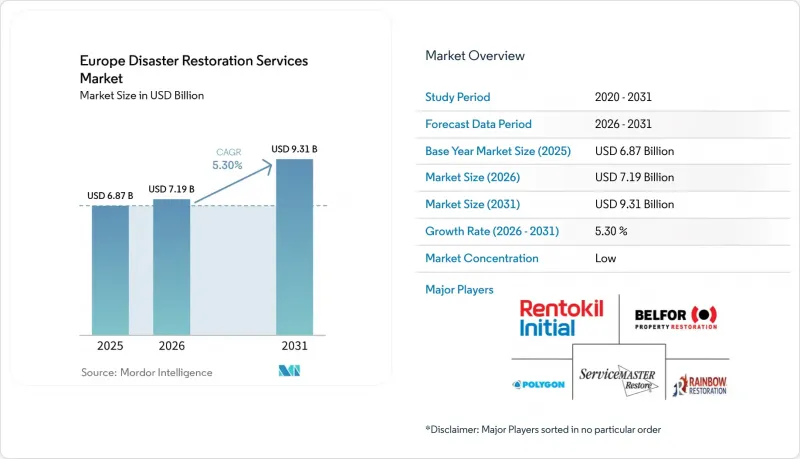
根據 Mordor Intelligence 預測,歐洲災害復原服務市場規模將從 2025 年的 68.7 億美元和 2026 年的 71.9 億美元成長到 2031 年的 93.1 億美元,2026 年至 2031 年的複合年成長率為 5.30%。
歐洲災害復原服務市場的趨勢與洞察
極端天氣事件的頻率和強度不斷增加
歐洲氣候暖化加劇,使得洪水、火災、乾旱和強風暴等災害發生後,專業災後復原服務的需求日益成長。到2025年,至少95%的歐洲地區年平均面積將高於平均水平,野火過火面積將達到創紀錄的103.4萬公頃,70%的歐洲河流年流量將低於平均水平。 2025年夏季,歐盟25%的地區將遭受熱浪、乾旱和洪水的侵襲,短期損失至少達465億美元,預計2029年,損失總額將達1,365億美元。 2020年至2024年,歐盟與氣候相關的經濟損失平均每年達486億美元,與1980年代的93億美元相比,增幅顯著。德國、荷蘭和英國人口稠密地區的野火災害,使得災後重建的需求範圍不再侷限於傳統易受洪水和火災侵襲的地區。因此,歐洲災害復原服務市場可以吸引來自更廣泛資產風險和地區的客戶。能夠在各種極端天氣事件後安全運作的供應商,可以處理單一區域性提供服務業者無法完成的任務。
破舊的建築物和供水基礎設施
老化的建築物和供水基礎設施因漏水、管道故障、污水回流和室內潮濕造成的損害而導致維修需求不斷成長。義大利的報告顯示,超過60%的市政管線鋪設時間已超過30年,導致漏水率高達42%。歐洲供水事業預計到2025年每年將在基礎建設方面投資396億美元,比2021年成長17.5%。然而,設備升級的需求仍然龐大。一項2026年的科學研究(採用2025年的外匯)估計,瑞典住宅每年的洪水維修總成本將達到9.46億美元。老化的基礎設施造成的故障給維修承包商帶來了持續的工作量。這種情況在都市區和鄉村建築中都普遍存在。歐洲災害復原服務市場受益於洪水災後重建,即使最初的原因是局部漏水,洪水災後重建通常需要專業的乾燥、清潔和修復工作。這一因素表明,在預測期內,住宅和商業房地產領域的就業前景將保持穩定。
技術純熟勞工短缺和資格認證瓶頸。
如果同時發生多起大規模保險索賠,訓練有素的災後重建人員短缺可能會限制應對能力。即使到了2025年,勞動力短缺仍將持續限制建築業及相關子部門滿足需求的能力。在歐盟各國,50歲以上的建築工人比例正在上升,這增加了對經驗豐富的替代人員的需求。建設業長期以來一直位列歐盟「人手不足職業清單」上,並且由於環境和數位化要求,新的技能需求正在湧現。在災後重建工作中,這個問題特別突出,因為可能需要乾燥、黴菌清除、石棉清除和結構修復等領域的資格。勞動力短缺增加了專案延誤的風險,並加劇了對分包商的依賴。在大規模災害發生後,人手不足人手不足尤其嚴重,因為修復和重組都需要相同的工種。歐洲災害復原服務市場需要更大、品質更高的勞動力,以確保從災後需求中獲得獲利。
細分市場分析
2025年,洪水災後重建服務將佔歐洲災害復原服務市場佔有率的32.6%。這一佔有率反映了管道故障、污水倒灌、洪水災害以及老舊建築潮濕等問題。一旦發生大規模洩漏,可能需要進行乾燥、消毒、清潔和結構修復。洪水災後重建服務佔據如此大的市場佔有率,反映了管道故障、污水倒灌、洪水和潮濕等問題在歐洲房地產市場造成的頻繁損失。
受2025年歐盟嚴重野火季的影響,火災和煙燻損害修復成為最大的服務領域之一。當洪水災害未能徹底解決,老舊建築內積聚潮氣時,黴菌清除的需求也會增加。 「其他」類別,包括家庭物品的恢復、臨時移除、清潔和存儲,是成長最快的服務類型,到2031年年複合成長率(CAGR)將達到6.90%。保險公司可以授權恢復家庭物品而非更換,以降低保險理賠成本。貝爾福的「紅色警報®」計畫展示了緊急應變系統如何在大規模災害期間為投保人提供優先服務。
其他好處:
- Excel格式的市場預測(ME)表
- 3個月的分析師支持
目錄
第1章:引言
- 研究假設和市場定義
- 調查範圍
第2章:調查方法
第3章執行摘要
第4章 市場狀況
- 市場概覽
- 歐洲災害復原服務市場背景
- 災害風險及損害原因概述
- 服務需求和緊急應變模式
- 維修服務的結構與收入來源
- 客戶細分和採購結構
- 保險介入和保險索賠的經濟學原理
- 修復生態系統和市場參與企業
- 各國市場成熟度與需求有差異
- 市場結構與正規化
- 災害趨勢和風險暴露
- 市場促進因素
- 極端天氣事件的頻率和嚴重性增加
- 破舊的建築物和供水基礎設施
- 對保險支援的專業追償服務的需求
- 公共韌性支出和關鍵基礎設施的恢復
- 感測器驅動的預防措施正在催生更高價值的響應合約。
- 應對跨越多個國家的大規模災害的復原能力
- 市場限制因素
- 技術純熟勞工短缺和資格認證瓶頸
- 原料、能源和專用設備的成本波動。
- 災害保險覆蓋範圍有差異和保障缺口。
- 歐洲同時發生的一系列事件導致的復甦和資源短缺問題
- 價值供應鏈分析
- 事件檢測、緊急應變和損失評估
- 緩解、矯正和穩定服務
- 目錄:恢復和專業維修
- 修復、重組、復原
- 保險公司、理賠員和承包商之間的合作
- 設備、化學品和分包商的供應鏈
- 監理情勢
- 歐盟和國家災害管理條例
- 關於建築、衛生和職業安全的要求
- 有關環境、有害物質和廢棄物管理的法規
- 化學物質和室內空氣合規性
- 保險、消費者保護和資料要求
- 技術展望
- 數位化檢測、損傷評估和遠端監控
- 物聯網和環境監測
- 利用人工智慧實現自動化評估和保險理賠處理
- 數位化工作流程與遠端維修管理
- 永續修復技術
- 預測性維修計劃和數位化解決方案
第5章 市場規模與成長預測
- 按服務類型
- 洪水災害復原(乾燥、除濕、污水回流預防)
- 火災和煙熏損害恢復
- 黴菌清除
- 風暴/大規模災害復原(風災、冰雹災害、洪水應變、大規模災害)
- 生物危害與創傷現場清理(犯罪現場、自然死亡現場、感染疾病相關清理)
- 專業服務
- 其他服務(家居用品修復、包裝、清潔、倉儲等)
- 透過使用
- 住宅
- 商業和工業用途
- 依客戶/付款人類型
- 保險涵蓋的維修工作
- 自籌/直接支付的維修工作
- 公共部門/政府資助的修復工作
- 按地區
- 德國
- 英國
- 法國
- 義大利
- 西班牙
- 希臘
- 羅馬尼亞
- 其他歐洲國家(瑞士、葡萄牙、奧地利、比利時、荷蘭、波蘭、捷克、匈牙利、瑞典、挪威、丹麥、芬蘭、愛爾蘭、克羅埃西亞、斯洛維尼亞、保加利亞、斯洛伐克、塞爾維亞等)
第6章 競爭情勢
- 市場集中度
- 策略趨勢
- 市佔率分析
- 公司簡介
- BELFOR Holdings, Inc.
- Polygon Group
- ServiceMaster Restore UK
- Rainbow Restoration UK
- Rentokil Initial plc
- SERVPRO Industries, LLC
- Paul Davis Restoration, Inc.
- PuroSystems, LLC
- First Onsite Property Restoration
- DKI Services, LLC
- Restoration 1
- ATI Restoration, LLC
- BMS CAT
- COIT Services, Inc.
- Steamatic, Inc.
- Bio-One, Inc.
- Duraclean Corporation
- Signal Restoration Services
- RestorePro Reconstruction
- Johns Lyng Group Limited
第7章 市場機會與未來展望
According to Mordor Intelligence, the Europe disaster restoration services market size is projected to expand from USD 6.87 billion in 2025 and USD 7.19 billion in 2026 to USD 9.31 billion by 2031, registering a CAGR of 5.30% between 2026 and 2031.
Europe Disaster Restoration Services Market Trends and Insights
More Frequent and Severe Extreme Weather
Europe's faster rate of warming is increasing the need for professional restoration after floods, fires, droughts, and severe storms. At least 95% of Europe had above-average annual temperatures in 2025, while wildfires burned a record 1.034 million hectares, and 70% of European rivers had below-average annual flows. Heatwaves, droughts, and floods affecting 25% of EU regions in summer 2025 caused at least USD 46.5 billion in short-term losses, and their effects were projected to reach USD 136.5 billion by 2029. Climate-related economic losses across the EU averaged USD 48.6 billion a year from 2020 to 2024, compared with USD 9.3 billion in the 1980s. Wildfires in populated areas of Germany, the Netherlands, and the United Kingdom are extending restoration needs beyond established flood and fire locations. The Europe disaster restoration services market can therefore draw demand from a wider set of property risks and locations. Operators that can mobilize safely after several types of weather events can address work that local single-service providers may not be able to handle.
Aging Buildings and Water Infrastructure
Aging buildings and water infrastructure create regular restoration demand from leaks, plumbing failures, sewer backups, and indoor moisture damage. Italy reported that more than 60% of municipal pipes were installed more than 30 years ago, and distribution losses reached 42%. European water providers invested USD 39.6 billion annually in infrastructure during 2025, which was 17.5% higher than in 2021, but the replacement needs remained substantial. A 2026 scientific study estimated annual water-damage repair costs in Swedish residential buildings at USD 946 million using 2025 conversion rates. Aging-related failures impose recurring workloads for restoration contractors. This condition is present across both urban and regional building stock. The Europe disaster restoration services market benefits because water damage often requires specialized drying, cleanup, and reinstatement, even when the original cause is a localized leak. This driver supports steady work across residential and commercial properties throughout the forecast period.
Skilled-Labor Shortages and Certification Bottlenecks
A shortage of trained restoration workers can restrict response capacity when large claims occur at the same time. Labor shortages continued to limit the ability of construction and related subsectors to meet demand in 2025. The share of construction workers aged 50 and older is rising across EU countries, increasing the need to replace experienced workers. Construction has remained on the EU list of shortage occupations for many years, and green and digital requirements add new skill needs. The issue is more difficult in restoration because work may require qualifications in drying, mold remediation, asbestos handling, and structural reinstatement. Shortages increase the risk of delayed projects and greater dependence on subcontractors. They are especially acute after major events, when the same trades are needed for both repair and reconstruction. The Europe disaster restoration services market needs a larger and more qualified workforce to convert post-disaster demand into completed revenue.
Other drivers and restraints analyzed in the detailed report include:
- Insurance-Backed Demand for Professional Restoration
- Public Resilience Spending and Critical-Infrastructure Recovery
- Volatile Materials, Energy, and Specialist-Equipment Costs
For complete list of drivers and restraints, kindly check the Table Of Contents.
Segment Analysis
Water damage restoration held 32.6% of the Europe disaster restoration services market share in 2025. Its position reflects plumbing failures, sewer backups, flood damage, and moisture problems across aging buildings. Significant leaks can require drying, decontamination, cleaning, and structural reinstatement. The large water-damage segment reflects the frequency of plumbing failures, sewer backups, flooding, and moisture-related losses across European properties.
Fire and smoke damage restoration formed one of the largest service pools, supported by the severe 2025 EU wildfire season. Mold remediation gains demand when water damage is not fully resolved, and moisture is trapped in older buildings. The Others category, including contents restoration, pack-out, cleaning, and storage, was the fastest-growing service type, registering a 6.90% CAGR through 2031. Insurers can authorize contents salvage instead of replacement to control claim costs. BELFOR's RED ALERT(R) program illustrates how emergency frameworks can give insured clients priority access during a major event.
Complete Report Scope:
- By Service Type
- Water Damage Restoration (drying/dehumidification, sewage backup)
- Fire & Smoke Damage Restoration
- Mold Remediation
- Storm / Catastrophe Restoration (wind, hail, flood response, large-loss)
- Biohazard & Trauma Cleanup (crime scene, unattended death, infectious cleanup)
- Specialty Services
- Others (contents restoration, pack-out, cleaning, storage, etc.)
- By Application
- Residential
- Commercial & Industrial
- By Customer/Payor Type
- Insurance-funded Restoration Work
- Self-funded / Direct-pay Restoration Work
- Public-sector / Government-funded Restoration Work
- By Geography
- Germany
- United Kingdom
- France
- Italy
- Spain
- Greece
- Romania
- Rest of Europe (Switzerland, Portugal, Austria, Belgium, Netherlands, Poland, Czech Republic, Hungary, Sweden, Norway, Denmark, Finland, Ireland, Croatia, Slovenia, Bulgaria, Slovakia, Serbia, etc.)
List of Companies Covered in this Report:
- BELFOR Holdings, Inc.
- Polygon Group
- ServiceMaster Restore UK
- Rainbow Restoration UK
- Rentokil Initial plc
- SERVPRO Industries, LLC
- Paul Davis Restoration, Inc.
- PuroSystems, LLC
- First Onsite Property Restoration
- DKI Services, LLC
- Restoration 1
- ATI Restoration, LLC
- BMS CAT
- COIT Services, Inc.
- Steamatic, Inc.
- Bio-One, Inc.
- Duraclean Corporation
- Signal Restoration Services
- RestorePro Reconstruction
- Johns Lyng Group Limited
Additional Benefits:
- The market estimate (ME) sheet in Excel format
- 3 months of analyst support
TABLE OF CONTENTS
1 INTRODUCTION
- 1.1 Study Assumptions and Market Definition
- 1.2 Scope of the Study
2 RESEARCH METHODOLOGY
3 EXECUTIVE SUMMARY
4 MARKET LANDSCAPE
- 4.1 Market Overview
- 4.1.1 Europe Disaster Restoration Services Market Context
- 4.1.2 Disaster Exposure and Loss-Causation Landscape
- 4.1.3 Service Demand and Emergency-Response Patterns
- 4.1.4 Restoration Service Mix and Revenue Pools
- 4.1.5 Customer Segments and Buying Structure
- 4.1.6 Insurance Involvement and Claims Economics
- 4.1.7 Restoration Ecosystem and Market Participants
- 4.1.8 Country Market Maturity and Demand Differences
- 4.1.9 Market Structure and Formalization
- 4.1.10 Disaster Trends and Hazard Exposure
- 4.2 Market Drivers
- 4.2.1 Increasing Frequency and Severity of Extreme Weather
- 4.2.2 Aging Buildings and Water Infrastructure
- 4.2.3 Insurance-Backed Demand for Professional Restoration
- 4.2.4 Public Resilience Spending and Critical-Infrastructure Recovery
- 4.2.5 Sensor-Led Prevention Creating Higher-Value Response Contracts
- 4.2.6 Restoration Capacity for Multi-Country Catastrophe Events
- 4.3 Market Restraints
- 4.3.1 Skilled-Labor Shortages and Certification Bottlenecks
- 4.3.2 Volatile Materials, Energy and Specialist-Equipment Costs
- 4.3.3 Uneven Catastrophe Insurance Take-Up and Protection Gaps
- 4.3.4 Restoration-Resource Scarcity During Concurrent European Events
- 4.4 Value / Supply-Chain Analysis
- 4.4.1 Incident Detection, Emergency Response and Damage Assessment
- 4.4.2 Mitigation, Remediation and Stabilization Services
- 4.4.3 Contents Recovery and Specialist Restoration
- 4.4.4 Repair, Reconstruction and Reinstatement
- 4.4.5 Insurer, Loss Adjuster and Contractor Interfaces
- 4.4.6 Equipment, Chemicals and Subcontractor Supply Chain
- 4.5 Regulatory Landscape
- 4.5.1 EU and National Disaster-Management Regulations
- 4.5.2 Building, Health and Occupational-Safety Requirements
- 4.5.3 Environmental, Hazardous-Material and Waste-Management Regulations
- 4.5.4 Chemical and Indoor-Air Compliance
- 4.5.5 Insurance, Consumer Protection and Data Requirements
- 4.6 Technological Outlook
- 4.6.1 Digital Inspection, Damage Assessment and Remote Monitoring
- 4.6.2 IoT and Environmental Monitoring
- 4.6.3 AI-Assisted Assessment and Claims Automation
- 4.6.4 Digital Workflows and Remote Restoration Management
- 4.6.5 Sustainable Restoration Technologies
- 4.6.6 Predictive Restoration Planning and Digital Solutions
5 MARKET SIZE & GROWTH FORECASTS (VALUE, IN USD BILLION)
- 5.1 By Service Type
- 5.1.1 Water Damage Restoration (drying/dehumidification, sewage backup)
- 5.1.2 Fire & Smoke Damage Restoration
- 5.1.3 Mold Remediation
- 5.1.4 Storm / Catastrophe Restoration (wind, hail, flood response, large-loss)
- 5.1.5 Biohazard & Trauma Cleanup (crime scene, unattended death, infectious cleanup)
- 5.1.6 Specialty Services
- 5.1.7 Others (contents restoration, pack-out, cleaning, storage, etc.)
- 5.2 By Application
- 5.2.1 Residential
- 5.2.2 Commercial & Industrial
- 5.3 By Customer/Payor Type
- 5.3.1 Insurance-funded Restoration Work
- 5.3.2 Self-funded / Direct-pay Restoration Work
- 5.3.3 Public-sector / Government-funded Restoration Work
- 5.4 By Geography
- 5.4.1 Germany
- 5.4.2 United Kingdom
- 5.4.3 France
- 5.4.4 Italy
- 5.4.5 Spain
- 5.4.6 Greece
- 5.4.7 Romania
- 5.4.8 Rest of Europe (Switzerland, Portugal, Austria, Belgium, Netherlands, Poland, Czech Republic, Hungary, Sweden, Norway, Denmark, Finland, Ireland, Croatia, Slovenia, Bulgaria, Slovakia, Serbia, etc.)
6 COMPETITIVE LANDSCAPE
- 6.1 Market Concentration
- 6.2 Strategic Moves
- 6.3 Market Share Analysis
- 6.4 Company Profiles (includes Global Level Overview, Market Level Overview, Core Segments, Financials as available, Strategic Information, Products and Services, Recent Developments)
- 6.4.1 BELFOR Holdings, Inc.
- 6.4.2 Polygon Group
- 6.4.3 ServiceMaster Restore UK
- 6.4.4 Rainbow Restoration UK
- 6.4.5 Rentokil Initial plc
- 6.4.6 SERVPRO Industries, LLC
- 6.4.7 Paul Davis Restoration, Inc.
- 6.4.8 PuroSystems, LLC
- 6.4.9 First Onsite Property Restoration
- 6.4.10 DKI Services, LLC
- 6.4.11 Restoration 1
- 6.4.12 ATI Restoration, LLC
- 6.4.13 BMS CAT
- 6.4.14 COIT Services, Inc.
- 6.4.15 Steamatic, Inc.
- 6.4.16 Bio-One, Inc.
- 6.4.17 Duraclean Corporation
- 6.4.18 Signal Restoration Services
- 6.4.19 RestorePro Reconstruction
- 6.4.20 Johns Lyng Group Limited
7 MARKET OPPORTUNITIES & FUTURE OUTLOOK
- 7.1 White-Space & Unmet-Need Assessment
- 7.1.1 Cross-Border Catastrophe Response Capacity
- 7.1.2 Underinsured Residential and Small-Business Restoration
- 7.1.3 Specialized Restoration for Heritage and Critical Properties
- 7.1.4 Pre-Loss Monitoring and Preventive Restoration Services
- 7.1.5 Sustainable and Circular Restoration Solutions
- 7.1.6 Public-Private Disaster Recovery Opportunities

 地震預警裝置市場:全球市場預測,2026-2032年
 2026年全球備份與災害復原解決方案市場報告
 亞太地區災害復原服務:市場佔有率分析、產業趨勢與統計及成長預測(2026-2031 年)北美災害復原服務:市場佔有率分析、產業趨勢與統計及成長預測(2026-2031 年)美國災害復原服務:市場佔有率分析、產業趨勢與統計及成長預測(2026-2031 年)
 全球危機管理軟體市場(2026-2030 年)緊急和災害應變:市場佔有率分析、行業趨勢和統計數據、成長預測(2026-2031 年)災害應變系統市場-2026-2032年全球市場預測
 災害應變系統市場:按類型、解決方案、服務、通訊技術、最終用途、國家和地區分類-全球產業分析、市場規模、市場佔有率和預測(2026-2033 年)
 銀行收費服務市場:市場規模、佔有率和趨勢分析(按服務、通路、最終用途和地區分類),細分市場預測(2026-2033 年)