


 |
市場調查報告書
商品編碼
2156949
北美災害復原服務:市場佔有率分析、產業趨勢與統計及成長預測(2026-2031 年)North America Disaster Restoration Services - Market Share Analysis, Industry Trends & Statistics, Growth Forecasts (2026 - 2031) |
||||||

※ 本網頁內容可能與最新版本有所差異。詳細情況請與我們聯繫。
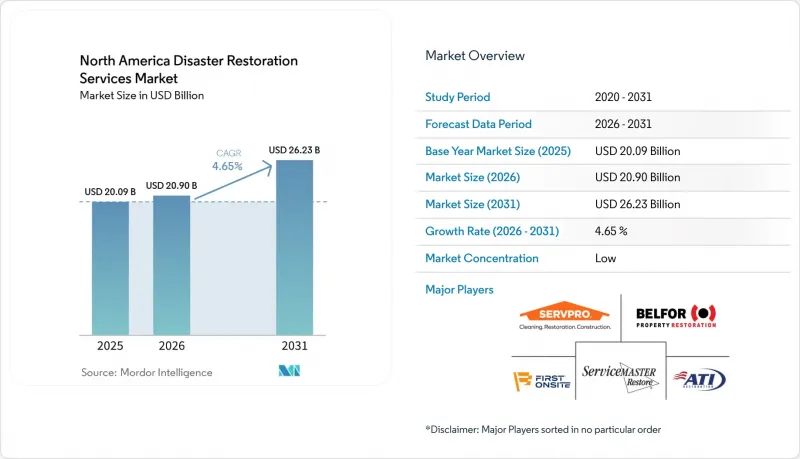
據 Mordor Intelligence 稱,2025 年北美災害復原服務市值為 200.9 億美元,預計到 2031 年將達到 262.3 億美元,而 2026 年為 209 億美元,預測期(2026-2031 年)的複合年成長率為 4.65%。
北美災害復原服務市場趨勢及洞察
易受野火和強對流風暴影響的地區,次生災害造成的損失加劇。
野火、強對流風暴、冰雹和大氣河流洪水正在加劇北美大部分地區的災後重建需求。預計到2025年,美國因天氣和氣候災害造成的損失將達230億美元,其中包括21起強烈對流天氣事件,直接損失總計達1,150億美元。 2025年1月洛杉磯發生的一系列野火造成了612億美元的損失,持續對當地的災後重建能力造成壓力。 《地球物理研究快報》2025年的一項研究估計,2026年至2030年間,美國因天氣和氣候災害造成的損失超過1兆美元的機率超過50%。這些災害事件導致對緊急災害緩解、清理、重組和財產復原服務的需求激增。擁有必要設備、合格人員和跨區域響應能力的營運商可以承擔小規模本地企業無法完成的任務。當保險公司需要能夠在災區快速回應的承包商時,北美災害復原服務市場便會受益。隨著災後重建週期的延長,這項因素也進一步提升了成熟特許經營模式和大型理賠應變網路的價值。
建築物老化和維護保養的延誤導致洪水發生的頻率增加。
老化的供水、雨水排放和污水處理系統即使在大規模災害時期也持續為災後重建工作提供需求。美國土木工程師協會 (ASCE) 在其 2025 年的評估報告中,將美國的雨水排放基礎設施評為“D”,將污水處理基礎設施評為“D+”。該報告指出,美國基礎設施投資缺口高達 3.7 兆美元。管道故障、污水回流和潮氣入侵導致住宅和商業建築需要乾燥、清潔和維修工作。美國國家公園管理局 (NPS) 報告稱,在 2025 會計年度,超過 7 萬處房產的維護和維修需求將高達 240 億美元。承包商正在使用濕度測繪、熱成像和乾燥設備來記錄損壞情況並管理黴菌風險。因此,北美災害復原服務市場擁有持續的需求基礎,其需求遠不止於與天氣相關的保險理賠。 IICRC 標準和工人安全要求有利於那些擁有正規培訓和文件記錄流程的公司。
保險減免、保障缺口及保險賠償
縮小保險覆蓋範圍可能會減少高風險地區資金籌措的修復項目數量。根據美國保險監理協會 (NAIC) 的數據,2018 年至 2025 年間,美國四大主要地區因保險公司拒保而導致的住宅保險續保率從 96% 上升至 216%。 NAIC 2025 年的報告指出,七家大型保險公司(佔加州住宅保險市場 35% 的佔有率)在 2023 年至 2025 年間停止承保新契約。報告也指出,全美無保險住宅的比例從 2019 年的 5% 上升至 2023 年的 12%。在加州,剩餘市場保險的保單數量從 2023 年的 5 萬份增加到 2025 年底的 32 萬多份。當保險覆蓋範圍受限時,修復承包商可能會面臨付款延遲、爭議或違約。較低的保險賠償會擠壓利潤空間,並限制對財產損失最頻繁地區的投資。北美災害復原服務市場受這些限制的影響最為直接,尤其是在易受野火和沿海災害影響的地區。美國保險監理協會 (NAIC) 於 2018 年至 2025 年開展的基於郵遞區號的住宅資料調查,或可為未來的政策和監管決策提供參考。
細分市場分析
截至2025年,洪水災後重建佔北美災害復原服務市場規模的32.6%。此領域涵蓋乾燥、除濕、污水回流處理和濕度控制。老化的管道系統經常導致住宅、商業和公共建築受損。暴雨和大氣洪水也會增加排水和乾燥工作的需求。乾燥不充分會導致黴菌滋生,從而可能擴大初始保險索賠的範圍。因此,洪水災後重建既涉及日常物業維護問題,也涉及與天氣相關的事件。承包商使用濕度測繪、熱成像和已記錄的乾燥程序來確定所需的工作範圍。 IICRC S500標準為專業洪水災後重建提供了實用指南。
「其他」類別預計將成為成長最快的服務類別,到2031年複合年成長率將達到6.90%。此類別包括家居用品的恢復、搬運、清潔和倉儲服務。保險公司在處理大規模洪水和火災索賠時,擴大要求提供家居用品清點和搬運服務。這些服務不僅可以用於大規模災害,還可以作為保險索賠工作的一部分。由於需要對家居用品進行專門的去污、除臭和清潔,火災和煙熏損害的恢復成本也更高。 IICRC S700標準定義了火災和煙熏損害恢復的流程。專業工作包括石棉清除、含鉛油漆清除以及重組期間的環境清理。美國環保署 (EPA) 和美國職業安全與健康管理局 (OSHA) 的要求會影響承包商如何管理這些任務。如此廣泛的服務範圍使企業能夠在財產損失發生後支援更廣泛的恢復工作。
其他好處:
- Excel格式的市場預測(ME)表
- 3個月的分析師支持
目錄
第1章:引言
- 研究假設和市場定義
- 調查範圍
第2章:調查方法
第3章執行摘要
第4章 市場狀況
- 市場概覽
- 北美需求趨勢與損壞頻率趨勢
- 定期損失和重大災害導致的需求增加。
- 按損害類型分類的需求細分:洪水、火災/煙熏損害、風暴/洪水、黴菌/環境損害和其他損害。
- 按住宅、商業和工業部門分類的需求細分
- 保險理賠與直接支付和公共資金用於維修的比較。
- 復原工作流程:緊急應變、損害緩解、修復、重組
- 客戶採購標準:回應時間、成本、文件和認證。
- 市場促進因素
- 易受野火和強對流風暴影響地區的第二次損害加劇。
- 建築物老化和維護保養的延誤導致漏水事件發生頻率增加。
- 保險理賠數位化及向首選供應商的路由
- 將特許經營和災害應變能力擴展到服務不足的次市場。
- 韌性、建築規範和公共重建投資正在擴大修復的範圍。
- 智慧洩漏檢測和損壞前監測正在催生持續的修復合約。
- 市場限制因素
- 保險業正在萎縮,保險覆蓋範圍有缺口,保險理賠支付也存在摩擦。
- 合格技術人員及重建相關職業短缺
- 設備、材料、人事費用和合規成本的上漲給利潤率帶來了壓力。
- 重大災害期間需求激增與正常時期需求激增之間的波動性和供給能力不平衡。
- 價值和供應鏈分析
- 尋找客戶、通知保險索賠、評估損失。
- 緊急應變和復原服務
- 家用物品的修理、清潔和修復
- 維修和重組服務
- 設備、化學品、耗材和廢棄物處理的供應鏈。
- 保險、資金籌措和支付/收款生態系統
- 市場結構與競爭環境
- 全國特許經營平台
- 本地獨立回收承包商
- 保險公司、第三方管理機構、理賠員及維修管理網路
- 技術、設備租賃及報價平台
- 股權市場的細分、整合和趨勢
- 區域趨勢
- 美國訴加拿大
- 美國各地區需求:東南部/墨西哥灣沿岸、西部、中西部、東北部
- 加拿大各區域需求:加拿大西部、加拿大中部和加拿大東部
- 區域需求因素:颶風、洪水、野火、冬季風暴、冰凍現象和強烈風暴。
- 調動季節性需求和區域間供給能力
- 保險和支付結構
- 與受保資產相關的保險索賠
- 針對未投保者的直接支付和追償措施
- 政府災害救濟和與公共部門的合約
- 優先供應商計劃和維修管理計劃
- 與保險索賠相關的文件、估價和審計要求
- 承保範圍、免賠額和保險金額不足
- 監理情勢
- 聯邦、州和州政府的復甦要求
- 承包商執照、環境保護和職業安全方面的要求。
- 關於黴菌、石棉、鉛、生物危害和有害物質的法規
- 建築規範、重組許可和抗災能力標準
- 有關廢棄物處理、運輸和廢水排放的法規
- 技術展望
- 數位檢測、熱成像和濕度測繪
- 基於物聯網的漏水偵測與災前監測
- 利用人工智慧進行估算、工作範圍界定和發票創建。
- 無人機、3D現場測量和數位化評估
- 基於雲端的工作流程、叫車和客戶溝通平台
- 先進的乾燥、密封和空氣品質技術
- 永續化學品、節能設備和低廢棄物修復。
第5章 市場規模與成長預測
- 按服務類型
- 洪水災害復原(乾燥、除濕、污水回流預防)
- 火災和煙熏損害恢復
- 黴菌清除
- 風暴/大規模災害復原(風災、冰雹災害、洪水應變、大規模災害)
- 生物危害與創傷現場清理(犯罪現場、自然死亡現場、感染疾病相關清理)
- 專業服務
- 其他服務(家居用品修復、包裝、清潔、倉儲等)
- 透過使用
- 住宅
- 商業和工業用途
- 依客戶/付款人類型
- 保險涵蓋的維修工作
- 自籌/直接支付的維修工作
- 公共部門/政府資助的修復工作
- 按地區
- 美國
- 加拿大
- 墨西哥
第6章 競爭情勢
- 市場集中度
- 策略趨勢
- 市佔率分析
- 公司簡介
- SERVPRO Industries, LLC
- BELFOR Holdings, Inc.
- ServiceMaster Restore
- First Onsite Property Restoration
- ATI Restoration
- Paul Davis Restoration, Inc.
- PuroClean
- Polygon Group
- DKI Services
- On Side Restoration
- WINMAR
- BMS CAT
- BluSky Restoration Contractors
- Rainbow Restoration
- Restoration 1
- Signal Restoration Services
- Steamatic
- United Water Restoration Group
- Johns Lyng Group
- Delta Restoration Services
- Ideal Restoration
第7章 市場機會與未來展望
According to Mordor Intelligence, the North America disaster restoration services market size was valued at USD 20.09 billion in 2025 and is estimated to grow from USD 20.90 billion in 2026 to reach USD 26.23 billion by 2031, at a CAGR of 4.65% during the forecast period (2026-2031).
North America Disaster Restoration Services Market Trends and Insights
Increasing Secondary-Peril Losses Across Wildfire and Severe Convective Storm Corridors
Wildfires, severe convective storms, hail, and atmospheric-river flooding are increasing restoration demand across most of the parts of North America. The United States recorded 23 billion-dollar disasters in weather and climate disasters in 2025, including 21 severe convective weather events, with USD 115 billion in direct losses. The January 2025 Los Angeles wildfire complex caused USD 61.2 billion in losses and placed sustained pressure on local restoration capacity. A 2025 Geophysical Research Letters study placed the probability of the United States weather and climate disaster losses exceeding USD 1 trillion during 2026 to 2030 above 50%. These events increase demand for emergency mitigation, cleaning, reconstruction, and content recovery services. Operators with equipment, certified crews, and cross-regional capacity can accept work that smaller local firms may not be able to take. The North America disaster restoration services market benefits when carrier networks need contractors that can respond quickly in affected locations. This driver also reinforces the value of established franchise and large-loss networks during extended recovery periods.
Aging Buildings and Deferred Maintenance Increasing Water-Loss Frequency
Aging water, stormwater, and wastewater systems create a consistent source of restoration work outside major catastrophe periods. ASCE gave the United States stormwater infrastructure a D grade and wastewater infrastructure a D+ grade in its 2025 report card The same report identified a USD 3.7 trillion national infrastructure investment gap. Pipe failures, sewage backups, and moisture intrusion require drying, cleanup, and remediation work in homes and commercial buildings. The National Park Service reported USD 24 billion in deferred maintenance and repair needs across more than 70,000 assets in FY 2025. Contractors use moisture mapping, thermal imaging, and drying equipment to document losses and control the risk of mold. The North America disaster restoration services market, therefore, has a recurring demand base that is not limited to weather-related claims. IICRC standards and worker safety requirements favor firms that maintain formal training and documentation processes.
Insurance Retrenchment, Coverage Gaps and Claim-Settlement Friction
Insurance coverage withdrawals can reduce the pool of funded restoration work in high-risk locations. NAIC data showed that company-initiated homeowner policy nonrenewal rates rose between 96% and 216% across four major United States regions between 2018 and 2025. A 2025 NAIC paper reported that seven large California homeowners' insurers, representing 35% of the state market, stopped writing new policies between 2023 and 2025. The paper also reported that the national share of uninsured homeowners rose from 5% in 2019 to 12% in 2023. In California, residual-market policy exposure rose from 50,000 in 2023 to more than 320,000 at the end of 2025. Restoration firms can encounter delayed, disputed, or unavailable reimbursement when claims coverage is limited. Lower reimbursement can restrict margin and investment in the areas with the most frequent property losses. The North America disaster restoration services market faces this constraint most directly in wildfire and coastal catastrophe corridors. NAIC's ZIP-code-level homeowners data call covering 2018 to 2025 may inform future policy and regulatory decisions.
Other drivers and restraints analyzed in the detailed report include:
- Insurance Claim Digitization and Preferred-Vendor Routing
- Franchise and Catastrophe-Capacity Expansion into Underserved Secondary Markets
- Shortage of Certified Technicians and Reconstruction Trades
For complete list of drivers and restraints, kindly check the Table Of Contents.
Segment Analysis
Water damage restoration accounted for 32.6% of the North America disaster restoration services market size in 2025. The segment includes drying, dehumidification, sewage backup response, and moisture mitigation. Aging plumbing systems create frequent losses in homes, commercial properties, and public buildings. Severe storms and atmospheric river flooding also increase the need for water removal and drying work. Incomplete drying can lead to mold conditions, which can expand the scope of an original claim. Water damage restoration is therefore linked to both everyday property maintenance issues and weather-related events. Contractors use moisture mapping, thermal imaging, and documented drying procedures to define the required work. IICRC S500 standards guide professional water damage restoration practices.
The Others category is expected to be the fastest-growing service type, with a CAGR of 6.90% through 2031. The category includes contents restoration, pack-out, cleaning, and storage services. Insurers increasingly require contents inventories and pack-out services for large water and fire claims. These services add work that can follow policy activity rather than only major catastrophe events. Fire and smoke restoration also has higher job values because it requires specialized decontamination, odor control, and contents cleaning. IICRC S700 standards guide fire and smoke restoration processes. Specialty work can include asbestos abatement, lead paint remediation, and environmental cleanup during reconstruction. EPA and OSHA requirements affect how contractors manage this work. This range of services helps providers support a broader restoration scope after property damage.
Complete Report Scope:
- By Service Type
- Water Damage Restoration (drying/dehumidification, sewage backup)
- Fire & Smoke Damage Restoration
- Mold Remediation
- Storm / Catastrophe Restoration (wind, hail, flood response, large-loss)
- Biohazard & Trauma Cleanup (crime scene, unattended death, infectious cleanup)
- Specialty Services
- Others (contents restoration, pack-out, cleaning, storage, etc.)
- By Application
- Residential
- Commercial & Industrial
- By Customer/Payor Type
- Insurance-funded Restoration Work
- Self-funded / Direct-pay Restoration Work
- Public-sector / Government-funded Restoration Work
- By Geography
- United States
- Canada
- Mexico
List of Companies Covered in this Report:
- SERVPRO Industries, LLC
- BELFOR Holdings, Inc.
- ServiceMaster Restore
- First Onsite Property Restoration
- ATI Restoration
- Paul Davis Restoration, Inc.
- PuroClean
- Polygon Group
- DKI Services
- On Side Restoration
- WINMAR
- BMS CAT
- BluSky Restoration Contractors
- Rainbow Restoration
- Restoration 1
- Signal Restoration Services
- Steamatic
- United Water Restoration Group
- Johns Lyng Group
- Delta Restoration Services
- Ideal Restoration
Additional Benefits:
- The market estimate (ME) sheet in Excel format
- 3 months of analyst support
TABLE OF CONTENTS
1 INTRODUCTION
- 1.1 Study Assumptions and Market Definition
- 1.2 Scope of the Study
2 RESEARCH METHODOLOGY
3 EXECUTIVE SUMMARY
4 MARKET LANDSCAPE
- 4.1 Market Overview
- 4.1.1 North America Demand Profile and Loss-Frequency Patterns
- 4.1.2 Recurring Losses vs. Catastrophe-Driven Demand
- 4.1.3 Demand Mix by Water, Fire & Smoke, Storm & Flood, Mold & Environmental, and Other Losses
- 4.1.4 Demand Mix by Residential, Commercial & Industrial
- 4.1.5 Insured Claims vs. Direct-Pay and Public-Funded Restoration
- 4.1.6 Restoration Workflow: Emergency Response, Mitigation, Remediation and Reconstruction
- 4.1.7 Customer Buying Criteria: Response Time, Cost, Documentation and Certification
- 4.2 Market Drivers
- 4.2.1 Increasing Secondary-Peril Losses Across Wildfire and Severe Convective Storm Corridors
- 4.2.2 Aging Buildings and Deferred Maintenance Increasing Water-Loss Frequency
- 4.2.3 Insurance Claim Digitization and Preferred-Vendor Routing
- 4.2.4 Franchise and Catastrophe-Capacity Expansion Into Underserved Secondary Markets
- 4.2.5 Resilience, Building-Code, and Public-Recovery Investment Expanding Restoration Scope
- 4.2.6 Smart Leak Detection and Pre-Loss Monitoring Creating Recurring Restoration Contracts
- 4.3 Market Restraints
- 4.3.1 Insurance Retrenchment, Coverage Gaps and Claim-Settlement Friction
- 4.3.2 Shortage of Certified Technicians and Reconstruction Trades
- 4.3.3 Rising Equipment, Materials, Labor, and Compliance Costs Compressing Margins
- 4.3.4 Demand Volatility and Capacity Mismatch Between Catastrophe Surges and Normal Periods
- 4.4 Value and Supply-Chain Analysis
- 4.4.1 Lead Generation, Claims Notification and Estimation
- 4.4.2 Emergency Mitigation and Restoration Services
- 4.4.3 Remediation, Cleaning and Contents Restoration
- 4.4.4 Repair and Reconstruction Services
- 4.4.5 Equipment, Chemicals, Consumables and Waste-Disposal Supply Chain
- 4.4.6 Insurance, Financing and Payment-Collection Ecosystem
- 4.5 Market Structure & Competitive Ecosystem
- 4.5.1 National Franchise Platforms
- 4.5.2 Regional and Independent Restoration Contractors
- 4.5.3 Insurers, TPAs, Adjusters and Managed-Repair Networks
- 4.5.4 Technology, Equipment Rental and Estimating Platforms
- 4.5.5 Market Fragmentation, Consolidation and Private-Equity Activity
- 4.6 Regional Dynamics
- 4.6.1 United States vs. Canada
- 4.6.2 United States Regional Demand: Southeast & Gulf Coast, West, Midwest, Northeast
- 4.6.3 Canada Regional Demand: Western Canada, Central & Eastern Canada
- 4.6.4 Regional Demand Drivers: Hurricanes, Floods, Wildfires, Winter Storms, Freeze Events and Severe Storms
- 4.6.5 Seasonal Demand and Cross-Regional Capacity Mobilization
- 4.7 Insurance & Payment Structure
- 4.7.1 Insured Property Claims
- 4.7.2 Direct-Pay and Uninsured Restoration
- 4.7.3 Government Disaster Assistance and Public-Sector Contracts
- 4.7.4 Preferred-Vendor and Managed-Repair Programs
- 4.7.5 Claim Documentation, Estimation and Audit Requirements
- 4.7.6 Coverage, Deductibles and Underinsurance
- 4.8 Regulatory Landscape
- 4.8.1 Federal, State and Provincial Restoration Requirements
- 4.8.2 Contractor Licensing, Environmental and Occupational-Safety Requirements
- 4.8.3 Mold, Asbestos, Lead, Biohazard and Hazardous-Material Regulations
- 4.8.4 Building Codes, Reconstruction Permits and Resilience Standards
- 4.8.5 Waste Disposal, Transportation and Water-Discharge Regulations
- 4.9 Technological Outlook
- 4.9.1 Digital Inspection, Thermal Imaging and Moisture Mapping
- 4.9.2 IoT-Based Leak Detection and Pre-Loss Monitoring
- 4.9.3 AI-Assisted Estimating, Scoping and Claims Documentation
- 4.9.4 Drones, 3D Site Capture and Digital Assessment
- 4.9.5 Cloud-Based Workflow, Dispatch and Customer-Communication Platforms
- 4.9.6 Advanced Drying, Containment and Air-Quality Technologies
- 4.9.7 Sustainable Chemicals, Energy-Efficient Equipment and Low-Waste Restoration
5 MARKET SIZE AND GROWTH FORECASTS(Value, In USD Billion)
- 5.1 By Service Type
- 5.1.1 Water Damage Restoration (drying/dehumidification, sewage backup)
- 5.1.2 Fire & Smoke Damage Restoration
- 5.1.3 Mold Remediation
- 5.1.4 Storm / Catastrophe Restoration (wind, hail, flood response, large-loss)
- 5.1.5 Biohazard & Trauma Cleanup (crime scene, unattended death, infectious cleanup)
- 5.1.6 Specialty Services
- 5.1.7 Others (contents restoration, pack-out, cleaning, storage, etc.)
- 5.2 By Application
- 5.2.1 Residential
- 5.2.2 Commercial & Industrial
- 5.3 By Customer/Payor Type
- 5.3.1 Insurance-funded Restoration Work
- 5.3.2 Self-funded / Direct-pay Restoration Work
- 5.3.3 Public-sector / Government-funded Restoration Work
- 5.4 By Geography
- 5.4.1 United States
- 5.4.2 Canada
- 5.4.3 Mexico
6 COMPETITIVE LANDSCAPE
- 6.1 Market Concentration
- 6.2 Strategic Moves
- 6.3 Market Share Analysis
- 6.4 Company Profiles (includes Global Level Overview, Market Level Overview, Core Segments, Financials as available, Strategic Information, Products and Services, Recent Developments)
- 6.4.1 SERVPRO Industries, LLC
- 6.4.2 BELFOR Holdings, Inc.
- 6.4.3 ServiceMaster Restore
- 6.4.4 First Onsite Property Restoration
- 6.4.5 ATI Restoration
- 6.4.6 Paul Davis Restoration, Inc.
- 6.4.7 PuroClean
- 6.4.8 Polygon Group
- 6.4.9 DKI Services
- 6.4.10 On Side Restoration
- 6.4.11 WINMAR
- 6.4.12 BMS CAT
- 6.4.13 BluSky Restoration Contractors
- 6.4.14 Rainbow Restoration
- 6.4.15 Restoration 1
- 6.4.16 Signal Restoration Services
- 6.4.17 Steamatic
- 6.4.18 United Water Restoration Group
- 6.4.19 Johns Lyng Group
- 6.4.20 Delta Restoration Services
- 6.4.21 Ideal Restoration
7 MARKET OPPORTUNITIES AND FUTURE OUTLOOK
- 7.1 White-Space and Unmet-Need Assessment
- 7.1.1 Underserved Geographic and Customer Segments
- 7.1.2 Pre-Loss Prevention, Monitoring and Planning Services
- 7.1.3 Underinsured and Uninsured Property Restoration
- 7.1.4 Emerging Disaster-Specific Restoration Services
- 7.1.5 Sustainable and Low-Carbon Restoration Solutions
- 7.2 Future Outlook
- 7.2.1 Digital Claims Automation and Straight-Through Processing
- 7.2.2 Predictive Monitoring and Preventive Restoration Services
- 7.2.3 Resilience, Mitigation and Restoration Solutions
- 7.2.4 Industry Consolidation and Multi-Regional Expansion
- 7.2.5 Workforce Productivity and Technology-Enabled Operations

 地震預警裝置市場:全球市場預測,2026-2032年
 2026年全球備份與災害復原解決方案市場報告
 亞太地區災害復原服務:市場佔有率分析、產業趨勢與統計及成長預測(2026-2031 年)歐洲災害復原服務:市場佔有率分析、產業趨勢與統計及成長預測(2026-2031 年)美國災害復原服務:市場佔有率分析、產業趨勢與統計及成長預測(2026-2031 年)
 全球危機管理軟體市場(2026-2030 年)緊急和災害應變:市場佔有率分析、行業趨勢和統計數據、成長預測(2026-2031 年)災害應變系統市場-2026-2032年全球市場預測
 災害應變系統市場:按類型、解決方案、服務、通訊技術、最終用途、國家和地區分類-全球產業分析、市場規模、市場佔有率和預測(2026-2033 年)
 銀行收費服務市場:市場規模、佔有率和趨勢分析(按服務、通路、最終用途和地區分類),細分市場預測(2026-2033 年)