


 |
市場調查報告書
商品編碼
2155611
非洲5G技術:市場佔有率分析、產業趨勢與統計及成長預測(2026-2031年)Africa 5G Technology - Market Share Analysis, Industry Trends & Statistics, Growth Forecasts (2026 - 2031) |
||||||

※ 本網頁內容可能與最新版本有所差異。詳細情況請與我們聯繫。
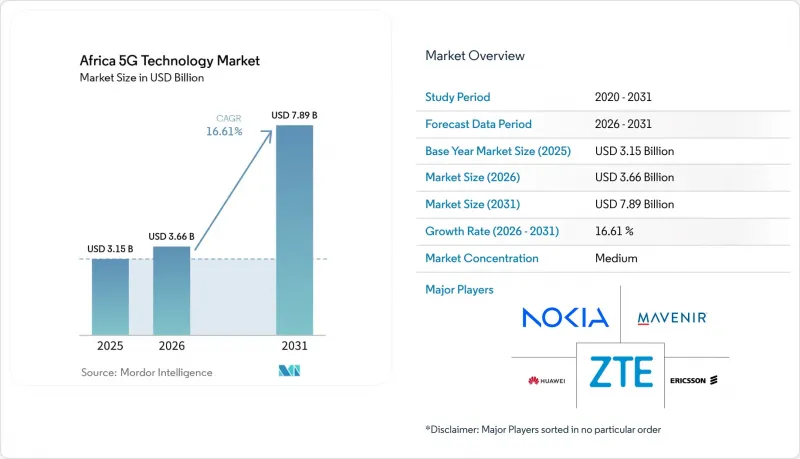
根據 Mordor Intelligence 預測,非洲 5G 技術市場規模預計將在 2025 年達到 31.5 億美元,2026 年達到 36.6 億美元,到 2031 年達到 78.9 億美元,2026 年至 2031 年的複合年成長率為 16.61%。
非洲5G技術市場趨勢與洞察
在固定寬頻普及率低的市場中,從 4G 到 5G 的飛躍。
在一些非洲國家,固定寬頻普及率仍然很低,只有個位數。因此,行動網路仍然是家庭和企業最實用的寬頻選擇。這種情況使得5G不僅是現有行動套餐的升級,更是一種寬頻替代方案。預計撒哈拉以南非洲地區的每月行動數據流量將從2025年的2.8Exabyte成長到2031年的9.7Exabyte。電信業者能否以永續的網路成本處理如此龐大的流量,取決於能否確保足夠的頻寬。預計到2025年,行動技術將在非洲創造2,400億美元的經濟價值,佔該地區GDP的7.8%。
固定無線存取 (FWA) 比光纖更快地彌合了寬頻差距。
固定無線接取 (FWA) 透過避免最後一公里土木工程,降低了家庭網路連線的成本和所需時間。這使得非洲 5G 技術市場即使在光纖部署經濟上不可行的情況下,也能開發出可行的線路。到 2025 年底,已有 25 家電信營運商在安哥拉、南非、奈及利亞、肯亞和尚比亞等市場推出了 FWA 服務。 MTN 集團將 FWA 和光纖定位為其在奈及利亞和加納家庭寬頻策略的關鍵支柱。截至 2026 年 6 月,Airtel Africa 在七個市場運作3,609 個 5G 基地台。家庭寬頻被列為該公司 2026 會計年度 11 億美元資本支出計畫中的一項主要投資領域。
不同市場間頻段的片段化阻礙了規模經濟的實現。
由於各市場對頻段的監管規定不盡相同,設備供應商和電信業者在非洲各地的部署成本都很高。截至2025年中期,僅有不到16個非洲國家完成了5G頻段分配。相比之下,超過90%的歐洲國家已經完成了5G頻段分配。埃及於2026年初與四家國內電信業者簽署了一項價值35億美元的頻段套裝保險契約。南非、奈及利亞和埃及在許可證制度、定價和服務覆蓋範圍方面均存在差異。這些差異限制了設備的標準化,並阻礙了非洲整體5G技術市場實現區域規模經濟。
細分市場分析
2025年,硬體在非洲5G技術市場佔有率中佔54.51%。這反映了大型基地台台、無線接取網路設備和天線系統的部署。愛立信、華為、諾基亞和中興通訊在南非、埃及、奈及利亞和肯亞獲得了重要的設備合約。許可要求也迫使業者履行規定的覆蓋義務。 MTN南非公司於2025年上半年完成了雙模5G核心網路升級。這個雲端原生封包核心網路處理了252萬個活躍會話和40 Gbps的即時流量。因此,硬體需求與軟體和雲端核心網的投資聯繫日益緊密。即使核心功能遷移到雲端環境,基地台建設仍然不可或缺。覆蓋義務使得部署時機與設備本身的選擇同樣重要。因此,實體網路資產在目前的部署階段仍然發揮核心作用。
預計2026年至2031年間,服務將以18.98%的複合年成長率成長。在初始覆蓋建立之後,託管服務、網路即服務(NaaS)合約和系統整合變得日益重要。電信業者可以利用這些機制來管理網路複雜性並控制營運成本。軟體包括核心網路功能、OSS/BSS平台和網路切片工具。其部署將取決於SA核心網路的部署速度。加納的批發網路採用軟體驅動的諾基亞雲端核心網,而MTN集團正在南非、辛巴威、安哥拉和烏干達推動雲端原生現代化。這些部署支援非洲5G技術市場對服務和軟體的長期需求。
2025年,6GHz以下頻段佔非洲5G技術市場規模的75.89%。 6GHz以下頻段為電信業者提供了覆蓋範圍和容量之間的合理平衡。這對於需要在不以極高密度部署基地台的情況下覆蓋大面積區域的網路至關重要。 2025年7月,摩洛哥向Maroc Telecom、Inwi和Orange Maroc頒發了3.5GHz頻段的授權。這些許可證要求在2026年底覆蓋45%的人口。 ICASA的《2026年國家無線電頻率規劃》確定了6GHz以上頻段和毫米波頻段的容量,用於行動應用。因此,6GHz以下頻段仍將是初始部署的主要頻段。與高頻率的替代方案相比,此頻段能夠以更少的基地台實現全國覆蓋目標。
預計到2031年,混合配置將以19.12%的複合年成長率成長。此配置將6GHz以下頻段的覆蓋範圍與高流量區域的毫米波容量結合。在營運商建立更廣泛的覆蓋範圍後,這種方法可能會變得更加重要。 Comsol正在南非使用單一60MHz頻段建構基於SA(獨立組網)的5G核心網路。該公司計劃在2028年為數百萬家庭提供服務,這表明專用容量可以支援後續的混合部署。毫米波系統還可以部署在港口、礦山和工業區等需要短距離、高吞吐量通訊鏈路的專用網路中。
其他好處:
- Excel格式的市場預測(ME)表
- 3個月的分析師支持
目錄
第1章:引言
- 研究假設和市場定義
- 調查範圍
第2章:調查方法
第3章執行摘要
第4章 市場狀況
- 市場概覽
- 市場促進因素
- 在固定寬頻普及率低的市場中,從 4G 到 5G 的飛躍。
- 固定無線存取比光纖速度更快,正在縮小寬頻差距。
- 行動支付、金融科技和企業數位化正在推動交易量成長。
- 泛非中立主機和基礎設施共用模式,可提高投資報酬率
- 低成本的6GHz以下設備生態系統正在推動消費者接受此技術。
- 網路現代化與資料主權和邊緣運算雲端計畫緊密相關。
- 市場限制因素
- 不同市場間頻段的分散化導致規模經濟效益放緩。
- 能源價格上漲和對柴油燃料的依賴正在推高地面營運成本。
- 外匯波動和對進口的依賴正在推高資本投資。
- 遍遠地區光纖回程傳輸和電力供應條件有限,延緩了獨立組網 5G 的獲利能力。
- 5G的歷史沿革與發展
- 目前引進週期(先行者、採用者、後入者)
- 產業價值鏈分析
- 監理情勢和政策趨勢
- 技術展望
- 波特五力分析
- 5G及未來5G(通往6G之路)
- 宏觀經濟因素對市場的影響
第5章 市場規模與成長預測
- 按組件
- 硬體
- 軟體
- 服務
- 按頻段
- 6GHz以下頻段
- 毫米波
- 混合型(低於 6 GHz 和毫米波)
- 透過使用
- 增強型行動寬頻(eMBB)
- 固定無線接入(FWA)
- 大規模機器類型通訊(mMTC)
- 超高可靠性、低延遲通訊(URLLC)
- 按最終用戶行業分類
- 消費者
- 製造業
- 衛生保健
- 車
- 能源公用事業
- 媒體與娛樂
- 公共安全與國防
- 透過網路架構
- 獨立版 (SA)
- 非獨立式(NSA)
- 國家
- 南非
- 奈及利亞
- 埃及
- 肯亞
- 其他非洲國家
第6章 競爭情勢
- 市場集中度
- 策略趨勢
- 市佔率分析
- 公司簡介
- Huawei Technologies Co., Ltd.
- Telefonaktiebolaget LM Ericsson(Ericsson)
- Nokia Corporation
- Qualcomm Incorporated
- Samsung Electronics Co., Ltd.
- ZTE Corporation
- Cisco Systems, Inc.
- Intel Corporation
- MediaTek Inc.
- NEC Corporation
- Fujitsu Limited
- CommScope Holding Company, Inc.
- Mavenir plc
- Parallel Wireless Inc.
- Juniper Networks, Inc.
- Sterlite Technologies Limited
- Aviat Networks, Inc.
- Radisys Corporation
- Ceragon Networks Ltd.
第7章 市場機會與未來展望
According to Mordor Intelligence, the Africa 5G technology market size is projected to be USD 3.15 billion in 2025, USD 3.66 billion in 2026, and reach USD 7.89 billion by 2031, growing at a CAGR of 16.61% from 2026 to 2031.
Africa 5G Technology Market Trends and Insights
Leapfrogging From 4G to 5G in Low-Fixed-Broadband Markets
Fixed broadband penetration remained in the low single digits in several African countries. Mobile networks have therefore remained the most viable broadband channel for households and businesses. This makes 5G a broadband alternative rather than only an upgrade to existing mobile plans. Sub-Saharan Africa's monthly mobile data traffic is projected to increase from 2.8 exabytes in 2025 to 9.7 exabytes by 2031. Spectrum availability will determine whether operators can carry this traffic at sustainable network costs. Mobile technologies generated USD 240 billion in economic value across Africa in 2025, equal to 7.8% of regional GDP.
Fixed Wireless Access Closing Broadband Gaps Faster Than Fiber
FWA can reduce the cost and time required to connect homes by avoiding last-mile civil works. This gives the Africa 5G technology market a practical route into areas where fiber deployment is difficult to justify. By late 2025, 25 operators had activated FWA services in markets including Angola, South Africa, Nigeria, Kenya, and Zambia. MTN Group identified FWA and fiber as the main pillars of its home broadband strategy in Nigeria and Ghana. Airtel Africa had 3,609 operational 5G sites across 7 markets in the quarter ended June 2026. Its USD 1.1 billion 2026 capital expenditure program identified home broadband as a primary investment area.
Spectrum Fragmentation Across Markets Slowing Scale Economics
Different spectrum rules make regional deployments more expensive for equipment suppliers and operators. Fewer than 16 African countries had completed 5G spectrum assignments by mid-2025. In comparison, more than 90% of European countries had allocated 5G spectrum. Egypt concluded a USD 3.5 billion spectrum package with its 4 operators in early 2026. National licensing, pricing, and coverage obligations differ across South Africa, Nigeria, and Egypt. These differences limit equipment standardization and delay the realization of regional-scale benefits across the African 5G technology market.
Other drivers and restraints analyzed in the detailed report include:
- Mobile Money, Fintech, and Enterprise Digitalization Raising Traffic Intensity
- Pan-African Neutral-Host and Infrastructure-Sharing Models Improving ROI
- High Energy and Diesel Reliance Raising Site Operating Costs
For complete list of drivers and restraints, kindly check the Table Of Contents.
Segment Analysis
Hardware accounted for 54.51% of Africa's 5G technology market share in 2025. This reflected the buildout of macro-cell sites, radio access network equipment, and antenna systems. Ericsson, Huawei, Nokia, and ZTE secured major equipment contracts in South Africa, Egypt, Nigeria, and Kenya. Licensing requirements also pushed operators to meet defined coverage commitments. MTN South Africa completed a dual-mode 5G core upgrade during the first half of 2025. The cloud-native packet core carried 2.52 million active sessions and 40 Gbps of live traffic. Hardware demand is therefore increasingly linked to software and cloud core investment. Site construction remains necessary even when core functions move into cloud environments. Coverage obligations make timing as important as the equipment selection itself. This keeps physical network assets central during the present rollout phase.
Services are projected to expand at an 18.98% CAGR from 2026 to 2031. Managed services, network-as-a-service contracts, and systems integration are becoming more important after initial coverage is established. Operators can use these arrangements to manage network complexity and contain operating costs. Software includes core network functions, OSS/BSS platforms, and network-slicing tools. Its adoption depends on the pace of SA core deployment. Ghana's wholesale network uses a software-driven Nokia cloud core, while MTN Group has pursued cloud-native modernization in South Africa, Zimbabwe, Angola, and Uganda. These deployments support longer-term service and software demand in the Africa 5G technology market.
Sub-6 GHz accounted for 75.89% of the Africa 5G technology market size in 2025. Frequencies below 6 GHz give operators a practical balance between coverage and capacity. This is important where networks must serve wide areas without very dense site deployment. Morocco licensed 3.5 GHz spectrum to Maroc Telecom, Inwi, and Orange Maroc in July 2025. The licenses required 45% population coverage by the end of 2026. ICASA's National Radio Frequency Plan 2026 also identified the upper 6 GHz and millimeter-wave capacity for mobile use. Sub-6 GHz should therefore remain the main initial rollout layer. The band supports national coverage targets with fewer base stations than higher-frequency alternatives.
Hybrid configurations are projected to expand at a 19.12% CAGR through 2031. They combine Sub-6 GHz coverage with millimeter-wave capacity in high-traffic locations. This approach may become more relevant once operators have established broader coverage footprints. Comsol is building an SA 5G core in South Africa using a single 60 MHz spectrum block. Its plan to serve millions of households by 2028 shows that the dedicated capacity can support later hybrid deployment. Private networks in ports, mines, and industrial sites can also introduce millimeter-wave systems where short-range, high-throughput links are justified.
Complete Report Scope:
- By Component
- Hardware
- Software
- Services
- By Spectrum Band
- Sub-6 GHz
- mmWave
- Hybrid (Sub-6 GHz and mmWave)
- By Application
- Enhanced Mobile Broadband (eMBB)
- Fixed Wireless Access (FWA)
- Massive Machine-Type Communications (mMTC)
- Ultra-Reliable Low-Latency Communications (URLLC)
- By End-User Industry
- Consumer
- Manufacturing
- Healthcare
- Automotive
- Energy and Utilities
- Media and Entertainment
- Public Safety and Defense
- By Network Architecture
- Stand-Alone (SA)
- Non-Stand-Alone (NSA)
- By Country
- South Africa
- Nigeria
- Egypt
- Kenya
- Rest of Africa
List of Companies Covered in this Report:
- Huawei Technologies Co., Ltd.
- Telefonaktiebolaget LM Ericsson (Ericsson)
- Nokia Corporation
- Qualcomm Incorporated
- Samsung Electronics Co., Ltd.
- ZTE Corporation
- Cisco Systems, Inc.
- Intel Corporation
- MediaTek Inc.
- NEC Corporation
- Fujitsu Limited
- CommScope Holding Company, Inc.
- Mavenir plc
- Parallel Wireless Inc.
- Juniper Networks, Inc.
- Sterlite Technologies Limited
- Aviat Networks, Inc.
- Radisys Corporation
- Ceragon Networks Ltd.
Additional Benefits:
- The market estimate (ME) sheet in Excel format
- 3 months of analyst support
TABLE OF CONTENTS
1 INTRODUCTION
- 1.1 Study Assumptions and Market Definition
- 1.2 Scope of the Study
2 RESEARCH METHODOLOGY
3 EXECUTIVE SUMMARY
4 MARKET LANDSCAPE
- 4.1 Market Overview
- 4.2 Market Drivers
- 4.2.1 Leapfrogging From 4G to 5G in Low-Fixed-Broadband Markets
- 4.2.2 Fixed Wireless Access Closing Broadband Gaps Faster Than Fiber
- 4.2.3 Mobile Money, Fintech, and Enterprise Digitalization Raising Traffic Intensity
- 4.2.4 Pan-African Neutral-Host and Infrastructure-Sharing Models Improving ROI
- 4.2.5 Lower-Cost Sub-6 GHz Device Ecosystems Improving Consumer Adoption
- 4.2.6 Network Modernization Tied to Data Sovereignty and Edge-Ready Cloud Programs
- 4.3 Market Restraints
- 4.3.1 Spectrum Fragmentation Across Markets Slowing Scale Economics
- 4.3.2 High Energy and Diesel Reliance Raising Site Operating Costs
- 4.3.3 FX Volatility and Import Dependence Inflating CAPEX
- 4.3.4 Limited Fiber Backhaul and Rural Power Availability Delaying Standalone 5G Economics
- 4.4 5G Timeline and Evolution
- 4.5 Current Adoption Cycle (Forerunners, Adopters, and Laggards)
- 4.6 Industry Value Chain Analysis
- 4.7 Regulatory and Policy Landscape
- 4.8 Technological Outlook
- 4.9 Porter's Five Forces Analysis
- 4.9.1 Threat of New Entrants
- 4.9.2 Bargaining Power of Suppliers
- 4.9.3 Bargaining Power of Buyers
- 4.9.4 Threat of Substitutes
- 4.9.5 Competitive Rivalry
- 4.10 5G and Beyond (6G Pathways)
- 4.11 Impact of Macroeconomic Factors on the Market
5 MARKET SIZE AND GROWTH FORECASTS (VALUE)
- 5.1 By Component
- 5.1.1 Hardware
- 5.1.2 Software
- 5.1.3 Services
- 5.2 By Spectrum Band
- 5.2.1 Sub-6 GHz
- 5.2.2 mmWave
- 5.2.3 Hybrid (Sub-6 GHz and mmWave)
- 5.3 By Application
- 5.3.1 Enhanced Mobile Broadband (eMBB)
- 5.3.2 Fixed Wireless Access (FWA)
- 5.3.3 Massive Machine-Type Communications (mMTC)
- 5.3.4 Ultra-Reliable Low-Latency Communications (URLLC)
- 5.4 By End-User Industry
- 5.4.1 Consumer
- 5.4.2 Manufacturing
- 5.4.3 Healthcare
- 5.4.4 Automotive
- 5.4.5 Energy and Utilities
- 5.4.6 Media and Entertainment
- 5.4.7 Public Safety and Defense
- 5.5 By Network Architecture
- 5.5.1 Stand-Alone (SA)
- 5.5.2 Non-Stand-Alone (NSA)
- 5.6 By Country
- 5.6.1 South Africa
- 5.6.2 Nigeria
- 5.6.3 Egypt
- 5.6.4 Kenya
- 5.6.5 Rest of Africa
6 COMPETITIVE LANDSCAPE
- 6.1 Market Concentration
- 6.2 Strategic Moves
- 6.3 Market Share Analysis
- 6.4 Company Profiles (includes Global Level Overview, Market Level Overview, Core Segments, Financials as available, Strategic Information, Market Rank/Share, Products and Services, Recent Developments)
- 6.4.1 Huawei Technologies Co., Ltd.
- 6.4.2 Telefonaktiebolaget LM Ericsson (Ericsson)
- 6.4.3 Nokia Corporation
- 6.4.4 Qualcomm Incorporated
- 6.4.5 Samsung Electronics Co., Ltd.
- 6.4.6 ZTE Corporation
- 6.4.7 Cisco Systems, Inc.
- 6.4.8 Intel Corporation
- 6.4.9 MediaTek Inc.
- 6.4.10 NEC Corporation
- 6.4.11 Fujitsu Limited
- 6.4.12 CommScope Holding Company, Inc.
- 6.4.13 Mavenir plc
- 6.4.14 Parallel Wireless Inc.
- 6.4.15 Juniper Networks, Inc.
- 6.4.16 Sterlite Technologies Limited
- 6.4.17 Aviat Networks, Inc.
- 6.4.18 Radisys Corporation
- 6.4.19 Ceragon Networks Ltd.
7 MARKET OPPORTUNITIES AND FUTURE OUTLOOK
- 7.1 White-Space and Unmet-Need Assessment

 5G波束成形技術市場預測至2034年-全球波束成形類型、組件、天線配置、頻段、應用、最終用戶和區域分析
 亞太地區5G技術:市佔率分析、產業趨勢與統計及成長預測(2026-2031年)北美5G技術:市場佔有率分析、產業趨勢與統計及成長預測(2026-2031年)南美洲5G技術:市場佔有率分析、產業趨勢與統計及成長預測(2026-2031年)歐洲5G技術:市場佔有率分析、產業趨勢與統計及成長預測(2026-2031年)5G技術:市場佔有率分析、產業趨勢與統計、成長預測(2026-2031年)
 2026年全球5G技術市場報告
 5G技術市場分析及預測(至2035年):按類型、產品類型、服務、技術、組件、應用、部署類型、最終用戶、解決方案和模式分類
 5G技術市場-全球產業規模、佔有率、趨勢、機會及預測(按組件、技術、頻段、應用、地區和競爭格局分類,2021-2031年)
 5G技術市場規模、佔有率和成長分析(按組件、性別、應用和地區分類)—產業預測,2026-2033年