


 |
市場調查報告書
商品編碼
2154990
歐洲5G技術:市場佔有率分析、產業趨勢與統計及成長預測(2026-2031年)Europe 5G Technology - Market Share Analysis, Industry Trends & Statistics, Growth Forecasts (2026 - 2031) |
||||||

※ 本網頁內容可能與最新版本有所差異。詳細情況請與我們聯繫。
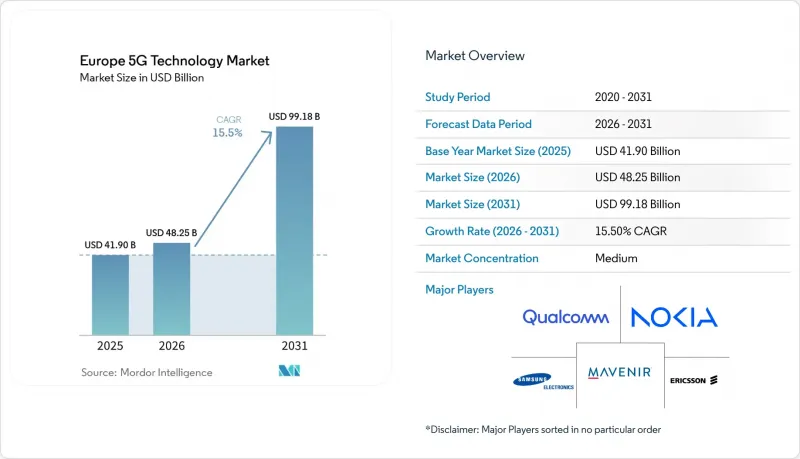
據 Mordor Intelligence 稱,歐洲 5G 技術市場預計將從 2025 年的 419 億美元成長到 2026 年的 482.5 億美元,到 2031 年達到 991.8 億美元,預計 2026 年至 2031 年的複合年成長率為 15.5%。
歐洲5G技術市場的趨勢與洞察
歐洲主要經濟體正在部署 5G 獨立組網。
沃達豐3已承諾投入110億英鎊(約148.5億美元)用於其為期10年的網路投資計畫。其中包括與愛立信和諾基亞簽訂的價值20億英鎊(約27億美元)的供應契約,用於在英國各地建造超過17,000個基地台。這些合約於2025年9月簽署,將獨立組網部署置於該計畫的核心,旨在2034年將5G獨立組網覆蓋範圍擴大到英國99%以上的人口。歐洲5G技術市場將受益於主要營運商從有限的試點營運轉向可重複的、全國性的項目,這些項目通用的技術標準、成熟的供應商、長期承諾,並製定從初始網路覆蓋到廣泛可用的獨立組網功能的清晰路徑。獨立組網為企業服務包提供了技術基礎,這些服務包利用網路切片、專用連接和專用性能特性,而不是標準的盡力而為型行動接取。這些特性至關重要,因為僅靠基本的行動覆蓋,營運商幾乎沒有空間來區分其服務,也無法向客戶證明付費購買高級服務的合理性。 2026 年 1 月 21 日,歐盟委員會提案了一項“數位網路法案”,其中包括有關頻段管理和跨境授權的措施。
工業製造群對專用5G的需求日益成長
2025年至2026年間,私有5G網路從獨立測試階段過渡到全面運營,尤其是在工業環境中,大型運作中生產場所需要可預測的無線效能。 2026年4月,西門子將其工業私有5G服務擴展至15個國家,新增比利時、芬蘭、法國、挪威、波蘭和英國。此次覆蓋範圍的擴大將有助於企業將通用網路設計應用於多個設施,而不是為每個站點單獨設計解決方案。隨著私有系統支援自動化、機器視覺、移動機器人和連網業務系統,歐洲5G技術市場需求持續成長。這些系統必須在單一營運環境中運行,包括擁有不同設備、生產階段和安全要求的場所。 3GPP Release 16定義了超可靠低延遲通訊(URLLC)功能,以滿足在受控條件下需要接近毫秒延遲和高可靠性的苛刻應用情境。這些要求表明,在需要行動裝置、感測器和生產流程之間保持一致性能的情況下,製造場所可能會以私有蜂巢式網路取代或補充固定工業連接。可複製的部署計畫減少了在中型工業設施中實施專用 5G 所需的工作量,並使站點間部署更加現實。
高密度中頻段和毫米波基礎設施需要高資本密集度。
根據GSMA Intelligence的估計,2026年至2036年間,歐洲行動通訊領域需要4,750億歐元(5,368億美元)的投資。其中,電信業者可獲得的資金預計為2,700億歐元(3,051億美元),這意味著資金缺口超過2,000億歐元(2,331.9億美元)。 GSMA指出,近一半的所需支出將用於主要交通幹線沿線的5G相關項目。這些區域需要大規模的網路基礎設施來滿足覆蓋範圍的連續性和容量需求。與覆蓋範圍更廣的6GHz以下宏網路相比,高密度中波和毫米波網路由於需要更小的站點間距和專用無線設備,會增加部署成本和站點相關成本。在網路經濟效益較低以及尚未展現出高容量流量需求的地區,這項要求使得投資負擔特別沉重。當資金受限時,電信業者可能會延長非獨立組網(NSA)網路的營運壽命,並優先考慮那些最具獲利潛力的基地台。此類決策可能會延遲與完整獨立組網(SA)功能相關的軟體和服務的支出,從而減緩從基本覆蓋向高級服務交付的過渡。
細分市場分析
2025年,歐洲5G技術市場中,硬體市佔率佔比44.85%,而服務領域預計到2031年將以17.41%的複合年成長率成長。硬體需求仍集中在構成5G部署實體存取層的MIMO無線單元、基地台和遠端射頻單元(RRH)。這些設備支援歐洲營運商網路中6GHz以下頻段的密度增強計劃,並為高流量區域的容量擴展提供所需設備。隨著消費者資料使用、固定無線存取和企業流量共用相同無線基礎設施,這些區域的需求日益成長。此外,當營運商擴展覆蓋範圍、升級基地台或為企業場所安裝專用設備時,硬體仍然至關重要。因此,即使支出結構開始發生變化,歐洲5G技術領域仍保持大規模的設備基礎。
隨著雲端原生部署、託管無線營運和網路即服務 (NaaS) 合約在多年網路規劃中日益普及,服務的重要性預計將會提升。這些活動將催生持續性契約,其範圍不僅限於初始設備採購,還包括設計、整合、最佳化、支援和營運管理。開放式無線接取網路 (Open RAN) 支援這項轉變,因為軟體可以取代部分專有硬體功能,並需要多個供應商之間更緊密的合作。軟體還支援編配、虛擬網路功能 (VNF)、營運營運支援系統),這些系統將網路效能和商業可用性連結起來,營運商可以藉此替換傳統的核心流程,並並行管理公共網路和企業部署。因此,與 5G 覆蓋部署初期相比,歐洲 5G 技術市場正經歷硬體、軟體和服務需求更加多樣化的配置。
到2025年,歐洲5G技術市場中,Sub-6 GHz頻段將佔66.48%,這反映了其在營運商網路容量組合中的重要地位。 n78頻段在這一覆蓋和容量策略中發揮了核心作用,因為它能夠以一致的網路設計覆蓋廣闊區域。其覆蓋範圍和容量的平衡使其適用於在都市區、郊區和許多農村地區的廣泛部署。透過利用此頻段,營運商無需依賴高密度基地台網路和更高頻率所需的專用設備,即可擴展5G服務覆蓋範圍。該頻段仍是大多數全國性5G網路規劃以及後續更有針對性的容量擴展的實用基礎,使營運商能夠在投入大量資源建設局部高頻基礎設施之前,優先保障廣泛的服務覆蓋。
混合(6GHz 以下頻段和毫米波)配置預計到 2031 年將以 17.98% 的複合年成長率成長。這些配置在高流量且需要更高局部吞吐量的場所(例如場館、企業園區和廣播設施)增加了毫米波容量。諾基亞和 EOLO 於 2024 年 12 月在義大利建成了歐洲首個 5G 獨立組網毫米波網路。歐洲 5G 技術市場可以利用混合網路,在特定地點實現可靠的 6GHz 以下頻段覆蓋與極高的局部容量共存。歐洲 26GHz 頻段的頻率協調為這些目標部署提供了頻率基礎,並為營運商的裝置規劃帶來了通用標準。
其他好處:
- Excel格式的市場預測(ME)表
- 3個月的分析師支持
目錄
第1章:引言
- 研究假設和市場定義
- 調查範圍
第2章:調查方法
第3章執行摘要
第4章 市場狀況
- 市場概覽
- 市場促進因素
- 歐洲主要經濟體正在繼續部署 5G 獨立組網。
- 工業和製造群對專用5G的需求日益成長
- 擴大固定無線接取在歐洲服務不足的寬頻市場的普及率。
- 引入開放式無線存取網和虛擬化網路,以增強供應商的柔軟性。
- 企業和公共部門用例中的網路切片需求
- 跨境頻段協調有助於提高泛歐部署的效率。
- 市場限制因素
- 由於中波和毫米波頻段基礎設施高度集中,因此資本密集度很高。
- 公司在實現5G高階應用情境的商業化方面存在延誤
- 頻率頻段分類以及各國許可條件的差異
- 設施層面的能源消耗增加和永續性壓力。
- 5G的歷史沿革與發展
- 目前引進週期(先行者、採用者、後入者)
- 產業價值鏈分析
- 監理情勢和政策趨勢
- 技術展望
- 波特五力分析
- 5G及未來5G(通往6G之路)
- 宏觀經濟因素對市場的影響
第5章 市場規模與成長預測
- 按組件
- 硬體
- 軟體
- 服務
- 按頻段
- 6GHz以下頻段
- 毫米波
- 混合型(低於 6 GHz 和毫米波)
- 透過使用
- 增強型行動寬頻(eMBB)
- 固定無線接入(FWA)
- 大規模機器類型通訊(mMTC)
- 超高可靠性、低延遲通訊(URLLC)
- 按最終用戶行業分類
- 消費者
- 製造業
- 衛生保健
- 車
- 能源公用事業
- 媒體與娛樂
- 公共安全與國防
- 透過網路架構
- 獨立版 (SA)
- 非獨立式(NSA)
- 國家
- 德國
- 英國
- 法國
- 義大利
- 西班牙
- 俄羅斯
- 其他歐洲國家
第6章 競爭情勢
- 市場集中度
- 策略趨勢
- 市佔率分析
- 公司簡介
- Huawei Technologies Co., Ltd.
- Telefonaktiebolaget LM Ericsson(Ericsson)
- Nokia Corporation
- Qualcomm Incorporated
- Samsung Electronics Co., Ltd.
- ZTE Corporation
- Intel Corporation
- MediaTek Inc.
- Cisco Systems, Inc.
- NEC Corporation
- Fujitsu Limited
- CommScope Holding Company, Inc.
- Vodafone Group plc
- Skyworks Solutions, Inc.
- Analog Devices, Inc.
- Juniper Networks, Inc.
- Mavenir plc
- Parallel Wireless, Inc.
- Rohde and Schwarz GmbH and Co. KG
- Deutsche Telekom AG
第7章 市場機會與未來展望
According to Mordor Intelligence, the Europe 5G technology market size is expected to increase from USD 41.90 billion in 2025 to USD 48.25 billion in 2026 and reach USD 99.18 billion by 2031, growing at a CAGR of 15.5% over 2026-2031.
Europe 5G Technology Market Trends and Insights
Ongoing 5G Standalone Network Rollouts Across Major European Economies
VodafoneThree committed GBP 11 billion (USD 14.85 billion) to a 10-year network investment plan, including GBP 2 billion (USD 2.7 billion) in supply agreements with Ericsson and Nokia for more than 17,000 United Kingdom sites. The September 2025 agreements placed standalone deployment at the center of a plan intended to extend 5G standalone coverage to more than 99% of the United Kingdom population by 2034. The European 5G technology market benefits when large operators move from limited trials to repeatable national programs with common technical standards, established suppliers, long-term commitments, and a clear route from initial network coverage to widely available standalone capability. Standalone networks provide the technical base for network slicing, private connectivity, and enterprise service packages that use dedicated performance characteristics rather than standard best-effort mobile access. Those capabilities matter because basic mobile coverage alone gives operators limited scope to differentiate their offerings or to explain why a customer should pay for an advanced service. The European Commission proposed the Digital Networks Act on January 21, 2026, with measures covering spectrum management and cross-border authorizations.
Rising Private 5G Demand in Industrial Manufacturing Clusters
Private 5G moved from isolated testing to operational deployment during 2025 and 2026, particularly in industrial settings that require predictable wireless performance across large, active production sites. Siemens expanded its industrial private 5G offer to 15 countries in April 2026, adding Belgium, Finland, France, Norway, Poland, and the United Kingdom. This wider availability supports companies that want to apply a common network design across multiple facilities rather than designing a separate solution for each location. The European 5G technology market gains recurring demand when private systems support automation, machine vision, mobile robots, and connected business systems that must work within the same operational environment, including sites with varied equipment, production stages, and safety requirements. 3GPP Release 16 defined URLLC capabilities for demanding use cases that require near-1 ms latency and high reliability under controlled conditions. These requirements explain that manufacturing sites may replace or supplement fixed industrial connections with private cellular networks when mobile equipment, sensors, and production processes require consistent performance. Replicable deployment plans can reduce the effort needed to introduce private 5G at midsize industrial sites and make cross-site deployment more practical.
High Capital Intensity of Dense Mid-Band and mmWave Infrastructure
GSMA Intelligence estimated that Europe requires EUR 475 billion (USD 536.8 billion) in mobile investment from 2026 to 2036. It estimated an operator-accessible pool of EUR 270 billion (USD 305.1 billion), leaving over EUR 200 billion (USD 233.19 billion). GSMA Nearly half of the required spending relates to 5G along major transport routes, where coverage continuity and capacity demand require more extensive network infrastructure. Dense mid-band and mmWave networks need closer site spacing and specialized radio equipment than broad sub-6 GHz macro coverage, adding both deployment and site-related costs. This requirement makes the investment burden particularly difficult in markets with weaker network economics and in areas where high-capacity traffic demand is not yet proven. Operators may keep non-standalone networks in service longer when capital is constrained and prioritize only the sites with the clearest return. That decision can delay the software and services spending associated with full standalone capabilities and slow the transition from basic coverage to advanced service delivery.
Other drivers and restraints analyzed in the detailed report include:
- Expanding Fixed Wireless Access Adoption in Underserved European Broadband Markets
- Open RAN and Virtualized Network Adoption to Improve Vendor Flexibility
- Slow Enterprise Monetization of Advanced 5G Use Cases
For complete list of drivers and restraints, kindly check the Table Of Contents.
Segment Analysis
Hardware accounted for 44.85% of the European 5G technology market share in 2025, while services are projected to expand at a 17.41% CAGR through 2031. Hardware demand remains centered on massive MIMO radio units, base stations, and remote radio heads that form the physical access layer of 5G deployment. These assets support sub-6 GHz densification programs across European operator networks and provide the equipment needed to add capacity in high-traffic areas, where demand increases as consumer data use, fixed wireless access, and enterprise traffic share the same radio infrastructure. Hardware also remains necessary when operators extend coverage, upgrade sites, or install specialized equipment for enterprise locations. Europe's 5G technology sector, therefore, retains a large equipment base even as the composition of spending begins to change.
Services are expected to gain importance as cloud-native deployment, managed radio operations, and network-as-a-service arrangements become more common across multi-year network programs. These activities create recurring engagements that extend beyond the original equipment purchase and encompass design, integration, optimization, support, and operational management. Open RAN supports this shift because software can replace some proprietary hardware functions and requires closer coordination between multiple suppliers. Software also supports orchestration, virtual network functions, operations support systems, and business support systems that connect network performance with commercial delivery as operators replace legacy core processes and manage public networks alongside enterprise deployments. The Europe 5G technology market, therefore, has a broader mix of hardware, software, and services requirements than in the initial phase of 5G coverage deployment.
Sub-6 GHz accounted for 66.48% of the European 5G technology market in 2025, reflecting its role as the primary capacity layer in operator portfolios. Band n78 has been a central part of this coverage and capacity strategy because it can serve a wide range of locations with a consistent network design. Its balance of reach and capacity makes it suitable for broad deployment across urban, suburban, and many rural areas. Operators can use this band to expand 5G availability without relying on the dense site grids and specialized equipment needed for higher frequencies. It remains the practical base for most nationwide 5G network plans and for later additions of more targeted capacity, allowing operators to prioritize broad availability before committing major resources to localized high-frequency infrastructure.
Hybrid (sub-6 GHz and mmWave) configurations are projected to expand at a 17.98% CAGR through 2031. These configurations add mmWave capacity where traffic is concentrated at venues, enterprise campuses, and broadcast locations that need higher local throughput. Nokia and EOLO deployed Europe's first 5G standalone mmWave network in Italy in December 2024. The European 5G technology market can use hybrid networks in which dependable sub-6 GHz coverage must coexist with very high local capacity at specific sites. European harmonization of the 26 GHz band provides a spectrum basis for these targeted deployments and gives operators a common reference for equipment planning.
Complete Report Scope:
- By Component
- Hardware
- Software
- Services
- By Spectrum Band
- Sub-6 GHz
- mmWave
- Hybrid (Sub-6 GHz and mmWave)
- By Application
- Enhanced Mobile Broadband (eMBB)
- Fixed Wireless Access (FWA)
- Massive Machine-Type Communications (mMTC)
- Ultra-Reliable Low-Latency Communications (URLLC)
- By End-User Industry
- Consumer
- Manufacturing
- Healthcare
- Automotive
- Energy and Utilities
- Media and Entertainment
- Public Safety and Defense
- By Network Architecture
- Stand-Alone (SA)
- Non-Stand-Alone (NSA)
- By Country
- Germany
- United Kingdom
- France
- Italy
- Spain
- Russia
- Rest of Europe
List of Companies Covered in this Report:
- Huawei Technologies Co., Ltd.
- Telefonaktiebolaget LM Ericsson (Ericsson)
- Nokia Corporation
- Qualcomm Incorporated
- Samsung Electronics Co., Ltd.
- ZTE Corporation
- Intel Corporation
- MediaTek Inc.
- Cisco Systems, Inc.
- NEC Corporation
- Fujitsu Limited
- CommScope Holding Company, Inc.
- Vodafone Group plc
- Skyworks Solutions, Inc.
- Analog Devices, Inc.
- Juniper Networks, Inc.
- Mavenir plc
- Parallel Wireless, Inc.
- Rohde and Schwarz GmbH and Co. KG
- Deutsche Telekom AG
Additional Benefits:
- The market estimate (ME) sheet in Excel format
- 3 months of analyst support
TABLE OF CONTENTS
1 INTRODUCTION
- 1.1 Study Assumptions and Market Definition
- 1.2 Scope of the Study
2 RESEARCH METHODOLOGY
3 EXECUTIVE SUMMARY
4 MARKET LANDSCAPE
- 4.1 Market Overview
- 4.2 Market Drivers
- 4.2.1 Ongoing 5G Standalone Network Rollouts Across Major European Economies
- 4.2.2 Rising Private 5G Demand in Industrial Manufacturing Clusters
- 4.2.3 Expanding Fixed Wireless Access Adoption in Underserved European Broadband Markets
- 4.2.4 Open RAN and Virtualized Network Adoption to Improve Vendor Flexibility
- 4.2.5 Network Slicing Requirements From Enterprise and Public Sector Use Cases
- 4.2.6 Cross-Border Spectrum Harmonization Supporting Pan-European Deployment Efficiency
- 4.3 Market Restraints
- 4.3.1 High Capital Intensity of Dense Mid-Band and mmWave Infrastructure
- 4.3.2 Slow Enterprise Monetization of Advanced 5G Use Cases
- 4.3.3 Spectrum Fragmentation and Varying National Licensing Conditions
- 4.3.4 Elevated Energy Use and Site-Level Sustainability Pressures
- 4.4 5G Timeline and Evolution
- 4.5 Current Adoption Cycle (Forerunners, Adopters, and Laggards)
- 4.6 Industry Value Chain Analysis
- 4.7 Regulatory and Policy Landscape
- 4.8 Technological Outlook
- 4.9 Porter's Five Forces Analysis
- 4.9.1 Threat of New Entrants
- 4.9.2 Bargaining Power of Suppliers
- 4.9.3 Bargaining Power of Buyers
- 4.9.4 Threat of Substitutes
- 4.9.5 Competitive Rivalry
- 4.10 5G and Beyond (6G Pathways)
- 4.11 Impact of Macroeconomic Factors on the Market
5 MARKET SIZE AND GROWTH FORECASTS (VALUE)
- 5.1 By Component
- 5.1.1 Hardware
- 5.1.2 Software
- 5.1.3 Services
- 5.2 By Spectrum Band
- 5.2.1 Sub-6 GHz
- 5.2.2 mmWave
- 5.2.3 Hybrid (Sub-6 GHz and mmWave)
- 5.3 By Application
- 5.3.1 Enhanced Mobile Broadband (eMBB)
- 5.3.2 Fixed Wireless Access (FWA)
- 5.3.3 Massive Machine-Type Communications (mMTC)
- 5.3.4 Ultra-Reliable Low-Latency Communications (URLLC)
- 5.4 By End-User Industry
- 5.4.1 Consumer
- 5.4.2 Manufacturing
- 5.4.3 Healthcare
- 5.4.4 Automotive
- 5.4.5 Energy and Utilities
- 5.4.6 Media and Entertainment
- 5.4.7 Public Safety and Defense
- 5.5 By Network Architecture
- 5.5.1 Stand-Alone (SA)
- 5.5.2 Non-Stand-Alone (NSA)
- 5.6 By Country
- 5.6.1 Germany
- 5.6.2 United Kingdom
- 5.6.3 France
- 5.6.4 Italy
- 5.6.5 Spain
- 5.6.6 Russia
- 5.6.7 Rest of Europe
6 COMPETITIVE LANDSCAPE
- 6.1 Market Concentration
- 6.2 Strategic Moves
- 6.3 Market Share Analysis
- 6.4 Company Profiles (includes Global Level Overview, Market Level Overview, Core Segments, Financials as available, Strategic Information, Market Rank/Share, Products and Services, Recent Developments)
- 6.4.1 Huawei Technologies Co., Ltd.
- 6.4.2 Telefonaktiebolaget LM Ericsson (Ericsson)
- 6.4.3 Nokia Corporation
- 6.4.4 Qualcomm Incorporated
- 6.4.5 Samsung Electronics Co., Ltd.
- 6.4.6 ZTE Corporation
- 6.4.7 Intel Corporation
- 6.4.8 MediaTek Inc.
- 6.4.9 Cisco Systems, Inc.
- 6.4.10 NEC Corporation
- 6.4.11 Fujitsu Limited
- 6.4.12 CommScope Holding Company, Inc.
- 6.4.13 Vodafone Group plc
- 6.4.14 Skyworks Solutions, Inc.
- 6.4.15 Analog Devices, Inc.
- 6.4.16 Juniper Networks, Inc.
- 6.4.17 Mavenir plc
- 6.4.18 Parallel Wireless, Inc.
- 6.4.19 Rohde and Schwarz GmbH and Co. KG
- 6.4.20 Deutsche Telekom AG
7 MARKET OPPORTUNITIES AND FUTURE OUTLOOK
- 7.1 White-Space and Unmet-Need Assessment

 5G波束成形技術市場預測至2034年-全球波束成形類型、組件、天線配置、頻段、應用、最終用戶和區域分析
 亞太地區5G技術:市佔率分析、產業趨勢與統計及成長預測(2026-2031年)非洲5G技術:市場佔有率分析、產業趨勢與統計及成長預測(2026-2031年)北美5G技術:市場佔有率分析、產業趨勢與統計及成長預測(2026-2031年)南美洲5G技術:市場佔有率分析、產業趨勢與統計及成長預測(2026-2031年)5G技術:市場佔有率分析、產業趨勢與統計、成長預測(2026-2031年)
 2026年全球5G技術市場報告
 5G技術市場分析及預測(至2035年):按類型、產品類型、服務、技術、組件、應用、部署類型、最終用戶、解決方案和模式分類
 5G技術市場-全球產業規模、佔有率、趨勢、機會及預測(按組件、技術、頻段、應用、地區和競爭格局分類,2021-2031年)
 5G技術市場規模、佔有率和成長分析(按組件、性別、應用和地區分類)—產業預測,2026-2033年