


 |
市場調查報告書
商品編碼
2154981
南美洲5G技術:市場佔有率分析、產業趨勢與統計及成長預測(2026-2031年)South America 5G Technology - Market Share Analysis, Industry Trends & Statistics, Growth Forecasts (2026 - 2031) |
||||||

※ 本網頁內容可能與最新版本有所差異。詳細情況請與我們聯繫。
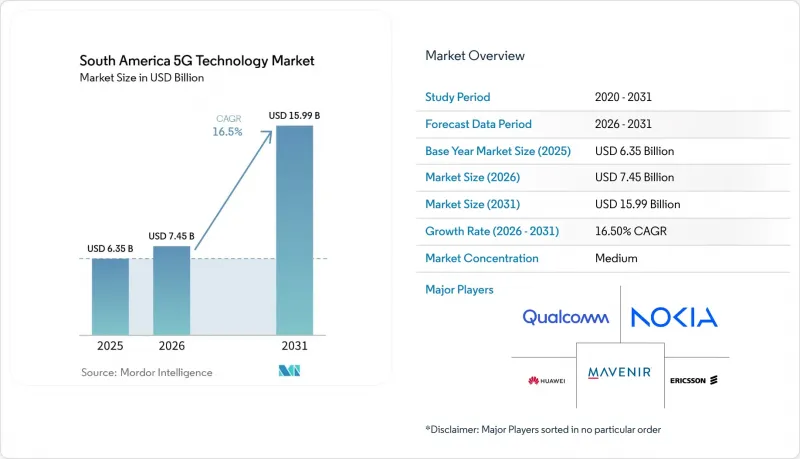
根據 Mordor Intelligence 預測,南美 5G 技術市場規模預計將在 2025 年達到 63.5 億美元,2026 年達到 74.5 億美元,到 2031 年達到 159.9 億美元,2026 年至 2031 年的複合年成長率為 16.50%。
南美洲5G科技市場趨勢與洞察
南美洲主要經濟體5G部署的擴展
巴西的頻段分配法規已將5G部署作為電信業者分階段的法律義務,其許可條件與部署期限掛鉤,網路擴展也成為商業環境的正式組成部分。巴西國家電信管理局(Anatel)被要求在2026年12月前為30%的人口低於3萬的城市提供5G服務。到2029年,這項要求將提高到涵蓋所有地區。截至2026年初,已有1966個城市部署了5G網路。通訊部預計到2026年底,將有超過2220個城市提供5G服務。 2026年1月,巴西電信公司(TIM Brasil)批准了與華為和諾基亞的供應契約,採購超過6500個4G和5G基地台。這些合約旨在滿足商業性吸引力有限的地區對無線接取網路和固定無線接入的需求,同時為供應商提供更清晰的設備交付、安裝和服務合約時間表。
企業對低延遲連線的需求日益成長
在採礦、港口、能源和製造業領域,企業部署正從試點計畫轉向全面營運網路。這些行業的商業性可行性取決於更強大的監控能力、更高的通訊可靠性、自動化以及針對特定現場的網路控制。 2026年3月,諾基亞將與巴西電信公司TIM的合作擴展至14個州,覆蓋巴西42%的人口。此計畫支援網路切片、影像分析、語音辨識和自主運作。諾基亞在此次部署中採用了Habrok的大規模MIMO無線電和NVIDIA的AI-RAN計算技術。淡水河谷、巴西石油公司、Gerdau、AXIA Energia和Flex都已在巴西推出專用網路。這些發展表明,專用無線連接正從一項實驗性技術轉變為計劃內的資本投資。工業客戶需要部署支援、持續最佳化、安全營運以及針對特定站點量身定做的連接,而這種需求正為南美5G技術市場的企業持續盈利鋪平道路。
頻段可用性的變化和競標的複雜性
南美洲各國對頻段的監管規定導致各國市場部署條件不盡相同,設備供應商和電信業者面臨各國特定的競標時間表、許可條件、頻段可用性和技術要求。巴西和智利領先,而其他國家仍處於起步階段。智利計劃於2026年初就剩餘3.5 GHz頻段的分配進行磋商。巴西也已就6 GHz頻段啟動了公眾諮詢。這些流程延長了從頻率規劃到實際部署的時間。每一次延誤都可能推遲終端的上市和企業服務的推出。阿根廷、秘魯、厄瓜多和玻利維亞的技術和程序要求也各不相同。這就需要各國採取不同的合規方式,而不是採用標準化的區域設計,這可能導致採購延誤、專案規劃複雜性增加,並限制全部區域設備部署方案的即時效益。
細分市場分析
2025年,南美洲5G技術市場中硬體佔比50.35%。這反映了初期部署階段,營運商在服務和軟體收入顯著成長之前需要大量的無線設備。初期部署階段需要大規模基地台、天線和無線單元,隨著覆蓋範圍擴展計畫的推進,營運商需要建立實體基礎設施,以提供更先進的服務能力。巴西的覆蓋義務支撐了這項設備需求。阿根廷的初期部署計畫也支撐了硬體需求。隨著營運商對其OSS/BSS系統進行現代化改造,軟體的重要性日益凸顯。這是因為新網路需要跨多個技術層協調配置、客戶支援、收費流程和服務保障。雲端原生網路功能也需要對軟體進行投資。諾基亞的「MantaRay SON」支援自動化網路管理。因此,組件的組合不再局限於無線設備,因為營運商除了需要實體基礎設施外,還需要能夠協調配置、服務保障、自動化和核心網路功能的系統。
預計2026年至2031年,服務市場將以18.35%的複合年成長率成長。電信業者需要專家支持,以進行部署、最佳化和維運管理。諾基亞與TIM巴西公司簽訂的合約包括部署AirScale和MantaRay SON自動化服務,以及在巴西14個州開發企業解決方案。獨立組網需要進行SIM卡遷移和核心網路設定工作,以及最佳化從無線到核心網路的延遲。開放式無線接取網路(Open RAN)提高了硬體介面的相容性。因此,服務交付和軟體整合在合約價值方面變得更加重要,因為客戶需要相容的系統、持續的營運以及即使在初始網路部署完成後也能獲得的技術支援。
2025年,南美洲5G技術市場中,Sub-6 GHz頻段將佔68.90%,凸顯了該地區在商業性和地理條件迥異的情況下,對覆蓋範圍和實際無線電波傳播的重視。此頻段在人口稠密的大都會圈和農村地區均能提供有效的覆蓋。它適用於南美洲各種不同的地區,包括人口密集的都會區、偏遠城鎮、農村地區、山區和工業區,這些地區對覆蓋的需求千差萬別。在巴西,3.5 GHz頻段在2021年的競標中被分配到全國。 Claro、Vivo和TIM獲得了全國範圍的頻段分配。 Anatel還在2026年5月獲得了700 MHz頻段的分配。該分配包括對服務不足地區和聯邦公路的投資義務。這種多層頻段方案確保了在高容量疊加網路廣泛應用之前就能實現覆蓋,使營運商能夠在城市中心以外擴展服務的同時,為人口稠密地區規劃額外的容量。
混合配置預計將在2026年至2031年間以18.80%的複合年成長率成長。電信業者正在將6GHz以下的宏頻段覆蓋範圍與毫米波(mmWave)容量結合,應用於人口密集區域。體育場館和企業設施是毫米波的早期應用案例,這些場所使用者眾多且資料密集型工業功能的存在,使得集中容量投資和專門的網路設計成為必要。截至2025年6月,市面上已有超過150款支援毫米波的設備。而2019年底,這數字僅為21款。根據GSMA的估計,到2030年,每個市場預計都需要2GHz的中波頻寬。因此,智利、阿根廷和秘魯將面臨長期的容量限制。混合網路是平衡覆蓋範圍和集中流量需求的實用方法,因為它可以應用於各個頻段傳播和容量特性最能有效利用的任何地方。
其他好處:
- Excel格式的市場預測(ME)表
- 3個月的分析師支持
目錄
第1章:引言
- 研究假設和市場定義
- 調查範圍
第2章:調查方法
第3章執行摘要
第4章 市場狀況
- 市場概覽
- 市場促進因素
- 5G網路部署正在南美洲主要經濟體中不斷擴大。
- 企業對低延遲連線的需求日益成長
- 在寬頻服務有限的地區,固定無線存取(FWA)正在發展。
- 通訊虛擬化與雲端原生核心網路現代化
- 在礦業、港口和工業走廊部署私人5G網路
- 頻率重新分配和新的競標方案將支援容量擴張
- 市場限制因素
- 頻寬供應不平衡和競標的複雜性
- 農村地區回程回程傳輸和光纖電纜安裝成本不斷上漲
- 宏觀經濟壓力對電信業者的資本投資和終端設備的可負擔性造成影響。
- 除消費者行動寬頻以外的其他領域,貨幣化進程出現延誤
- 5G的歷史沿革與發展
- 目前引進週期(先行者、採用者、後入者)
- 產業價值鏈分析
- 監理情勢和政策趨勢
- 技術展望
- 波特五力分析
- 5G及未來5G(通往6G之路)
- 宏觀經濟因素對市場的影響
第5章 市場規模與成長預測
- 按組件
- 硬體
- 軟體
- 服務
- 按頻段
- 6GHz以下頻段
- 毫米波
- 混合型(低於 6 GHz 和毫米波)
- 透過使用
- 增強型行動寬頻(eMBB)
- 固定無線接入(FWA)
- 大規模機器類型通訊(mMTC)
- 超高可靠性、低延遲通訊(URLLC)
- 按最終用戶行業分類
- 消費者
- 製造業
- 衛生保健
- 車
- 能源公用事業
- 媒體與娛樂
- 公共安全與國防
- 透過網路架構
- 獨立版 (SA)
- 非獨立式(NSA)
- 國家
- 巴西
- 阿根廷
- 其他南美國家
第6章 競爭情勢
- 市場集中度
- 策略趨勢
- 市佔率分析
- 公司簡介
- Huawei Technologies Co., Ltd.
- Telefonaktiebolaget LM Ericsson(Ericsson)
- Nokia Corporation
- Qualcomm Incorporated
- Samsung Electronics Co., Ltd.
- ZTE Corporation
- Intel Corporation
- MediaTek Inc.
- Cisco Systems, Inc.
- NEC Corporation
- CommScope Holding Company, Inc.
- Apple Inc.
- Skyworks Solutions, Inc.
- Analog Devices, Inc.
- Juniper Networks, Inc.
- Mavenir plc
- Parallel Wireless, Inc.
- America Movil, SAB de CV
- Telefonica Brasil SA
第7章 市場機會與未來展望
According to Mordor Intelligence, the South America 5G technology market size is projected to be USD 6.35 billion in 2025, USD 7.45 billion in 2026, and reach USD 15.99 billion by 2031, growing at a CAGR of 16.50% from 2026 to 2031.
South America 5G Technology Market Trends and Insights
Rising 5G Rollout Across Major South American Economies
Brazil's spectrum obligations have made 5G rollout a phased statutory requirement for operators, connecting license conditions to deployment deadlines and making network extension a formal part of the operating environment. Anatel requires service in 30% of municipalities below 30,000 residents by December 2026. The requirement rises to universal coverage by 2029. 5G had reached 1,966 municipalities by early 2026. The Ministry of Communications expects service to be available in more than 2,220 cities by the end of 2026. TIM Brasil approved Huawei and Nokia supply contracts for more than 6,500 4G and 5G sites during January 2026. These obligations support demand for radio access networks and fixed wireless access in locations with limited commercial appeal, while giving suppliers clearer timing for equipment deliveries, installation work, and service contracts.
Expanding Enterprise Demand for Low-Latency Connectivity
Enterprise deployment is moving from trials toward operational networks in mining, ports, energy, and manufacturing, where the commercial case rests on better monitoring, more dependable communications, automation, and site-specific network control. Nokia expanded its TIM Brasil partnership across 14 additional states in March 2026. The coverage reaches 42% of Brazil's population. The program supports network slicing, image analysis, voice recognition, and autonomous operations. Nokia uses Habrok Massive MIMO radios and NVIDIA AI-RAN computing in the deployment. Vale, Petrobras, Gerdau, AXIA Energia, and Flex have commissioned private networks in Brazil. Their activity makes private wireless connectivity a planned capital investment rather than an experimental technology. This demand gives the South America 5G technology market a path to recurring enterprise revenue, since industrial customers require deployment support, ongoing optimization, secure operations, and connectivity tailored to specific sites.
Uneven Spectrum Availability and Auction Complexity
South American spectrum rules create different rollout conditions across national markets, so equipment suppliers and operators face different auction schedules, licensing terms, spectrum availability, and technical conditions from one country to another. Brazil and Chile have moved earlier, while other countries remain at earlier stages. Chile was conducting a consultation on the remaining 3.5 GHz allocations in early 2026. Brazil also opened a public consultation on the 6 GHz band. These processes extend the period between spectrum planning and physical deployment. Each delay can postpone the availability of devices and enterprise service launches. Argentina, Peru, Ecuador, and Bolivia also apply different technical and procedural requirements. Vendors, therefore, need country-specific compliance work instead of standardized regional designs, which can slow procurement, complicate project planning, and limit the immediate benefits of a region-wide equipment approach.
Other drivers and restraints analyzed in the detailed report include:
- Growth in Fixed Wireless Access for Broadband-Underserved Areas
- Telecom Virtualization and Cloud-Native Core Modernization
- Elevated Rural Backhaul and Fiber Deployment Costs
For complete list of drivers and restraints, kindly check the Table Of Contents.
Segment Analysis
Hardware accounted for 50.35% of the South America 5G technology market in 2025, reflecting the early rollout stage, when operators needed large volumes of radio equipment before service and software revenues could become more prominent. The first deployment phase required base stations, antennas, and radio units at scale, with coverage programs demanding physical infrastructure before operators can offer more advanced service capabilities. Brazilian coverage obligations sustained this equipment requirement. Argentina's early deployment program also supported demand for hardware. Software is becoming increasingly important as operators modernize OSS/BSS systems, because newer networks require coordinated provisioning, customer support, billing processes, and service assurance across multiple technology layers. Cloud-native network functions also require software investment. Nokia's MantaRay SON supports automated network management. The component mix is therefore moving beyond radio equipment alone, as operators need systems that coordinate provisioning, service assurance, automation, and core-network functions alongside physical infrastructure.
Services are projected to expand at an 18.35% CAGR from 2026 to 2031. Operators need specialist support for deployment, optimization, and managed operations. Nokia's TIM Brasil agreement includes AirScale installation and MantaRay SON automation services. It also includes enterprise solution development across 14 Brazilian states. Stand-alone networks require SIM migration and core configuration work. They also require radio-to-core latency optimization. Open RAN can make hardware interfaces more interchangeable. Service delivery and software integration, therefore, become more important to contract value, since customers need compatible systems, operational continuity, and technical support after the initial network installation is completed.
Sub-6 GHz accounted for 68.90% of the South America 5G technology market in 2025, underscoring the priority given to coverage and usable propagation across a region where commercial and geographic conditions vary widely. The band provides useful coverage in dense cities and rural areas. This suits South America's varied geography, which includes dense metropolitan areas, distant municipalities, rural communities, mountainous territory, and industrial locations with very different coverage needs. Brazil assigned 3.5 GHz spectrum nationally in its 2021 auction. Claro, Vivo, and TIM received national allocations. Anatel also awarded 700 MHz lots during May 2026. The awards included investment obligations for underserved locations and federal highways. This layered spectrum approach supports coverage before higher-capacity overlays become widespread, allowing operators to extend service beyond central urban areas while planning additional capacity for dense locations.
Hybrid configurations are projected to expand at an 18.80% CAGR from 2026 to 2031. Operators combine sub-6 GHz macro coverage with mmWave capacity in dense settings. Stadiums and enterprise locations are early use cases for mmWave, where large numbers of users or data-intensive industrial functions can justify focused capacity investment and specialized network design. More than 150 commercial mmWave-capable devices were available by June 2025. The total was 21 at the end of 2019. The GSMA estimates that each market will need 2 GHz of mid-band spectrum by 2030. Chile, Argentina, and Peru therefore face longer-term capacity constraints. Hybrid networks provide a practical way to match coverage and concentrated traffic demand, because each spectrum layer can be used where its propagation and capacity characteristics are most useful.
Complete Report Scope:
- By Component
- Hardware
- Software
- Services
- By Spectrum Band
- Sub-6 GHz
- mmWave
- Hybrid (Sub-6 GHz and mmWave)
- By Application
- Enhanced Mobile Broadband (eMBB)
- Fixed Wireless Access (FWA)
- Massive Machine-Type Communications (mMTC)
- Ultra-Reliable Low-Latency Communications (URLLC)
- By End-User Industry
- Consumer
- Manufacturing
- Healthcare
- Automotive
- Energy and Utilities
- Media and Entertainment
- Public Safety and Defense
- By Network Architecture
- Stand-Alone (SA)
- Non-Stand-Alone (NSA)
- By Country
- Brazil
- Argentina
- Rest of South America
List of Companies Covered in this Report:
- Huawei Technologies Co., Ltd.
- Telefonaktiebolaget LM Ericsson (Ericsson)
- Nokia Corporation
- Qualcomm Incorporated
- Samsung Electronics Co., Ltd.
- ZTE Corporation
- Intel Corporation
- MediaTek Inc.
- Cisco Systems, Inc.
- NEC Corporation
- CommScope Holding Company, Inc.
- Apple Inc.
- Skyworks Solutions, Inc.
- Analog Devices, Inc.
- Juniper Networks, Inc.
- Mavenir plc
- Parallel Wireless, Inc.
- America Movil, S.A.B. de C.V.
- Telefonica Brasil S.A.
Additional Benefits:
- The market estimate (ME) sheet in Excel format
- 3 months of analyst support
TABLE OF CONTENTS
1 INTRODUCTION
- 1.1 Study Assumptions and Market Definition
- 1.2 Scope of the Study
2 RESEARCH METHODOLOGY
3 EXECUTIVE SUMMARY
4 MARKET LANDSCAPE
- 4.1 Market Overview
- 4.2 Market Drivers
- 4.2.1 Rising 5G Network Rollout Across Major South American Economies
- 4.2.2 Expanding Enterprise Demand for Low-Latency Connectivity
- 4.2.3 Growth in Fixed Wireless Access for Broadband Underserved Areas
- 4.2.4 Telecom Virtualization and Cloud-Native Core Modernization
- 4.2.5 Private 5G Adoption in Mining, Ports, and Industrial Corridors
- 4.2.6 Spectrum Refarming and New Auction Programs Supporting Capacity Expansion
- 4.3 Market Restraints
- 4.3.1 Uneven Spectrum Availability and High Auction Complexity
- 4.3.2 Elevated Rural Backhaul and Fiber Deployment Costs
- 4.3.3 Macroeconomic Pressure on Operator Capex and Device Affordability
- 4.3.4 Slow Monetization Beyond Consumer Mobile Broadband
- 4.4 5G Timeline and Evolution
- 4.5 Current Adoption Cycle (Forerunners, Adopters, and Laggards)
- 4.6 Industry Value Chain Analysis
- 4.7 Regulatory and Policy Landscape
- 4.8 Technological Outlook
- 4.9 Porter's Five Forces Analysis
- 4.9.1 Threat of New Entrants
- 4.9.2 Bargaining Power of Suppliers
- 4.9.3 Bargaining Power of Buyers
- 4.9.4 Threat of Substitutes
- 4.9.5 Competitive Rivalry
- 4.10 5G and Beyond (6G Pathways)
- 4.11 Impact of Macroeconomic Factors on the Market
5 MARKET SIZE AND GROWTH FORECASTS (VALUE)
- 5.1 By Component
- 5.1.1 Hardware
- 5.1.2 Software
- 5.1.3 Services
- 5.2 By Spectrum Band
- 5.2.1 Sub-6 GHz
- 5.2.2 mmWave
- 5.2.3 Hybrid (Sub-6 GHz and mmWave)
- 5.3 By Application
- 5.3.1 Enhanced Mobile Broadband (eMBB)
- 5.3.2 Fixed Wireless Access (FWA)
- 5.3.3 Massive Machine-Type Communications (mMTC)
- 5.3.4 Ultra-Reliable Low-Latency Communications (URLLC)
- 5.4 By End-User Industry
- 5.4.1 Consumer
- 5.4.2 Manufacturing
- 5.4.3 Healthcare
- 5.4.4 Automotive
- 5.4.5 Energy and Utilities
- 5.4.6 Media and Entertainment
- 5.4.7 Public Safety and Defense
- 5.5 By Network Architecture
- 5.5.1 Stand-Alone (SA)
- 5.5.2 Non-Stand-Alone (NSA)
- 5.6 By Country
- 5.6.1 Brazil
- 5.6.2 Argentina
- 5.6.3 Rest of South America
6 COMPETITIVE LANDSCAPE
- 6.1 Market Concentration
- 6.2 Strategic Moves
- 6.3 Market Share Analysis
- 6.4 Company Profiles (includes Global Level Overview, Market Level Overview, Core Segments, Financials as Available, Strategic Information, Market Rank/Share, Products and Services, Recent Developments)
- 6.4.1 Huawei Technologies Co., Ltd.
- 6.4.2 Telefonaktiebolaget LM Ericsson (Ericsson)
- 6.4.3 Nokia Corporation
- 6.4.4 Qualcomm Incorporated
- 6.4.5 Samsung Electronics Co., Ltd.
- 6.4.6 ZTE Corporation
- 6.4.7 Intel Corporation
- 6.4.8 MediaTek Inc.
- 6.4.9 Cisco Systems, Inc.
- 6.4.10 NEC Corporation
- 6.4.11 CommScope Holding Company, Inc.
- 6.4.12 Apple Inc.
- 6.4.13 Skyworks Solutions, Inc.
- 6.4.14 Analog Devices, Inc.
- 6.4.15 Juniper Networks, Inc.
- 6.4.16 Mavenir plc
- 6.4.17 Parallel Wireless, Inc.
- 6.4.18 America Movil, S.A.B. de C.V.
- 6.4.19 Telefonica Brasil S.A.
7 MARKET OPPORTUNITIES AND FUTURE OUTLOOK
- 7.1 White-Space and Unmet-Need Assessment

 5G波束成形技術市場預測至2034年-全球波束成形類型、組件、天線配置、頻段、應用、最終用戶和區域分析
 亞太地區5G技術:市佔率分析、產業趨勢與統計及成長預測(2026-2031年)非洲5G技術:市場佔有率分析、產業趨勢與統計及成長預測(2026-2031年)北美5G技術:市場佔有率分析、產業趨勢與統計及成長預測(2026-2031年)歐洲5G技術:市場佔有率分析、產業趨勢與統計及成長預測(2026-2031年)5G技術:市場佔有率分析、產業趨勢與統計、成長預測(2026-2031年)
 2026年全球5G技術市場報告
 5G技術市場分析及預測(至2035年):按類型、產品類型、服務、技術、組件、應用、部署類型、最終用戶、解決方案和模式分類
 5G技術市場-全球產業規模、佔有率、趨勢、機會及預測(按組件、技術、頻段、應用、地區和競爭格局分類,2021-2031年)
 5G技術市場規模、佔有率和成長分析(按組件、性別、應用和地區分類)—產業預測,2026-2033年