


 |
市場調查報告書
商品編碼
2155001
南美洲氣體感測器:市場佔有率分析、產業趨勢與統計及成長預測(2026-2031 年)South America Gas Sensors - Market Share Analysis, Industry Trends & Statistics, Growth Forecasts (2026 - 2031) |
||||||

※ 本網頁內容可能與最新版本有所差異。詳細情況請與我們聯繫。
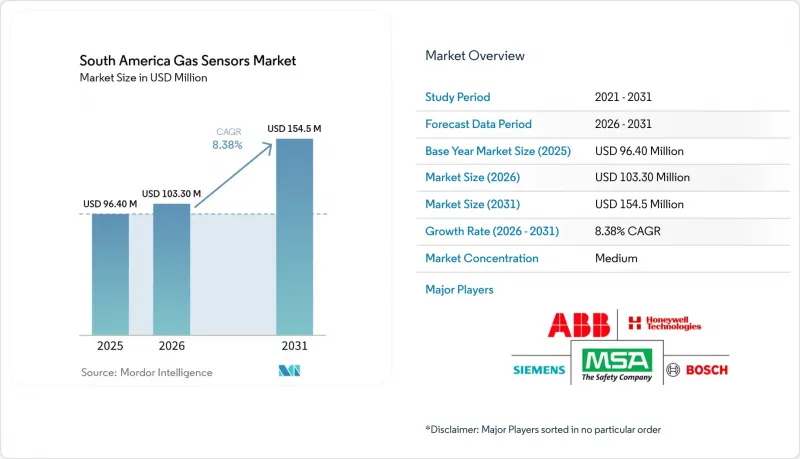
根據 Mordor Intelligence 預測,南美氣體感測器市場規模將從 2025 年的 1.545 億美元,2026 年至 2031 年的年複合成長率(CAGR)為 8.38%。
南美氣體感測器市場趨勢與洞察
更嚴格的工業安全和排放法規
在巴西,職業安全體系透過NR-15、NR-20、NR-33和NR-35等法規得以維護。這些法規涵蓋危險作業、易燃材料、密閉空間、高空作業、氣體偵測器校準以及爆炸性環境防護。 2024年12月,ABNT修訂了ABNT NBR IEC 60079-29-2標準,強化了對可燃性氣體和氧氣偵測器的選擇、安裝、使用和維護的要求。此次修訂加強了文件和校準記錄的要求,並可能導致需要更換那些缺乏必要記錄或無法證明其性能符合更新後要求的過時設備。 2026年3月,秘魯發布了《2026年礦業安全與健康法規》,將氣體監測義務擴大到先前未被正式合規要求全面涵蓋的中型礦業企業。巴西的NR-15標準也可能進行修訂,這可能會導致目前依賴定期採樣的領域更多地採用連續監測。
石油天然氣、採礦和化學工業的業務擴張。
2025年8月,BP宣佈在巴西桑托斯盆地的布梅朗格區塊發現大規模油氣蘊藏量。未來的深海開發將需要固定式氣體感測器,以滿足製程安全、緊急停車系統和運作完整性的要求。在阿根廷,Vista Energy和YPF在瓦卡穆爾塔區塊的生產計畫,正推動著對碳氫化合物和二氧化碳監測的需求成長,這主要基於各州的排放報告要求。阿內洛和內烏肯附近的新石化基礎設施也需要對封閉空間和裝卸區內的揮發性有機化合物(VOC)和有毒氣體進行監測。在這些應用中,電化學多氣體偵測器仍然是標準配置,因為工作人員在日常操作中可能會接觸到碳氫化合物、二氧化碳和有毒氣體的混合物。用於食品級供應鏈的工業二氧化碳回收技術,正在為純度感測器創造新的應用,其應用與石化產品的產量掛鉤,而非原油價格波動。
安裝成本和生命週期成本高。
固定式多點氣體偵測網路需要經過認證的佈線、試運行、年度校準和感測器元件更換。在南美洲工業設施中,這些生命週期成本可能高達硬體標價的兩到四倍。巴西對感測器組件徵收的進口關稅使到貨成本比全球基準高出10%至20%。這種成本結構會延長更換週期,這也是即使新型架構減少了所需的佈線、支架和現場工作量,老舊的有線系統仍然被繼續使用的原因之一。一項在巴西進行的系統性調查發現,南美低成本空氣品質感測器節點的價格從71美元到1573美元不等,不包括校準服務費用。遠端負責人更傾向於選擇維護週期為三年或更長的非分散紅外線(NDIR)和微機電系統(MEMS)感測器,而不是可能需要每12至24個月更換一次的電化學感測器。
細分市場分析
氣體類型的選擇與各設施的暴露源和監測目標(例如工人保護、洩漏檢測、製程控制、空氣品質監測和確保食品儲存安全)密切相關。因此,在可能同時出現可燃性氣體、有毒氣體和氧氣不足的情況下,多氣體配置的重要性仍然很高。
2025年,碳氫化合物(VOCs/CH4)在南美氣體感測器市場佔有26.10%的佔有率。這個細分市場反映了巴西、阿根廷和哥倫比亞上游油氣、鋼鐵和化學工業中可燃性氣體暴露的普遍性。用於監測爆炸下限(LEL)的觸媒珠檢測器和多氣體電化學檢測器仍然是煉油廠和工業工廠的標準設備。它們豐富的應用經驗支撐了替換需求,尤其是在煉油廠、生產設施和化工廠,這些場所的運作人員必須在危險區域保持監控覆蓋,否則安全操作將無法進行。
預計到2031年,二氧化碳將成為成長最快的氣體成分。這項需求主要源自於建築自動化、暖通空調最佳化、食品飲料冷鏈以及高濃度二氧化碳鹽層下下層海上監測等方面的需求。英國石油公司(BP)的布梅朗格油田聯產氣中二氧化碳濃度很高,隨著該油田進入開發階段,對二氧化碳檢測的需求預計將進一步成長。氧氣感測器在密閉空間檢驗中保持穩定的作用,而硫化氫和二氧化硫檢測器則為智利和秘魯的酸性氣體處理和硫酸生產作業提供支援。此外,隨著空氣品質標準的日益嚴格,聖保羅、波哥大和聖地牙哥等城市正在透過都市區計畫擴大氮氧化物監測的範圍。
因此,該類別不僅滿足重工業的安全需求,還涵蓋更廣泛的商業和民用應用,使供應商除了能夠應對生產環境中的暴露風險外,還能滿足通風、儲存和環境監測方面的需求。這種廣泛的應用範圍降低了對單一工業採購週期的依賴。
預計到2031年,MEMS半導體光學元件的複合年成長率將達到10.15%,成為所有技術類型中成長最快的。其小型化和低功耗特性使其適用於電池供電設備、物聯網穿戴式裝置和LoRaWAN節點。一項2026年的研究展示了一種基於單矽基基板的整合式NDIR二氧化碳感測器,該感測器具有更優異的光耦合性能和更快的氣體交換速度。這些技術特性對於在高濕度環境和極端溫度波動條件下運作的工業和公共應用至關重要,因為感測器的面積、功耗和快速氣體交換能力都會影響其安裝方式。
在南美洲氣體感測器產業,電化學技術仍然是應用最廣泛的技術。此技術持續應用於CO、H₂S和O₂的監測,在這些應用中,ppm級靈敏度和成熟的校準程序至關重要。 PID感測器則用於石油化學衛生管理和工業接觸評估中的VOC監測。此外,隨著辦公室、學校和醫院等場所對CO₂監測的需求日益成長,NDIR設備的應用範圍也從製程安全擴展到建築系統。在NDIR設備單價較高的情況下,尤其是在已有成熟的有線檢測系統和完善的維護流程的環境中,觸媒珠產品仍然是固定式可燃性氣體監測的一種經濟高效的選擇。
技術選擇還取決於檢測週期、可用功率、運行條件以及待檢測氣體的類型。這些因素決定了多種成熟檢測方法的需求。
其他好處:
- Excel格式的市場預測(ME)表
- 3個月的分析師支持
目錄
第1章:引言
- 研究假設和市場定義
- 調查範圍
第2章:調查方法
第3章執行摘要
第4章 市場狀況
- 市場概覽
- 宏觀經濟因素對市場的影響
- 市場促進因素
- 加強職業安全健康及排放法規
- 石油天然氣、採礦和化學工業的業務擴張。
- 智慧城市發展與室內空氣品質監測
- 聯網工作人員和無線感測器的部署狀態
- 鋰和銅計畫的監測要求
- 遠端生產設施的甲烷外洩檢測
- 市場限制因素
- 高昂的實施成本與生命週期成本
- 感測器干擾、漂移和校準負擔
- 該地區缺乏服務和校準基礎設施
- 小規模工業企業缺乏集中採購。
- 產業價值鏈分析
- 監理情勢
- 技術展望
- 波特五力分析
第5章 市場規模與成長預測
- 依氣體類型
- 氧
- 一氧化碳(CO)
- 二氧化碳(CO2)
- 氮氧化物(NOx)
- 碳氫化合物(VOCs/CH4)
- 其他氣體(SO2、H2S)
- 透過技術
- 電化學
- 光電離(PID)
- 固態/MOS
- 觸媒珠
- 非色散紅外光譜(NDIR)
- 微機電系統與半導體光學
- 按外形規格
- 固定/現場安裝模組
- 可攜式/手持終端機
- 穿戴式徽章/貼片
- 連結性別
- 有線(4-20 mA、CAN、RS-485)
- 無線(BLE、NB-IoT、LoRaWAN)
- 按最終用途行業分類
- 工業安全與製程(石油天然氣、化學)
- 汽車動力系統和暖通空調
- 建築自動化/智慧家居
- 醫療和生命科學設備
- 食品飲料及冷鏈物流
- 環境監測與智慧城市節點
- 其他終端用戶產業
- 國家
- 巴西
- 阿根廷
- 哥倫比亞
- 其他南美國家
第6章 競爭情勢
- 市場集中度
- 策略趨勢
- 市佔率分析
- 公司簡介
- ABB Ltd.
- Honeywell International Inc.
- MSA Safety Incorporated
- Dragerwerk AG & Co. KGaA
- Siemens AG
- Robert Bosch GmbH
- Amphenol Corporation
- Industrial Scientific Corporation
- Blackline Safety Corporation
- Crowcon Detection Instruments Limited
- RIKEN KEIKI CO., LTD.
- Figaro Engineering Inc.
- Nemoto & Co., Ltd.
- Dynament Ltd.
- MEMBRAPOR AG
- Trolex Ltd.
- Sensirion AG
- Process Sensing Technologies
- GfG Gesellschaft fur Geratebau mbH
- SENKO CO., LTD.
第7章 市場機會與未來展望
According to Mordor Intelligence, the South America gas sensors market size is projected to expand from USD 96.40 million in 2025 and USD 103.30 million in 2026 to USD 154.5 million by 2031, registering a CAGR of 8.38% between 2026 to 2031.
South America Gas Sensors Market Trends and Insights
Stricter Industrial Safety and Emissions Regulations
Brazil maintains a structured occupational safety framework through NR-15, NR-20, NR-33, and NR-35. These rules cover unhealthy activities, flammables, confined spaces, work at height, gas detector calibration, and protection in explosive atmospheres. ABNT revised ABNT NBR IEC 60079-29-2 in December 2024, strengthening requirements for selecting, installing, using, and maintaining flammable-gas and oxygen detectors. The revision increases documentation and calibration record requirements, which can bring replacement demand for legacy equipment that lacks the required records or cannot demonstrate continued performance against the updated requirements. Peru published its 2026 mining safety and health regulation in March 2026, extending formal gas-monitoring obligations to more mid-tier mining operations that had previously been less consistently covered by formal compliance requirements. A potential revision to Brazil's NR-15 could increase the use of continuous monitoring in sectors that still rely on periodic sampling.
Expansion of Oil and Gas, Mining, and Chemical Operations
BP announced a major oil and gas discovery at the Bumerangue block in Brazil's Santos Basin in August 2025. Future deepwater development would require fixed gas sensors for process safety, emergency shutdown systems, and operational integrity requirements. In Argentina, Vaca Muerta production plans by Vista Energy and YPF support demand for hydrocarbon and CO2 monitoring under provincial emissions reporting requirements. New petrochemical infrastructure near Anelo and Neuquen City also requires VOC and toxic-gas monitoring in confined spaces and loading areas. Electrochemical multi-gas instruments remain the normal specification for those applications, where workers may face a mix of hydrocarbon, carbon dioxide, and toxic-gas exposures during routine operations. Recovered industrial CO2 used in food-grade supply chains creates another use for purity sensors that is linked to petrochemical output rather than oil price movements.
High Installation and Lifecycle Costs
Fixed multi-point gas detection networks require certified wiring, commissioning, annual calibration, and sensor element replacement. In South American industrial facilities, those lifecycle requirements can cost 2 to 4 times the listed hardware price. Brazil's import duties on sensor components add 10-20% to landed costs compared with global benchmarks. This cost structure can delay refresh cycles and helps explain the continued use of older wired systems, even where newer architectures could reduce the amount of cable, scaffolding, and site work required. A Brazilian systematic review found that low-cost air-quality sensor nodes in South America ranged from USD 71 to USD 1,573 before calibration services. Remote operators are giving more attention to NDIR and MEMS designs with service intervals of 3 years or more, rather than electrochemical cells that may require replacement after 12-24 months.
Other drivers and restraints analyzed in the detailed report include:
- Methane-Leak Detection for Remote Production Assets
- Growth in Smart-City and Indoor-Air-Quality Monitoring
- Sensor Interference, Drift, and Calibration Burden
For complete list of drivers and restraints, kindly check the Table Of Contents.
Segment Analysis
Gas type selection remains closely tied to the source of exposure and the monitoring purpose at each facility, including worker protection, leak identification, process control, air-quality oversight, and food storage integrity. This keeps multi-gas configurations important, where flammable, toxic, and oxygen-deficient conditions can occur together.
Hydrocarbons (VOC/CH4) held 26.10% of the South America gas sensors market share in 2025. The segment reflects flammable-gas exposure in upstream oil and gas, steel, and chemical operations across Brazil, Argentina, and Colombia. Catalytic bead instruments and multi-gas electrochemical devices configured for lower-explosive-limit monitoring remain standard equipment in refineries and industrial plants. Their broad installed base supports replacement demand where operators must maintain coverage in hazardous locations, particularly where refineries, production facilities, and chemical plants cannot safely operate without continuous monitoring.
CO2 is the fastest-expanding gas type through 2031. Building automation, HVAC optimization, food and beverage cold chains, and offshore monitoring needs at high-CO2 pre-salt reservoirs support this demand. BP's Bumerangue discovery contains elevated CO2 in associated gas, creating a further need for CO2 sensing if the block moves into development. O2 sensors retain a stable role in confined-space verification, while H2S and SO2 devices support sour-gas processing and sulfuric acid operations in Chilean and Peruvian mining. NOx monitoring is also extending through urban programs in Sao Paulo, Bogota, and Santiago as ambient air standards tighten.
The category therefore serves both heavy industrial safety needs and a wider set of commercial and civic applications, allowing suppliers to address exposure risks in production environments as well as ventilation, storage, and ambient monitoring needs. That range reduces reliance on any single industrial purchasing cycle.
MEMS semiconductor optical devices are forecast to expand at a CAGR of 10.15% through 2031, the highest rate across technology types. Their smaller size and lower power use suit battery-powered equipment, IoT wearables, and LoRaWAN nodes. A 2026 study described an integrated NDIR CO2 sensor built on a single silicon substrate with improved optical coupling and rapid gas exchange. These technical characteristics are relevant to industrial and civic deployments that operate in humid or thermally variable conditions, where sensor footprint, power draw, and the ability to exchange gas rapidly affect installation choices.
Electrochemical technology retains the deepest installed base in the South America gas sensors industry. It remains widely specified for CO, H2S, and O2 monitoring where parts-per-million sensitivity and established calibration procedures are important. PID sensors support VOC monitoring for petrochemical hygiene and industrial exposure assessments. NDIR devices are expanding from process safety into building systems as CO2 requirements become more common in offices, schools, and hospitals. Catalytic bead products remain a cost-effective option for fixed combustible-gas monitoring when NDIR's higher unit cost is not justified, especially at sites that already have mature hard-wired detection systems and established maintenance practices.
Technology choice also depends on service intervals, available power, operating conditions, and the type of gas that requires detection. These considerations preserve demand for several established sensing methods.
Complete Report Scope:
- By Gas Type
- Oxygen
- Carbon Monoxide (CO)
- Carbon Dioxide ( CO2)
- Nitrogen Oxides (NOx)
- Hydrocarbons (VOC/CH4)
- Other Gases ( SO2, H2S)
- By Technology
- Electrochemical
- Photo-Ionization (PID)
- Solid-State / MOS
- Catalytic Bead
- Non-Dispersive Infrared (NDIR)
- MEMS-Semiconductor Optical
- By Form Factor
- Fixed / In-Situ Modules
- Portable / Hand-Held Devices
- Wearable Badges / Patches
- By Connectivity
- Wired (4-20 mA, CAN, RS-485)
- Wireless (BLE, NB-IoT, LoRaWAN)
- By End-Use Industry
- Industrial Safety and Process (Oil and Gas, Chemicals)
- Automotive Powertrain and HVAC
- Building Automation / Smart Homes
- Medical and Life-Science Equipment
- Food, Beverage, and Cold-Chain Logistics
- Environmental Monitoring and Smart City Nodes
- Other End-Use Industries
- By Country
- Brazil
- Argentina
- Colombia
- Rest of South America
List of Companies Covered in this Report:
- ABB Ltd.
- Honeywell International Inc.
- MSA Safety Incorporated
- Dragerwerk AG & Co. KGaA
- Siemens AG
- Robert Bosch GmbH
- Amphenol Corporation
- Industrial Scientific Corporation
- Blackline Safety Corporation
- Crowcon Detection Instruments Limited
- RIKEN KEIKI CO., LTD.
- Figaro Engineering Inc.
- Nemoto & Co., Ltd.
- Dynament Ltd.
- MEMBRAPOR AG
- Trolex Ltd.
- Sensirion AG
- Process Sensing Technologies
- GfG Gesellschaft fur Geratebau mbH
- SENKO CO., LTD.
Additional Benefits:
- The market estimate (ME) sheet in Excel format
- 3 months of analyst support
TABLE OF CONTENTS
1 INTRODUCTION
- 1.1 Study Assumptions and Market Definition
- 1.2 Scope of the Study
2 RESEARCH METHODOLOGY
3 EXECUTIVE SUMMARY
4 MARKET LANDSCAPE
- 4.1 Market Overview
- 4.2 Impact of Macroeconomic Factors on the Market
- 4.3 Market Drivers
- 4.3.1 Stricter Industrial Safety and Emissions Regulations
- 4.3.2 Expansion of Oil and Gas, Mining, and Chemical Operations
- 4.3.3 Growth in Smart-City and Indoor-Air-Quality Monitoring
- 4.3.4 Connected-Worker and Wireless Sensor Deployments
- 4.3.5 Lithium and Copper Project Monitoring Requirements
- 4.3.6 Methane-Leak Detection for Remote Production Assets
- 4.4 Market Restraints
- 4.4.1 High Installation and Lifecycle Costs
- 4.4.2 Sensor Interference, Drift, and Calibration Burden
- 4.4.3 Limited Local Service and Calibration Infrastructure
- 4.4.4 Fragmented Procurement Across Small Industrial Operators
- 4.5 Industry Value Chain Analysis
- 4.6 Regulatory Landscape
- 4.7 Technological Outlook
- 4.8 Porter's Five Forces Analysis
- 4.8.1 Threat of New Entrants
- 4.8.2 Bargaining Power of Suppliers
- 4.8.3 Bargaining Power of Buyers
- 4.8.4 Threat of Substitutes
- 4.8.5 Competitive Rivalry
5 MARKET SIZE AND GROWTH FORECASTS (VALUE)
- 5.1 By Gas Type
- 5.1.1 Oxygen
- 5.1.2 Carbon Monoxide (CO)
- 5.1.3 Carbon Dioxide ( CO2)
- 5.1.4 Nitrogen Oxides (NOx)
- 5.1.5 Hydrocarbons (VOC/CH4)
- 5.1.6 Other Gases ( SO2, H2S)
- 5.2 By Technology
- 5.2.1 Electrochemical
- 5.2.2 Photo-Ionization (PID)
- 5.2.3 Solid-State / MOS
- 5.2.4 Catalytic Bead
- 5.2.5 Non-Dispersive Infrared (NDIR)
- 5.2.6 MEMS-Semiconductor Optical
- 5.3 By Form Factor
- 5.3.1 Fixed / In-Situ Modules
- 5.3.2 Portable / Hand-Held Devices
- 5.3.3 Wearable Badges / Patches
- 5.4 By Connectivity
- 5.4.1 Wired (4-20 mA, CAN, RS-485)
- 5.4.2 Wireless (BLE, NB-IoT, LoRaWAN)
- 5.5 By End-Use Industry
- 5.5.1 Industrial Safety and Process (Oil and Gas, Chemicals)
- 5.5.2 Automotive Powertrain and HVAC
- 5.5.3 Building Automation / Smart Homes
- 5.5.4 Medical and Life-Science Equipment
- 5.5.5 Food, Beverage, and Cold-Chain Logistics
- 5.5.6 Environmental Monitoring and Smart City Nodes
- 5.5.7 Other End-Use Industries
- 5.6 By Country
- 5.6.1 Brazil
- 5.6.2 Argentina
- 5.6.3 Colombia
- 5.6.4 Rest of South America
6 COMPETITIVE LANDSCAPE
- 6.1 Market Concentration
- 6.2 Strategic Moves
- 6.3 Market Share Analysis
- 6.4 Company Profiles (includes Global Level Overview, Market Level Overview, Core Segments, Financials as available, Strategic Information, Market Rank/Share, Products and Services, Recent Developments)
- 6.4.1 ABB Ltd.
- 6.4.2 Honeywell International Inc.
- 6.4.3 MSA Safety Incorporated
- 6.4.4 Dragerwerk AG & Co. KGaA
- 6.4.5 Siemens AG
- 6.4.6 Robert Bosch GmbH
- 6.4.7 Amphenol Corporation
- 6.4.8 Industrial Scientific Corporation
- 6.4.9 Blackline Safety Corporation
- 6.4.10 Crowcon Detection Instruments Limited
- 6.4.11 RIKEN KEIKI CO., LTD.
- 6.4.12 Figaro Engineering Inc.
- 6.4.13 Nemoto & Co., Ltd.
- 6.4.14 Dynament Ltd.
- 6.4.15 MEMBRAPOR AG
- 6.4.16 Trolex Ltd.
- 6.4.17 Sensirion AG
- 6.4.18 Process Sensing Technologies
- 6.4.19 GfG Gesellschaft fur Geratebau mbH
- 6.4.20 SENKO CO., LTD.
7 MARKET OPPORTUNITIES AND FUTURE OUTLOOK
- 7.1 White-Space and Unmet-Need Assessment

 2026年全球熱線半導體感測器市場報告
 光學氧氣感測器市場:全球市場預測,2026-2032年
 礦業雷射甲烷感測器市場報告:趨勢、預測和競爭分析(至2035年)
 氣體感測器、偵測器和分析儀器:市場佔有率分析、行業趨勢和統計數據以及成長預測(2026-2031 年)氧氣感知器:市場佔有率分析、產業趨勢與統計、成長預測(2026-2031)美國氣體感測器:市場佔有率分析、行業趨勢和統計數據、成長預測(2026-2031 年)氣體感測器:市場佔有率分析、產業趨勢與統計、成長預測(2026-2031)氣體感測器市場:2026-2032年全球市場預測(按產品類型、連接方式、技術、類別、氣體類型、應用和最終用戶分類)
 全球臭氧感測器市場:市場規模、佔有率、趨勢和成長分析(2026-2034)2026年全球建築用黑色花崗岩市場報告