


 |
市場調查報告書
商品編碼
2123002
氣體感測器、偵測器和分析儀器:市場佔有率分析、行業趨勢和統計數據以及成長預測(2026-2031 年)Gas Sensor, Detector And Analyzer - Market Share Analysis, Industry Trends & Statistics, Growth Forecasts (2026 - 2031) |
||||||

※ 本網頁內容可能與最新版本有所差異。詳細情況請與我們聯繫。
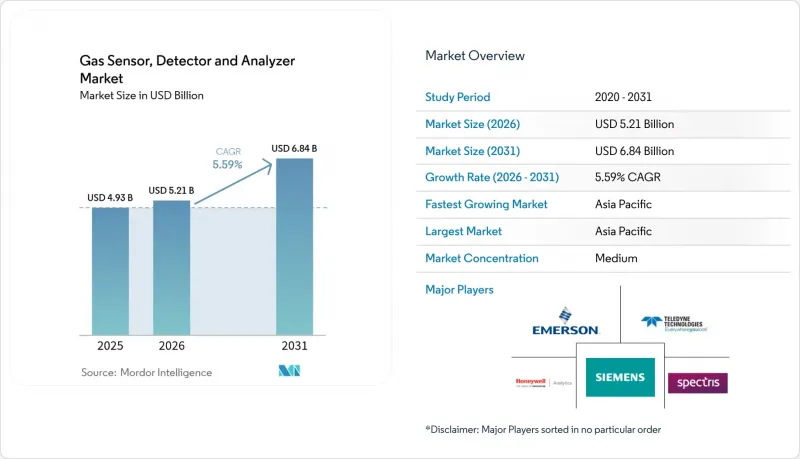
根據 Mordor Intelligence 預測,氣體感測器、偵測器和分析儀器的市場規模預計將從 2025 年的 49.3 億美元成長到 2026 年的 52.1 億美元,到 2031 年將達到 68.4 億美元,2026 年至 2031 年的複合成長率為 5.59%。
本報告按產品類型(氣體分析儀、氣體感測器、氣體探測器)、技術(電化學、順磁性、其他)、通訊類型(有線、無線)、終端用戶產業(石油天然氣、金屬和採礦、公共產業和發電、製藥、食品飲料、其他)以及地區進行細分。市場預測以美元計價。
全球氣體感測器、偵測器及分析儀器市場趨勢及洞察
提高對職業危害的安全意識
隨著民眾對職場死亡事故的關注度日益提高,工業企業正將持續檢測納入其標準作業規程。根據美國職業安全與健康管理局 (OSHA) 的記錄,預計到 2024 年將有 5190 名工人死亡,其中 8% 的死亡原因是氣體暴露。保險公司目前為實施經認證的檢測網路的公司提供高達 25% 的保費折扣,使合規成為一項直接的成本節約措施。此外,隨著監管範圍擴展到食品加工廠等「非傳統」環境,即使是首次購買者,也被迫進入氣體感測器、偵測器和分析儀市場。因此,需求正從零星的採購週期轉向與公司整體安全關鍵績效指標 (KPI) 掛鉤的規劃部署。
攜帶式多氣體檢測儀的普及
繼國際消防局長協會於2024年建議所有緊急應變團隊採用攜帶式多氣體偵測儀後,此類設備已從專用設備轉變為不可或缺的初步應變工具。目前型號配備六種氣體檢測陣列,交叉靈敏度低於2%,使消防員和維修人員能夠即時監測危險情況。電池續航時間延長至72小時,消除了執勤停機時間,而GPS和行動電話數據傳輸功能則使每位工作人員都能作為移動感測器節點使用。這種使用方式的轉變帶來了持續兩位數的銷售額成長,尤其是在快速發展的東南亞建築產業。
初始設定和校準成本高昂
為整個工廠部署有線感測網路的成本在 25,000 美元到 75,000 美元之間,而年度校準合約又會使擁有成本增加 20% 到 30%。新興亞洲地區 40% 的工廠由於預算已分配給其他資本項目而推遲了升級計劃。雖然訂閱模式越來越普及,可以降低高達 70% 的實施成本,但許多小規模企業仍將氣體監測視為一種可有可無的措施,直到監管部門介入為止。
細分市場分析
就以金額為準,預計到2025年,感測器將佔氣體感測器、偵測器和分析儀市場佔有率的47.33%,這反映了分散式架構中即插即用的兼容性。在MEMS探測器小型化(無需結構改造即可直接整合到機器面板中)的推動下,預計到2031年,該細分市場將以6.62%的複合年成長率成長。探測器在密閉空間警報系統和消防隊員用裝備中繼續發揮至關重要的作用,而分析儀則在實驗室和排放氣體報告領域佔據主導地位,這些領域需要百萬分之一公尺的精度。目前,製造商正在模糊這些界限,提供可通用的即插即用混合模組,並符合IEC 62990標準,此舉有望強化「感測器優先」的設計理念。
第二代平台將警報、分析和雲端閘道功能整合到單一機殼中,安裝時間縮短了35%。小規模供應商現在可以利用開放標準協議銷售可與一級監控系統無縫整合的利基分析儀器,從而降低供應商鎖定風險。這種互通性正促使採購模式從一次性的檢測器訂單轉向公司範圍內的框架契約,從而逐步提高氣體感測器、檢測器和分析儀器市場的平均合約價值。
由於電化學堆在傳統應用中持續保持成本績效效益,其在氣體感測器、偵測器和分析儀市場中仍佔據37.08%的佔有率。半導體陣列正推動短期創新,其運作耐久性和低於1毫瓦的功耗實現了5.66%的複合年成長率。非色散紅外線(NDIR)探頭在食品包裝中微量二氧化碳檢測這一細分市場中保持著強勁的地位,而順磁環則在惰性系統中保障了氧氣的純度。觸媒珠在碳氫化合物環境中仍然被廣泛應用,因為在這些環境中,本質安全標準比選擇性更為重要。
先進的光聲電池雖然目前價格昂貴,但面積小巧,卻能實現多種氣體檢測。預計到2024年,該領域的專利申請量將成長45%,凸顯了研發投入的增加。監管機構也對此予以關注,美國環保署(EPA)去年批准了幾種新型感測器化學技術,用於強制性洩漏調查。該聯盟預計,隨著電池壽命目標超過五年,校準週期延長至每年一次,終端用戶將逐步採用這些固態感測器。
區域分析
預計到2025年,亞太地區將佔全球銷售額的35.42%,複合年成長率(CAGR)為5.86%。在中國,GB/T 50493-2024標準已生效,強制要求化學企業安裝多點偵測網路。同時,印度修訂後的工廠法規要求對危險品處理設施進行即時監控。日本原始設備製造商(OEM),例如Figaro Engineering,正在出口功耗降低30%的微機電系統(MEMS)感測器,這加速了東南亞注重成本的中小企業對這些感測器的採用。韓國的造船廠正在部署耐鹽霧的船用探測器,而澳洲的地下礦井則正在採用遠程網狀網路來克服岩層造成的射頻衰減。
在北美,穩定的市場需求主要來自現有設備的更換,而非新設備的安裝。由於美國職業安全與健康管理局 (OSHA) 對密閉空間作業的規定,攜帶式偵測器的需求仍然強勁;加拿大油砂業者需要能夠在-40 度C低溫下穩定運作的分析儀。美國即將訂定的甲烷排放法規將強制要求每季進行洩漏檢測,預計將持續推動光學成像器和高精度分析儀的訂單成長。此外,在墨西哥蓬勃發展的汽車產業叢集中,一氧化碳和二氧化氮測量陣列正被安裝在噴漆車間的通風系統中,這也促進了相關產品銷售的逐步成長。
在歐洲,近乎連續的排放氣體監測是重點。根據2024年工業排放指令,配備氮氧化物(NOx)洗滌器的發電廠必須確保廢氣濃度低於15 ppm。在德國,感測器輸出已整合到工業4.0平台中,為預測性維護演算法提供信息,以防止反應器停機。英國的離岸風力發電電場在水泥漿期間需要監測硫化氫(H2S)濃度,而波蘭的銅礦正在採用防爆探測器,因為生產重心已轉向電池用金屬。南美洲、中東和非洲也是重要的市場,這主要得益於南美洲的銅和鋰項目,以及中東和非洲煉油廠和天然氣驅動海水淡化廠的擴張。
其他好處
- Excel格式的市場預測(ME)表
- 3個月的分析師支持
目錄
第1章:引言
- 研究假設和市場定義
- 調查範圍
第2章:調查方法
第3章執行摘要
第4章 市場狀況
- 市場概覽
- 市場促進因素
- 提高對職業危害的安全意識
- 攜帶式多氣體檢測儀的普及
- 所有行業都將面臨更嚴格的排放氣體法規。
- 擴大物聯網氣體監測解決方案的應用
- 綠色氫氣生產設施的快速擴張
- 用於室內空氣品質測量的光聲光譜感測器的微型化
- 市場限制因素
- 初始設定和校準成本高昂
- 低感測器選擇性引起的交叉靈敏度誤差
- 新興經濟體缺乏熟練的校準技術人員
- 雲端連線偵測網路中的資料安全問題
- 產業價值鏈分析
- 監理情勢
- 技術展望
- 波特五力分析
- 宏觀經濟因素的影響
- 投資分析
- 評估新冠疫情對產業的影響
第5章 市場規模與成長預測
- 產品類型
- 氣體分析儀
- 氣體感測器
- 氣體探測器
- 透過技術
- 電化學
- 順磁性
- 氧化鋯
- 非色散紅外線
- 半導體
- 光電離
- 催化劑
- 光聲學
- 其他
- 依溝通類型
- 有線
- 無線的
- 按最終用戶行業分類
- 石油和天然氣
- 化工/石油化工
- 供水和廢水處理
- 金屬和採礦
- 公共產業和發電
- 製藥
- 飲食
- 其他
- 按地區
- 北美洲
- 美國
- 加拿大
- 歐洲
- 德國
- 英國
- 法國
- 義大利
- 西班牙
- 其他歐洲國家
- 亞太地區
- 中國
- 日本
- 印度
- 韓國
- 澳洲
- 其他亞太國家
- 南美洲
- 巴西
- 阿根廷
- 其他南美國家
- 中東
- 沙烏地阿拉伯
- 阿拉伯聯合大公國
- 土耳其
- 其他中東國家
- 非洲
- 南非
- 奈及利亞
- 其他非洲地區
- 北美洲
第6章 競爭情勢
- 市場集中度
- 策略趨勢
- 市佔率分析
- 公司簡介
- Emerson Electric Company
- Teledyne Technologies Incorporated
- Siemens Aktiengesellschaft
- Spectris plc(Servomex Group Limited)
- Honeywell Analytics Inc.
- Draegerwerk Aktiengesellschaft and Co. KGaA
- Industrial Scientific Corporation
- MSA Safety Incorporated
- Crowcon Detection Instruments Limited
- Yokogawa Electric Corporation
- Control Instruments Corporation
- Membrapor AG
- Senseair AB
- Eaton Corporation plc
- GfG Gesellschaft fuer Geratebau mbH
- Figaro Engineering Inc.
- Robert Bosch GmbH
- Thermo Fisher Scientific Inc.
- Detector Electronics Corporation
- Alphasense Limited
- California Analytical Instruments, Inc.
- Testo SE and Co. KGaA
- Trolex Ltd.
- Bacharach Inc.
- MKS Instruments Inc.
- RKI Instruments Inc.
- HORIBA Ltd.
- SGX Sensortech Limited
- AFRISO-Euro-Index GmbH
- General Electric Company
- NGK Spark Plug Co., Ltd.
- BorgWarner Inc.(Delphi Technologies)
- Denso Corporation
第7章 市場機會與未來展望
According to Mordor Intelligence, the gas sensor, detector, and Analyzer Market size is expected to grow from USD 4.93 billion in 2025 to USD 5.21 billion in 2026 and is forecast to reach USD 6.84 billion by 2031 at 5.59% CAGR over 2026-2031.
This report is Segmented by Product Category (Gas Analyzers, Gas Sensors, and Gas Detectors), Technology (Electrochemical, Paramagnetic, and More), Communication Type (Wired, and Wireless), End-User Industry (Oil and Gas, Metals and Mining, Utilities and Power Generation, Pharmaceuticals, Food and Beverage, and More), and Geography. The Market Forecasts are Provided in Terms of Value (USD).
Global Gas Sensor, Detector And Analyzer Market Trends and Insights
Increasing Safety Awareness Regarding Occupational Hazards
Rising public scrutiny of workplace fatalities has prompted industrial operators to incorporate continuous detection into their standard operating procedures. OSHA recorded 5,190 worker deaths in 2024, with exposure to gases accounting for 8% of those incidents. Insurance carriers now offer discounts of up to 25% on premiums when certified detection networks are installed, making compliance a direct cost-saving measure. Expanded mandates also reach "non-traditional" settings such as food processing plants, forcing first-time buyers to enter the gas sensor, detector, and analyzer market. Demand therefore shifts from episodic purchase cycles to programmatic rollouts tied to enterprise-wide safety KPIs.
Proliferation of Handheld Multigas Detectors
Portable multigas units have transitioned from specialty gear to first-response essentials following the International Association of Fire Chiefs' endorsement in 2024 for all emergency teams. Current devices feature six-gas arrays with cross-sensitivity trimmed to below 2%, enabling firefighters and maintenance crews to validate hazards in real-time. Battery life now stretches to 72 hours, eliminating mid-shift downtimes, while GPS and cellular backhauls convert each worker into a mobile sensing node. This behavioral shift supports sustained double-digit unit volumes, especially across fast-growing Southeast Asian construction sectors.
High Initial Installation and Calibration Costs
A full-plant wired detection grid can cost USD 25,000-75,000, and annual calibration contracts add 20-30% to ownership outlays. Forty percent of factories in emerging Asia defer upgrades because budgets are exhausted by other capital projects. Subscription models are gaining traction, trimming entry costs by as much as 70%, yet many small operators still treat gas monitoring as discretionary until regulators intervene.
Other drivers and restraints analyzed in the detailed report include:
- Rising Stringency of Emission Control Regulations
- Growing Adoption of IoT-Enabled Gas Monitoring Solutions
- Limited Sensor Selectivity Leading to Cross-Sensitivity Errors
For complete list of drivers and restraints, kindly check the Table Of Contents.
Segment Analysis
In value terms, sensors captured 47.33% of the gas sensor, detector, and analyzer market share in 2025, reflecting their plug-and-play compatibility within distributed architectures. The segment is expected to grow at a 6.62% CAGR to 2031, driven by the miniaturization of MEMS detectors that can be embedded directly into machinery panels without requiring structural retrofits. Detectors sustain relevance for confined-space alerts and firefighter kits, whereas analyzers dominate lab and emissions-reporting contexts that demand parts-per-million precision. Manufacturers now collapse these boundaries, offering hybrid modules under IEC 62990 for universal slot-in use, a move expected to reinforce sensor-first design approaches.
Second-generation platforms fold alarms, analytics, and cloud gateways into a single housing, cutting installation hours by 35%. Smaller vendors can now exploit open-standard protocols to sell niche analyzers that integrate seamlessly with tier-one supervisory systems, thereby reducing vendor lock-in concerns. This interoperability steers procurement away from one-off detector orders toward enterprise-wide framework agreements, and the gas sensor, detector, and analyzer market, therefore, inches toward larger average contract values.
Electrochemical stacks still hold 37.08% of the gas sensor, detector, and analyzer market size because their cost-performance ratio remains favorable in legacy deployments. Nevertheless, semiconductor arrays are driving near-term innovation, with a 5.66% CAGR in operational durability and sub-milliwatt power budgets. Non-dispersive infrared heads maintain a stronghold niche for CO2 trace detection in food packaging, while paramagnetic loops safeguard oxygen purity in inerting systems. Catalytic beads endure in hydrocarbon environments, where intrinsically safe ratings outweigh selectivity concerns.
Advanced photoacoustic cells, although currently more expensive, offer multi-gas capabilities with compact footprints; patent filings for this class increased by 45% in 2024, underscoring the heightened R&D investments. Regulatory bodies are noticing: the EPA cleared several novel sensor chemistries for mandated leak surveys last year. Consortia expect end users to phase in these solid-state variants as battery life targets extend beyond five years and calibration cycles widen to annual intervals.
Complete Report Scope:
- By Product Category
- Gas Analyzers
- Gas Sensors
- Gas Detectors
- By Technology
- Electrochemical
- Paramagnetic
- Zirconia
- Non Dispersive Infrared
- Semiconductor
- Photoionization
- Catalytic
- Photoacoustic
- Other Technology
- By Communication Type
- Wired
- Wireless
- By End-User Industry
- Oil and Gas
- Chemicals and Petrochemicals
- Water and Wastewater Treatment
- Metals and Mining
- Utilities and Power Generation
- Pharmaceuticals
- Food and Beverage
- Other End-User Industry
- By Geography
- North America
- United States
- Canada
- Europe
- Germany
- United Kingdom
- France
- Italy
- Spain
- Rest of Europe
- Asia Pacific
- China
- Japan
- India
- South Korea
- Australia
- Rest of Asia Pacific
- South America
- Brazil
- Argentina
- Rest of South America
- Middle East
- Saudi Arabia
- United Arab Emirates
- Turkey
- Rest of Middle East
- Africa
- South Africa
- Nigeria
- Rest of Africa
- North America
Geography Analysis
Asia Pacific controlled 35.42% of 2025 revenue and is advancing at a 5.86% CAGR. China enforces GB/T 50493-2024, which compels chemical producers to install multi-point detection networks, while India's amended Factories Act mandates real-time monitoring in hazardous units. Japanese OEMs, such as Figaro Engineering, export MEMS sensors that reduce power consumption by 30%, thereby accelerating adoption among cost-sensitive Southeast Asian SMEs. South Korea's shipyards deploy marine-grade detectors resistant to salt spray, and Australia's underground mines opt for long-range mesh networks to overcome rock-mass RF attenuation.
North America shows replacement-driven stability rather than first-time adoption. OSHA's confined-space code ensures the health of portable detector volumes, and Canada's oil-sands operators require ruggedized analyzers capable of operating at -40 °C. Upcoming U.S. methane legislation will enforce quarterly leak surveys, ensuring sustained orders for optical imagers and high-accuracy analyzers. Mexico's growing automotive clusters are also installing CO and NO2 arrays in paint-shop ventilation, adding incremental unit sales.
Europe emphasizes near-continuous emissions monitoring. Power generators equipped with NOx scrubbers must verify exhaust levels of less than 15 ppm under the 2024 Industrial Emissions Directive. Germany integrates sensor outputs into Industry 4.0 platforms, feeding predictive maintenance algorithms that prevent furnace trips. The United Kingdom's offshore wind farms require H2S monitoring during monopile grouting, while Poland's copper mines adopt flameproof detectors as production pivots to battery metals. South America, the Middle East, and Africa round out the landscape, with the former driven by copper and lithium projects, and the latter by refinery expansions and gas-powered desalination plants.
- Emerson Electric Company
- Teledyne Technologies Incorporated
- Siemens Aktiengesellschaft
- Spectris plc (Servomex Group Limited)
- Honeywell Analytics Inc.
- Draegerwerk Aktiengesellschaft and Co. KGaA
- Industrial Scientific Corporation
- MSA Safety Incorporated
- Crowcon Detection Instruments Limited
- Yokogawa Electric Corporation
- Control Instruments Corporation
- Membrapor AG
- Senseair AB
- Eaton Corporation plc
- GfG Gesellschaft fuer Geratebau mbH
- Figaro Engineering Inc.
- Robert Bosch GmbH
- Thermo Fisher Scientific Inc.
- Detector Electronics Corporation
- Alphasense Limited
- California Analytical Instruments, Inc.
- Testo SE and Co. KGaA
- Trolex Ltd.
- Bacharach Inc.
- MKS Instruments Inc.
- RKI Instruments Inc.
- HORIBA Ltd.
- SGX Sensortech Limited
- AFRISO-Euro-Index GmbH
- General Electric Company
- NGK Spark Plug Co., Ltd.
- BorgWarner Inc. (Delphi Technologies)
- Denso Corporation
Additional Benefits:
- The market estimate (ME) sheet in Excel format
- 3 months of analyst support
TABLE OF CONTENTS
1 INTRODUCTION
- 1.1 Study Assumptions and Market Definition
- 1.2 Scope of the Study
2 RESEARCH METHODOLOGY
3 EXECUTIVE SUMMARY
4 MARKET LANDSCAPE
- 4.1 Market Overview
- 4.2 Market Drivers
- 4.2.1 Increasing Safety Awareness Regarding Occupational Hazards
- 4.2.2 Proliferation of Handheld Multigas Detectors
- 4.2.3 Rising Stringency of Emission Control Regulations Across Industries
- 4.2.4 Growing Adoption of IoT-Enabled Gas Monitoring Solutions
- 4.2.5 Rapid Expansion of Green Hydrogen Production Facilities
- 4.2.6 Miniaturization of Photoacoustic Spectroscopy Sensors for Indoor Air Quality
- 4.3 Market Restraints
- 4.3.1 High Initial Installation and Calibration Costs
- 4.3.2 Limited Sensor Selectivity Leading to Cross-Sensitivity Errors
- 4.3.3 Shortage of Skilled Calibration Technicians in Emerging Economies
- 4.3.4 Data Security Concerns in Cloud-Connected Detection Networks
- 4.4 Industry Value Chain Analysis
- 4.5 Regulatory Landscape
- 4.6 Technological Outlook
- 4.7 Porter's Five Forces Analysis
- 4.7.1 Bargaining Power of Suppliers
- 4.7.2 Bargaining Power of Buyers
- 4.7.3 Threat of New Entrants
- 4.7.4 Threat of Substitutes
- 4.7.5 Intensity of Competitive Rivalry
- 4.8 Impact of Macroeconomic Factors
- 4.9 Investment Analysis
- 4.10 Assessment of the Impact of COVID-19 on the Industry
5 MARKET SIZE AND GROWTH FORECASTS (VALUE)
- 5.1 By Product Category
- 5.1.1 Gas Analyzers
- 5.1.2 Gas Sensors
- 5.1.3 Gas Detectors
- 5.2 By Technology
- 5.2.1 Electrochemical
- 5.2.2 Paramagnetic
- 5.2.3 Zirconia
- 5.2.4 Non Dispersive Infrared
- 5.2.5 Semiconductor
- 5.2.6 Photoionization
- 5.2.7 Catalytic
- 5.2.8 Photoacoustic
- 5.2.9 Other Technology
- 5.3 By Communication Type
- 5.3.1 Wired
- 5.3.2 Wireless
- 5.4 By End-User Industry
- 5.4.1 Oil and Gas
- 5.4.2 Chemicals and Petrochemicals
- 5.4.3 Water and Wastewater Treatment
- 5.4.4 Metals and Mining
- 5.4.5 Utilities and Power Generation
- 5.4.6 Pharmaceuticals
- 5.4.7 Food and Beverage
- 5.4.8 Other End-User Industry
- 5.5 By Geography
- 5.5.1 North America
- 5.5.1.1 United States
- 5.5.1.2 Canada
- 5.5.2 Europe
- 5.5.2.1 Germany
- 5.5.2.2 United Kingdom
- 5.5.2.3 France
- 5.5.2.4 Italy
- 5.5.2.5 Spain
- 5.5.2.6 Rest of Europe
- 5.5.3 Asia Pacific
- 5.5.3.1 China
- 5.5.3.2 Japan
- 5.5.3.3 India
- 5.5.3.4 South Korea
- 5.5.3.5 Australia
- 5.5.3.6 Rest of Asia Pacific
- 5.5.4 South America
- 5.5.4.1 Brazil
- 5.5.4.2 Argentina
- 5.5.4.3 Rest of South America
- 5.5.5 Middle East
- 5.5.5.1 Saudi Arabia
- 5.5.5.2 United Arab Emirates
- 5.5.5.3 Turkey
- 5.5.5.4 Rest of Middle East
- 5.5.6 Africa
- 5.5.6.1 South Africa
- 5.5.6.2 Nigeria
- 5.5.6.3 Rest of Africa
- 5.5.1 North America
6 COMPETITIVE LANDSCAPE
- 6.1 Market Concentration
- 6.2 Strategic Moves
- 6.3 Market Share Analysis
- 6.4 Company Profiles (includes Global level Overview, Market level overview, Core Segments, Financials as available, Strategic Information, Market Rank/Share for key companies, Products and Services, and Recent Developments)
- 6.4.1 Emerson Electric Company
- 6.4.2 Teledyne Technologies Incorporated
- 6.4.3 Siemens Aktiengesellschaft
- 6.4.4 Spectris plc (Servomex Group Limited)
- 6.4.5 Honeywell Analytics Inc.
- 6.4.6 Draegerwerk Aktiengesellschaft and Co. KGaA
- 6.4.7 Industrial Scientific Corporation
- 6.4.8 MSA Safety Incorporated
- 6.4.9 Crowcon Detection Instruments Limited
- 6.4.10 Yokogawa Electric Corporation
- 6.4.11 Control Instruments Corporation
- 6.4.12 Membrapor AG
- 6.4.13 Senseair AB
- 6.4.14 Eaton Corporation plc
- 6.4.15 GfG Gesellschaft fuer Geratebau mbH
- 6.4.16 Figaro Engineering Inc.
- 6.4.17 Robert Bosch GmbH
- 6.4.18 Thermo Fisher Scientific Inc.
- 6.4.19 Detector Electronics Corporation
- 6.4.20 Alphasense Limited
- 6.4.21 California Analytical Instruments, Inc.
- 6.4.22 Testo SE and Co. KGaA
- 6.4.23 Trolex Ltd.
- 6.4.24 Bacharach Inc.
- 6.4.25 MKS Instruments Inc.
- 6.4.26 RKI Instruments Inc.
- 6.4.27 HORIBA Ltd.
- 6.4.28 SGX Sensortech Limited
- 6.4.29 AFRISO-Euro-Index GmbH
- 6.4.30 General Electric Company
- 6.4.31 NGK Spark Plug Co., Ltd.
- 6.4.32 BorgWarner Inc. (Delphi Technologies)
- 6.4.33 Denso Corporation
7 MARKET OPPORTUNITIES AND FUTURE OUTLOOK
- 7.1 White-Space and Unmet-Need Assessment

 礦業雷射甲烷感測器市場報告:趨勢、預測和競爭分析(至2035年)
 氧氣感知器:市場佔有率分析、產業趨勢與統計、成長預測(2026-2031)美國氣體感測器:市場佔有率分析、行業趨勢和統計數據、成長預測(2026-2031 年)氣體感測器:市場佔有率分析、產業趨勢與統計、成長預測(2026-2031)
 氣體感測器市場:2026-2032年全球市場預測(按產品類型、連接方式、技術、類別、氣體類型、應用和最終用戶分類)低功耗、緊湊型氣體感測器市場:2026-2032年全球市場預測(依偵測技術、目標氣體類型、輸出介面、應用、銷售管道和最終用戶產業分類)
 全球氣體感測器市場規模、佔有率、趨勢和成長分析報告(2026-2034年)全球臭氧感測器市場:市場規模、佔有率、趨勢和成長分析(2026-2034)
 2026年全球建築用黑色花崗岩市場報告
 氣體感測器市場:按氣體類型、技術、最終用戶和地區分類