


 |
市場調查報告書
商品編碼
2121441
美國氣體感測器:市場佔有率分析、行業趨勢和統計數據、成長預測(2026-2031 年)United States Gas Sensors - Market Share Analysis, Industry Trends & Statistics, Growth Forecasts (2026 - 2031) |
||||||

※ 本網頁內容可能與最新版本有所差異。詳細情況請與我們聯繫。
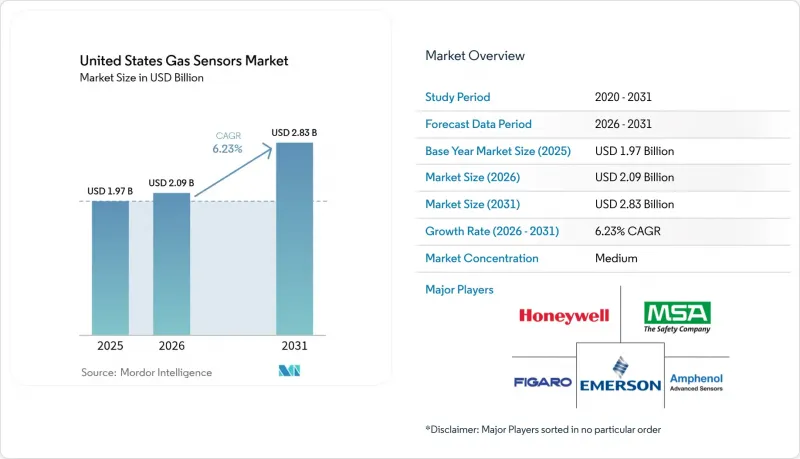
據 Mordor Intelligence 稱,美國氣體感測器市場預計到 2026 年價值 20.9 億美元,高於 2025 年的 19.7 億美元,預計到 2031 年將達到 28.3 億美元。
預計 2026 年至 2031 年的複合年成長率為 6.23%。
本報告按類型(有線、無線)、氣體類型(氧氣、一氧化碳等)、技術(電化學、光電離檢測器(PID)等)和應用(醫療/保健、建築自動化等)分類。市場預測以美元計價。
美國氣體感測器市場趨勢與洞察
遵守 OSHA 和 EPA 法規正在推動工業需求。
隨著甲烷和有毒氣體排放法規的更新,工廠現在需要檢驗更低閾值的洩漏,否則可能面臨每天高達 25,000 美元的罰款。因此,各工廠正在投資能夠檢測十億分之一 (ppb) 濃度的多氣體陣列,從而提供超越合規要求的製程控制價值。工程團隊現在將偵測器納入規範,這些偵測器與安全儀器系統協同工作,當達到危險濃度時自動關閉,從而縮短反應時間並降低法律責任風險。與合規相關的支出在德克薩斯州、路易斯安那州和賓州的石油、天然氣和化工產業叢集中最高,為供應商提供了穩定的收入來源。大型買家更傾向於選擇配備校準程序的產品線,這些程序可以簡化監管報告和基於雲端的審計追蹤。
在暖通空調/室內空氣品質 (IAQ) 領域擴大應用 (ASHRAE 62.1)
隨著 ASHRAE 62.1 標準於 2024 年修訂,提高了二氧化碳測量儀的精度要求,建築運營方正用更先進的光學或電化學設備取代老舊設備。辦公大樓、醫院和學校目前正在實施基於佔用率的通風控制系統,該系統將氣體測量與暖通空調系統連接起來,從而在能源效率和健康標準之間取得平衡。物業所有者將室內空氣數據視為有助於提高租戶留存率的便利設施,氣體感測器也從幕後設備轉變為健康品牌形像中一個顯眼的元素。在各州獎勵和永續性義務的推動下,美國東北部和加州的部署最為先進。系統整合商正在將感測器與分析儀表板捆綁在一起,在同一螢幕上提供故障警報和通風評分卡。
高昂的校準和維護成本
季度校準程序需要專用測試氣體、經過訓練的人員以及運作,這可能導致設備終身擁有成本高達設備成本的40%。小規模的設施通常會延長檢查間隔,從而增加誤報和未發現洩漏的風險,並可能損害安全投資。雖然製造商正在透過自我校準感測器和遠距離診斷來解決這個問題,但設備價格正在上漲,迫使買家仔細權衡初始成本節省和持續的人事費用。農村地區熟練技術人員的短缺進一步加劇了這一負擔,導致一些營運商將感測器、維護和合規文件等維護工作外包。
細分市場分析
到2025年,有線氣體感測器在美國氣體感測器市場仍佔據53.42%的佔有率。這主要得益於流程工業對不斷電系統和故障安全通訊的需求。這些設備通常直接連接到分散式控制系統,確保在危險區域符合相關法規。同時,無線節點正以11.12%的複合年成長率成長,這得益於低功耗廣域通訊技術,可將電池壽命延長五年以上。設施管理人員正在部署網狀網路,以便在檢修期間或在老舊建築中進行臨時安裝,因為在這些場所佈線成本過高。無線技術的柔軟性允許更精確地放置感測器,從而擴大多層學校和醫院的檢測範圍,並滿足對通風狀況更深入了解的需求。整合商正在將無線氣體數據與人員佔用率和能源指標結合,以提供超越安全範疇、提升營運效率的增值提案。
無線技術的興起也正在改變服務模式。供應商現在提供訂閱套餐,將硬體、網路連接和分析儀錶板捆綁到一份合約中。這種轉變降低了資本支出預算,並允許隨著新型感測器的推出而進行持續升級。隨著美國無線氣體感測器市場的擴張,採購團隊正將重點轉向總體擁有成本 (TCO) 評估,強調生命週期價值和軟體功能。雖然有線系統仍然是高風險區域的標準配置,但混合架構正在興起,它將 I 類 1 區中的永久性有線探測器與低風險區域的無線設備相結合,以最佳化支出。
到2025年,電化學電池將佔據美國氣體感測器市場31.08%的佔有率,這主要歸功於其在CO、H₂S和NO₂檢測方面久經考驗的高精度。雖然觸媒珠法仍是I類環境中可燃性氣體檢測的主流選擇,但NDIR光學方法在暖通空調控制中的CO₂檢測領域日益普及。 PID感測器在工業衛生宣傳活動中的危險物質緊急應變和VOC監測方面發揮著獨特的作用。
預計從2026年到2031年,MEMS MOS元件的複合年成長率將達到12.74%,這主要得益於半導體生產單位成本的降低以及在硬幣大小的封裝中識別多種氣體的能力。機器學習演算法能夠補償交叉敏感性,使單一晶片能夠以上下文相關的精度識別甲烷、氫氣和揮發性有機化合物。這些晶片被應用於穿戴式裝置和家用電子電器中,旨在保障獨行工作者的安全,並提供危險環境的即時預警。向MEMS技術的過渡也降低了功耗,延長了無線節點的電池壽命,並透過減少電池更換頻率,符合永續性目標。
其他好處:
- Excel格式的市場預測(ME)表
- 3個月的分析師支持
目錄
第1章:引言
- 研究假設和市場定義
- 調查範圍
第2章:調查方法
第3章執行摘要
第4章 市場狀況
- 市場概覽
- 市場促進因素
- 遵守 OSHA 和 EPA 法規正在推動工業需求。
- 擴大暖通空調(室內空調)和室內空氣品質(IAQ)實施範圍(ASHRAE 62.1)
- 監測車內空氣品質及排放氣體
- 利用邊緣人工智慧和物聯網進行預測性維護
- 在氫氣加註過程中引入洩漏檢測系統。
- IIJA管線計畫下的甲烷外洩控制
- 市場限制因素
- 高昂的校準和維護成本
- 感測器價格的商品化
- 國內MEMS製造廠產能瓶頸
- 關於雲端連接感測器的網路安全問題
- 價值供應鏈分析
- 監理情勢
- 技術展望
- 波特五力分析
- 評估疫情對宏觀經濟的影響
第5章 市場規模與成長預測
- 按類型
- 有線
- 無線的
- 依氣體類型
- 氧
- 一氧化碳
- 二氧化碳
- 氮氧化物
- 碳氫化合物
- 其他
- 透過技術
- 電化學
- 光電離檢測器(PID)
- 固態/MOS
- 觸媒珠
- 紅外光譜(NDIR)
- 半導體
- 透過使用
- 醫療保健
- 建築自動化
- 工業安全與製程
- 食品/飲料
- 車
- 運輸/物流
- 其他用途
第6章 競爭情勢
- 市場集中度
- 策略趨勢
- 市佔率分析
- 公司簡介
- Honeywell International Inc.
- Sensirion AG
- Amphenol Advanced Sensors
- Figaro Engineering Inc.
- Emerson Electric Co.
- MSA Safety Inc.
- Robert Bosch GmbH
- City Technology Ltd
- Renesas Electronics Corp.
- AMS OSRAM AG
- Trolex Ltd
- Sensata Technologies
- Draeger Safety AG
- NevadaNano
- Aeroqual Ltd
- SPEC Sensors LLC
- AlphaSense Inc.
- Figaro USA Inc.
- Membrapor AG
- Cubic Sensor and Instrumentation
第7章 市場機會與未來展望
According to Mordor Intelligence, the United States gas sensors market size in 2026 is estimated at USD 2.09 billion, growing from 2025 value of USD 1.97 billion with 2031 projections showing USD 2.83 billion, growing at 6.23% CAGR over 2026-2031.
This report is Segmented by Type (Wired, Wireless), Gas Type (Oxygen, Carbon Monoxide and More), Technology (Electrochemical, Photo-Ionisation Detector (PID) and More), Application (Medical and Healthcare, Building Automation and More). The Market Forecasts are Provided in Terms of Value (USD).
United States Gas Sensors Market Trends and Insights
OSHA and EPA Compliance Driving Industrial Demand
Regulatory updates on methane and toxic gas emissions require plants to verify leaks at lower thresholds and carry penalties that can reach USD 25,000 per day. Facilities therefore invest in multi-gas arrays that detect parts-per-billion concentrations, adding process-control value beyond compliance. Engineering teams are now specifying detectors that integrate with safety-instrumented systems to automate shutdowns when hazardous levels arise, a capability that shortens response time and limits liability exposure. Compliance spending is heaviest in oil, gas, and chemical clusters across Texas, Louisiana, and Pennsylvania, securing a reliable revenue stream for suppliers. Large buyers prefer product lines supported by calibration programs and cloud-based audit trails that simplify regulatory reporting.
Growing HVAC / IAQ Adoption (ASHRAE 62.1)
The 2024 update to ASHRAE 62.1 tightened accuracy targets for CO2 meters, prompting building operators to swap older hardware for advanced optical or electrochemical devices. Office towers, hospitals, and schools now integrate occupancy-based ventilation controls that link gas readings to air-handling units, balancing energy savings with health criteria. Portfolio owners see indoor-air data as an amenity that supports tenant retention, elevating gas sensors from back-of-house equipment to a visible part of wellness branding. Strongest adoption is in the Northeast and California, where state incentives pair with sustainability mandates. System integrators bundle sensors with analytics dashboards to provide fault alerts and ventilation scorecards in a single view.
High Calibration & Maintenance Costs
Quarterly calibration protocols require specialty test gas, trained staff, and downtime that can push lifetime ownership costs to 40% of equipment spend. Smaller plants often delay service intervals, risking false alarms or undetected leaks that undermine safety investments. Manufacturers respond with self-calibrating cells and remote diagnostics, yet capital prices rise, forcing buyers to weigh upfront savings against recurring labour. Skill shortages in rural regions worsen the burden, prompting some operators to outsource maintenance contracts that bundle sensors, service, and compliance documentation.
Other drivers and restraints analyzed in the detailed report include:
- Automotive Cabin-Air Quality & Emissions Monitoring
- Edge-AI and IoT-Enabled Predictive Maintenance
- Methane-Leak Rules Under IIJA Pipelines Program
- Sensor Price Commoditisation
For complete list of drivers and restraints, kindly check the Table Of Contents.
Segment Analysis
The wired category maintained a 53.42% position in the United States gas sensors market during 2025, anchored by process industries that require uninterrupted power and fail-safe communication. These installations typically connect directly to distributed control systems, ensuring compliance in hazardous zones. However, wireless nodes are growing at an 11.12% CAGR, propelled by low-power wide-area technologies that stretch battery life to more than five years. Facility managers deploy mesh networks that allow temporary placement during turnarounds or in legacy buildings where cabling is cost prohibitive. Wireless flexibility supports granular sensor placement, elevating coverage in multi-story schools and hospitals that seek better ventilation insight. Integrators combine wireless gas data with occupancy and energy metrics, bundling value propositions that extend beyond safety into operational efficiency.
The rise of wireless options also reshapes service models. Vendors now offer subscription packages that wrap hardware, network connectivity, and analytics dashboards in single agreements. This shift reduces capital budgets and enables evergreen upgrades when new sensors emerge. As the United States gas sensors market size relevant to wireless installations climbs, procurement teams pivot toward total-cost evaluations that emphasize lifetime value and software functionality. While wired systems will remain standard in high-risk areas, hybrid architectures emerge, pairing permanent wired detectors in Class I Division 1 zones with wireless devices in less hazardous spaces to optimize spend.
Electrochemical cells held 31.08% of the United States gas sensors market share in 2025 due to their proven accuracy for CO, H2S, and NO2. Catalytic-bead designs persisted as the go-to choice for combustible gases in Class I environments, while NDIR optics gained popularity for CO2 in HVAC controls. PIDs served niche roles monitoring VOCs during hazmat response and industrial hygiene campaigns.
MEMS MOS devices are on track to post 12.74% CAGR growth between 2026 and 2031 as semiconductor production reduces per-unit costs and enables multi-gas identification in coin-sized packages. Machine-learning algorithms compensate for cross-sensitivity, letting a single die discriminate among methane, hydrogen, and volatile organics with contextual accuracy. Wearables for lone-worker safety and consumer electronics integrate these chips to alert users to hazardous environments in real time. The migration to MEMS also lowers power draw, extending battery life in wireless nodes and aligning with sustainability objectives that discourage frequent battery swaps.
Complete Report Scope:
- By Type
- Wired
- Wireless
- By Gas Type
- Oxygen
- Carbon Monoxide
- Carbon Dioxide
- Nitrogen Oxide
- Hydrocarbon
- Others
- By Technology
- Electrochemical
- Photo-Ionisation Detector (PID)
- Solid-State / MOS
- Catalytic Bead
- Infra-Red (NDIR)
- Semiconductor
- By Application
- Medical and Healthcare
- Building Automation
- Industrial Safety and Process
- Food and Beverage
- Automotive
- Transportation and Logistics
- Other Applications
List of Companies Covered in this Report:
- Honeywell International Inc.
- Sensirion AG
- Amphenol Advanced Sensors
- Figaro Engineering Inc.
- Emerson Electric Co.
- MSA Safety Inc.
- Robert Bosch GmbH
- City Technology Ltd
- Renesas Electronics Corp.
- AMS OSRAM AG
- Trolex Ltd
- Sensata Technologies
- Draeger Safety AG
- NevadaNano
- Aeroqual Ltd
- SPEC Sensors LLC
- AlphaSense Inc.
- Figaro USA Inc.
- Membrapor AG
- Cubic Sensor and Instrumentation
Additional Benefits:
- The market estimate (ME) sheet in Excel format
- 3 months of analyst support
TABLE OF CONTENTS
1 INTRODUCTION
- 1.1 Study Assumptions and Market Definition
- 1.2 Scope of the Study
2 RESEARCH METHODOLOGY
3 EXECUTIVE SUMMARY
4 MARKET LANDSCAPE
- 4.1 Market Overview
- 4.2 Market Drivers
- 4.2.1 OSHA and EPA compliance driving industrial demand
- 4.2.2 Growing HVAC / IAQ adoption (ASHRAE 62.1)
- 4.2.3 Automotive cabin-air quality and emissions monitoring
- 4.2.4 Edge-AI and IoT-enabled predictive maintenance
- 4.2.5 Hydrogen refueling leak-detection roll-out
- 4.2.6 Methane-leak rules under IIJA pipelines program
- 4.3 Market Restraints
- 4.3.1 High calibration and maintenance costs
- 4.3.2 Sensor price commoditisation
- 4.3.3 Domestic MEMS-fab capacity bottlenecks
- 4.3.4 Cyber-security worries for cloud-connected sensors
- 4.4 Value / Supply-Chain Analysis
- 4.5 Regulatory Landscape
- 4.6 Technological Outlook
- 4.7 Porter's Five Forces Analysis
- 4.7.1 Threat of New Entrants
- 4.7.2 Bargaining Power of Buyers
- 4.7.3 Bargaining Power of Suppliers
- 4.7.4 Threat of Substitutes
- 4.7.5 Intensity of Competitive Rivalry
- 4.8 Pandemic and Macroeconomic Impact Assessment
5 MARKET SIZE AND GROWTH FORECASTS (VALUE)
- 5.1 By Type
- 5.1.1 Wired
- 5.1.2 Wireless
- 5.2 By Gas Type
- 5.2.1 Oxygen
- 5.2.2 Carbon Monoxide
- 5.2.3 Carbon Dioxide
- 5.2.4 Nitrogen Oxide
- 5.2.5 Hydrocarbon
- 5.2.6 Others
- 5.3 By Technology
- 5.3.1 Electrochemical
- 5.3.2 Photo-Ionisation Detector (PID)
- 5.3.3 Solid-State / MOS
- 5.3.4 Catalytic Bead
- 5.3.5 Infra-Red (NDIR)
- 5.3.6 Semiconductor
- 5.4 By Application
- 5.4.1 Medical and Healthcare
- 5.4.2 Building Automation
- 5.4.3 Industrial Safety and Process
- 5.4.4 Food and Beverage
- 5.4.5 Automotive
- 5.4.6 Transportation and Logistics
- 5.4.7 Other Applications
6 COMPETITIVE LANDSCAPE
- 6.1 Market Concentration
- 6.2 Strategic Moves
- 6.3 Market Share Analysis
- 6.4 Company Profiles (includes Global level Overview, Market level overview, Core Segments, Financials as available, Strategic Information, Market Rank/Share for key companies, Products and Services, and Recent Developments)
- 6.4.1 Honeywell International Inc.
- 6.4.2 Sensirion AG
- 6.4.3 Amphenol Advanced Sensors
- 6.4.4 Figaro Engineering Inc.
- 6.4.5 Emerson Electric Co.
- 6.4.6 MSA Safety Inc.
- 6.4.7 Robert Bosch GmbH
- 6.4.8 City Technology Ltd
- 6.4.9 Renesas Electronics Corp.
- 6.4.10 AMS OSRAM AG
- 6.4.11 Trolex Ltd
- 6.4.12 Sensata Technologies
- 6.4.13 Draeger Safety AG
- 6.4.14 NevadaNano
- 6.4.15 Aeroqual Ltd
- 6.4.16 SPEC Sensors LLC
- 6.4.17 AlphaSense Inc.
- 6.4.18 Figaro USA Inc.
- 6.4.19 Membrapor AG
- 6.4.20 Cubic Sensor and Instrumentation
7 MARKET OPPORTUNITIES & FUTURE OUTLOOK
- 7.1 White-space and Unmet-Need Assessment

 礦業雷射甲烷感測器市場報告:趨勢、預測和競爭分析(至2035年)
 氣體感測器、偵測器和分析儀器:市場佔有率分析、行業趨勢和統計數據以及成長預測(2026-2031 年)氧氣感知器:市場佔有率分析、產業趨勢與統計、成長預測(2026-2031)氣體感測器:市場佔有率分析、產業趨勢與統計、成長預測(2026-2031)
 氣體感測器市場:2026-2032年全球市場預測(按產品類型、連接方式、技術、類別、氣體類型、應用和最終用戶分類)低功耗、緊湊型氣體感測器市場:2026-2032年全球市場預測(依偵測技術、目標氣體類型、輸出介面、應用、銷售管道和最終用戶產業分類)
 全球氣體感測器市場規模、佔有率、趨勢和成長分析報告(2026-2034年)全球臭氧感測器市場:市場規模、佔有率、趨勢和成長分析(2026-2034)
 2026年全球建築用黑色花崗岩市場報告
 氣體感測器市場:按氣體類型、技術、最終用戶和地區分類