


 |
市場調查報告書
商品編碼
2154961
南美LED構裝:市場佔有率分析、產業趨勢與統計及成長預測(2026-2031年)South America LED Packaging - Market Share Analysis, Industry Trends & Statistics, Growth Forecasts (2026 - 2031) |
||||||

※ 本網頁內容可能與最新版本有所差異。詳細情況請與我們聯繫。
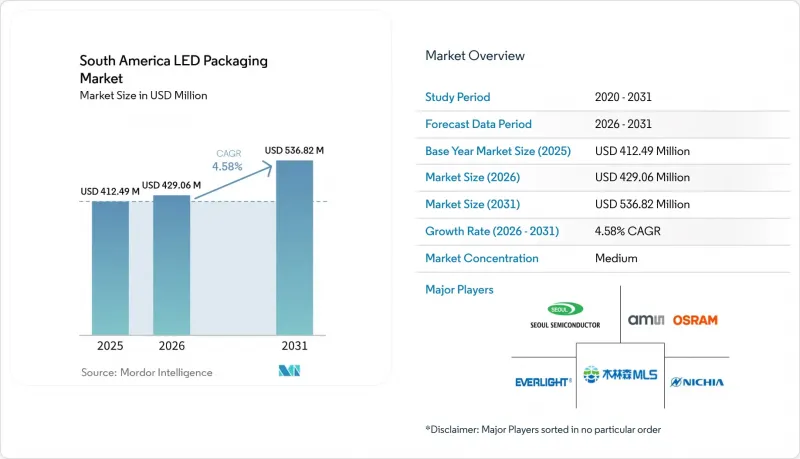
據 Mordor Intelligence 稱,南美LED構裝市場預計到 2025 年價值 4.1249 億美元,從 2026 年的 4.2906 億美元成長到 2031 年的 5.3682 億美元。
預測期(2026-2031 年)的複合年成長率預計為 4.58%。
南美洲LED構裝市場趨勢與洞察
能源效率法規與LED維修的經濟性
巴西2026年節能法規的實施,使得合規性成為南美洲LED構裝市場短期需求的關鍵促進因素。 CGIEE 2/2026號決議通過兩個強制實施階段,為LED燈設定了最低光通量效率標準。該框架將在五年內逐步淘汰不合規產品,並為產品設計者設定明確的性能目標。政府宣布,到2040年,這項措施將實現高達432太瓦時的節能。這一節能量相當於同期巴西1400萬戶家庭的電力消耗量。此外,INMETRO的Portaria 231/2026法規還整合了功率因數、閃爍、諧波、ENCE認證標誌和QR碼的要求,提高了進入巴西供應鏈的封裝產品的規格標準。
該法規為無法滿足合規照明燈具設計要求的現有產品建立了更換週期。與典型的更換採購相比,這種要求並非完全自願,而是遵循已公佈的過渡要求。對於中功率高功率封裝產品,重新設計照明燈具以滿足更高的能源效率標準將大有裨益。這項變更有利於已擁有相關合格文件並能提供設計認證支援的供應商。同時,它也降低了低效率通用產品線在正式採購中的作用。隨著截止日期的臨近,買家可能會開始採購認證組件,從而有可能縮短南美洲LED構裝市場的交貨週期。
智慧城市與公共照明現代化
官民合作關係在巴西照明現代化改造中扮演著重要角色,是其需求基礎的關鍵組成部分。根據巴西照明和照明基礎設施委員會(ABCIP)的報告,截至2025年中期,將有146項公共照明夥伴關係協議生效,涵蓋173個城市,惠及5,700萬人。根據該報告引用的2025年平均外匯,這些協議的總價值將達到320億巴西雷亞爾(約55.2億美元)。產業分析顯示,到2026年,巴西僅有19.6%的公共照明燈具將完成LED改造。剩餘的燈具將繼續滿足長期的通用照明需求。
分析表明,按照文中引用的外匯,如果將巴西所有維修的公共照明燈具更換為LED燈,每年可節省50億巴西雷亞爾(約8.62億美元)的能源成本。此外,波哥大正在Calle 85大道推廣智慧照明試點項目,將LED燈具與攝影機、感測器和自適應控制系統結合。聯網系統需要溫度控制、光照強度穩定性以及可靠的驅動介面。這些要求使得基礎封裝方案不適用於許多智慧城市計畫。因此,即使路燈數量變化緩慢,南美LED構裝市場也能從現代化改造工程中獲益。能夠滿足系統級認證要求的供應商將在市政項目中獲得競爭優勢。
進口成本和外匯波動
該地區嚴重依賴從中國大陸、台灣、日本和韓國進口晶片、基板、封裝和成品LED構裝。巴西的進口關稅、ICMS稅和PIS/Cofins稅推高了封裝組件的進口成本。外匯波動進一步增加了以外幣計價的買家的不確定性。巴西幣貶值可能會改變從下單到接受的交貨成本。阿根廷披索的不穩定和進口限制使得延長採購週期特別困難。這些因素限制了供應商和當地客戶對南美LED構裝市場的可預測性。
2025年前10個月,巴西LED燈進口額達4.615億美元。這一數字清晰地表明了巴西照明供應鏈對外部進口的依賴。阿根廷的通貨膨脹和零星的進口限制可能會擾亂包裝產品的訂單,並削弱數量計畫的可靠性。雖然本地庫存可以降低交貨風險,但卻會增加經銷商的資金籌措和倉儲成本。這些成本對於低利潤率的零件類別來說難以承受。因此,小規模供應商往往會避免大規模庫存。在持續依賴進口的情況下,能夠管理認證庫存和外匯風險的成熟經銷商仍然具有優勢。
細分市場分析
2025年,表面黏著型元件(SMD)封裝佔據了南美洲LED構裝市場51.48%的比重。這反映了其在通用照明、標牌和家用電子電器領域的廣泛應用。標準化的外形規格、與照明燈具的兼容性以及低廉的單位成本,推動了其在巴西市政項目和哥倫比亞路燈項目中的應用。由於這種封裝形式為當地組裝和經銷商所熟知,即使高階架構的價值佔有率不斷擴大,預計它仍將保持領先地位。受三星和TCL等公司推出的新產品對緊湊型、高分檔背光封裝的需求推動,預計2026年至2031年間,Mini-LED顯示封裝的複合年成長率將達到6.18%。它們的高密度陣列增加了每個顯示面積所需的封裝數量,南美洲LED構裝市場正朝著更高附加價值的設計、專用材料和更嚴格的光學要求轉型。
板載晶片(COB)正被廣泛應用於工業和特殊照明領域,例如園藝照明燈具和體育場泛光燈,在這些應用中,均勻的光通量和整合溫度控管比晶片成本更為重要。晶片級和覆晶形式則支援緊湊型汽車和家用電子電器的設計,這些產品對空間、熱控制和光學均勻性要求極高。 Polymatec 已承諾投資 2,500 萬美元在新加坡建立板載晶片(COB)工廠,預計這將提高對南美分銷商的供貨穩定性。玻璃封裝(GBO)、雙列直插式封裝(DIL)和通孔封裝(THP)在高階細分市場、傳統指示器和低頻開關應用中仍發揮有限的作用。雖然由於表面黏著技術技術的出現,對傳統封裝形式的需求正在下降,但由於汽車和園藝行業的需求,先進架構的應用預計將逐步擴大。
2025年,功率在0.5瓦至1瓦之間的中功率封裝將佔區域銷售額的30.51%,成為商業、住宅、線性燈具和麵板燈應用領域的主要出貨類別之一。中功率SMD陣列能夠提供許多市政和商業設施規格所需的光輸出和效率。儘管面臨來自低成本替代品的壓力,但由於巴西照明燈具的廣泛應用,其出貨量仍保持在高水準。南美洲中功率LED構裝市場規模與持續的更換和維修活動密切相關。預計在體育場館照明、機器視覺和高通量汽車頭燈等應用的推動下,高功率LED封裝市場將在2026年至2031年間以5.37%的複合年成長率成長。
對於超高高功率應用,需要良好的熱控制、可靠的高電流輸出以及嚴格的汽車認證標準,這些都推高了其售價。 2026年2月,Lumileds宣布,LED頭燈的全球滲透率已接近80%,預計到2027年,模組化光引擎將佔到解決方案的50%。模組化光引擎會導致車輛頭燈組件中封裝數量和單價的增加。 1瓦至3瓦的高功率封裝正用於戶外建築和體育照明,包括巴西的體育場館和基礎設施建設項目。低功率封裝在指示燈、裝飾照明和背光照明方面仍然十分重要,但隨著產品線逐漸向更高光通量方向發展,與通用產品的競爭限制了其銷售佔有率。
其他好處:
- Excel格式的市場預測(ME)表
- 3個月的分析師支持
目錄
第1章:引言
- 研究假設和市場定義
- 調查範圍
第2章:調查方法
第3章執行摘要
第4章 市場狀況
- 市場概覽
- 宏觀經濟因素對市場的影響
- 市場促進因素
- 強制性節能改造和LED維修的經濟可行性。
- 智慧城市與公共照明現代化
- 汽車電子和電氣化
- 採用Mini-LED和高密度顯示螢幕
- 利用紫外線LED進行消毒與特殊感測
- 區域組裝和電子設備進口替代
- 市場限制因素
- 進口成本和外匯波動
- 低功耗SMD裝置價格下降
- 高功率封裝中的溫度控管限制
- 先進封裝領域的專利和認證壁壘
- 產業價值鏈分析
- 監理情勢
- 技術展望
- 波特五力分析
第5章 市場規模與成長預測
- 透過包裝架構
- 表面黏著型元件封裝
- 板載晶片封裝
- 晶片級封裝
- 覆晶LED構裝
- 雙直列式封裝和通孔封裝
- 整合模組化元件封裝
- 玻璃機上包裝
- 迷你LED顯示封裝
- 按權力等級
- 低功耗(小於0.5瓦)
- 中功率(0.5–1 瓦)
- 高功率(1-3瓦)
- 高功率(3瓦或以上)
- 按排放類型
- 可見光LED構裝
- 紅外線LED構裝
- 紫外線LED構裝
- 材料化學
- 基材
- 封裝
- 黏接/晶片貼裝
- 磷光體/塗層
- 透過使用
- 一般照明
- 汽車照明
- 顯示器和背光
- 家用電子產品
- 工業和專業應用
- 按地區
- 巴西
- 阿根廷
- 哥倫比亞
- 其他南美國家
第6章 競爭情勢
- 市場集中度
- 策略趨勢
- 市佔率分析
- 公司簡介
- NICHIA CORPORATION
- ams-OSRAM AG
- Lumileds Holding BV
- Seoul Semiconductor Co., Ltd.
- EVERLIGHT ELECTRONICS CO., LTD.
- MLS Co., Ltd.
- Foshan NationStar Optoelectronics Co., Ltd.
- Stanley Electric Co., Ltd.
- Toyoda Gosei Co., Ltd.
- Lextar Electronics Corporation
- Edison Opto Corporation
- Prolight Opto Technology Corporation
- Dominant Opto Technologies Sdn. Bhd.
- Citizen Electronics Co., Ltd.
- Bridgelux, Inc.
- Epistar Corporation
- Refond Optoelectronics Co., Ltd.
- Jufei Optoelectronics Co., Ltd.
- Cree LED(SMART Global Holdings)
- Harvatek Corporation
- Broadcom Inc.
第7章 市場機會與未來展望
According to Mordor Intelligence, the South America LED packaging market size was valued at USD 412.49 million in 2025 and is estimated to expand from USD 429.06 million in 2026 to reach USD 536.82 million by 2031, at a CAGR of 4.58% during the forecast period (2026-2031).
South America LED Packaging Market Trends and Insights
Energy-Efficiency Mandates and LED Retrofit Economics
Brazil's 2026 efficiency rules make compliance a major near-term driver of demand for the South America LED packaging market. Resolution CGIEE 2/2026 set minimum luminous efficacy thresholds for LED lamps and luminaires through 2 mandatory implementation stages. The framework phases out noncompliant products over a 5-year period and sets clear performance targets for product designers. The government stated that the measure could save up to 432 TWh by 2040. That level of saving was presented as equivalent to the electricity consumption of 14 million Brazilian households over the same period. INMETRO Portaria 231/2026 also consolidated requirements for power factor, flicker, harmonics, ENCE labeling, and QR codes, raising the specification baseline for packages entering Brazilian supply chains.
The rules create a replacement cycle for installed products that cannot support compliant luminaire designs. This demand is less discretionary than ordinary replacement purchases because it follows published transition requirements. Mid-power and high-power packages can benefit from fixture redesigns that meet higher efficacy thresholds. The change favors suppliers that already maintain applicable conformity documentation and can support design qualification. It also narrows the role of low-efficacy commodity arrays in formal procurement. As deadlines approach, the South America LED packaging market may see shorter procurement windows as buyers move to secure qualified components.
Smart-City and Public-Lighting Modernization
Public-private partnerships for lighting modernization provide a substantial component of the demand base in Brazil. ABCIP reported 146 active public-lighting partnership contracts by mid-2025, covering 173 municipalities and serving 57 million people. The contracts totaled BRL 32 billion (USD 5.52 billion) at the average exchange rate for 2025 cited in the source. A 2026 industry analysis found that only 19.6% of Brazil's public luminaires had been converted to LED. The remaining installed base keeps general lighting demand active for a long period.
The same analysis stated that full conversion of unretrofitted Brazilian public luminaires could yield BRL 5 billion (USD 862 million) in annual energy savings using the exchange rate provided in the source. Bogota is also advancing a smart-lighting pilot on Calle 85 that combines LED luminaires with cameras, sensors, and adaptive control. Networked systems require thermal control, photometric stability, and dependable driver interfaces. These requirements make basic package selection less suitable for many smart-city projects. The South America LED packaging market, therefore, gains value from modernization projects even when the number of poles changes slowly. Suppliers that support system-level qualification can have an advantage in municipal projects.
Import-Cost and Foreign-Exchange Volatility
The region depends heavily on imported dies, substrates, encapsulants, and finished LED packages from China, Taiwan, Japan, and South Korea. Brazil's import duties, ICMS, and PIS/Cofins taxes increase the landed cost of packaged components. Exchange-rate movements add another layer of uncertainty for buyers who procure in foreign currency. The Brazilian real's depreciation episodes can change the economics of deliveries between order and receipt. Argentina's peso instability and import restrictions make longer purchasing cycles especially difficult. These conditions limit the predictability of the South America LED packaging market for suppliers and local customers.
Brazilian imports of LED lamps and luminaires reached USD 461.5 million in the first 10 months of 2025. The figure illustrates the scale of external dependence in the lighting supply chain. Argentina's inflation and sporadic import restrictions can disrupt package orders and render volume planning unreliable. Local stockholding reduces delivery risk but adds financing and carrying costs for distributors. Those costs are harder to absorb in low-margin component categories. Smaller suppliers may therefore avoid making inventory commitments at scale. Import dependence continues to favor established distributors that can manage certified inventory and currency exposure.
Other drivers and restraints analyzed in the detailed report include:
- Automotive Electronics and Electrification
- Mini-LED and High-Density Display Adoption
- Low-Power SMD Price Erosion
For complete list of drivers and restraints, kindly check the Table Of Contents.
Segment Analysis
Surface-mount device packages accounted for 51.48% of the South America LED packaging market in 2025, reflecting their broad use in general lighting, signage, and consumer electronics. Standardized form factors, luminaire compatibility, and low unit cost support their use in Brazil's municipal programs and Colombia's street-lighting projects. The format is familiar to regional assemblers and distributors, so it will remain the volume leader even as premium architectures gain value share. Mini-LED display packages are projected to expand at a 6.18% CAGR from 2026 to 2031, supported by Samsung and TCL launches that require compact, tightly binned backlight packages. Their higher-density arrays increase the number of packages used per display area and are shifting the South America LED packaging market toward higher-value designs, specialized material inputs, and more exacting optical requirements.
Chip-on-board packages serve industrial and specialty lighting where uniform beams and consolidated thermal management outweigh per-chip cost, including horticulture fixtures and stadium floodlighting. Chip-scale and flip-chip formats support compact automotive and consumer electronics designs where space, thermal control, and optical uniformity are important. Polymatech established a chip-on-board packaging hub in Singapore with USD 25 million in committed investment, which can improve supply availability for South American distributors. Glass-on-board, dual-in-line, and through-hole packages continue to play smaller roles in premium niches, legacy indicators, and low-frequency switching applications. Surface-mount alternatives are reducing demand for legacy formats, while automotive and horticulture requirements are expected to gradually expand the use of advanced architecture.
Mid-power packages from 0.5 W to 1 W accounted for 30.51% of regional revenue in 2025, making them the principal volume class for commercial, residential, linear-lamp, and panel-light applications. Mid-power SMD arrays provide the light output and efficiency required in many municipal and commercial specifications. Brazil's large installed base of these fixtures sustains high shipment volumes despite pressure from lower-cost alternatives. The South America LED packaging market size for mid-power packages remains linked to ongoing replacement and retrofit activity. Ultra-high-power packages exceeding 3 W are projected to grow at a 5.37% CAGR from 2026 to 2031, driven by stadium lighting, machine vision, and high-flux automotive headlamps.
Ultra-high-power applications require thermal control, reliable high-current output, and demanding automotive qualification, which supports higher selling prices. Lumileds stated in February 2026 that global LED headlamp adoption was approaching 80% and that modular light engines are projected to account for 50% of solutions by 2027. Modular light engines can increase package count and unit value in vehicle headlamp assemblies. High-power packages from 1 W to 3 W serve outdoor architectural and sports lighting, including projects connected with Brazil's stadium and infrastructure programs. Low-power packages remain important for indicators, decorative lighting, and backlighting, but commodity competition is constraining their revenue contribution as the mix gradually shifts toward high-flux formats.
Complete Report Scope:
- By Packaging Architecture
- Surface-Mount Device Packages
- Chip-on-Board Packages
- Chip-Scale Packages
- Flip-Chip LED Packages
- Dual In-Line and Through-Hole Packages
- Integrated Module Device Packages
- Glass-on-Board Packages
- Mini-LED Display Packages
- By Power Class
- Low Power (Below 0.5 W)
- Mid Power (0.5-1 W)
- High Power (1-3 W)
- Ultra-High Power (Above 3 W)
- By Emission Type
- Visible LED Packages
- Infrared LED Packages
- Ultraviolet LED Packages
- By Material Chemistry
- Substrates
- Encapsulation
- Bonding / Die-Attach
- Phosphors / Coatings
- By Application
- General Lighting
- Automotive Lighting
- Display and Backlighting
- Consumer Electronics
- Industrial and Specialty
- By Geography
- Brazil
- Argentina
- Colombia
- Rest of South America
List of Companies Covered in this Report:
- NICHIA CORPORATION
- ams-OSRAM AG
- Lumileds Holding B.V.
- Seoul Semiconductor Co., Ltd.
- EVERLIGHT ELECTRONICS CO., LTD.
- MLS Co., Ltd.
- Foshan NationStar Optoelectronics Co., Ltd.
- Stanley Electric Co., Ltd.
- Toyoda Gosei Co., Ltd.
- Lextar Electronics Corporation
- Edison Opto Corporation
- Prolight Opto Technology Corporation
- Dominant Opto Technologies Sdn. Bhd.
- Citizen Electronics Co., Ltd.
- Bridgelux, Inc.
- Epistar Corporation
- Refond Optoelectronics Co., Ltd.
- Jufei Optoelectronics Co., Ltd.
- Cree LED (SMART Global Holdings)
- Harvatek Corporation
- Broadcom Inc.
Additional Benefits:
- The market estimate (ME) sheet in Excel format
- 3 months of analyst support
TABLE OF CONTENTS
1 INTRODUCTION
- 1.1 Study Assumptions and Market Definition
- 1.2 Scope of the Study
2 RESEARCH METHODOLOGY
3 EXECUTIVE SUMMARY
4 MARKET LANDSCAPE
- 4.1 Market Overview
- 4.2 Impact of Macroeconomic Factors on the Market
- 4.3 Market Drivers
- 4.3.1 Energy-Efficiency Mandates and LED Retrofit Economics
- 4.3.2 Smart-City and Public-Lighting Modernization
- 4.3.3 Automotive Electronics and Electrification
- 4.3.4 Mini-LED and High-Density Display Adoption
- 4.3.5 UV LED Disinfection and Specialty Sensing
- 4.3.6 Regional Electronics Assembly and Import Substitution
- 4.4 Market Restraints
- 4.4.1 Import-Cost and Foreign-Exchange Volatility
- 4.4.2 Low-Power SMD Price Erosion
- 4.4.3 Thermal-Management Constraints in High-Power Packages
- 4.4.4 Patent and Qualification Barriers for Advanced Packages
- 4.5 Industry Value Chain Analysis
- 4.6 Regulatory Landscape
- 4.7 Technological Outlook
- 4.8 Porter's Five Forces Analysis
- 4.8.1 Bargaining Power of Suppliers
- 4.8.2 Bargaining Power of Buyers
- 4.8.3 Threat of New Entrants
- 4.8.4 Threat of Substitutes
- 4.8.5 Competitive Rivalry
5 MARKET SIZE AND GROWTH FORECASTS (VALUE)
- 5.1 By Packaging Architecture
- 5.1.1 Surface-Mount Device Packages
- 5.1.2 Chip-on-Board Packages
- 5.1.3 Chip-Scale Packages
- 5.1.4 Flip-Chip LED Packages
- 5.1.5 Dual In-Line and Through-Hole Packages
- 5.1.6 Integrated Module Device Packages
- 5.1.7 Glass-on-Board Packages
- 5.1.8 Mini-LED Display Packages
- 5.2 By Power Class
- 5.2.1 Low Power (Below 0.5 W)
- 5.2.2 Mid Power (0.5-1 W)
- 5.2.3 High Power (1-3 W)
- 5.2.4 Ultra-High Power (Above 3 W)
- 5.3 By Emission Type
- 5.3.1 Visible LED Packages
- 5.3.2 Infrared LED Packages
- 5.3.3 Ultraviolet LED Packages
- 5.4 By Material Chemistry
- 5.4.1 Substrates
- 5.4.2 Encapsulation
- 5.4.3 Bonding / Die-Attach
- 5.4.4 Phosphors / Coatings
- 5.5 By Application
- 5.5.1 General Lighting
- 5.5.2 Automotive Lighting
- 5.5.3 Display and Backlighting
- 5.5.4 Consumer Electronics
- 5.5.5 Industrial and Specialty
- 5.6 By Geography
- 5.6.1 Brazil
- 5.6.2 Argentina
- 5.6.3 Colombia
- 5.6.4 Rest of South America
6 COMPETITIVE LANDSCAPE
- 6.1 Market Concentration
- 6.2 Strategic Moves
- 6.3 Market Share Analysis
- 6.4 Company Profiles (includes Global Level Overview, Market Level Overview, Core Segments, Financials as available, Strategic Information, Market Rank/Share, Products and Services, Recent Developments)
- 6.4.1 NICHIA CORPORATION
- 6.4.2 ams-OSRAM AG
- 6.4.3 Lumileds Holding B.V.
- 6.4.4 Seoul Semiconductor Co., Ltd.
- 6.4.5 EVERLIGHT ELECTRONICS CO., LTD.
- 6.4.6 MLS Co., Ltd.
- 6.4.7 Foshan NationStar Optoelectronics Co., Ltd.
- 6.4.8 Stanley Electric Co., Ltd.
- 6.4.9 Toyoda Gosei Co., Ltd.
- 6.4.10 Lextar Electronics Corporation
- 6.4.11 Edison Opto Corporation
- 6.4.12 Prolight Opto Technology Corporation
- 6.4.13 Dominant Opto Technologies Sdn. Bhd.
- 6.4.14 Citizen Electronics Co., Ltd.
- 6.4.15 Bridgelux, Inc.
- 6.4.16 Epistar Corporation
- 6.4.17 Refond Optoelectronics Co., Ltd.
- 6.4.18 Jufei Optoelectronics Co., Ltd.
- 6.4.19 Cree LED (SMART Global Holdings)
- 6.4.20 Harvatek Corporation
- 6.4.21 Broadcom Inc.
7 MARKET OPPORTUNITIES AND FUTURE OUTLOOK
- 7.1 White-Space and Unmet-Need Assessment

 LED構裝測試設備市場:全球市場預測,2026-2032年晶片級封裝 (CSP) LED 市場:2026-2032 年全球市場預測(按產品類型、顏色類型、功率等級、應用、終端用戶產業和分銷管道分類)
 歐洲LED構裝:市場佔有率分析、產業趨勢與統計及成長預測(2026-2031年)
 全球LED構裝市場規模、佔有率、趨勢及成長分析報告(2026-2034年)
 LED構裝市場規模、佔有率和趨勢分析報告:按材料、封裝類型、應用、地區和細分市場分類(2026-2033年)LED構裝設備:市場佔有率分析、產業趨勢與統計、成長預測(2026-2031年)LED構裝:市場佔有率分析、產業趨勢與統計、成長預測(2026-2031年)亞太地區LED構裝:市佔率分析、產業趨勢與統計及成長預測(2026-2031年)LED構裝市場:依封裝類型、基板材料、晶片類型和應用分類-全球預測,2026-2032年LED導線架市場按產品、材質、電鍍類型、導線架類型和最終用戶分類 - 全球預測 2026-2032