


 |
市場調查報告書
商品編碼
2154887
南美洲勞動力管理軟體:市場佔有率分析、產業趨勢與統計及成長預測(2026-2031 年)South America Workforce Management Software - Market Share Analysis, Industry Trends & Statistics, Growth Forecasts (2026 - 2031) |
||||||

※ 本網頁內容可能與最新版本有所差異。詳細情況請與我們聯繫。
據 Mordor Intelligence 稱,2025 年南美洲勞動力管理軟體市場價值為 5.1524 億美元,預計到 2031 年將達到 8.9658 億美元,而 2026 年為 5.8137 億美元,預測期(2026-2031 年)的複合年成長率為 9.05%。
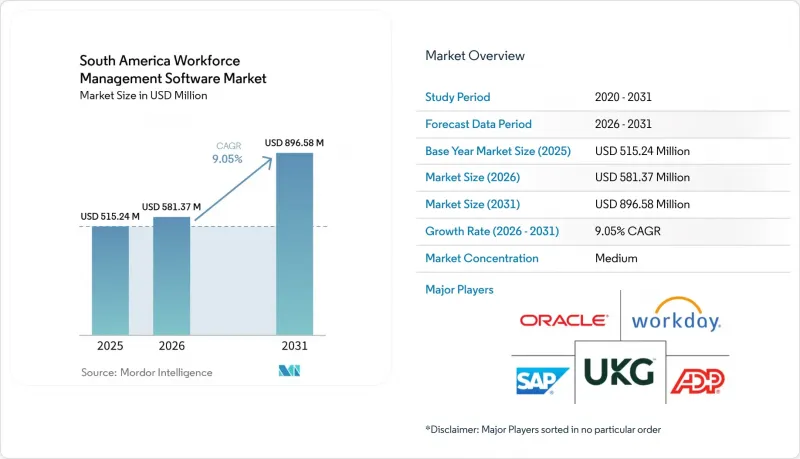
南美洲勞動力管理軟體市場趨勢及洞察。
巴西數位勞動合規性和可審計性要求
巴西的數位化勞動框架是南美洲勞動力管理軟體市場的主要驅動力。 eSocial 和 FGTS Digital 使相關部門能夠透過整合報告流程存取薪資、工時和職業健康資訊。近期頒布的巴西勞動部 (MTE) 整合條例將關鍵的電子勞動義務統一到通用框架中,降低了先前因種種原因推遲投資自動化記錄和報告系統的雇主的不確定性。更新後的 eSocial 指南引入了檢驗規則,並對不準確的員工資料處以巨額罰款。因此,雇主需要的是能夠關聯考勤、休假、薪資資料和合規記錄的系統,而不是依賴單獨的考勤應用程式。
中型企業採用雲端運算的情況
中型企業 (MME) 對雲端技術的採用正在擴大南美洲勞動力管理軟體的潛在基本客群。擁有 200 至 999 名員工的中型企業通常需要企業級合規管理功能,但缺乏大規模的內部 IT 團隊。訂閱式定價模式為企業提供了一種替代方案,避免了本地部署軟體的高昂前期成本,並支援分階段部署。智利於 2025 年 4 月生效的「第 38 號豁免決議」強制要求使用政府認證的電子考勤登記系統,這明確了對相容數位工具的需求。該要求正在推動對符合身分驗證框架並能保護員工資訊的雲端產品的需求。
整合傳統薪資核算系統和ERP系統面臨的挑戰。
將傳統薪資核算系統與ERP系統整合仍然是南美洲勞動力管理軟體市場面臨的一大挑戰。雇主通常使用區域性的薪資核算和ERP系統,這些系統具有獨特的資料結構和自訂介面。在巴西,這項挑戰尤其突出,因為巴西的薪資核算可能包含利潤分成、夜班津貼、危險津貼以及其他複雜項目。傳統的整合方法可能無法為這些要素產生必要的匹配邏輯。雖然分階段遷移可以減輕中斷,但這會導致勞動力管理系統和薪資核算系統之間的資料碎片化。這會延長專案週期,並削弱自動化帶來的即時效益。
細分市場分析
2025年,整合軟體在南美洲人力資源管理軟體市場佔據了68.52%的佔有率。這一佔有率反映了雇主對能夠將考勤管理、排班和分析功能整合到通用工作流程中的套件的需求。當需要將考勤數據與薪資核算、休假管理和勞動力報告要求整合時,整合軟體尤其有用。對於希望在滿足初始合規要求後添加更高級功能的雇主而言,它也是一個基礎。該軟體類別之所以保持核心地位,是因為它提供了買家所需的核心記錄保存、工作流程和報告功能。跨多個地點和員工群體管理重複性勞動力事件的需求也支撐了其市場地位。
預計到2031年,服務業將以9.28%的複合年成長率成長,成長高於其他組成產業。隨著沒有專門內部團隊的中型買家部署系統,部署、客製化和託管支援的重要性日益凸顯。供應商通常需要在部署過程中滿足當地的電子社會責任(eSocial)要求、與薪資核算系統整合並配置資料管理流程。資料管治方面的諮詢服務也不再局限於一次性部署,尤其是在雇主需要有關當地隱私和勞動法規方面的支援時。區域整合商可以幫助全球供應商進入巴西、哥倫比亞和阿根廷市場,而無需自行建立所有必要的內部能力。因此,預計南美洲勞動力管理軟體產業將持續獲得服務,因為買家在部署後需要持續的合規支援。
截至2025年,考勤管理佔南美洲勞動力管理軟體市場規模的34.26%。此類別滿足了雇主的廣泛需求,因為雇主需要可靠的工時和考勤資訊來提高排班和薪資核算的準確性。巴西的eSocial義務和智利的認證電子考勤系統進一步凸顯了這項基本功能的重要性。這確保了雇主擁有可追溯的工時記錄資訊來源,並輔以定期報告。對許多買家而言,這是他們取代人工流程的首選應用。因此,考勤管理已成為採用更廣泛的勞動力平台的一個切實可行的切入點。
預計到2031年,勞動力分析將以9.32%的複合年成長率成長。雇主正利用分析技術,不再只是記錄工作事件,而是著重分析加班風險、缺勤趨勢以及工作安排的有效性。工作安排管理和缺勤/休假管理還能幫助零售、物流和製造業等行業的雇主更好地應對輪班波動。雖然疲勞管理和任務管理的市場規模仍然較小,但它在農業和採礦相關企業中發揮著至關重要的作用,因為這些行業對工作量和安全記錄的關注至關重要。
其他好處:
- Excel格式的市場預測(ME)表
- 3個月的分析師支持
目錄
第1章:引言
- 研究假設和市場定義
- 調查範圍
第2章:調查方法
第3章執行摘要
第4章 市場狀況
- 市場概覽
- 市場促進因素
- 巴西數位勞動合規性和可審計性要求
- 中型企業的雲端採用現狀
- 零售、物流和農產品企業等大量採用輪班工作的企業不斷擴張。
- 利用生物識別考勤管理減少物流中心的薪資欺詐
- 利用人工智慧驅動的勞動力預測來減少加班罰款
- 偏遠工業場所的「線下優先」勞動力管理
- 市場限制因素
- 將傳統薪資系統與ERP系統整合所面臨的挑戰
- 東京都會區以外地區寬頻和資料中心普及率不平衡
- 匯率波動推高了SaaS的實際成本。
- 對生物識別數據的管治和持續監控的擔憂
- 宏觀經濟因素對市場的影響
- 產業價值鏈分析
- 監理情勢
- 技術展望
- 波特五力分析
第5章 市場規模與成長預測
- 按組件
- 軟體
- 服務
- 軟體類型
- 考勤管理
- 工作日程管理
- 勞動力分析
- 缺勤和休假管理
- 疲勞與任務管理
- 部署模式
- 雲
- 現場
- 按組織規模
- 大公司
- 小型企業
- 按最終用途行業分類
- BFSI
- 消費品和零售
- 車
- 能源公用事業
- 衛生保健
- 製造業
- 資訊科技/通訊
- 物流/運輸
- 其他終端用戶產業
- 按地區
- 巴西
- 阿根廷
- 智利
- 哥倫比亞
- 其他南美國家
第6章 競爭情勢
- 市場集中度
- 策略趨勢
- 市佔率分析
- 公司簡介
- Automatic Data Processing, Inc.
- Oracle Corporation
- SAP SE
- Ultimate Kronos Group, Inc.
- Workday, Inc.
- Dayforce, Inc.
- WorkForce Software, LLC
- Infor(US), LLC
- TOTVS SA
- Senior Sistemas SA
- SOLIDES TECNOLOGIA SA
- Odoo SA
- Cegid Group SA
- Meta4 Spain SAU
- Deel Inc.
- Rippling People Center Inc.
- Quinyx AB
- Deputy Technology Pty Ltd
- Replicon Inc.
第7章 市場機會與未來展望
According to Mordor Intelligence, the South America workforce management software market size was valued at USD 515.24 million in 2025 and is estimated to grow from USD 581.37 million in 2026 to reach USD 896.58 million by 2031, at a CAGR of 9.05% during the forecast period (2026-2031).
South America Workforce Management Software Market Trends and Insights
Brazil's Digital Labor Compliance and Auditability Requirements
Brazil's digital labor framework is a leading driver of the South America workforce management software market. eSocial and FGTS Digital provide authorities with access to payroll, working hours, and occupational health information through integrated reporting processes. A consolidated MTE ordinance recently brought key electronic labor obligations under a common framework, reducing uncertainty for employers that had delayed investment in automated records and reporting. Updated eSocial guidance introduced validation rules and substantial fines for inaccurate employee data. Employers, therefore, need systems that connect attendance, leave, payroll inputs, and compliance records rather than relying on separate timekeeping applications.
Cloud Adoption Among Mid-Sized Employers
Cloud adoption among mid-sized employers is widening the addressable base for the South America workforce management software market. Employers with 200 to 999 workers often need enterprise-level compliance controls but lack large internal technology teams. Subscription pricing can replace the higher initial cost of on-premises software and allows adoption in smaller stages. Chile's Exempt Resolution No. 38, which took effect in April 2025, required a government-authorized electronic attendance registration system and created a clear need for compatible digital tools. This requirement supports cloud-compatible products that can work with the certification framework and protect employee information.
Legacy Payroll and ERP Integration Friction
Legacy payroll and ERP integration remains a significant restraint for the South America workforce management software market. Employers often operate regional payroll or ERP systems with proprietary data structures that require custom interfaces. The challenge is most evident in Brazil, where payroll can include profit-sharing, night-shift differentials, and hazard pay. Generic integration approaches may not generate the reconciliation logic needed for these elements. A phased migration can reduce disruption, but it can also leave data split between workforce and payroll systems for a period. This extends project timelines and reduces the immediate return from automation.
Other drivers and restraints analyzed in the detailed report include:
- Expansion of Shift-Intensive Retail, Logistics and Agribusiness Operations
- AI-Enabled Labor Forecasting to Reduce Overtime Penalties
- Currency Volatility Increasing Effective SaaS Costs
For complete list of drivers and restraints, kindly check the Table Of Contents.
Segment Analysis
Software held 68.52% of the South America workforce management software market size in 2025. The share reflected employer demand for suites that bring time and attendance, scheduling, and analytics into a common workflow. Integrated software is useful when attendance inputs need to connect with payroll, leave, and labor reporting requirements. It also provides a foundation for employers that want to add more advanced functions after initial compliance needs are addressed. The software category remains central because it carries the core recordkeeping, workflow, and reporting functions that buyers require. Its position is supported by the need to manage recurring labor events across multiple locations and employee groups.
Services are projected to expand at a 9.28% CAGR through 2031, faster than the other component segment. Implementation, customization, and managed support are becoming more important as mid-sized buyers adopt systems without dedicated internal teams. Providers often must configure local eSocial requirements, payroll connections, and data management processes during deployment. Data-governance advice also extends work beyond a one-time implementation, particularly where employers need support for local privacy and labor requirements. Regional integrators can help global suppliers reach Brazil, Colombia, and Argentina without building every delivery capability internally. The South America workforce management software industry therefore has recurring services potential as buyers seek continued compliance support after go-live.
Time and attendance management held 34.26% of the South America workforce management software market size in 2025. The category serves a broad need because employers must collect reliable hours and attendance information before they can improve scheduling or payroll accuracy. Brazil's eSocial obligations and Chile's authorized electronic attendance system reinforce the role of this basic capability. It gives employers a traceable source for working-time records and supports regular reporting. For many buyers, it is the first application selected when replacing manual processes. This makes time and attendance a practical entry point for wider workforce platform adoption.
Workforce analytics is projected to expand at a 9.32% CAGR through 2031. Employers are using analytics to move from recording labor events toward examining overtime risk, absenteeism patterns, and scheduling effectiveness. Workforce scheduling and absence and leave management also support retail, logistics, and manufacturing employers that need better control of changing shifts. Fatigue and task management remains smaller, but it is relevant for agribusiness and mining settings where workload and safety documentation need closer attention.
Complete Report Scope:
- By Component
- Software
- Services
- By Software Type
- Time and Attendance Management
- Workforce Scheduling
- Workforce Analytics
- Absence and Leave Management
- Fatigue and Task Management
- By Deployment Mode
- Cloud
- On-Premises
- By Organization Size
- Large Enterprises
- Small and Medium Enterprises
- By End-Use Industry
- BFSI
- Consumer Goods and Retail
- Automotive
- Energy and Utilities
- Healthcare
- Manufacturing
- IT and Telecommunications
- Logistics and Transportation
- Other End-Use Industries
- By Geography
- Brazil
- Argentina
- Chile
- Colombia
- Rest of South America
List of Companies Covered in this Report:
- Automatic Data Processing, Inc.
- Oracle Corporation
- SAP SE
- Ultimate Kronos Group, Inc.
- Workday, Inc.
- Dayforce, Inc.
- WorkForce Software, LLC
- Infor (US), LLC
- TOTVS S.A.
- Senior Sistemas S.A.
- SOLIDES TECNOLOGIA SA
- Odoo S.A.
- Cegid Group SA
- Meta4 Spain S.A.U.
- Deel Inc.
- Rippling People Center Inc.
- Quinyx AB
- Deputy Technology Pty Ltd
- Replicon Inc.
Additional Benefits:
- The market estimate (ME) sheet in Excel format
- 3 months of analyst support
TABLE OF CONTENTS
1 INTRODUCTION
- 1.1 Study Assumptions and Market Definition
- 1.2 Scope of the Study
2 RESEARCH METHODOLOGY
3 EXECUTIVE SUMMARY
4 MARKET LANDSCAPE
- 4.1 Market Overview
- 4.2 Market Drivers
- 4.2.1 Brazil's Digital Labor Compliance and Auditability Requirements
- 4.2.2 Cloud Adoption Among Mid-sized Employers
- 4.2.3 Expansion of Shift-intensive Retail, Logistics and Agribusiness Operations
- 4.2.4 Biometric Attendance to Reduce Payroll Fraud in Logistics Hubs
- 4.2.5 AI-enabled Labor Forecasting to Reduce Overtime Penalties
- 4.2.6 Offline-first Workforce Management for Remote Industrial Sites
- 4.3 Market Restraints
- 4.3.1 Legacy Payroll and ERP Integration Friction
- 4.3.2 Uneven Broadband and Data-center Coverage Outside Capital Cities
- 4.3.3 Currency Volatility Increasing Effective SaaS Costs
- 4.3.4 Biometric-data Governance and Persistent Monitoring Concerns
- 4.4 Impact of Macroeconomic Factors on the Market
- 4.5 Industry Value Chain Analysis
- 4.6 Regulatory Landscape
- 4.7 Technological Outlook
- 4.8 Porter's Five Forces Analysis
- 4.8.1 Bargaining Power of Suppliers
- 4.8.2 Bargaining Power of Buyers
- 4.8.3 Threat of New Entrants
- 4.8.4 Threat of Substitutes
- 4.8.5 Competitive Rivalry
5 MARKET SIZE AND GROWTH FORECASTS (VALUE)
- 5.1 By Component
- 5.1.1 Software
- 5.1.2 Services
- 5.2 By Software Type
- 5.2.1 Time and Attendance Management
- 5.2.2 Workforce Scheduling
- 5.2.3 Workforce Analytics
- 5.2.4 Absence and Leave Management
- 5.2.5 Fatigue and Task Management
- 5.3 By Deployment Mode
- 5.3.1 Cloud
- 5.3.2 On-Premises
- 5.4 By Organization Size
- 5.4.1 Large Enterprises
- 5.4.2 Small and Medium Enterprises
- 5.5 By End-Use Industry
- 5.5.1 BFSI
- 5.5.2 Consumer Goods and Retail
- 5.5.3 Automotive
- 5.5.4 Energy and Utilities
- 5.5.5 Healthcare
- 5.5.6 Manufacturing
- 5.5.7 IT and Telecommunications
- 5.5.8 Logistics and Transportation
- 5.5.9 Other End-Use Industries
- 5.6 By Geography
- 5.6.1 Brazil
- 5.6.2 Argentina
- 5.6.3 Chile
- 5.6.4 Colombia
- 5.6.5 Rest of South America
6 COMPETITIVE LANDSCAPE
- 6.1 Market Concentration
- 6.2 Strategic Moves
- 6.3 Market Share Analysis
- 6.4 Company Profiles (includes Global Level Overview, Market Level Overview, Core Segments, Financials as available, Strategic Information, Market Rank/Share, Products and Services, Recent Developments)
- 6.4.1 Automatic Data Processing, Inc.
- 6.4.2 Oracle Corporation
- 6.4.3 SAP SE
- 6.4.4 Ultimate Kronos Group, Inc.
- 6.4.5 Workday, Inc.
- 6.4.6 Dayforce, Inc.
- 6.4.7 WorkForce Software, LLC
- 6.4.8 Infor (US), LLC
- 6.4.9 TOTVS S.A.
- 6.4.10 Senior Sistemas S.A.
- 6.4.11 SOLIDES TECNOLOGIA SA
- 6.4.12 Odoo S.A.
- 6.4.13 Cegid Group SA
- 6.4.14 Meta4 Spain S.A.U.
- 6.4.15 Deel Inc.
- 6.4.16 Rippling People Center Inc.
- 6.4.17 Quinyx AB
- 6.4.18 Deputy Technology Pty Ltd
- 6.4.19 Replicon Inc.
7 MARKET OPPORTUNITIES AND FUTURE OUTLOOK
- 7.1 White-Space and Unmet-Need Assessment

 員工GPS追蹤軟體市場:全球市場預測,2026-2032年
 勞動力管理市場規模、佔有率、成長、全球產業分析、區域趨勢及2026年至2034年預測
 人力資源管理市場:依解決方案類型和業務功能分類-預測至2031年
 後勤部門勞動力管理市場規模、佔有率和成長分析:按服務類型、功能、部署類型、企業規模、最終用戶產業和地區分類-2026-2033年產業預測
 勞動力追蹤軟體市場分析及預測(至2035年):依類型、產品、服務、技術、組件、應用、部署模式、最終用戶、模組及功能分類
 神經多樣性勞動力管理市場預測至2034年—按管理解決方案、人才管理職能、支援職能、人才分析、最終用戶和地區分類的全球分析
 中東和非洲(MEA)勞動力管理軟體:市場佔有率分析、行業趨勢和統計數據以及成長預測(2026-2031 年)物流人力資源管理軟體:市場佔有率分析、產業趨勢與統計、成長預測(2026-2031)歐洲勞動力管理軟體:市場佔有率分析、產業趨勢與統計及成長預測(2026-2031 年)勞動力管理軟體:市場佔有率分析、行業趨勢和統計數據、成長預測(2026-2031 年)