


 |
市場調查報告書
商品編碼
2154809
電池能源儲存系統:市場佔有率分析、產業趨勢與統計、成長預測(2026-2031)Vessel Battery Energy Storage Systems - Market Share Analysis, Industry Trends & Statistics, Growth Forecasts (2026 - 2031) |
||||||

※ 本網頁內容可能與最新版本有所差異。詳細情況請與我們聯繫。
據 Mordor Intelligence 稱,海洋電池能源儲存系統的市場規模預計將從 2025 年的 1.2621 億美元成長到 2026 年的 1.382 億美元,到 2031 年達到 2.5341 億美元,2026 年至 2031 年的複合年成長率為 12.89%。
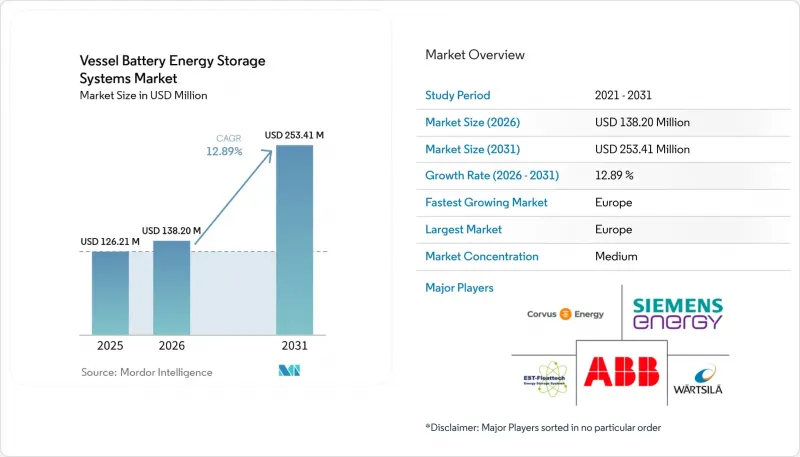
全球船舶電池能源儲存系統。
混合動力和電動船舶需求的成長正在推動對電池系統的需求。
對於營運週期頻繁的短程航線而言,混合動力和純電動推進系統正成為更具吸引力的選擇。當電池充放電循環不僅有助於符合法規要求,還能降低整體營運成本時,船舶電池能源儲存系統市場將從中受益。 2026年1月,Waltzila連續第三年從Incat Tasmania獲得Morslingyen高速渡輪的電動推進系統訂單。這些重複選擇表明,營運商可以將成熟的架構標準化應用於相關船舶。這種方法減少了後續船舶所需的設計工作量,並縮短了採購決策時間。此外,它還鼓勵航線和充電環境可預測的渡輪營運商更廣泛地採用電池。
嚴格的環境法規正在加速清潔能源的普及應用。
法規使得排放性能成為目前營運的一項挑戰,這也推動了歐洲和國際航線上船用電池能源儲存系統市場的發展。國際海事組織(IMO)在2025年4月舉行的第83屆海洋環境保護委員會(MEPC)會議上批准了「淨零排放框架」。該框架結合了全球溫室氣體排放強度標準和船用燃料排放定價機制,預計2027年生效。 「FuelEU Maritime」已於2025年1月1日全面生效,並要求在2026年1月31日前提交經檢驗的2025年溫室氣體排放強度數據。違規處罰將於2026年5月1日起生效。電池動力船舶可以降低溫室氣體排放強度,如果性能超過法規要求,還可以產生可貨幣化或可轉讓的合規盈餘單位。
高昂的初始投資成本限制了除主要營運商引領的行業之外的其他行業的採用。
高昂的初始投資仍然是中小航運公司、漁船隊以及低收入貿易地區營運商面臨的一大障礙。奧爾堡大學的一項分析發現,一艘標準電動渡輪10年的總擁有成本為328萬歐元,而同等規格的柴電渡輪則為248萬歐元。研究發現,只有在航線日利用率較高的情況下,兩者的成本才具有可比性。船舶認證系統,包括振動控制、安全艙室以及船級社認證要求,都會推高成本。因此,高頻沿海渡輪航線比遠洋航線或利用率較低的貨物運輸航線更快達到經濟可行的水平。這種成本差異影響著船上電池能源儲存系統市場,有利於那些能夠累積經驗和成本優勢的早期採用者。
細分市場分析
截至2025年,奈米複合材料電池(NMC)在船舶電池能源儲存系統市場中佔據79.1%的市場以金額為準。這主要歸功於其高能量密度,使其能夠滿足空間和重量受限的設計要求。磷酸鐵鋰電池(LFP)預計在2026年至2031年間以15.8%的複合年成長率成長,是所有化學電池類型中成長最快的。其熱穩定性降低了與火災風險相關的認證複雜性,而中國製造商正在努力降低LFP電池的成本。新加坡海事研究院對七種類型船舶的評估表明,就充放電循環特性和安全要求而言,LFP電池適用於渡輪、海上支援船和漁船。船舶電池能源儲存系統產業正在尋求在奈米複合材料電池的空間優勢和磷酸鋰電池的安全性和生命週期特性之間取得平衡。
鎳鎘電池在需要在極端溫度範圍內運行的軍事應用中仍然發揮著至關重要的作用,而鈦酸鋰電池則用於短週期渡輪和港口拖船等需要快速充電的船舶,因為這些船舶的快速充電成本較高。 ISO 18962:2026 標準於 2026 年 1 月發布,規定了可更換船用電池的安裝和運作要求。该标准支持船用电池能源儲存系統市场的模块化设计,并有望在船舶服役期间实现电池化学成分的升级,而无需更换整个系统。 Corvus Energy 和比亞迪儲能於 2026 年 5 月簽署了一項策略合作協議,共同開發高倍率磷酸鐵鋰電池(LFP)船用系統。該協議表明,儘管主要的船用電池供應商正在推動磷酸鐵鋰電池的發展,但鎳基複合材料(NMC)供應商也在尋求在空間受限的應用領域中保持其地位。
至2025年,新造船將佔船舶電池能源儲存系統市場75.2%的佔有率。這是因為新船從一開始就可以考慮到電池艙和電氣系統的設計。同時,維修市場預計將在2026年至2031年間以15.6%的複合年成長率成長。這是因為營運商選擇在計劃的乾船塢維護期間加裝電池組,而不是等待船舶更換。這將有助於降低老舊柴電船隊的溫室氣體排放強度,並幫助營運商在維護現有船體的同時滿足監管要求。船舶電池能源儲存系統產業正在進一步拓展其市場管道,進入那些尚未準備好建造新船的船隊。
船舶改裝工程需要與現有電氣系統、船舶佈局以及船級社要求進行精心整合。瓦薩航運公司的「極光博托尼亞號」於2026年初進行了改裝,加裝了10.4兆瓦時的磷酸鐵鋰電池,並獲得了DNV船級社的認證,使其總船上電池容量提升至12.6兆瓦時。該項目表明,即使是大規模的電池升級也能在最短的停機時間內完成。 Everence和WE Tech Solutions正在探討一項試點項目,旨在利用船舶例行乾船塢維護期間,為多達33艘船舶升級動力輸出裝置(PTO)和變頻驅動裝置(VFD)。這種安裝方法尤其適用於那些在更換前長期運作的貨船和漁船船隊。
區域分析
到2025年,歐洲將佔據全球船用電池能源儲存系統系統70.8%的市場佔有率,預計到2031年將以14.1%的複合年成長率成長。這一主導地位反映了排放氣體法規、已建成的渡輪電氣化走廊以及挪威、德國、瑞典和荷蘭等國船用電池供應商的存在。德國HADAG公司在漢堡營運三艘全電動港口渡輪,每艘渡輪都配備了3.8兆瓦時的Lehmann Marine CUBE磷酸鐵鋰電池系統。在斯堪地那維亞,Aurora Botnia號和Baltic Whale號貨輪的改造已展示了大規模部署的可行性。渡輪的積極升級以及歐盟自2030年起對客船和貨櫃船岸電的要求,都支撐著持續成長的需求。
亞太地區是船舶電池能源儲存系統系統市場技術最活躍的成長區域。在中國,一艘1萬噸級全電動智慧貨櫃船於2026年4月投入運營,該船整合了2萬千瓦時的電池儲能容量和自主導航能力。該船還採用了高壓岸電和電池貨櫃更換技術。在日本的「MEGURI2040」計畫中,四艘自主船舶於2026年獲得政府認證,商船三井(MOL)已將多艘船舶與陸基船隊營運中心即時連接。這些進展凸顯了可靠的電池電能品質對於自主船舶運作至關重要。
在北美,政府資助的渡輪計畫和國防部門對電池動力船舶系統的興趣正在推動相關領域的發展。華盛頓州渡輪公司(Washington State Ferry)的新型混合動力船舶採用了ABB和Corvus Energy合作開發的13.2兆瓦時電池系統。卑詩渡輪公司(BC Ferry)的「高峰會」( Summit Class)船舶設計可容納高達70兆瓦時的電池組。在南美洲,由於充電基礎設施尚在發展中,電池動力船舶系統的部署仍處於早期階段。同時,在中東和非洲,儘管沙烏地阿拉伯和阿拉伯聯合大公國對此表現出興趣,但電池動力船舶系統的部署也處於早期階段。
其他好處:
- Excel格式的市場預測(ME)表
- 3個月的分析師支持
目錄
第1章:引言
- 研究假設和市場定義
- 調查範圍
第2章:調查方法
第3章執行摘要
第4章 市場狀況
- 市場概覽
- 市場促進因素
- 減少排放氣體的需要推動了對混合動力和電動船舶日益成長的需求。
- 嚴格的環境法規正在推動清潔能源解決方案的採用。
- 船用電池系統的技術進步提高了效率。
- 對海上作業中引入可再生能源的投資正在增加。
- 沿海發電廠和港口對電氣化的需求日益成長,推動了船用電池的應用。
- 隨著自主航行和數位化連接船舶的普及,對可靠的船上能源儲存系統的需求日益成長。
- 市場限制因素
- 船用電池能源儲存系統的初始成本很高。
- 港口和航道缺乏充電基礎設施。
- 電池溫度控管和火災風險的安全隱患。
- 在惡劣的海洋環境中,產品壽命短,效能下降。
- 供應鏈分析
- 波特五力分析
- 科技趨勢
- 監理情勢
- 投資分析
第5章 市場規模與成長預測
- 化學分類
- NMC(鋰鎳錳鈷氧化物電池)
- 磷酸鋰鐵電池(LFP)
- 鎳鎘電池
- 鈦酸鋰(LTO)
- 其他類型(NCA、TNO、XNO 等)
- 透過部署配置
- 新安裝
- 改裝
- 按船舶類型
- 貨船
- 客船
- 海軍艦艇
- 漁船
- 海上支援船
- 其他
- 透過使用
- 輔助動力裝置
- 主推進系統
- 應急電源
- 可再生能源併網
- 混合動力系統
- 按地區
- 北美洲
- 美國
- 加拿大
- 墨西哥
- 歐洲
- 德國
- 法國
- 義大利
- 西班牙
- 英國
- 波蘭
- 俄羅斯
- 其他歐洲國家
- 亞太地區
- 中國
- 印度
- 日本
- 韓國
- 澳洲
- 印尼
- 越南
- 泰國
- 其他亞太國家
- 南美洲
- 巴西
- 阿根廷
- 智利
- 其他南美國家
- 中東和非洲
- 沙烏地阿拉伯
- 阿拉伯聯合大公國
- 埃及
- 南非
- 摩洛哥
- 其他中東和非洲國家
- 北美洲
第6章 競爭情勢
- 市場集中度
- 策略趨勢
- 市佔率分析
- 公司簡介
- ABB Ltd
- AYK Energy
- BorgWarner Inc.
- Corvus Energy Holding AS
- EAS Batteries GmbH
- Echandia Marine AB
- ePropulsion Europe SLU
- EST-Floattech BV
- EVE Energy Co., Ltd.
- Kongsberg Gruppen ASA
- KREISEL Electric GmbH
- Leclanche SA
- Lehmann Marine GmbH
- Saft Groupe SAS
- Siemens Energy AG
- Sunlight Group
- Wartsila Oyj Abp
- ZEM AS
第7章 市場機會與未來展望
According to Mordor Intelligence, the vessel battery energy storage systems market size is expected to increase from USD 126.21 million in 2025 to USD 138.20 million in 2026 and reach USD 253.41 million by 2031, growing at a CAGR of 12.89% over 2026-2031.
Global Vessel Battery Energy Storage Systems Market Trends and Insights
Rising Demand for Hybrid and Electric Vessels Drives Battery System Volume
Hybrid and all-electric propulsion have become more attractive for short-haul routes with frequent operating cycles. The vessel battery energy storage systems market benefits when battery cycling can reduce total operating costs rather than only support compliance. Wartsila received its third successive electric propulsion order for a Molslinjen high-speed ferry at Incat Tasmania in January 2026. The repeated selection shows that operators can standardize a proven architecture across related vessels. This approach reduces the engineering effort needed for follow-on ships and can shorten procurement decisions. It also supports wider battery deployment among ferry operators that have predictable routes and charging access.
Stringent Environmental Regulations Accelerate Clean Energy Adoption
Regulation has made emissions performance a current operating issue that supports the vessel battery energy storage systems market in European and international trades. The IMO approved its Net-Zero Framework at MEPC 83 in April 2025, combining a global marine-fuel greenhouse gas intensity standard with an emissions pricing mechanism. The framework is anticipated to enter into force in 2027. FuelEU Maritime has applied fully since January 1, 2025, and requires verified 2025 greenhouse gas intensity data by January 31, 2026. Penalties for noncompliance apply from May 1, 2026. Battery-assisted operations can lower attained greenhouse gas intensity and may create bankable or transferable compliance surplus units when performance exceeds the regulation's requirements.
High Initial Capital Cost Constrains Adoption Beyond Lead-Operator Segments
Initial investment remains a barrier for smaller shipping companies, fishing fleets, and operators in lower-income trade regions. An Aalborg University analysis found that a baseline electric ferry produced EUR 3.28 million in 10-year total cost of ownership, compared with EUR 2.48 million for a diesel-electric equivalent. The study found parity only at higher daily route utilization. Marine-certified systems include vibration protection, safety enclosures, and class-certification requirements that add cost. High-frequency short-sea ferry routes can therefore reach a workable economic threshold earlier than offshore or low-utilization cargo applications. This cost divide shapes the vessel battery energy storage systems market by favoring early users who can build experience and cost advantages.
Other drivers and restraints analyzed in the detailed report include:
- Technological Advancements Improve Marine Battery Performance and Lifecycle Economics
- Shore Power and Port Electrification Reshape Vessel Battery Utility
- Inadequate Port Charging Infrastructure Limits Battery-Dependent Route Expansion
For complete list of drivers and restraints, kindly check the Table Of Contents.
Segment Analysis
NMC held 79.1% of the vessel battery energy storage systems market by value in 2025 because its energy density supports designs with tight space and weight limits. LFP is forecast to grow at a 15.8% CAGR from 2026 to 2031, the fastest rate among chemistry types. Its thermal stability can reduce fire-risk certification complexity, while Chinese manufacturers have supported a declining LFP cell cost curve. A Singapore Maritime Institute assessment of 7 vessel types identified LFP as suitable for ferries, offshore support vessels, and fishing vessels because of their cycling patterns and safety requirements. The vessel battery energy storage systems industry is balancing NMC's space advantage against LFP's safety and lifecycle attributes.
Ni-Cd remains relevant in military applications that require operation across extreme temperatures, while LTO serves short-turnaround ferries and harbor tugs where rapid charging can justify a cost premium. ISO 18962:2026, published in January 2026, sets installation and operating requirements for swappable ship batteries. The standard supports modular designs in the vessel battery energy storage systems market and may enable chemistry upgrades during a vessel's working life without a full system replacement. Corvus Energy and BYD Energy Storage signed a strategic cooperation agreement in May 2026 to develop high-rate LFP marine systems. The agreement shows that a major marine battery supplier is pursuing LFP development while NMC suppliers seek to sustain their position in space-constrained applications
Newbuild installations held 75.2% of the vessel battery energy storage systems market in 2025 because new vessels can be designed around battery bays and electrical systems from the beginning. Retrofits are forecast to grow at a 15.6% CAGR from 2026 to 2031 as operators add packs during planned dry-docking periods rather than wait for vessel replacement. This allows aging diesel-electric fleets to improve greenhouse gas intensity performance. It also helps operators manage regulatory requirements while preserving the use of existing hulls. The vessel battery energy storage systems industry is finding a wider route into fleets that are not ready for newbuild procurement.
Retrofit projects require careful integration with existing electrical architecture, vessel layout, and class requirements. Wasaline's Aurora Botnia received a 10.4 MWh LFP retrofit in early 2026, lifting total onboard capacity to 12.6 MWh with DNV class approval. The project demonstrated that large battery upgrades can be completed with limited operational downtime. Everllence and WE Tech Solutions were discussing a pilot covering up to 33 vessels for Power Take-Off and Variable Frequency Drive upgrades during scheduled dry dockings. This installation route is particularly relevant for cargo and fishing fleets that operate for long periods before replacement.
Complete Report Scope:
- By Chemistry
- NMC (Lithium Nickel Manganese Cobalt Oxide Battery)
- LFP (Lithium Iron Phosphate Battery)
- Ni-Cd (Nickel-Cadmium Battery)
- Lithium Titanate Oxide (LTO)
- Other Types (NCA, TNO, XNO, etc.)
- By Installation Configuration
- Newbuild
- Retrofit
- By Vessel Type
- Cargo Ships
- Passenger Ships
- Naval Vessels
- Fishing Vessels
- Offshore Support Vessels
- Others
- By Application
- Auxiliary Power Units
- Main Propulsion Systems
- Emergency Power Supply
- Renewable Energy Integration
- Hybrid Power Systems
- By Geography
- North America
- United States
- Canada
- Mexico
- Europe
- Germany
- France
- Italy
- Spain
- United Kingdom
- Poland
- Russia
- Rest of Europe
- Asia-Pacific
- China
- India
- Japan
- South Korea
- Australia
- Indonesia
- Vietnam
- Thailand
- Rest of Asia-Pacific
- South America
- Brazil
- Argentina
- Chile
- Rest of South America
- Middle East and Africa
- Saudi Arabia
- United Arab Emirates
- Egypt
- South Africa
- Morocco
- Rest of Middle East and Africa
- North America
Geography Analysis
Europe held 70.8% of vessel battery energy storage systems market share in 2025 and is forecast to grow at a 14.1% CAGR through 2031. Its lead reflects emissions regulation, established ferry electrification corridors, and marine battery suppliers in Norway, Germany, Sweden, and the Netherlands. Germany's HADAG fleet is deploying 3 fully electric harbor ferries in Hamburg, each with a 3.8 MWh Lehmann Marine CUBE LFP system. Scandinavia has demonstrated large installed capacity through the Aurora Botnia retrofit and the Baltic Whale freight operation. Active ferry replacement programs and the EU shore power requirement for passenger and container ships from 2030 provide continued demand support.
Asia-Pacific is the most technically active growth region in the vessel battery energy storage systems market. China commissioned a 10,000-ton-class pure-electric intelligent container ship in April 2026 with 20,000 kWh of battery storage and integrated autonomous navigation. The vessel also uses high-voltage shore power and battery-container swapping. Japan's MEGURI2040 program secured government certification for 4 autonomous vessels in 2026, and MOL connected multiple ships in real time to land-based Fleet Operation Centers. These developments place reliable battery-backed power quality at the center of autonomous vessel operations.
North America is advancing through state-procured ferry programs and defense interest in battery-electric vessel systems. Washington State Ferries' hybrid-electric newbuilds use 13.2 MWh battery systems through an ABB and Corvus Energy partnership. BC Ferries' Summit Class vessels are designed for up to 70 MWh per vessel. South America remains at an earlier stage because charging infrastructure is still being developed, while the Middle East and Africa are also early in adoption despite interest from Saudi Arabia and the United Arab Emirates.
- ABB Ltd
- AYK Energy
- BorgWarner Inc.
- Corvus Energy Holding AS
- EAS Batteries GmbH
- Echandia Marine AB
- ePropulsion Europe SLU
- EST-Floattech B.V.
- EVE Energy Co., Ltd.
- Kongsberg Gruppen ASA
- KREISEL Electric GmbH
- Leclanche SA
- Lehmann Marine GmbH
- Saft Groupe S.A.S.
- Siemens Energy AG
- Sunlight Group
- Wartsila Oyj Abp
- ZEM AS
Additional Benefits:
- The market estimate (ME) sheet in Excel format
- 3 months of analyst support
TABLE OF CONTENTS
1 INTRODUCTION
- 1.1 Study Assumptions and Market Definition
- 1.2 Scope of the Study
2 RESEARCH METHODOLOGY
3 EXECUTIVE SUMMARY
4 MARKET LANDSCAPE
- 4.1 Market Overview
- 4.2 Market Drivers
- 4.2.1 Rising Demand for Hybrid and Electric Vessels to Reduce Emissions.
- 4.2.2 Stringent Environmental Regulations Driving Adoption of Clean Energy Solutions.
- 4.2.3 Technological Advancements in Marine Battery Systems are Improving Efficiency.
- 4.2.4 Increasing Investments in Renewable Energy Integration for Maritime Operations.
- 4.2.5 Growing Demand for Shore Power and Port Electrification is Supporting Vessel Battery Adoption.
- 4.2.6 Expansion of Autonomous and Digitally Connected Vessels is Increasing Demand for Reliable Onboard Energy Storage.
- 4.3 Market Restraints
- 4.3.1 High Initial Cost of Battery Energy Storage Systems for Vessels.
- 4.3.2 Limited Charging Infrastructure in Ports and Marine Routes.
- 4.3.3 Safety Concerns Related to Battery Thermal Management and Fire Risks.
- 4.3.4 Short Lifecycle and Performance Degradation In Harsh Marine Environments.
- 4.4 Supply-Chain Analysis
- 4.5 Porter's Five Forces Analysis
- 4.5.1 Bargaining Power of Suppliers
- 4.5.2 Bargaining Power of Buyers
- 4.5.3 Threat of New Entrants
- 4.5.4 Threat of Substitutes
- 4.5.5 Competitive Rivalry
- 4.6 Technology Outlook
- 4.7 Regulatory Landscape
- 4.8 Investment Analysis
5 MARKET SIZE AND GROWTH FORECASTS
- 5.1 By Chemistry
- 5.1.1 NMC (Lithium Nickel Manganese Cobalt Oxide Battery)
- 5.1.2 LFP (Lithium Iron Phosphate Battery)
- 5.1.3 Ni-Cd (Nickel-Cadmium Battery)
- 5.1.4 Lithium Titanate Oxide (LTO)
- 5.1.5 Other Types (NCA, TNO, XNO, etc.)
- 5.2 By Installation Configuration
- 5.2.1 Newbuild
- 5.2.2 Retrofit
- 5.3 By Vessel Type
- 5.3.1 Cargo Ships
- 5.3.2 Passenger Ships
- 5.3.3 Naval Vessels
- 5.3.4 Fishing Vessels
- 5.3.5 Offshore Support Vessels
- 5.3.6 Others
- 5.4 By Application
- 5.4.1 Auxiliary Power Units
- 5.4.2 Main Propulsion Systems
- 5.4.3 Emergency Power Supply
- 5.4.4 Renewable Energy Integration
- 5.4.5 Hybrid Power Systems
- 5.5 By Geography
- 5.5.1 North America
- 5.5.1.1 United States
- 5.5.1.2 Canada
- 5.5.1.3 Mexico
- 5.5.2 Europe
- 5.5.2.1 Germany
- 5.5.2.2 France
- 5.5.2.3 Italy
- 5.5.2.4 Spain
- 5.5.2.5 United Kingdom
- 5.5.2.6 Poland
- 5.5.2.7 Russia
- 5.5.2.8 Rest of Europe
- 5.5.3 Asia-Pacific
- 5.5.3.1 China
- 5.5.3.2 India
- 5.5.3.3 Japan
- 5.5.3.4 South Korea
- 5.5.3.5 Australia
- 5.5.3.6 Indonesia
- 5.5.3.7 Vietnam
- 5.5.3.8 Thailand
- 5.5.3.9 Rest of Asia-Pacific
- 5.5.4 South America
- 5.5.4.1 Brazil
- 5.5.4.2 Argentina
- 5.5.4.3 Chile
- 5.5.4.4 Rest of South America
- 5.5.5 Middle East and Africa
- 5.5.5.1 Saudi Arabia
- 5.5.5.2 United Arab Emirates
- 5.5.5.3 Egypt
- 5.5.5.4 South Africa
- 5.5.5.5 Morocco
- 5.5.5.6 Rest of Middle East and Africa
- 5.5.1 North America
6 COMPETITIVE LANDSCAPE
- 6.1 Market Concentration
- 6.2 Strategic Moves
- 6.3 Market Share Analysis
- 6.4 Company Profiles (includes Global Level Overview, Market Level Overview, Core Segments, Financials as available, Strategic Information, Products and Services, Recent Developments)
- 6.4.1 ABB Ltd
- 6.4.2 AYK Energy
- 6.4.3 BorgWarner Inc.
- 6.4.4 Corvus Energy Holding AS
- 6.4.5 EAS Batteries GmbH
- 6.4.6 Echandia Marine AB
- 6.4.7 ePropulsion Europe SLU
- 6.4.8 EST-Floattech B.V.
- 6.4.9 EVE Energy Co., Ltd.
- 6.4.10 Kongsberg Gruppen ASA
- 6.4.11 KREISEL Electric GmbH
- 6.4.12 Leclanche SA
- 6.4.13 Lehmann Marine GmbH
- 6.4.14 Saft Groupe S.A.S.
- 6.4.15 Siemens Energy AG
- 6.4.16 Sunlight Group
- 6.4.17 Wartsila Oyj Abp
- 6.4.18 ZEM AS
7 MARKET OPPORTUNITIES AND FUTURE OUTLOOK
- 7.1 White-Space and Unmet-Need Assessment

 電池能源儲存系統市場預測至2034年—全球電池化學成分、組件、連接方式、應用、所有權模式和區域分析
 2026年全球電池能源儲存系統市場報告
 中東和非洲電池能源儲存系統(BESS):市場佔有率分析、行業趨勢和統計數據以及成長預測(2026-2031 年)南美洲電池能源儲存系統(BESS):市場佔有率分析、行業趨勢和統計數據以及成長預測(2026-2031 年)歐洲電池能源儲存系統(BESS):市場佔有率分析、產業趨勢與統計及成長預測(2026-2031)
 對 2035 年前的太陽能電池儲能系統市場進行分析和預測:按類型、產品、技術、組件、應用、最終用戶、功能、安裝類型、解決方案和模式。電池能源儲存系統(BESS):市場佔有率分析、產業趨勢與統計及成長預測(2026-2031)印度電池能源儲存系統(BESS):市場佔有率分析、產業趨勢與統計及成長預測(2026-2031)2026年全球電錶前電池市場報告2026年全球電池租賃即服務市場報告