


 |
市場調查報告書
商品編碼
2124348
歐洲電池能源儲存系統(BESS):市場佔有率分析、產業趨勢與統計及成長預測(2026-2031)Europe Battery Energy Storage System (BESS) - Market Share Analysis, Industry Trends & Statistics, Growth Forecasts (2026 - 2031) |
||||||

※ 本網頁內容可能與最新版本有所差異。詳細情況請與我們聯繫。
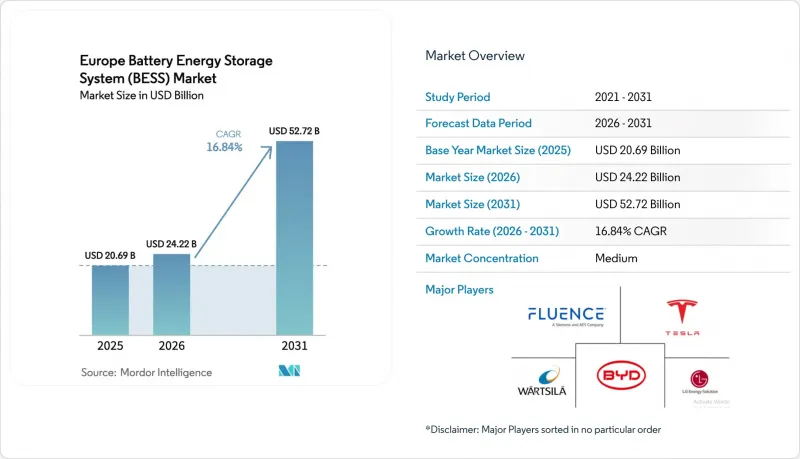
根據 Mordor Intelligence 預測,歐洲電池能源儲存系統(BESS) 市場規模將從 2025 年的 206.9 億美元和 2026 年的 242.2 億美元成長到 2031 年的 527.2 億美元。
這代表著 16.84% 的複合年成長率,凸顯了投資者對長期系統靈活性解決方案的信心。
本報告按電池類型(鋰離子電池、鉛酸電池等)、連接類型(併網和離網)、組件(電池組和支架、能源管理軟體等)、能源容量範圍(10-100 MWh、500 MWh 及以上等)、最終用戶應用(電力公司、商業和工業、住宅)以及地區(德國、英國等)進行分類。
歐洲電池能源儲存系統(BESS)市場趨勢與洞察
歐盟範圍內的「適用於55年」柔軟性要求正在加速電池儲能系統(BESS)的採購。
該指令要求各成員國到2030年至少有30%的調頻儲備來自非化石能源,進而為歐洲電池能源儲存系統(BESS)市場的需求設定了結構性下限。電池專案現在可以參與自動頻率恢復競標的資格預審,此前該資格預審僅限於水電和天然氣資產,這使得德國和荷蘭的投資回收期縮短至七年以內。開發商正爭分奪秒地爭取併網契約,以應對預計的併網等待名單變化,而輸電運營商則增加了中期目標,以進一步加快投資決策。
住宅產消者的價格套利
2025年下半年,德國平均零售電費將為每度電0.41歐元,比前一日批發價高出0.26至0.36歐元。即使沒有上網電價補貼(FIT),這項價差也能確保一套10度電的家用儲能系統在8至10年內收回成本。目前,德國超過60%的住宅電池儲能系統採用演算法,在電價為負值時段(2025年為300次)充電,並在晚高峰時段放電。
電網連接隊列和有限的連接容量
預計到2025年底,德國的併網等待名單將超過100吉瓦,等待時間最長可達36個月,這將使專案的淨現值(NPV)降低高達20%。西班牙和英國也面臨類似的限制,促使英國電網營運商採用「先到先得」的製度,優先考慮可以立即動工的項目。
細分市場分析
到2025年,鋰離子電池將佔裝置容量的87.8%,在歐洲電池能源儲存系統市場佔據主導地位。液流電池的複合年成長率(CAGR)為28.3%,其放電週期為6至10小時,對於希望避免鋰成本上漲的電網營運商來說極具吸引力。鈉離子電池和鈦酸鋰技術目前處於試驗階段,適用於對耐久性和溫度耐受性有特定要求的應用。總體而言,儘管由於化學成分的多樣化,鋰的絕對用量將繼續增加,但預計到2031年,其市場佔有率將保持在80%以下。
預計到2031年,歐洲液流式電池能源儲存系統市場規模將超過40億美元,這得益於供應商提供的超過20年的保固。電力公司傾向於選擇能夠運作數小時的設備,這與併網設備升級的趨勢相符,後者旨在減少系統數量並提高運作。同時,企業買家也更重視環境因素,尤其是那些與釩回收產業鏈相整合的因素。
到2025年,併網設施將佔總裝置容量的85.5%,反映出電網業務收益模式的成熟。離網和混合微電網將以28.9%的複合年成長率成長,在工業園區和島嶼地區開拓新的需求領域。與離網採礦作業相關的歐洲電池能源儲存系統(BESS)市場規模已超過10億美元。瑞典Waltila公司建造的10兆瓦微電網就是一個典型的例子,預計到2025年,該專案的成本將降低40%。
由於併網延遲問題持續存在,資料中心營運商和化學企業正在申請離網許可,以繞過電網。混合動力電站能夠在停電期間獨立運行,滿足電力系統的彈性要求,並有助於降低電網費用。在德國,電網費用最高可達每千瓦每年150歐元。
其他好處:
- Excel格式的市場預測(ME)表
- 3個月的分析師支持
目錄
第1章:引言
- 研究假設和市場定義
- 調查範圍
第2章:調查方法
第3章執行摘要
第4章 市場狀況
- 市場概覽
- 市場促進因素
- 歐盟範圍內「適合55年」的柔軟性需求正在加速BESS的採購。
- 住宅消者的價格套利
- 透過國內發電能力和快速備用容量競標來建構高盈利的收入結構(英國、義大利)
- 德國引進智慧電錶,使得電錶後方的儲能設備得以整合。
- 公司間購電協議 (PPA) 的蓬勃發展正在推動公用事業規模的太陽能和風能發電設施採用電池儲能系統 (BESS)。
- 透過歐盟的「電池護照」和「基本礦產法」加速降低鋰離子電池供應風險
- 市場限制因素
- 電網連接候機名單和連接容量限制
- 輔助服務價格的波動正在降低專案的內部報酬率(IRR)。
- 歐盟高密度城市的消防和城市規劃法規正在推動資本投資的成長。
- 由於該項目依賴從中國進口電池,因此面臨外匯和貿易政策風險。
- 供應鏈分析
- 監理情勢
- 技術展望
- 波特五力分析
- 投資分析
第5章 市場規模與成長預測
- 依電池類型
- 鋰離子(磷酸鋰鐵(LFP)、鎳錳鈷鋰(NMC)、鈦酸鋰(LTO))
- 鉛酸
- 液流電池(釩液流電池、鋅溴液流電池)
- 鈉離子
- 其他電池技術(鎳鎘電池、混合型超級電容)
- 按連線類型
- 併網型(與電力公司連接)
- 離網(微電網、混合電網)
- 按組件
- 電池組和支架
- 電源轉換系統(PCS)
- 能源管理軟體(EMS)
- 工廠設施和服務
- 能量容量範圍
- 小於10兆瓦時
- 10~100 MWh
- 100~500 MWh
- 500兆瓦時或以上
- 透過最終用戶應用程式
- 公用事業
- 商業和工業用途
- 住宅
- 按地區
- 德國
- 英國
- 義大利
- 法國
- 西班牙
- 北歐國家(挪威、瑞典、丹麥、芬蘭)
- 其他歐洲國家
第6章 競爭情勢
- 市場集中度
- 策略趨勢(併購、聯盟、購電協議)
- 市場佔有率分析(主要公司的市場排名和佔有率)
- 公司簡介
- Fluence Energy Inc.
- Tesla Inc.
- BYD Co. Ltd.
- LG Energy Solution Ltd.
- Samsung SDI Co. Ltd.
- Wartsila Oyj Abp
- Northvolt AB
- Saft Groupe SAS(TotalEnergies)
- Panasonic Holdings Corp.
- Contemporary Amperex Technology Co. Ltd.
- Hitachi Energy Ltd.
- ABB Ltd.
- Toshiba Corp.
- Murata Manufacturing Co. Ltd.
- Leclanche SA
- EVE Energy Co. Ltd.
- NEC Energy Solutions(Koch)
- VARTA AG
- Zenobe Energy Ltd.
- Kokam Co. Ltd.
第7章 市場機會與未來展望
According to Mordor Intelligence, the Europe battery energy storage system (BESS) market size is projected to expand from USD 20.69 billion in 2025 and USD 24.22 billion in 2026 to USD 52.72 billion by 2031, reflecting a 16.84% CAGR and confirming investor confidence in long-duration grid flexibility solutions.
This report is Segmented by Battery Type (Lithium-Ion, Lead-Acid, and More), Connection Type (On-Grid and Off-Grid), Component (Battery Pack and Racks, Energy Management Software, and More), Energy Capacity Range (10 To 100 MWh, Above 500 MWh, and More), End-User Application (Utility, Commercial and Industrial, and Residential), and Geography (Germany, United Kingdom, and More).
Europe Battery Energy Storage System (BESS) Market Trends and Insights
EU-Wide Fit-for-55 Flexibility Mandates Accelerating BESS Procurement
The directive requires each member state to source at least 30% of balancing reserves from non-fossil resources by 2030, providing a structural demand floor for the European Battery Energy Storage Systems market. Battery projects now pre-qualify for automatic frequency restoration tenders that formerly went to hydro and gas assets, shortening payback periods below seven years in Germany and the Netherlands. Developers are racing to secure connection agreements ahead of expected queue reforms, while transmission operators add interim targets that further pull forward investment decisions.
Residential Prosumer Tariff-Arbitrage Amid Record-High Retail Prices
Retail electricity prices averaged EUR 0.41 per kWh in late 2025 in Germany, creating a spread of EUR 0.26-0.36 versus day-ahead wholesale prices. This margin underpins eight-to-ten-year payback periods for 10 kWh home systems even without feed-in tariffs. More than 60% of German residential batteries now use algorithms that charge during negative-price hours, which occurred 300 times in 2025, and discharge during evening peaks.
Grid-Connection Queues and Limited Interconnection Capacity
Germany's queue exceeded 100 GW by end-2025, stretching wait times to 36 months and eroding project NPVs by up to 20%. Spain and the United Kingdom face similar constraints, prompting the U.K. grid operator to adopt a first-ready approach that favors shovel-ready applications.
Other drivers and restraints analyzed in the detailed report include:
- National Capacity & Fast-Reserve Auctions Creating Bankable Revenue Stacks
- Germany's Smart-Meter Roll-out Unlocking Aggregation of Behind-the-Meter Storage
- Volatile Ancillary-Service Prices Undermining Project IRRs
For complete list of drivers and restraints, kindly check the Table Of Contents.
Segment Analysis
Lithium-ion held 87.8% of installed capacity in 2025, giving the segment the dominant Europe Battery Energy Storage Systems market share. Flow batteries, expanding at a 28.3% CAGR, appeal to grid operators that need 6-10 hour discharge profiles and wish to avoid lithium cost escalations. Sodium-ion and lithium titanate technologies are entering pilot phases for specific resilience or temperature-tolerant applications. Overall, chemistry diversification is likely to cap lithium's share below 80% by 2031, even as absolute lithium volume continues to rise.
The European Battery Energy Storage Systems market size for flow chemistries is expected to surpass USD 4 billion by 2031, supported by vendor-financed warranties exceeding 20 years. Utility preference for multi-hour assets aligns with interconnection upgrades that favor fewer, longer-duration systems, while corporate buyers value the environmental credentials embedded in vanadium recycling chains.
On-grid assets accounted for 85.5% of capacity in 2025, reflecting mature grid-service revenue models. Off-grid and hybrid microgrids will advance at a 28.9% CAGR, carving new demand pools inside industrial campuses and island communities. The European Battery Energy Storage Systems market size tied to off-grid mining operations already exceeds USD 1 billion, highlighted by Wartsila's 10 MW Swedish microgrid that delivered 40% savings in 2025.
As grid queues lengthen, data-center operators and chemical producers are securing off-grid permits that bypass transmission interconnection. Hybrid plants capable of islanding during outages support resilience mandates and reduce network charges that can reach EUR 150 per kW yearly in Germany.
Complete Report Scope:
- By Battery Type
- Lithium-ion (Lithium Iron Phosphate (LFP), Nickel-Manganese-Cobalt (NMC), Lithium Titanate (LTO))
- Lead-acid
- Flow Battery (Vanadium Redox, Zinc-Bromine)
- Sodium-ion
- Other Battery Technologies (NiCd, Hybrid Super-capacitors)
- By Connection Type
- On-Grid (Utility Interconnected)
- Off-Grid (Micro-Grid, Hybrid)
- By Component
- Battery Pack and Racks
- Power Conversion System (PCS)
- Energy Management Software (EMS)
- Balance-of-Plant and Services
- By Energy Capacity Range
- Below 10 MWh
- 10 to 100 MWh
- 100 to 500 MWh
- Above 500 MWh
- By End-user Application
- Utility
- Commercial and Industrial
- Residential
- By Geography
- Germany
- United Kingdom
- Italy
- France
- Spain
- Nordic Countries (Norway, Sweden, Denmark, Finland)
- Rest of Europe
List of Companies Covered in this Report:
- Fluence Energy Inc.
- Tesla Inc.
- BYD Co. Ltd.
- LG Energy Solution Ltd.
- Samsung SDI Co. Ltd.
- Wartsila Oyj Abp
- Northvolt AB
- Saft Groupe SAS (TotalEnergies)
- Panasonic Holdings Corp.
- Contemporary Amperex Technology Co. Ltd.
- Hitachi Energy Ltd.
- ABB Ltd.
- Toshiba Corp.
- Murata Manufacturing Co. Ltd.
- Leclanche SA
- EVE Energy Co. Ltd.
- NEC Energy Solutions (Koch)
- VARTA AG
- Zenobe Energy Ltd.
- Kokam Co. Ltd.
Additional Benefits:
- The market estimate (ME) sheet in Excel format
- 3 months of analyst support
TABLE OF CONTENTS
1 Introduction
- 1.1 Study Assumptions & Market Definition
- 1.2 Scope of the Study
2 Research Methodology
3 Executive Summary
4 Market Landscape
- 4.1 Market Overview
- 4.2 Market Drivers
- 4.2.1 EU-wide "Fit-for-55" Flexibility Mandates Accelerating BESS Procurement
- 4.2.2 Residential Prosumer Tariff-Arbitrage Amid Record-High Retail Prices
- 4.2.3 National Capacity & Fast-Reserve Auctions (UK, Italy) Creating Bankable Revenue Stacks
- 4.2.4 Germany's Smart-Meter Roll-out Unlocking Aggregation of Behind-the-Meter Storage
- 4.2.5 Corporate PPA Boom Driving Co-located BESS with Utility-Scale Solar & Wind
- 4.2.6 Accelerated De-Risking of Li-ion Supply via EU Battery Passport & Critical-Mineral Acts
- 4.3 Market Restraints
- 4.3.1 Grid-Connection Queues and Limited Interconnection Capacity
- 4.3.2 Volatile Ancillary-Service Prices Undermining Project IRRs
- 4.3.3 Fire-Safety & Urban-Zoning Rules Raising Capex for Dense EU Cities
- 4.3.4 Reliance on Chinese Cell Imports Exposing Projects to FX & Trade-Policy Risk
- 4.4 Supply-Chain Analysis
- 4.5 Regulatory Landscape
- 4.6 Technological Outlook
- 4.7 Porter's Five Forces Analysis
- 4.7.1 Bargaining Power of Suppliers
- 4.7.2 Bargaining Power of Buyers
- 4.7.3 Threat of New Entrants
- 4.7.4 Threat of Substitutes
- 4.7.5 Intensity of Competitive Rivalry
- 4.8 Investment Analysis
5 Market Size & Growth Forecasts
- 5.1 By Battery Type
- 5.1.1 Lithium-ion (Lithium Iron Phosphate (LFP), Nickel-Manganese-Cobalt (NMC), Lithium Titanate (LTO))
- 5.1.2 Lead-acid
- 5.1.3 Flow Battery (Vanadium Redox, Zinc-Bromine)
- 5.1.4 Sodium-ion
- 5.1.5 Other Battery Technologies (NiCd, Hybrid Super-capacitors)
- 5.2 By Connection Type
- 5.2.1 On-Grid (Utility Interconnected)
- 5.2.2 Off-Grid (Micro-Grid, Hybrid)
- 5.3 By Component
- 5.3.1 Battery Pack and Racks
- 5.3.2 Power Conversion System (PCS)
- 5.3.3 Energy Management Software (EMS)
- 5.3.4 Balance-of-Plant and Services
- 5.4 By Energy Capacity Range
- 5.4.1 Below 10 MWh
- 5.4.2 10 to 100 MWh
- 5.4.3 100 to 500 MWh
- 5.4.4 Above 500 MWh
- 5.5 By End-user Application
- 5.5.1 Utility
- 5.5.2 Commercial and Industrial
- 5.5.3 Residential
- 5.6 By Geography
- 5.6.1 Germany
- 5.6.2 United Kingdom
- 5.6.3 Italy
- 5.6.4 France
- 5.6.5 Spain
- 5.6.6 Nordic Countries (Norway, Sweden, Denmark, Finland)
- 5.6.7 Rest of Europe
6 Competitive Landscape
- 6.1 Market Concentration
- 6.2 Strategic Moves (M&A, Partnerships, PPAs)
- 6.3 Market Share Analysis (Market Rank/Share for key companies)
- 6.4 Company Profiles (includes Global level Overview, Market level overview, Core Segments, Financials as available, Strategic Information, Products & Services, and Recent Developments)
- 6.4.1 Fluence Energy Inc.
- 6.4.2 Tesla Inc.
- 6.4.3 BYD Co. Ltd.
- 6.4.4 LG Energy Solution Ltd.
- 6.4.5 Samsung SDI Co. Ltd.
- 6.4.6 Wartsila Oyj Abp
- 6.4.7 Northvolt AB
- 6.4.8 Saft Groupe SAS (TotalEnergies)
- 6.4.9 Panasonic Holdings Corp.
- 6.4.10 Contemporary Amperex Technology Co. Ltd.
- 6.4.11 Hitachi Energy Ltd.
- 6.4.12 ABB Ltd.
- 6.4.13 Toshiba Corp.
- 6.4.14 Murata Manufacturing Co. Ltd.
- 6.4.15 Leclanche SA
- 6.4.16 EVE Energy Co. Ltd.
- 6.4.17 NEC Energy Solutions (Koch)
- 6.4.18 VARTA AG
- 6.4.19 Zenobe Energy Ltd.
- 6.4.20 Kokam Co. Ltd.
7 Market Opportunities & Future Outlook
- 7.1 White-Space & Unmet-Need Assessment

 中東和非洲電池能源儲存系統(BESS):市場佔有率分析、行業趨勢和統計數據以及成長預測(2026-2031 年)南美洲電池能源儲存系統(BESS):市場佔有率分析、行業趨勢和統計數據以及成長預測(2026-2031 年)
 對 2035 年前的太陽能電池儲能系統市場進行分析和預測:按類型、產品、技術、組件、應用、最終用戶、功能、安裝類型、解決方案和模式。
 電池能源儲存系統市場預測至2034年—按電池類型、系統組件、安裝配置、額定功率、最終用戶和地區分類的全球分析
 電池能源儲存系統市場:2026-2032年全球市場預測(按組件、電池類型、能源容量、連接類型、電網位置、應用和銷售管道)
 全球電池能源儲存系統(BESS)TIC市場:按服務類型、電池類型、交付方式、採購類型、最終用戶和地區分類-預測至2032年電池能源儲存系統市場預測至2034年—按電池技術、輸出容量、應用、最終用戶和地區分類的全球分析電池能源儲存系統(BESS):市場佔有率分析、產業趨勢與統計及成長預測(2026-2031)印度電池能源儲存系統(BESS):市場佔有率分析、產業趨勢與統計及成長預測(2026-2031)
 2026年全球電錶前電池市場報告