

 |
市場調查報告書
商品編碼
2124359
南美洲電池能源儲存系統(BESS):市場佔有率分析、行業趨勢和統計數據以及成長預測(2026-2031 年)South America Battery Energy Storage System (BESS) - Market Share Analysis, Industry Trends & Statistics, Growth Forecasts (2026 - 2031) |
||||||

※ 本網頁內容可能與最新版本有所差異。詳細情況請與我們聯繫。
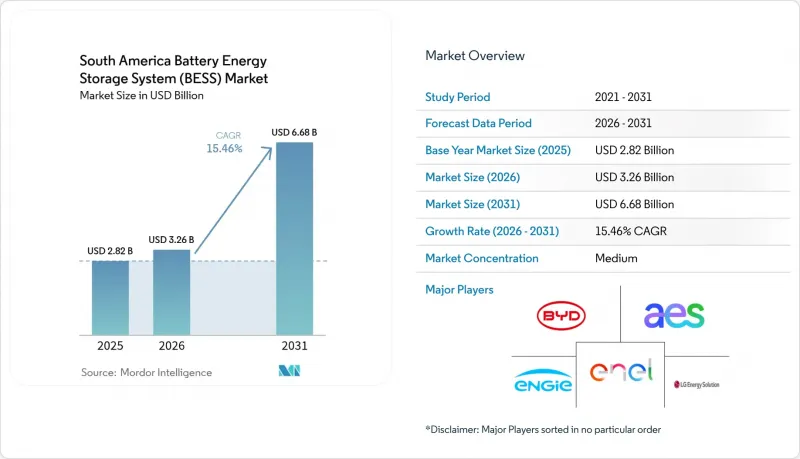
據 Mordor Intelligence 稱,南美洲電池能源儲存系統(BESS) 的市場規模預計在 2026 年達到 32.6 億美元,高於 2025 年的 28.2 億美元,預計到 2031 年將達到 66.8 億美元。
預計從 2026 年到 2031 年,其複合年成長率將達到 15.46%。
本報告按電池類型(鋰離子電池、其他電池)、連接類型(併網、離網)、組件(電池組架、能源管理軟體、其他組件)、能源容量範圍(10-100 MWh、500 MWh 及以上、其他組件)、最終用戶應用(公共產業、商業和工業、住宅)以及地區(巴西、智利、阿根廷、其他地區)進行分類。
南美洲電池能源儲存系統(BESS)市場趨勢與洞察
巴西和智利可變可再生能源的採用率迅速成長
2024年,巴西將新增8.8吉瓦的太陽能和風能發電裝置容量,使可變可再生能源在電網中的比例達到23%。智利阿塔卡馬沙漠位置一座4.2吉瓦的太陽能發電廠,但由於中午時段會實施限電措施,因此在晚間用電高峰時段,鋰離子電池系統可以分時段運作四小時,從而創造了盈利的套利機會。智利電網營運商要求裝置容量超過100兆瓦的太陽能發電廠必須配備儲能系統,否則將面臨限電處罰。巴西電網營運商正在測試和運營基於電池的「複合慣性」服務,以取代正在退役的老舊火力發電廠。阿根廷巴塔哥尼亞風能走廊也存在類似的限電情況,但由於缺乏容量定價機制,採礦業的儲能投資仍處於離網狀態。
鋰離子(LFP 和 NMC)電池的價格(美元/kWh)大幅下降。
2024年,磷酸鋰鐵電池(LFP)價格降至115美元/kWh時,年減17%。這使得4小時儲能系統的平準化成本低於150美元/兆瓦時。鎳基碳化物電池(NMC)價格降至128美元/千瓦時,縮小了成本差距,並使得混合電池組成為可能,該混合電池組結合了LFP的高能量儲存容量和NMC的瞬時輸出特性。在巴西2025年的競標中,競標價格上限設定為180美元/kWh時,只有LFP供應商才能在保持獲利的情況下達到這一水準。韓國企業正在將NMC的生產轉移到南美洲的電動車工廠,為固定式儲能系統整合商創造了第二個供應來源。預計到2027年,6小時儲能系統的成本將與4小時儲能系統的成本相當,使其能夠應用於季節性電力供需調節。
初始資本支出高,企劃案融資有限。
公用事業規模系統的成本為每千瓦時300至400美元,這意味著一座300兆瓦時的電廠需要投資1.2億美元。在阿根廷,風險溢酬高達1500個基點,這意味著如果沒有擔保,企業無法從國際金融機構獲得融資。哥倫比亞開發銀行在2024年提供了8,500萬美元的優惠貸款,滿足的需求是可用產能的三倍。在秘魯,礦業公司以資產負債表為基礎為專案提供資金,因此只有投資合格公司才能參與。巴西國家開發銀行(BNDES)將融資額度限制在資本支出的70%,迫使企業提高資本充足率。
細分市場分析
預計到2031年,液流電池將以24.6%的複合年成長率成長。這反映了市場對8-12小時放電時長的需求日益成長,而鋰離子電池在經濟上無法滿足這一需求。南美洲液流電池能源儲存系統(BESS)市場預計到2025年將達到2.8億美元,並且隨著電網運作法規將限電成本內部化,市場規模將進一步加速成長。智利一個75兆瓦時的鐵基液流電池計畫就是一個典型的例子,這個計畫實現了12小時的續航時間且容量沒有劣化。
由於磷酸鐵鋰電池在高溫氣候下具有成本和熱優勢,鋰離子電池保持了90.05%的市場佔有率。巴西的一個鈉離子電池先導計畫旨在實現供應鏈本地化。混合型超級電容等小眾化學技術正在滿足市場對亞秒級反應時間的需求。 UL 1973認證正逐漸成為強制性要求,並影響採購規範。南美洲的電池能源儲存系統市場持續呈現兩極化:一方面是成本最佳化的4小時鋰離子電池堆,另一方面是能夠實現更長運作時間的液流電池解決方案。
受採礦業脫碳和偏遠社區電氣化進程的推動,離網微電網預計將以25.1%的複合年成長率成長。秘魯一項農村計畫的目標是到2027年部署500個太陽能發電和儲能微電網。然而,到2025年,併網系統將佔部署總量的79.85%,主要得益於巴西電力公司的競標和智利的市場化採購。混合配置結合了這兩種模式,能夠在停電期間實現孤島運作。
南美洲的電池能源儲存系統(BESS)市場受益於偏遠地區無需擴建電網,而併並聯型計畫則透過整合多種收入來源來擴大收益。在阿根廷,微電網因其上市時間短的優勢而備受青睞,因為併網等待期通常為12至18個月。在巴西,淨計量系統的改革使得表後混合配置成為可能,進一步提升了對分散式解決方案的需求。
其他好處
- Excel格式的市場預測(ME)表
- 3個月的分析師支持
目錄
第1章:引言
- 研究假設和市場定義
- 調查範圍
第2章:調查方法
第3章執行摘要
第4章 市場狀況
- 市場概覽
- 市場促進因素
- 在巴西和智利,可變可再生能源的採用率正在迅速提高。
- 鋰離子(LFP 和 NMC)電池的每千瓦時價格大幅下降。
- 2025年,電力公司透過儲能競標採購BESS(建築儲能系統)用於輔助服務的比例上升(巴西、智利)
- 礦業部門的公司間購電協議(PPA)以及安地斯地區對微電網的需求
- 巴西2024年綠色產業法包含國內電池生產的稅收優惠。
- 能源即服務 (EaaS) 和虛擬電廠 (VPP) 聚合模式的興起
- 市場限制因素
- 初始資本投入高,且企劃案融資供給能力有限。
- 監管缺陷/除智利和巴西以外地區倉儲服務補償方面的不確定性
- 供應鏈對進口電池的依賴以及關鍵礦物價格的波動
- 對消防安全措施和授權的擔憂正在減緩城市發展項目的進展。
- 供應鏈分析
- 監理情勢
- 技術展望
- 波特五力模型
- 投資分析
第5章 市場規模與成長預測
- 依電池類型
- 鋰離子(磷酸鋰鐵(LFP)、鎳錳鈷鋰(NMC)、鈦酸鋰(LTO))
- 鉛酸電池
- 液流電池(釩氧化還原電池,鋅溴電池)
- 鈉離子
- 其他電池技術(鎳鎘電池、混合型超級電容)
- 按連線類型
- 併網型(與電力公司連接)
- 離網(微電網、混合電網)
- 按組件
- 電池組支架
- 電源轉換系統(PCS)
- 能源管理軟體(EMS)
- 工廠相關設施和服務
- 能量容量範圍
- 小於10兆瓦時
- 10~100MWh
- 100~500MWh
- 500兆瓦時或以上
- 透過最終用戶應用程式
- 公共產業
- 商業和工業用途
- 住宅
- 按地區
- 巴西
- 智利
- 阿根廷
- 哥倫比亞
- 秘魯
- 南美洲其他地區
第6章 競爭情勢
- 市場集中度
- 策略趨勢(併購、聯盟、購電協議)
- 市場佔有率分析(主要公司的市場排名和佔有率)
- 公司簡介
- Enel SpA
- AES Andes/AES Gener
- BYD Co Ltd
- Engie SA
- LG Energy Solution
- Fluence Energy
- Tesla Inc.
- Siemens Energy
- Schneider Electric SE
- ABB Ltd.
- CATL
- Panasonic Corp.
- Samsung SDI
- Saft Groupe SA
- EnerSys
- Acumuladores Moura SA
- Nidec ASI
- Hitachi Energy
- SUNRED
- Atlas Renewable Energy
第7章 市場機會與未來展望
According to Mordor Intelligence, South America battery energy storage system market size in 2026 is estimated at USD 3.26 billion, growing from 2025 value of USD 2.82 billion with 2031 projections showing USD 6.68 billion, growing at 15.46% CAGR over 2026-2031.
This report is Segmented by Battery Type (Lithium-Ion, and More), Connection Type (On-Grid and Off-Grid), Component (Battery Pack and Racks, Energy Management Software, and More), Energy Capacity Range (10 To 100 MWh, Above 500 MWh, and More), End-User Application (Utility, Commercial and Industrial, and Residential), and Geography (Brazil, Chile, Argentina, and More).
South America Battery Energy Storage System (BESS) Market Trends and Insights
Surging Variable-Renewable Penetration Across Brazil & Chile
Brazil added 8.8 GW of solar and wind energy in 2024, increasing variable renewables to 23% of the grid's supply. Chile's Atacama Desert hosts 4.2 GW of solar that faces midday curtailment, creating lucrative evening-peak arbitrage windows for 4-hour lithium-ion systems. The Chilean grid operator requires solar plants exceeding 100 MW to co-locate storage or face curtailment penalties. Brazil's system operator pilots synthetic-inertia services from batteries to replace retiring thermal plants. Argentina's Patagonia wind corridor experiences similar curtailment yet lacks capacity payments, resulting in storage investment remaining off-grid for mines.
Rapid Decline in Lithium-Ion (LFP & NMC) Battery USD/kWh
LFP cell prices declined to USD 115/kWh in 2024, representing a 17% year-over-year decrease, which drove levelized storage costs below USD 150/MWh for 4-hour systems. NMC chemistries fell to USD 128 / kWh, narrowing the cost gap and enabling hybrid stacks that combine LFP bulk capacity with NMC power bursts. Brazil's 2025 auction caps bids at USD 180 / kWh, a threshold only LFP suppliers can meet profitably. South Korean firms are redirecting NMC output to South American EV plants, creating a secondary supply for stationary integrators. Projections indicate 6-hour systems will match 4-hour costs by 2027, opening seasonal-firming applications.
High Upfront Capex & Limited Project-Finance Depth
Utility-scale systems cost USD 300-400 / kWh, implying USD 120 million for 300 MWh plants. Argentina's 1,500-basis-point risk premium blocks international lenders absent guarantees. Colombia's development bank issued USD 85 million in concessional loans in 2024, meeting a threefold demand. Peru's miners fund projects on a balance-sheet basis, narrowing participation to investment-grade firms. Brazil's BNDES limits loans to 70% of capex, forcing higher equity shares.
Other drivers and restraints analyzed in the detailed report include:
- Emerging Utility Procurement of Ancillary-Service BESS Through 2025 Storage Auctions
- Corporate PPAs & Micro-Grid Demand From Mining Sector in Andean Region
- Regulatory Gaps / Uncertain Remuneration Outside Chile & Brazil
For complete list of drivers and restraints, kindly check the Table Of Contents.
Segment Analysis
Flow batteries are set to grow at a 24.6% CAGR through 2031, reflecting rising demand for 8-12-hour discharge durations that lithium-ion cannot match economically. The South America battery energy storage system market size for flow batteries reached USD 0.28 billion in 2025 and is poised for accelerated expansion as grid codes internalize curtailment costs. ESS Inc.'s 75 MWh iron-flow project in Chile exemplifies 12-hour performance without capacity fade.
Lithium-ion retained a 90.05% share owing to LFP's cost and thermal advantages in hot climates. Sodium-ion pilots in Brazil aim to localize the supply chain. Niche chemistries such as hybrid super-capacitors serve sub-second response markets. Certification under UL 1973 is becoming mandatory, shaping procurement specifications. The South America battery energy storage system market continues to bifurcate between cost-optimized 4-hour lithium-ion stacks and longer-duration flow solutions.
Off-grid microgrids are forecasted to grow at a 25.1% CAGR, driven by decarbonization in the mining sector and electrification in remote communities. Peru's rural program aims for 500 solar-plus-storage microgrids by 2027. On-grid systems nonetheless dominate 79.85% of 2025 installs, underpinned by utility auctions in Brazil and market-based procurement in Chile. Hybrid configurations that allow islanding during outages blend both models.
The South America battery energy storage system market benefits from avoided transmission build-outs in off-grid sites, while on-grid projects capture multi-revenue stacking. Interconnection queues in Argentina typically stretch 12-18 months, favoring microgrids due to their time-to-market advantage. Net-metering reforms in Brazil permit behind-the-meter hybrid setups, intensifying distributed demand.
Complete Report Scope:
- By Battery Type
- Lithium-ion (Lithium Iron Phosphate (LFP), Nickel-Manganese-Cobalt (NMC), Lithium Titanate (LTO))
- Lead-acid
- Flow Battery (Vanadium Redox, Zinc-Bromine)
- Sodium-ion
- Other Battery Technologies (NiCd, Hybrid Super-capacitors)
- By Connection Type
- On-Grid (Utility Interconnected)
- Off-Grid (Micro-Grid, Hybrid)
- By Component
- Battery Pack and Racks
- Power Conversion System (PCS)
- Energy Management Software (EMS)
- Balance-of-Plant and Services
- By Energy Capacity Range
- Below 10 MWh
- 10 to 100 MWh
- 100 to 500 MWh
- Above 500 MWh
- By End-user Application
- Utility
- Commercial and Industrial
- Residential
- By Geography
- Brazil
- Chile
- Argentina
- Colombia
- Peru
- Rest of South America
List of Companies Covered in this Report:
- Enel S.p.A.
- AES Andes / AES Gener
- BYD Co Ltd
- Engie SA
- LG Energy Solution
- Fluence Energy
- Tesla Inc.
- Siemens Energy
- Schneider Electric SE
- ABB Ltd.
- CATL
- Panasonic Corp.
- Samsung SDI
- Saft Groupe SA
- EnerSys
- Acumuladores Moura S.A.
- Nidec ASI
- Hitachi Energy
- SUNRED
- Atlas Renewable Energy
Additional Benefits:
- The market estimate (ME) sheet in Excel format
- 3 months of analyst support
TABLE OF CONTENTS
1 Introduction
- 1.1 Study Assumptions & Market Definition
- 1.2 Scope of the Study
2 Research Methodology
3 Executive Summary
4 Market Landscape
- 4.1 Market Overview
- 4.2 Market Drivers
- 4.2.1 Surging variable-renewable penetration across Brazil & Chile
- 4.2.2 Rapid decline in lithium-ion (LFP & NMC) battery USD/kWh
- 4.2.3 Emerging utility procurement of ancillary-service BESS through 2025 storage auctions (Brazil, Chile)
- 4.2.4 Corporate PPAs & micro-grid demand from mining sector in Andean region
- 4.2.5 Local-production tax incentives for batteries under Brazil's 2024 green-industry law
- 4.2.6 Rise of Energy-as-a-Service & VPP aggregation models
- 4.3 Market Restraints
- 4.3.1 High upfront capex & limited project-finance depth
- 4.3.2 Regulatory gaps / uncertain remuneration for storage services outside Chile & Brazil
- 4.3.3 Supply-chain dependence on imported cells & critical minerals volatility
- 4.3.4 Fire-safety & permitting concerns slowing urban projects
- 4.4 Supply-Chain Analysis
- 4.5 Regulatory Landscape
- 4.6 Technological Outlook
- 4.7 Porter's Five Forces
- 4.7.1 Bargaining Power of Suppliers
- 4.7.2 Bargaining Power of Consumers
- 4.7.3 Threat of New Entrants
- 4.7.4 Threat of Substitutes
- 4.7.5 Intensity of Competitive Rivalry
- 4.8 Investment Analysis
5 Market Size & Growth Forecasts
- 5.1 By Battery Type
- 5.1.1 Lithium-ion (Lithium Iron Phosphate (LFP), Nickel-Manganese-Cobalt (NMC), Lithium Titanate (LTO))
- 5.1.2 Lead-acid
- 5.1.3 Flow Battery (Vanadium Redox, Zinc-Bromine)
- 5.1.4 Sodium-ion
- 5.1.5 Other Battery Technologies (NiCd, Hybrid Super-capacitors)
- 5.2 By Connection Type
- 5.2.1 On-Grid (Utility Interconnected)
- 5.2.2 Off-Grid (Micro-Grid, Hybrid)
- 5.3 By Component
- 5.3.1 Battery Pack and Racks
- 5.3.2 Power Conversion System (PCS)
- 5.3.3 Energy Management Software (EMS)
- 5.3.4 Balance-of-Plant and Services
- 5.4 By Energy Capacity Range
- 5.4.1 Below 10 MWh
- 5.4.2 10 to 100 MWh
- 5.4.3 100 to 500 MWh
- 5.4.4 Above 500 MWh
- 5.5 By End-user Application
- 5.5.1 Utility
- 5.5.2 Commercial and Industrial
- 5.5.3 Residential
- 5.6 By Geography
- 5.6.1 Brazil
- 5.6.2 Chile
- 5.6.3 Argentina
- 5.6.4 Colombia
- 5.6.5 Peru
- 5.6.6 Rest of South America
6 Competitive Landscape
- 6.1 Market Concentration
- 6.2 Strategic Moves (M&A, Partnerships, PPAs)
- 6.3 Market Share Analysis (Market Rank/Share for key companies)
- 6.4 Company Profiles (includes Global level Overview, Market level overview, Core Segments, Financials as available, Strategic Information, Products & Services, and Recent Developments)
- 6.4.1 Enel S.p.A.
- 6.4.2 AES Andes / AES Gener
- 6.4.3 BYD Co Ltd
- 6.4.4 Engie SA
- 6.4.5 LG Energy Solution
- 6.4.6 Fluence Energy
- 6.4.7 Tesla Inc.
- 6.4.8 Siemens Energy
- 6.4.9 Schneider Electric SE
- 6.4.10 ABB Ltd.
- 6.4.11 CATL
- 6.4.12 Panasonic Corp.
- 6.4.13 Samsung SDI
- 6.4.14 Saft Groupe SA
- 6.4.15 EnerSys
- 6.4.16 Acumuladores Moura S.A.
- 6.4.17 Nidec ASI
- 6.4.18 Hitachi Energy
- 6.4.19 SUNRED
- 6.4.20 Atlas Renewable Energy
7 Market Opportunities & Future Outlook
- 7.1 White-space & Unmet-need Assessment

 中東和非洲電池能源儲存系統(BESS):市場佔有率分析、行業趨勢和統計數據以及成長預測(2026-2031 年)歐洲電池能源儲存系統(BESS):市場佔有率分析、產業趨勢與統計及成長預測(2026-2031)
 對 2035 年前的太陽能電池儲能系統市場進行分析和預測:按類型、產品、技術、組件、應用、最終用戶、功能、安裝類型、解決方案和模式。
 電池能源儲存系統市場預測至2034年—按電池類型、系統組件、安裝配置、額定功率、最終用戶和地區分類的全球分析
 電池能源儲存系統市場:2026-2032年全球市場預測(按組件、電池類型、能源容量、連接類型、電網位置、應用和銷售管道)
 全球電池能源儲存系統(BESS)TIC市場:按服務類型、電池類型、交付方式、採購類型、最終用戶和地區分類-預測至2032年電池能源儲存系統市場預測至2034年—按電池技術、輸出容量、應用、最終用戶和地區分類的全球分析電池能源儲存系統(BESS):市場佔有率分析、產業趨勢與統計及成長預測(2026-2031)印度電池能源儲存系統(BESS):市場佔有率分析、產業趨勢與統計及成長預測(2026-2031)
 2026年全球電錶前電池市場報告