


 |
市場調查報告書
商品編碼
2154295
CNG汽車:市佔率分析、產業趨勢與統計、成長預測(2026-2031年)CNG Vehicles - Market Share Analysis, Industry Trends & Statistics, Growth Forecasts (2026 - 2031) |
||||||

※ 本網頁內容可能與最新版本有所差異。詳細情況請與我們聯繫。
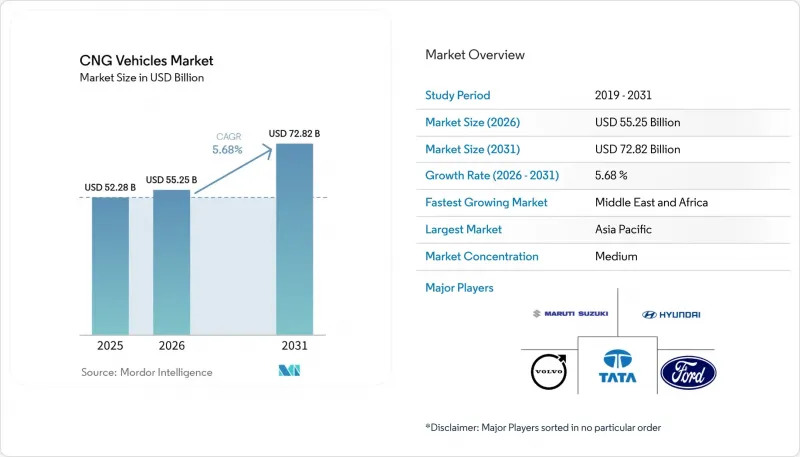
根據 Mordor Intelligence 的數據顯示,2025 年 CNG 汽車市值為 522.8 億美元,預計 2026 年將達到 552.5 億美元。預計在預測期(2026-2031 年)內,該市場將以 5.68% 的複合年成長率成長,到 2031 年將達到 728.2 億美元。
全球 CNG 汽車市場趨勢與洞察
與汽油和柴油相比,總擁有成本更低。
不斷擴大的燃料價格差異以及維修分析結果顯示引擎壽命延長,正日益推動壓縮天然氣 (CNG) 在營運經濟性方面的應用。營運商報告稱,與柴油相比,燃料成本降低了 30% 至 40%,動力傳動系統壽命延長了約 15% 至 25%。這些優勢在小包裹遞送服務和城市公車營運等高運轉率應用中尤其顯著。遠端資訊處理平台提供全面的每英里成本數據,使車隊管理人員能夠更準確地評估和最佳化燃料策略。已實現的成本節約與旨在降低總營運成本的財務目標密切相關。此外,採購政策擴大納入基於預設燃料價格差異閾值的CNG 採用觸發條件,使未來需求規劃流程更加規範和有效率。
嚴格的廢氣排放法規
歐洲和北美的新法規對氮氧化物 (NOx) 和顆粒物排放設定了更嚴格的限制,使得柴油引擎在不配備昂貴的後處理系統的情況下難以達到標準。而壓縮天然氣 (CNG)動力傳動系統則可滿足其中許多法規標準,為車隊營運商提供了實用且經濟高效的合規解決方案。在印度,BS VI 標準的實施使得 CNG 車輛的註冊量在 18 個月內顯著增加了 40%。同樣,美國環保署 (EPA) 第三階段法規中即將訂定的針對 8 級卡車的監管要求也提振了消費者的購車需求。這種法規環境也促使汽車製造商 (OEM) 擴大其 CNG 車型陣容。這些趨勢共同推動了政策驅動的 CNG 車輛需求,為即將到來的電氣化技術普及奠定了基礎。
50個主要大都會圈以外的農村地區站點密度低。
加氣站的建設仍集中在都市區。這是因為農村市場的平均處理量往往不足以支撐每個加氣站所需的資本投資。長途車隊經常權衡續航里程帶來的成本與燃料成本節省之間的關係,這往往導致向壓縮天然氣 (CNG) 過渡的進程被延緩。儘管公共和私人津貼提供了財務支持,但這些補貼通常只能涵蓋專案成本的 20-30%,使得這些專案的財務可行性存在不確定性。可攜式壓縮機和車載儲氣技術的進步為解決這些挑戰提供了一些方案,但它們無法完全取代高密度固定加氣站網路的需求。這種情況造成了 CNG 基礎設施部署的地域差異,持續阻礙該市場在全國範圍內的全面發展。
細分市場分析
到2025年,乘用車將佔據CNG汽車市場64.48%的主導佔有率,鞏固其在銷量上的領先地位。然而,成長勢頭正轉向商用車。預計巴士和長途客車將成為成長最快的細分市場,到2031年年複合成長率(CAGR)將達到9.14%。這一成長主要得益於公共交通部門為實現即時排放氣體採取的措施,同時避免全面電氣化所帶來的複雜性。卡車繼續主導長途運輸路線,尤其是在高功率充電站稀缺的地區。同時,在南亞地區,兩輪和三輪車輛的需求正在成長,因為燃油價格對消費者的選擇有顯著影響。
輕型商用車佔據戰略地位,利用壓縮天然氣(CNG)在都市區配送的可靠性來彌補電池續航里程的不足。預計到2031年,在公共投資增加刺激車輛採購週期的推動下,CNG公車的市場規模將成長近一倍。目前的技術藍圖已納入氫燃料相容的改良方案,使企業能夠在車輛的多燃料使用壽命內延長底盤的折舊週期。在乘用車領域,汽車製造商正在推出價格差異極小的雙燃料車型,確保即使電池式電動車在富裕的大都會圈市場佔有率不斷成長,也能確保穩定的市場需求。
到2025年,OEM整合將主導CNG汽車市場,佔據75.74%的佔有率。這一趨勢清楚地表明,車隊和消費者都更傾向於選擇原廠設計的動力傳動系統。選擇原廠配置的車型不僅簡化了保固管理,還能為金融機構提供更清晰的殘值預測,從而實現更具競爭力的租賃價格。對於汽車製造商而言,這為噴油器、氣缸和控制單元等關鍵零件創造了穩定的需求。這種需求的可預測性使得大量訂購成為可能,有效降低了零件成本。行銷策略強調在認證服務中心進行維修的便利性,將原廠配置的CNG汽車定位為傳統汽油汽車的完美替代方案。這種做法提高了整個產業的標準,也提升了消費者的期望值。
同時,改裝車輛市場預計將以8.21%的複合年成長率成長。改裝套件不僅延長了車輛的使用壽命,還能確保其符合日益嚴格的排放氣體法規。此外,經銷商安裝的設備認證和三年引擎保固解決了先前阻礙售後市場成長的可靠性問題。標準化的安裝流程最大限度地減少了停機時間,即使是小規模企業也能在日常維護期間完成車輛改裝,而無需長時間前往服務中心。從地理來看,改裝工作正隨著CNG加氣站的密度而展開。初期部署主要集中在已建成CNG走廊的州,為全國範圍的擴展鋪平道路。因此,改裝正從小眾解決方案發展成為利用現有車輛環境的重要成長領域。
區域分析
亞太地區是市場的主要驅動力,並為收入做出了顯著貢獻。印度的政策框架(包括車輛獎勵、加氣站津貼、監管時間表等)正將CNG走廊打造成為城際巴士和共享轎車的最佳選擇。在中國,由於電池充電在經濟上仍然不可行,內陸省份的商用車隊優先考慮使用CNG。日本正在推廣氫燃料相容的CNG動力系統,將其作為適應未來燃料轉型的策略選擇。包括噴油嘴和氣瓶等零件在內的區域性OEM供應鏈正在實現本地化,以降低成本,這正在加速CNG在主要城市以外地區的普及。
中東和非洲地區正經歷全球最快的成長速度,複合年成長率高達7.28%。天然氣資源豐富的國家正利用壓縮天然氣(CNG)來減少汽油進口並充分利用國內天然氣蘊藏量。奈及利亞總統CNG舉措正透過優惠融資和稅收激勵措施,推動公車採用CNG。阿拉伯聯合大公國(阿拉伯聯合大公國)正利用其液化天然氣(LNG)基礎設施,開發整合天然氣、氫氣和電動車充電的多燃料服務中心,以確保其物流走廊的長期永續性。然而,農村地區的普及率有限,因此需要行動加氣解決方案來實現「最後一公里」的配送。
歐洲和北美市場呈現穩定成長態勢。隨著車輛電氣化進程的推進,日益嚴格的排放氣體法規和生物甲烷的強制使用,使得壓縮天然氣(CNG)的環保吸引力不斷提升。在美國,超過700座公共加氣站為跨國貨運提供支持,而美國環保署(EPA)第三階段排放法規也加大了柴油車合規的壓力。在歐洲,卡車製造商正與燃油系統專家合作,引進高壓缸內直噴(HPDI)技術。該技術在降低甲烷排放的同時,也能保持與柴油車相當的扭力性能。沃爾沃集團與韋斯特波特公司的合作是這一趨勢的典型例證。
其他好處:
- Excel格式的市場預測(ME)表
- 3個月的分析師支持
目錄
第1章:引言
- 研究假設和市場定義
- 調查範圍
第2章:調查方法
第3章執行摘要
第4章 市場狀況
- 市場概覽
- 市場促進因素
- 與汽油和柴油相比,總擁有成本更低。
- 嚴格的廢氣排放法規(歐盟6/7、CAFE、BS VI)
- CNG加氣基礎設施擴建及OEM廠商擔保
- 歐盟和加州可再生天然氣(生物壓縮天然氣)的混合目標
- 在所有車輛上實施遠端資訊處理技術,使維護成本降低了兩位數。
- 適用於氫氣的壓縮天然氣(CNG)引擎平台將於2025年至2027年間發表。
- 市場限制因素
- 前50大都會圈。
- 緊湊型汽車領域電池式電動車的總擁有成本(TCO)正在迅速下降。
- 未來將要實施的美國環保署法規中與甲烷外洩相關的合規風險
- 2022年起全球液化天然氣及壓縮天然氣商品價格波動劇烈
- 價值供應鏈分析
- 監理情勢
- 技術展望
- 波特五力分析
第5章 市場規模與成長預測
- 車輛類型
- 搭乘用車
- 輕型商用車
- 巴士和長途汽車
- 卡車(中型和大型)
- 二輪車和三輪車
- 按銷售管道
- 原廠適配
- 售後/附加組件
- 按最終用途
- 私人/個人用途
- 計程車和叫車
- 大眾運輸
- 工業及公共產業車輛
- 依氣缸類型
- I 型(全金屬)
- 第二類(金屬箍包覆)
- III型(全複合型)
- IV型(聚合物襯裡複合材料)
- 按地區
- 北美洲
- 美國
- 加拿大
- 其他北美國家
- 南美洲
- 巴西
- 阿根廷
- 哥倫比亞
- 其他南美國家
- 歐洲
- 德國
- 英國
- 法國
- 義大利
- 西班牙
- 俄羅斯
- 其他歐洲國家
- 亞太地區
- 中國
- 印度
- 日本
- 韓國
- 印尼
- 泰國
- 其他亞太國家
- 中東和非洲
- 土耳其
- 沙烏地阿拉伯
- 阿拉伯聯合大公國
- 卡達
- 南非
- 奈及利亞
- 埃及
- 肯亞
- 其他中東和非洲國家
- 北美洲
第6章 競爭情勢
- 市場集中度
- 策略趨勢
- 市佔率分析
- 公司簡介
- Suzuki Motor Corp
- Hyundai Motor Co
- Tata Motors Limited
- AB Volvo Group
- CNH Industrial(Iveco)
- General Motors
- Ford Motor Company
- MAN Truck and Bus SE
- Scania AB
- Ashok Leyland Ltd.
- Isuzu Motors Ltd.
- Westport Fuel Systems Inc.
- Landi Renzo SpA
- Hexagon Composites ASA
- Everest Kanto Cylinders Ltd.
第7章 市場機會與未來展望
According to Mordor Intelligence, the CNG vehicles market size was valued at USD 52.28 billion in 2025 and is estimated at USD 55.25 billion in 2026, and is projected to reach USD 72.82 billion by 2031, at a CAGR of 5.68% during the forecast period (2026-2031).
Global CNG Vehicles Market Trends and Insights
Lower Total Cost-of-Ownership Versus Gasoline and Diesel
Fleet economics increasingly support the adoption of compressed natural gas (CNG) due to the widening of pump price spreads and maintenance analytics that demonstrate improvements in engine longevity. Operators have reported achieving fuel cost savings ranging from 30% to 40% when compared to diesel, along with powertrain lifespan extensions of approximately 15% to 25%. These benefits are particularly significant in high-utilization applications, including parcel delivery services and urban bus operations. Telematics platforms provide comprehensive cost-per-mile data, enabling fleet managers to evaluate and optimize fuel strategies with greater accuracy. Verified cost savings align closely with financial objectives aimed at reducing overall operating expenses. Additionally, procurement policies are increasingly incorporating CNG adoption triggers that are based on predefined fuel-spread thresholds, thereby formalizing and streamlining future demand planning processes.
Stringent Tail-Pipe Emission Regulations
New regulations in Europe and North America have introduced stricter limits on nitrogen oxide (NOx) and particulate emissions, creating significant challenges for diesel engines to achieve compliance without the incorporation of expensive after-treatment systems. In comparison, compressed natural gas (CNG) powertrains are capable of meeting many of these regulatory standards, providing fleet operators with a practical and cost-effective compliance solution. In India, the implementation of BS VI standards resulted in a notable 40% increase in CNG vehicle registrations over a period of 18 months. Similarly, the forthcoming compliance requirements for U.S. Class-8 trucks under the Environmental Protection Agency (EPA) Phase 3 rules are driving increased pre-purchase activity. This regulatory environment is also encouraging original equipment manufacturers (OEMs) to expand their CNG vehicle offerings. These developments have collectively contributed to a policy-driven increase in demand for CNG vehicles, occurring in advance of the anticipated widespread adoption of electrification technologies.
Sparse Rural Station Density Outside Top 50 Metro Areas
Station development remains concentrated in urban areas, as the average throughput in rural markets often fails to justify the capital investment required for each site. Fleets operating across extensive routes frequently evaluate the costs associated with range anxiety in comparison to potential fuel savings, which often results in delays in adopting compressed natural gas (CNG) conversions. Although public-private grants provide some financial assistance, they typically cover only 20 to 30% of project costs, leaving the financial feasibility of such projects uncertain. Portable compression units and advancements in on-vehicle storage technologies offer partial solutions to address these challenges but cannot fully replace the need for a dense and fixed station network. This situation has created a geographic disparity in the adoption of CNG infrastructure, which continues to hinder the potential for comprehensive national growth in this market.
Other drivers and restraints analyzed in the detailed report include:
- Expanding CNG Refueling Infrastructure and OEM-Backed Warranty
- Renewable Natural Gas Blending Targets in the EU and California
- Rapidly Falling Battery-Electric TCO in Light-Duty Segment
For complete list of drivers and restraints, kindly check the Table Of Contents.
Segment Analysis
In 2025, passenger cars held a dominant 64.48% share of the CNG vehicle market, solidifying their lead in unit sales. However, the growth trajectory is shifting towards commercial vehicles. Buses and coaches are set to be the fastest-growing segment, with a projected CAGR of 9.14% through 2031. This growth is largely attributed to public transit authorities seeking immediate emission reductions while avoiding the complexities of full electrification. Trucks continue to dominate long-haul routes, particularly in areas lacking high-power charging stations. Simultaneously, two- and three-wheelers are experiencing growth in South Asia, where fuel prices significantly influence consumer choices.
Light commercial vehicles occupy a strategic position, leveraging CNG's reliability for urban deliveries, which is advantageous given battery range constraints. By 2031, the market size for CNG buses is expected to nearly double, driven by public investments unlocking fleet procurement cycles. Technology roadmaps are now incorporating hydrogen-ready modifications, enabling agencies to extend chassis amortization over multi-fuel lifetimes. On the passenger front, OEMs are introducing bi-fuel variants at minimal price premiums, ensuring steady demand even as battery-electric vehicles gain a larger share in affluent metropolitan areas.
In 2025, OEM integration dominated the CNG vehicle market, capturing a 75.74% share. This trend highlights a clear preference among fleets and consumers for powertrains meticulously engineered at the factory. Opting for factory-fitted models not only streamlines warranty management but also provides financiers with enhanced clarity on residual-value projections, enabling more competitive lease rates. For automakers, this results in consistent demand for essential components such as injectors, cylinders, and control units. Such predictability facilitates volume contracts, effectively reducing component costs. Marketing strategies emphasize the convenience of servicing at authorized workshops, positioning factory-fitted CNGs as a seamless alternative to traditional gasoline. This approach collectively raises industry standards, shaping elevated buyer expectations.
Conversely, retrofitted fleets are projected to grow at a CAGR of 8.21%. Conversion kits not only extend asset life but also ensure compliance with tightening emission regulations. Additionally, certifications for dealer-installed equipment and three-year engine warranties address reliability concerns that previously hindered aftermarket growth. Standardized installation protocols minimize downtime, allowing smaller operators to convert vehicles during routine maintenance rather than extended shop stays. Geographically, retrofitting initiatives are being rolled out in alignment with station density. Initial availability is focused on states with established CNG corridors, paving the way for broader national expansion. As a result, retrofitting is evolving from a niche solution into a significant growth avenue, leveraging the existing vehicle landscape.
Complete Report Scope:
- By Vehicle Type
- Passenger Cars
- Light Commercial Vehicles
- Buses and Coaches
- Trucks (Medium and Heavy-Duty)
- Two and Three-Wheelers
- By Sales Channel
- OEM-fitted
- Retrofitted/ After-market
- By End-use Application
- Private/Personal Use
- Taxi and Ride-hailing Fleets
- Public Transit Authorities
- Industrial and Utility Fleets
- By Cylinder Type
- Type I (All-metal)
- Type II (Metal hoop-wrapped)
- Type III (Full composite)
- Type IV (Polymer-liner composite)
- By Geography
- North America
- United States
- Canada
- Rest of North America
- South America
- Brazil
- Argentina
- Colombia
- Rest of South America
- Europe
- Germany
- United Kingdom
- France
- Italy
- Spain
- Russia
- Rest of Europe
- Asia-Pacific
- China
- India
- Japan
- South Korea
- Indonesia
- Thailand
- Rest of Asia-Pacific
- Middle East and Africa
- Turkey
- Saudi Arabia
- United Arab Emirates
- Qatar
- South Africa
- Nigeria
- Egypt
- Kenya
- Rest of Middle East and Africa
- North America
Geography Analysis
Asia-Pacific leads the market, contributing significantly to revenues. India's policy framework, including vehicle incentives, station grants, and regulatory timelines, has established CNG corridors as the preferred option for intercity buses and ride-share sedans. In China, CNG is prioritized for commercial fleets in inland provinces where battery charging remains economically unviable. Japan promotes hydrogen-ready CNG drivelines as a strategic option to adapt to future fuel transitions. Regional OEM supply chains, encompassing components such as injectors and cylinders, are localized to reduce costs, facilitating CNG adoption beyond tier-one cities.
The Middle East and Africa region is experiencing the fastest growth globally, with a CAGR of 7.28%, as gas-rich countries utilize CNG to reduce gasoline imports and capitalize on domestic gas reserves. Nigeria's Presidential CNG Initiative combines concessional loans with tax incentives to drive bus-fleet conversions. The UAE leverages its LNG infrastructure to develop multi-fuel service hubs integrating natural gas, hydrogen, and EV charging, positioning logistics corridors for long-term sustainability. However, rural areas face limited penetration, necessitating mobile refueling solutions to enable last-mile adoption.
Europe and North America exhibit steady growth trajectories. Strict emission regulations and biomethane mandates enhance CNG's environmental appeal, even as fleet electrification gains traction. In the United States, over 700 public stations support coast-to-coast freight operations, while EPA Phase 3 regulations increase compliance pressures on diesel fleets. In Europe, truck OEMs collaborate with fuel-system specialists to implement high-pressure direct-injection (HPDI) technologies, reducing methane emissions while maintaining diesel-like torque performance. This trend is exemplified by Volvo Group's partnership with Westport.
- Suzuki Motor Corp
- Hyundai Motor Co
- Tata Motors Limited
- AB Volvo Group
- CNH Industrial (Iveco)
- General Motors
- Ford Motor Company
- MAN Truck and Bus SE
- Scania AB
- Ashok Leyland Ltd.
- Isuzu Motors Ltd.
- Westport Fuel Systems Inc.
- Landi Renzo SpA
- Hexagon Composites ASA
- Everest Kanto Cylinders Ltd.
Additional Benefits:
- The market estimate (ME) sheet in Excel format
- 3 months of analyst support
TABLE OF CONTENTS
1 Introduction
- 1.1 Study Assumptions and Market Definition
- 1.2 Scope of the Study
2 Research Methodology
3 Executive Summary
4 Market Landscape
- 4.1 Market Overview
- 4.2 Market Drivers
- 4.2.1 Lower Total Cost-of-Ownership Versus Gasoline and Diesel
- 4.2.2 Stringent Tail-Pipe Emission Regulations (Euro 6/7, CAFE, BS VI)
- 4.2.3 Expanding CNG Refueling Infrastructure and OEM-Backed Warranty
- 4.2.4 Renewable Natural Gas (Bio-CNG) Blending Targets in EU and California
- 4.2.5 Fleet-Wide Telematics Proving Double-Digit Maintenance Savings
- 4.2.6 Hydrogen-Ready CNG Engine Platforms Announced 2025-27
- 4.3 Market Restraints
- 4.3.1 Sparse Rural Station Density Outside Top 50 Metro Areas
- 4.3.2 Rapidly Falling Battery-Electric TCO In Light-Duty Segment
- 4.3.3 Methane-Slip Compliance Risk Under Forthcoming EPA Rules
- 4.3.4 Volatile Global LNG/CNG Commodity Pricing Since 2022
- 4.4 Value/Supply-Chain Analysis
- 4.5 Regulatory Landscape
- 4.6 Technological Outlook
- 4.7 Porter's Five Forces Analysis
- 4.7.1 Threat of New Entrants
- 4.7.2 Bargaining Power of Suppliers
- 4.7.3 Bargaining Power of Buyers
- 4.7.4 Threat of Substitutes
- 4.7.5 Intensity of Competitive Rivalry
5 Market Size and Growth Forecasts (Value (USD) and Volume (Units))
- 5.1 By Vehicle Type
- 5.1.1 Passenger Cars
- 5.1.2 Light Commercial Vehicles
- 5.1.3 Buses and Coaches
- 5.1.4 Trucks (Medium and Heavy-Duty)
- 5.1.5 Two and Three-Wheelers
- 5.2 By Sales Channel
- 5.2.1 OEM-fitted
- 5.2.2 Retrofitted/ After-market
- 5.3 By End-use Application
- 5.3.1 Private/Personal Use
- 5.3.2 Taxi and Ride-hailing Fleets
- 5.3.3 Public Transit Authorities
- 5.3.4 Industrial and Utility Fleets
- 5.4 By Cylinder Type
- 5.4.1 Type I (All-metal)
- 5.4.2 Type II (Metal hoop-wrapped)
- 5.4.3 Type III (Full composite)
- 5.4.4 Type IV (Polymer-liner composite)
- 5.5 By Geography
- 5.5.1 North America
- 5.5.1.1 United States
- 5.5.1.2 Canada
- 5.5.1.3 Rest of North America
- 5.5.2 South America
- 5.5.2.1 Brazil
- 5.5.2.2 Argentina
- 5.5.2.3 Colombia
- 5.5.2.4 Rest of South America
- 5.5.3 Europe
- 5.5.3.1 Germany
- 5.5.3.2 United Kingdom
- 5.5.3.3 France
- 5.5.3.4 Italy
- 5.5.3.5 Spain
- 5.5.3.6 Russia
- 5.5.3.7 Rest of Europe
- 5.5.4 Asia-Pacific
- 5.5.4.1 China
- 5.5.4.2 India
- 5.5.4.3 Japan
- 5.5.4.4 South Korea
- 5.5.4.5 Indonesia
- 5.5.4.6 Thailand
- 5.5.4.7 Rest of Asia-Pacific
- 5.5.5 Middle East and Africa
- 5.5.5.1 Turkey
- 5.5.5.2 Saudi Arabia
- 5.5.5.3 United Arab Emirates
- 5.5.5.4 Qatar
- 5.5.5.5 South Africa
- 5.5.5.6 Nigeria
- 5.5.5.7 Egypt
- 5.5.5.8 Kenya
- 5.5.5.9 Rest of Middle East and Africa
- 5.5.1 North America
6 Competitive Landscape
- 6.1 Market Concentration
- 6.2 Strategic Moves
- 6.3 Market Share Analysis
- 6.4 Company Profiles (Includes Global level Overview, Market level overview, Core Segments, Financials as available, Strategic Information, Market Rank/Share, Products and Services, Recent Developments)
- 6.4.1 Suzuki Motor Corp
- 6.4.2 Hyundai Motor Co
- 6.4.3 Tata Motors Limited
- 6.4.4 AB Volvo Group
- 6.4.5 CNH Industrial (Iveco)
- 6.4.6 General Motors
- 6.4.7 Ford Motor Company
- 6.4.8 MAN Truck and Bus SE
- 6.4.9 Scania AB
- 6.4.10 Ashok Leyland Ltd.
- 6.4.11 Isuzu Motors Ltd.
- 6.4.12 Westport Fuel Systems Inc.
- 6.4.13 Landi Renzo SpA
- 6.4.14 Hexagon Composites ASA
- 6.4.15 Everest Kanto Cylinders Ltd.
7 Market Opportunities and Future Outlook
- 7.1 White-space and Unmet-need Assessment

 壓縮氣體儲存解決方案市場報告:趨勢、預測和競爭分析(至2035年)
 2026-2030年全球壓縮天然氣燃料箱市場
 非洲 CNG 和 LPG 汽車:市場佔有率分析、行業趨勢和統計數據以及成長預測(2026-2031 年)CNG 和 LPG 汽車:市場佔有率分析、行業趨勢和統計數據以及成長預測(2026-2031 年)
 CNG 和 LPG 汽車市場:按燃料類型、引擎系統、汽缸類型、車輛類型、應用和銷售管道分類 - 全球市場預測(2026-2032 年)
 CNG 和 LPG 汽車市場 - 全球產業規模、佔有率、趨勢、機會和預測:按燃料類型、車輛類型、需求類別、地區和競爭格局分類,2021-2031 年
 2026年全球CNG和LPG汽車市場報告
 壓縮天然氣(CNG)汽車系統市場機會、成長促進因素、產業趨勢分析及預測(2025-2034年)印度 CNG 汽車市場:市場佔有率分析、行業趨勢和統計數據、成長預測(2025-2030 年)