


 |
市場調查報告書
商品編碼
2125722
美國割草機:市場佔有率分析、行業趨勢和統計數據、成長預測(2026-2031 年)United States Lawn Mowers - Market Share Analysis, Industry Trends & Statistics, Growth Forecasts (2026 - 2031) |
||||||

※ 本網頁內容可能與最新版本有所差異。詳細情況請與我們聯繫。
據 Mordor Intelligence 稱,2025 年美國割草機市值為 71 億美元,預計到 2031 年將從 2026 年的 74.8 億美元成長至 97.1 億美元,預測期(2026-2031 年)的複合年成長率為 5.35%。
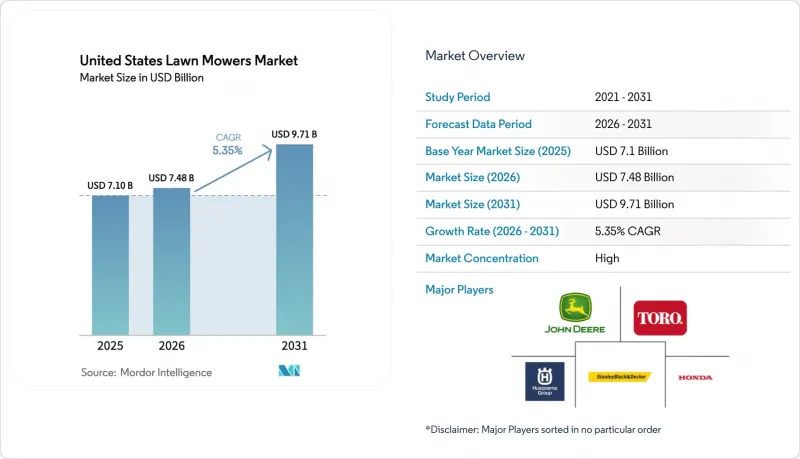
本報告按產品類型(手動、電動、汽油、機器人及其他產品類型)和最終用戶(住宅、商業或政府)進行細分。市場預測以美元計價。
美國割草機市場趨勢與洞察
住宅花園景觀美化需求日益成長
2024年,住宅率穩定在66%左右,維持了獨棟住宅草坪護理設備的基本需求。從策略角度來看,陽光地帶的市場正向擁有更大地塊的郊區開發案轉變。在這些地區,花園的平均面積超過0.25英畝,需要使用搭乘用或零轉彎割草機,而不是手推式割草機。這種地域性偏好推高了平均售價,使在德克薩斯州州、佛羅裡達州和亞利桑那州擁有強大經銷商網路的目的地設備製造商(OEM)受益。美觀仍是影響轉售價值的重要因素,維護良好的房產在競爭激烈的住宅市場中可獲得5-10%的夥伴關係,從而確保即使在經濟不確定時期,也能持續更換。美國環保署的「節水之星」(WaterSense)合作計畫正在推廣耐旱草坪替代品,這有望減少乾旱地區的割草頻率。
州級禁令禁止銷售新型小型非道路汽油引擎
2024年,加州空氣資源委員會最終確定了相關法規,禁止銷售2024款及以後生產的新型汽油動力小型非道路引擎,併計劃於2026年全面實施。 2025年1月,美國環保署(EPA)授予加州《清潔空氣法》豁免權,允許該州實施比聯邦法規更嚴格的標準。這項豁免將使其他州無需獲得聯邦政府的單獨批准即可採用加州的框架。包括奧勒岡州和華盛頓州在內的幾個東北部州正在考慮類似措施。這些法規的影響力巨大。由於經濟限制,目的地設備製造商(OEM)難以維持兩條生產線,因此,實際上,加州的法規將成為2026年及以後銷售設備的全國標準。此外,這些法規的合規範圍不僅限於排放氣體,還包括噪音法規。雖然汽油動力割草機的噪音超過 90 分貝,但電池動力割草機的噪音只有 60-70 分貝,因此即使在有噪音規定的地區,也可以在清晨或深夜割草。
技術純熟勞工短缺導致服務成本上升。
2024年,園藝服務市場的空置率高達12%,創近十年新高。勞動力短缺的原因在於移民限制和人口結構變化導致可用勞動力減少。為因應這一局面,服務提供者提高了服務價格,大都會圈的每小時收費從2022年的40-60美元上漲至50-75美元。人事費用的上漲促使住宅轉向「自己動手」打理草坪,從而推動了家用割草機市場的擴張。專業園藝公司面臨利潤率下降的壓力,因為他們無法將增加的成本完全轉嫁給對價格敏感的客戶。人手不足也促使人們對自動駕駛和零轉彎電動割草機產生興趣,這些割草機可以減輕操作員的疲勞,並使一名工人能夠覆蓋更大的區域。然而,由於中小園林綠化公司面臨的財務限制,這些割草機的普及仍然有限。
細分市場分析
汽油動力割草機佔最大的市場佔有率,預計到2025年將占美國割草機市場規模的39.30%。這反映了它們在住宅和小規模商業用途上的強勢地位。隨著加州於2024年禁止銷售新的汽油車輛,更換需求正轉向電池驅動的電動割草機。汽油動力割草機面臨著最嚴峻的挑戰,因為各州的排放氣體和噪音法規削弱了它們的價值提案,但在監管壓力較小的州,它們仍然是注重預算的買家最具性價比的選擇。
預計到2031年,機器人割草機的複合年成長率將達到18.4%,這主要得益於地方政府的推廣應用以及商業園林綠化領域的試點項目,使其成為整體成長最快的產品類型。機器人割草機市場正經歷顯著成長,並已成為成長最快的類別。這一顯著成長得益於人工智慧、物聯網和機器學習技術的快速發展。
其他好處:
- Excel格式的市場預測(ME)表
- 3個月的分析師支持
目錄
第1章:引言
- 研究假設和市場定義
- 調查範圍
第2章:調查方法
第3章執行摘要
第4章 市場狀況
- 市場概覽
- 市場促進因素
- 住宅花園景觀美化需求日益成長
- 國家層級禁止引進新型小型非道路汽油引擎
- 各大汽車製造商正在加速採用電池驅動平台。
- 鋰離子電池組成本的快速下降
- 面向地方政府的訂閱式自動割草車隊
- 草坪分析平台正在加速割草機的更換週期。
- 市場限制因素
- 技術純熟勞工短缺導致服務成本上升。
- 機器人和商用零轉彎半徑車型的初始成本較高
- 郊區大型充電站電網容量的限制
- 無人機器人割草機的被竊和人為破壞風險
- 監理情勢
- 技術展望
- 波特五力分析
第5章 市場規模與成長預測
- 產品類型
- 手動的
- 電的
- 汽油
- 機器人技術
- 其他產品類型
- 最終用戶
- 住宅
- 私人或政府
第6章 競爭情勢
- 市場集中度
- 策略趨勢
- 市佔率分析
- 公司簡介
- Deere & Company
- The Toro Company
- Husqvarna AB
- Stanley Black & Decker Outdoor Power Equipment, Inc.
- American Honda Motor Co., Inc.
- Kubota Corporation
- Makita Corporation
- Stihl Holding AG & Co. KG
- Briggs & Stratton, LLC
- Ariens Company
- Textron Specialty Vehicles Inc.
- Yamabiko Corporation
- Bad Boy Mowers, Inc.
- Globe Technologies, LLC
- Robert Bosch Power Tools GmbH
第7章 市場機會與未來展望
According to Mordor Intelligence, the United States lawn mowers market size was valued at USD 7.1 billion in 2025 and estimated to grow from USD 7.48 billion in 2026 to reach USD 9.71 billion by 2031, at a CAGR of 5.35% during the forecast period (2026-2031).
This report is Segmented by Product Type (Manual, Electric, Petrol, Robotics, and Other Product Types) and by End User (Residential and Commercial or Government). The Market Forecasts are Provided in Terms of Value (USD).
United States Lawn Mowers Market Trends and Insights
Rising Demand for Landscaped Residential Yards
Homeownership rates stabilized near 66% in 2024, sustaining baseline demand for lawn maintenance equipment across single-family properties. The strategic implication lies in the shift toward larger-lot suburban development in Sun Belt markets, where median yard sizes exceed 0.25 acres and require ride-on or zero-turn platforms rather than walk-behind units. This geographic skew elevates average selling prices and favors Original Equipment Manufacturer (OEMs) with strong dealer networks in Texas, Florida, and Arizona. Curb appeal remains a key driver of resale value, with landscaped properties commanding premiums of 5% to 10% in competitive housing markets, ensuring replacement cycles continue even during economic uncertainty. The Environmental Protection Agency's (EPA) WaterSense partnership is promoting drought-tolerant turf alternatives, which could reduce mowing frequency in arid regions.
State-Level Bans on New Small Off-Road Gas Engines
In 2024, California's Air Resources Board finalized regulations prohibiting the sale of new gasoline-powered small off-road engines starting with model year 2024 equipment, with full enforcement planned for 2026. In January 2025, the Environmental Protection Agency (EPA) granted California a Clean Air Act waiver, allowing the state to implement stricter standards than those mandated by federal regulations. This waiver allows other states to adopt California's framework without requiring separate federal approval. States such as Oregon and Washington, as well as several in the Northeast, are considering similar measures. The impact of these regulations is significant. Original Equipment Manufacturers (OEMs) are unlikely to sustain dual production lines due to economic constraints, effectively making California's rules a national standard for equipment sold after 2026. Additionally, compliance extends beyond emissions to noise regulations. Battery-powered mowers, which operate at 60 to 70 decibels compared to over 90 decibels for gasoline models, enable mowing during early-morning and late-evening hours in municipalities with noise restrictions.
Shortage of Skilled Landscaping Labor Inflating Service Costs
The landscaping services market experienced a 12% vacancy rate in 2024, marking the highest level in a decade. This shortage was driven by immigration restrictions and demographic changes that reduced the available workforce. In response, operators increased hourly service rates, which ranged from USD 50 to USD 75 per hour in metropolitan areas, compared to USD 40 to USD 60 in 2022 . Rising labor costs have prompted residential customers to shift toward do-it-yourself lawn care, thereby expanding the market for consumer-grade mowers. Professional landscapers face compressed margins as they are unable to fully pass on cost increases to price-sensitive clients. The labor shortage has also heightened interest in autonomous and zero-turn electric mowers, which help reduce operator fatigue and allow a single worker to cover larger areas. Despite this, adoption remains limited due to capital constraints faced by small and mid-sized landscaping firms.
Other drivers and restraints analyzed in the detailed report include:
- Accelerating Adoption of Battery-Powered Platforms by Major OEMs
- Rapid Cost Declines in Lithium-Ion Packs
- High Upfront Price of Robotic and Commercial Zero-Turn Units
For complete list of drivers and restraints, kindly check the Table Of Contents.
Segment Analysis
Petrol holds the largest share, accounting for 39.30% of the United States lawn mower market size in 2025, reflecting its entrenched position in residential and small commercial applications. Replacement demand is shifting toward battery-electric alternatives as California's 2024 ban on new gasoline-powered vehicles takes effect. Petrol mowers face the steepest headwinds, as state-level emission bans and noise ordinances erode their value proposition, yet they remain the lowest-cost option for budget-conscious buyers in states without regulatory pressure.
Robotic lawn mowers are forecast to grow at a 18.4% CAGR through 2031, the fastest expansion across all product categories, driven by municipal fleet adoptions and commercial landscaping trials. The robotic lawn mower segment is experiencing remarkable growth, emerging as the fastest-growing category in the market. This impressive growth is driven by rapid technological advancements in artificial intelligence, the Internet of Things (IoT), and machine learning capabilities.
Complete Report Scope:
- Product Type
- Manual
- Electric
- Petrol
- Robotics
- Other Product Types
- End User
- Residential
- Commercial or Government
List of Companies Covered in this Report:
- Deere & Company
- The Toro Company
- Husqvarna AB
- Stanley Black & Decker Outdoor Power Equipment, Inc.
- American Honda Motor Co., Inc.
- Kubota Corporation
- Makita Corporation
- Stihl Holding AG & Co. KG
- Briggs & Stratton, LLC
- Ariens Company
- Textron Specialty Vehicles Inc.
- Yamabiko Corporation
- Bad Boy Mowers, Inc.
- Globe Technologies, LLC
- Robert Bosch Power Tools GmbH
Additional Benefits:
- The market estimate (ME) sheet in Excel format
- 3 months of analyst support
TABLE OF CONTENTS
1 INTRODUCTION
- 1.1 Study Assumptions and Market Definition
- 1.2 Scope of the Study
2 RESEARCH METHODOLOGY
3 EXECUTIVE SUMMARY
4 MARKET LANDSCAPE
- 4.1 Market Overview
- 4.2 Market Drivers
- 4.2.1 Rising demand for landscaped residential yards
- 4.2.2 State-level bans on new small-off-road gas engines
- 4.2.3 Accelerating adoption of battery-powered platforms by major OEMs
- 4.2.4 Rapid cost declines in lithium-ion packs
- 4.2.5 Subscription-based autonomous mower fleets for municipalities
- 4.2.6 Turf-analytics platforms boosting mower replacement cycles
- 4.3 Market Restraints
- 4.3.1 Shortage of skilled landscaping labor inflating service costs
- 4.3.2 High upfront price of robotic and commercial zero-turn units
- 4.3.3 Grid-capacity limits for large charging depots in suburbs
- 4.3.4 Theft and vandalism risk for unattended robotic mowers
- 4.4 Regulatory Landscape
- 4.5 Technological Outlook
- 4.6 Porter's Five Forces Analysis
- 4.6.1 Threat of New Entrants
- 4.6.2 Bargaining Power of Buyers
- 4.6.3 Bargaining Power of Suppliers
- 4.6.4 Threat of Substitutes
- 4.6.5 Intensity of Competitive Rivalry
5 MARKET SIZE AND GROWTH FORECASTS (VALUE)
- 5.1 Product Type
- 5.1.1 Manual
- 5.1.2 Electric
- 5.1.3 Petrol
- 5.1.4 Robotics
- 5.1.5 Other Product Types
- 5.2 End User
- 5.2.1 Residential
- 5.2.2 Commercial or Government
6 COMPETITIVE LANDSCAPE
- 6.1 Market Concentration
- 6.2 Strategic Moves
- 6.3 Market Share Analysis
- 6.4 Company Profiles (Includes Global-level Overview, Market-level Overview, Core Segments, Financials, Strategic Information, Market Rank/Share, Products and Services, Recent Developments)
- 6.4.1 Deere & Company
- 6.4.2 The Toro Company
- 6.4.3 Husqvarna AB
- 6.4.4 Stanley Black & Decker Outdoor Power Equipment, Inc.
- 6.4.5 American Honda Motor Co., Inc.
- 6.4.6 Kubota Corporation
- 6.4.7 Makita Corporation
- 6.4.8 Stihl Holding AG & Co. KG
- 6.4.9 Briggs & Stratton, LLC
- 6.4.10 Ariens Company
- 6.4.11 Textron Specialty Vehicles Inc.
- 6.4.12 Yamabiko Corporation
- 6.4.13 Bad Boy Mowers, Inc.
- 6.4.14 Globe Technologies, LLC
- 6.4.15 Robert Bosch Power Tools GmbH
7 MARKET OPPORTUNITIES AND FUTURE OUTLOOK

 電動割草機:市場佔有率分析、行業趨勢和統計數據、成長預測(2026-2031 年)
 電動割草機市場-2026-2032年全球市場預測割草機市場-2026-2032年全球市場預測手推式割草機:市場佔有率分析、行業趨勢和統計數據以及成長預測(2026-2031 年)
 自動割草機市場 - 全球產業規模、佔有率、趨勢、機會、預測:按產品類型、技術、燃料類型、應用、地區和競爭格局分類,2021-2031年
 無線園藝設備市場機會、成長要素、產業趨勢分析及2026-2035年預測電動切割機:市場佔有率分析、行業趨勢和統計數據、成長預測(2026-2031 年)
 割草機市場:依最終用戶產業、產品類型、驅動系統、預期用途、動力來源和地區分類
 無線割草機市場規模、佔有率、成長及全球產業分析:按類型、應用和地區分類的洞察,2026-2034 年預測割草機市場:產品類型、動力系統、銷售管道、應用、最終用途 - 2026-2032年全球市場預測