


 |
市場調查報告書
商品編碼
2123603
電動割草機:市場佔有率分析、行業趨勢和統計數據、成長預測(2026-2031 年)Electric Lawn Mowers - Market Share Analysis, Industry Trends & Statistics, Growth Forecasts (2026 - 2031) |
||||||

※ 本網頁內容可能與最新版本有所差異。詳細情況請與我們聯繫。
根據 Mordor Intelligence 估計,2025 年電動割草機市場價值為 55.5 億美元,2026 年將達到 62 億美元。
此外,預計到 2031 年將達到 114 億美元,預計從 2026 年到 2031 年將達到 12.95% 的複合年成長率。
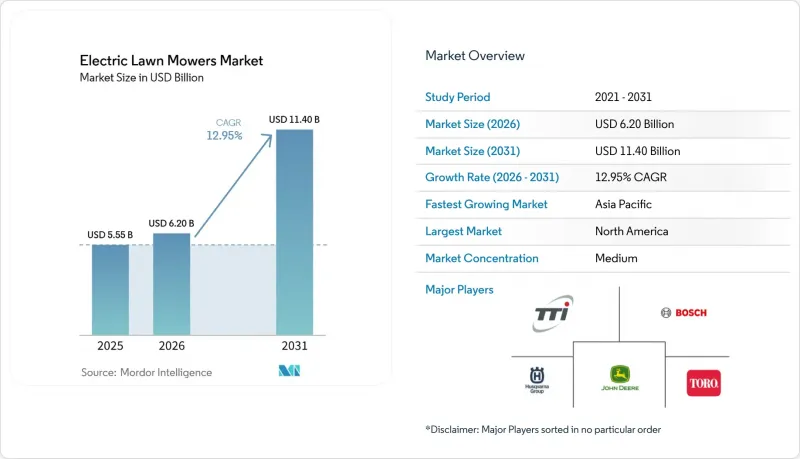
本報告按產品類型(有線手推車、無線手推車及其他)、最終用戶(住宅DIY、專業園林綠化服務及其他)、電池電壓(36V及以下及其他)、分銷管道(實體零售及其他)和地區(北美、南美及其他)進行細分。市場預測以美元計價。
全球電動割草機市場趨勢與洞察
降低電池成本並提高能量密度
電池成本效益的提升正推動電動割草機市場從利基市場轉向更廣泛的更換需求市場。消費者現在可以享受更長的運作時間,而無需像老式無線割草機那樣承受過重的重量。這對住宅用戶來說至關重要,因為他們只需一次充電即可修剪典型的郊區草坪,同時也能保持操作便利。更高的能量密度使得品牌能夠提供自走式、大割幅的步行式割草機,而不會讓用戶感到過於笨重。第二個好處是產品線的擴展。現在,同一台電池平台可用於割草機、修剪機、吹風機和搭乘用割草機,從而實現更穩定的性能。這使得已經擁有無線工具並希望盡量減少引擎相關維護的家庭更容易做出購買決定。對於製造商而言,這使得他們可以將電池投資分散到更多產品類別,從而製定更精細的定價策略,並有助於在未來幾年內支持電動割草機市場的發展。
對小型引擎實施更嚴格的排放氣體和噪音法規
法規是推動電動割草機市場發展最顯著的結構性因素之一。加州小型非道路引擎法規已於2025年1月獲得美國環保署 (EPA) 的批准,這使得零排放設備成為新產品符合美國主要州法規的可行選擇。這一轉變的影響遠不止於加州,因為製造商往往更傾向於通用產品平台而非針對特定州的硬體。地方噪音法規也在人口密集的住宅催生了對電動割草機的需求,在這些地區,電動割草機有明顯的操作優勢。像門洛帕克這樣的城市實施的代金券和以舊換新計劃降低了初始購買門檻,並加速了老舊汽油動力割草機的更換。當合規壓力和消費者便利性相結合時,法規的影響最為顯著,因為在對使用時間有嚴格限制的社區,更安靜的設備更容易使用。因此,電動割草機市場對環保意識自願購買的依賴程度降低,而與永續政策的變革連結則更加緊密。
初始購買價格高
電動割草機市場的一大障礙仍然是初始購買價格,尤其是在高檔住宅和嚴格監管的商業細分市場之外。雖然小型手推式割草機的價格差異不大,但在大型搭乘用式和零轉彎割草機領域,電池組容量越大,成本越高,價格差異仍然顯著。商用電池驅動的零轉彎割草機價格可能遠高於汽油動力割草機,這使得那些資金籌措柔軟性有限的買家難以相信投資回報是值得的。雖然獎勵計劃可以在某些地區縮小價格差距,但這些計劃並不普及,而且各地區的預算分配也不均衡。電池更換成本也會影響買家的購買意願,因為一些用戶將電池更換視為額外的資本支出,而不是日常維護。這種擔憂在新興市場和服務網路稀少的農村地區更為突出。因此,許多對價格敏感的買家即使預期長期可以節省成本,也會繼續推遲更換。因此,電動割草機市場的部分領域仍然依靠政策支援、零售商融資或不斷上漲的燃料成本來填補價值缺口。
細分市場分析
2025年,手推式無線割草機佔據了電動割草機市場54.3%的佔有率,成為各產品類型中市場佔有率最大的產品。其優勢在於適合普通住宅用地面積,並且可以透過量販店和經銷商管道廣泛購買。 EGO、Greenworks、RYOBI和Makita等領先品牌透過頻繁推出新機型和支援其電池生態系統,重振了這一細分市場。因此,手推式無線割草機已成為最容易獲得的入門選擇,逐漸取代了汽油動力割草機。
預計到2031年,機器人和自動割草機的複合年成長率將達到17.1%,成為電動割草機市場中成長最快的產品類別。 Husqvarna的「AI Vision」藍圖及其對無線機器人技術的廣泛投入表明,這一細分市場正在迅速發展,並逐漸超越早期用戶群。搭乘用式和零轉彎電動割草機也正在崛起,這要歸功於高壓平台提高了大型草坪和商業用途的運作。像AriensCo的「Arrow E」系列這樣的站立式產品則瞄準了需要繞過障礙物的承包商和市政用戶。有線手推式割草機在歐洲部分地區仍然佔據著一定的市場佔有率,但隨著來自無線產品的價格競爭加劇,其在商店中的比例正在下降。電動割草機產業一個更根本的轉變是,自動化正在改變未來的支出方向,從不斷更換手推式割草機轉向擁有可自動管理的機器人割草機。
DIY住宅佔電動割草機市場的71.2%,是最大的終端用戶群。這群人反映了越來越多的自行維護草坪的住宅正在用電池驅動的設備替換老舊的汽油動力割草機。零售通路的普及和平台熟悉度正在推動這一轉變,尤其是在已經擁有電池驅動戶外工具的消費者群體中。由於演示和對比至關重要,而許多住宅購買行為仍然始於家居裝飾商店,因此該分銷管道的影響不容忽視。
預計到2031年,地方政府用戶將以13.3%的複合年成長率成長,成為電動割草機市場成長最快的終端用戶群。公共車輛的電氣化是由採購法規、排放氣體目標以及降低學校、醫院和公共設施周邊噪音的壓力所推動的。隨著電動草坪護理設備性能的提升,高爾夫球場和體育設施也越來越接受電動設備。約翰迪爾的「2775 E-Cut電動三聯割草機」將於2025年8月起在美國和加拿大上市,單次充電即可修剪超過22個果嶺。專業園藝公司仍然是主要的商業買家,但在高頻使用環境下,白天充電和員工電池管理仍然是重大挑戰。拉里默縣津貼設備升級的案例表明,當資金和政策協調一致時,公共部門的升級改造可以多麼迅速地推進。就整個電動割草機產業而言,這意味著需求不再僅由住宅驅動,因為公共和受管理的綠地正成為更可靠的成長基礎。
區域分析
到2025年,北美將佔全球銷售額的30.2%,成為最大的區域市場。美國仍然是核心驅動力,因為相關法規、零售網路擴張和消費者接受度都在朝著同一個方向發展。美國環保署(EPA)於2025年1月批准了加州關於小型非道路引擎標準的申請,這是影響該地區產品組合的最重要政策變化。這項影響正透過地方補貼計畫擴展到加州以外,例如鹽湖城在2024-2025財政年度為園林綠化設備提供更換支援。在加拿大,本田電池驅動手推割草機系列於2025年7月在該國上市,也加速了商業和消費領域向現代化設備的轉變。
預計到2031年,亞太地區將以16.8%的複合年成長率成長,成為電動割草機市場成長最快的地區。中國電池製造規模優勢支撐了無線設備的價格競爭,鞏固了其在國內銷售和出口領域的領先地位。日本的高城市密度和嚴格的噪音法規也推動了機器人和低噪音馬達型號的普及,尤其是在住宅,操作便利性是首要考慮因素。韓國和澳洲透過注重永續性的採購方式以及專業園林綠化的需求,進一步增強了該地區的成長勢頭。印度和亞太其他地區仍處於電動割草機普及的初期階段,但商業園藝和高階住宅項目正在為更廣泛的成長奠定基礎。從區域來看,儘管北美目前仍佔據電動割草機市場佔有率的領先地位,但亞太地區仍在持續成長。
由於高普及率和嚴格的噪音法規,歐洲在2025年仍是第二大區域市場。德國是該地區最大的各國市場,也是重要的製造和產品研發中心。機器人割草機在該地區已被廣泛接受,因此其需求結構與北美有所不同。在一些國家,自動化已成為普遍現象。中東市場規模仍然小規模,但大型住宅開發和綠色城市項目正在創造早期商業需求。非洲面臨基礎設施和購買力方面的限制,但預計度假村和體育設施將帶來有限的高階需求機會。南美洲擁有中期成長機會,但由於外匯波動和電池供應鏈的限制,電動割草機市場的短期擴張持續放緩。
其他好處
- Excel格式的市場預測(ME)表
- 3個月的分析師支持
目錄
第1章:引言
- 研究假設和市場定義
- 調查範圍
第2章:調查方法
第3章執行摘要
第4章 市場狀況
- 市場概覽
- 市場促進因素
- 降低電池成本並提高能量密度
- 對小型引擎實施更嚴格的排放氣體和噪音法規
- 與汽油動力割草機相比,維護和運作成本更低。
- 利用人工智慧機器人割草機降低工作強度。
- 零售商店展示空間轉向電池驅動的戶外設備
- 公共部門引入零排放現場設施的計劃
- 市場限制因素
- 初始購買價格高
- 大型物業的運作時間和充電限制
- 進口電池及電池組件的關稅
- 按品牌和電壓對電池平台進行細分
- 監理情勢
- 技術展望
- 波特五力分析
第5章 市場規模與成長預測
- 依產品類型
- 手推式,附繩
- 無線按壓式
- 搭乘用式割草機
- 搭乘用式零轉彎車輛
- 站立式
- 機器人與自主系統
- 最終用戶
- DIY住宅
- 專業庭園綠化服務
- 高爾夫球場和體育設施
- 地方政府機構
- 電池電壓
- 36V 或更低(適用於輕負載)
- 37-60V(適用於中等負載)
- 60V以上(商用級)
- 透過分銷管道
- 實體零售
- 專業
- 網路市集
- 按地區
- 北美洲
- 美國
- 加拿大
- 墨西哥
- 其他北美國家
- 南美洲
- 巴西
- 阿根廷
- 其他南美國家
- 歐洲
- 德國
- 英國
- 法國
- 西班牙
- 俄羅斯
- 其他歐洲國家
- 亞太地區
- 中國
- 日本
- 印度
- 韓國
- 澳洲
- 其他亞太國家
- 中東
- 沙烏地阿拉伯
- 阿拉伯聯合大公國
- 其他中東國家
- 非洲
- 南非
- 埃及
- 肯亞
- 其他非洲地區
- 北美洲
第6章 競爭情勢
- 市場集中度
- 策略趨勢
- 市佔率分析
- 公司簡介
- Deere & Company
- Husqvarna Group
- The Toro Company
- Robert Bosch GmbH
- Stanley Black and Decker
- STIGA SpA
- AriensCo
- Greenworks North America
- Chervon(EGO Power+)
- Techtronic Industries(Ryobi)
- Positec(WORX)
- ANDREAS STIHL PVT LTD
- Segway Navimow
- Mammotion
- Makita
- Generac Holdings, Inc.(DR Power Equipment)
- AL-KO Gardentech
第7章 市場機會與未來展望
According to Mordor Intelligence, the electric lawn mower market size was valued at USD 5.55 billion in 2025 and is estimated to reach USD 6.20 billion in 2026, and is projected to reach USD 11.40 billion by 2031, registering a CAGR of 12.95% from 2026 to 2031.
This report is Segmented by Product Type (Walk-Behind Corded, Walk-Behind Cordless, and More), by End User (Residential DIY, Professional Landscaping Services, and More), by Battery Voltage (Less Than or Equal To 36V, and More), by Distribution Channel (In-Store Retail, and More), and by Geography (North America, South America, and More). The Market Forecasts are Provided in Terms of Value (USD).
Global Electric Lawn Mowers Market Trends and Insights
Battery Cost Deflation and Higher Energy Density
Battery economics have moved the electric lawn mower market closer to broad replacement demand rather than niche adoption. Buyers are seeing better runtime without the weight penalties that older cordless models often carried. That matters most in the residential segment, where a mower needs to finish a typical suburban lawn on a single charge and remain easy to handle. Higher energy density is also helping brands offer self-propelled, larger-deck walk-behind products without making the machines feel too heavy for household use. A second benefit is an expanded product portfolio, as the same battery platform can now support mowers, trimmers, blowers, and riders with more consistent performance. That makes the purchase decision easier for households that already own cordless tools and want fewer engine-related service needs. It also helps manufacturers spread battery investment across more categories, strengthening pricing discipline and supporting the electric lawn mower market over the next few years.
Tightening Emission and Noise Rules for Small Engines
Regulation is one of the clearest structural supports for the electric lawn mower market. California's small off-road engine rules, which the United States Environmental Protection Agency authorized in January 2025, make zero-emission equipment the practical route for new product compliance in a major U.S. state. That shift matters beyond California because manufacturers often prefer common product platforms rather than state-specific hardware. Local noise regulations are also shaping demand in dense residential areas, where electric mowing offers a clear operational advantage. Voucher and exchange programs in cities such as Menlo Park are reducing the upfront barrier and speeding the replacement of older gas units. The rule effect is strongest when it combines compliance pressure with consumer convenience, since quieter equipment is easier to use in neighborhoods with tighter time-of-day expectations. This is making the electric lawn mower market less dependent on voluntary green purchasing alone and more tied to lasting policy change.
Higher Upfront Purchase Price
Upfront pricing remains one of the clearest barriers in the electric lawn mower market, especially outside premium residential and regulated commercial niches. The gap is modest in smaller walk-behind models, but it is still meaningful in larger riding and zero-turn categories, where battery pack size drives cost higher. Commercial battery zero-turn products can still sit well above gasoline alternatives, which makes payback harder to justify for buyers with limited financing flexibility. Incentive programs can narrow the gap in some locations, but those programs are not widely available, and their budgets are uneven across regions. Replacement battery costs also weigh on buyer confidence, as some users view battery replacement as a second capital event rather than routine maintenance. That concern is stronger in emerging markets and in rural areas where service networks are thinner. The result is that many price-sensitive buyers continue to delay switching even if they see long-term savings. This keeps a portion of the electric lawn mower market dependent on policy support, retailer financing, or rising fuel costs to close the value gap.
Other drivers and restraints analyzed in the detailed report include:
- Lower Maintenance and Operating Costs versus Gas Mowers
- AI-Enabled Robotic Mowing Reduces Labor Intensity
- Tariffs on Imported Batteries and Battery Components
For complete list of drivers and restraints, kindly check the Table Of Contents.
Segment Analysis
Walk-behind cordless mowers accounted for 54.3% of the electric lawn mowers market share in 2025, giving them the largest share of the electric lawn mower market by product type. Their lead comes from a good fit with common residential lot sizes and broad product availability across mass retail and dealer channels. Major brands such as EGO, Greenworks, RYOBI, and Makita have kept this segment active through frequent model launches and support for their battery ecosystems. That has made walk-behind cordless equipment the most accessible entry point for households, replacing gasoline mowers.
Robotic and autonomous mowers are projected to expand at a 17.1% CAGR through 2031, making them the fastest-growing product format in the electric lawn mower market. Husqvarna's AI Vision roadmap and broader push into wire-free robotics show how quickly the segment is moving beyond early adopters. Ride-on and zero-turn electric products are also gaining ground as higher-voltage platforms improve runtime for larger lawns and commercial use. Stand-on products such as AriensCo's Arrow E series are targeting contractor and municipal buyers who want maneuverability around obstacles. Corded walk-behind models still hold a niche in parts of Europe, but their shelf presence is fading as cordless pricing improves. Within the electric lawn mower industry, the deeper shift is that automation is starting to redirect future spending away from repeat walk-behind replacement and toward managed robotic ownership.
Residential do-it-yourself users accounted for 71.2% of the electric lawn mowers market size, making them the largest end-user segment in the electric lawn mower market. The segment reflects the large number of homeowners who manage lawns directly and increasingly replace aging gas models with battery equipment. Retail visibility and platform familiarity are helping that transition, especially for buyers who already own battery-powered outdoor tools. The channel effect is important because many residential purchases still begin in home centers, where demonstration and comparison matter.
Municipal and government users are forecast to grow at a 13.3% CAGR through 2031, making them the fastest-growing end-user group in the electric lawn mower market. Public fleet conversion is being pushed by procurement rules, emissions goals, and pressure to reduce noise around schools, hospitals, and public venues. Golf courses and sports facilities are also becoming more receptive as electric turf equipment improves, with John Deere's 2775 E-Cut Electric Triplex Mower offering more than 22 greens per charge in the United States and Canada from August 2025. Professional landscaping remains a major commercial buyer group, though mid-day charging and crew battery management still matter in intensive-use settings. Larimer County's grant-backed equipment transition shows how institutional replacement can move quickly once funding and policy align[3]. Across the electric lawn mower industry, this means demand is no longer driven only by homeowners, since public and managed landscapes are becoming a more dependable growth layer.
Complete Report Scope:
- By Product Type
- Walk-behind - Corded
- Walk-behind - Cordless
- Ride-on - Lawn Tractor
- Ride-on - Zero-Turn
- Stand-on
- Robotic/Autonomous
- By End User
- Residential DIY
- Professional Landscaping Services
- Golf Courses and Sports Facilities
- Municipal and Government
- By Battery Voltage
- Less than or equal to 36 V(Light-Duty)
- 37-60 V(Mid-Duty)
- More than 60 V (Commercial-Grade)
- By Distribution Channel
- In-store Retail
- Specialty
- Online Marketplaces
- By Geography
- North America
- United States
- Canada
- Mexico
- Rest of North America
- South America
- Brazil
- Argentina
- Rest of South America
- Europe
- Germany
- United Kingdom
- France
- Spain
- Russia
- Rest of Europe
- Asia-Pacific
- China
- Japan
- India
- South Korea
- Australia
- Rest of Asia-Pacific
- Middle East
- Saudi Arabia
- United Arab Emirates
- Rest of Middle East
- Africa
- South Africa
- Egypt
- Kenya
- Rest of Africa
- North America
Geography Analysis
North America accounted for 30.2% of 2025 revenue, making it the largest regional market. The United States remains the core driver because regulation, retail breadth, and homeowner adoption are all moving in the same direction. California's small off-road engine standards are the single most important policy change shaping regional product mix, since the U.S. Environmental Protection Agency authorized the state's request in January 2025. Local voucher programs are widening the impact beyond California, including Salt Lake City's FY2024-25 exchange support for landscaping equipment. Canada is also becoming an active market for early commercial and homeowner conversion, supported by Honda's July 2025 launch of its battery walk-behind lineup in the country.
Asia-Pacific is forecast to grow at a 16.8% CAGR through 2031, making it the fastest-expanding region in the electric lawn mower market. China's battery manufacturing scale supports price competitiveness across cordless equipment, which helps both domestic sales and export positioning. Japan's high urban density and stricter noise regulations also support robotic and low-noise electric formats, especially in residential areas where operational convenience matters. South Korea and Australia add to regional momentum through sustainability-led procurement and professional landscaping demand. India and the rest of Asia-Pacific are still early adopters, but commercial horticulture and premium residential projects are creating a foundation for broader growth. In regional terms, the Asia-Pacific is growing, even though North America still leads the electric lawn mower market share at present.
Europe remained the second-largest regional market in 2025, supported by strong robotic mower penetration and tighter noise regulations. Germany stands out as the largest country market in the region and a major base for manufacturing and product development. The region's mature acceptance of robotic mowing gives it a different demand mix from North America, with automation already normalized in several countries. The Middle East is still small, but large-lot residential development and green-city projects are creating early commercial demand. Africa remains constrained by infrastructure and purchasing power, though resorts and sports venues offer limited premium opportunities. South America is a mid-term opportunity, but currency volatility and supply chain constraints for batteries continue to slow near-term expansion of the electric lawn mower market.
- Deere & Company
- Husqvarna Group
- The Toro Company
- Robert Bosch GmbH
- Stanley Black and Decker
- STIGA S.p.A.
- AriensCo
- Greenworks North America
- Chervon (EGO Power+)
- Techtronic Industries (Ryobi)
- Positec (WORX)
- ANDREAS STIHL PVT LTD
- Segway Navimow
- Mammotion
- Makita
- Generac Holdings, Inc. (DR Power Equipment)
- AL-KO Gardentech
Additional Benefits:
- The market estimate (ME) sheet in Excel format
- 3 months of analyst support
TABLE OF CONTENTS
1 Introduction
- 1.1 Study Assumptions and Market Definition
- 1.2 Scope of the Study
2 Research Methodology
3 Executive Summary
4 Market Landscape
- 4.1 Market Overview
- 4.2 Market Drivers
- 4.2.1 Battery cost deflation and higher energy density
- 4.2.2 Tightening emission and noise rules for small engines
- 4.2.3 Lower maintenance and operating costs versus gas mowers
- 4.2.4 AI-enabled robotic mowing reduces labor intensity
- 4.2.5 Retailer shelf-space shift toward battery outdoor power equipment
- 4.2.6 Public-sector zero-emission grounds equipment programs
- 4.3 Market Restraints
- 4.3.1 Higher upfront purchase price
- 4.3.2 Runtime and recharge constraints on larger properties
- 4.3.3 Tariffs on imported batteries and battery components
- 4.3.4 Battery-platform fragmentation across brands and voltages
- 4.4 Regulatory Landscape
- 4.5 Technological Outlook
- 4.6 Porter's Five Forces Analysis
- 4.6.1 Threat of New Entrants
- 4.6.2 Bargaining Power of Buyers
- 4.6.3 Bargaining Power of Suppliers
- 4.6.4 Threat of Substitute Products
- 4.6.5 Intensity of Competitive Rivalry
5 Market Size and Growth Forecasts (Value)
- 5.1 By Product Type
- 5.1.1 Walk-behind - Corded
- 5.1.2 Walk-behind - Cordless
- 5.1.3 Ride-on - Lawn Tractor
- 5.1.4 Ride-on - Zero-Turn
- 5.1.5 Stand-on
- 5.1.6 Robotic/Autonomous
- 5.2 By End User
- 5.2.1 Residential DIY
- 5.2.2 Professional Landscaping Services
- 5.2.3 Golf Courses and Sports Facilities
- 5.2.4 Municipal and Government
- 5.3 By Battery Voltage
- 5.3.1 Less than or equal to 36 V(Light-Duty)
- 5.3.2 37-60 V(Mid-Duty)
- 5.3.3 More than 60 V (Commercial-Grade)
- 5.4 By Distribution Channel
- 5.4.1 In-store Retail
- 5.4.2 Specialty
- 5.4.3 Online Marketplaces
- 5.5 By Geography
- 5.5.1 North America
- 5.5.1.1 United States
- 5.5.1.2 Canada
- 5.5.1.3 Mexico
- 5.5.1.4 Rest of North America
- 5.5.2 South America
- 5.5.2.1 Brazil
- 5.5.2.2 Argentina
- 5.5.2.3 Rest of South America
- 5.5.3 Europe
- 5.5.3.1 Germany
- 5.5.3.2 United Kingdom
- 5.5.3.3 France
- 5.5.3.4 Spain
- 5.5.3.5 Russia
- 5.5.3.6 Rest of Europe
- 5.5.4 Asia-Pacific
- 5.5.4.1 China
- 5.5.4.2 Japan
- 5.5.4.3 India
- 5.5.4.4 South Korea
- 5.5.4.5 Australia
- 5.5.4.6 Rest of Asia-Pacific
- 5.5.5 Middle East
- 5.5.5.1 Saudi Arabia
- 5.5.5.2 United Arab Emirates
- 5.5.5.3 Rest of Middle East
- 5.5.6 Africa
- 5.5.6.1 South Africa
- 5.5.6.2 Egypt
- 5.5.6.3 Kenya
- 5.5.6.4 Rest of Africa
- 5.5.1 North America
6 Competitive Landscape
- 6.1 Market Concentration
- 6.2 Strategic Moves
- 6.3 Market Share Analysis
- 6.4 Company Profiles (Includes Global Level Overview, Market Level Overview, Core Segments, Financials as Available, Strategic Information, Market Rank/Share for Key Companies, Products and Services, and Recent Developments)
- 6.4.1 Deere & Company
- 6.4.2 Husqvarna Group
- 6.4.3 The Toro Company
- 6.4.4 Robert Bosch GmbH
- 6.4.5 Stanley Black and Decker
- 6.4.6 STIGA S.p.A.
- 6.4.7 AriensCo
- 6.4.8 Greenworks North America
- 6.4.9 Chervon (EGO Power+)
- 6.4.10 Techtronic Industries (Ryobi)
- 6.4.11 Positec (WORX)
- 6.4.12
ANDREAS STIHL PVT LTD
- 6.4.13 Segway Navimow
- 6.4.14 Mammotion
- 6.4.15 Makita
- 6.4.16 Generac Holdings, Inc. (DR Power Equipment)
- 6.4.17 AL-KO Gardentech
7 Market Opportunities and Future Outlook

 美國割草機:市場佔有率分析、行業趨勢和統計數據、成長預測(2026-2031 年)
 電動割草機市場-2026-2032年全球市場預測割草機市場-2026-2032年全球市場預測手推式割草機:市場佔有率分析、行業趨勢和統計數據以及成長預測(2026-2031 年)
 自動割草機市場 - 全球產業規模、佔有率、趨勢、機會、預測:按產品類型、技術、燃料類型、應用、地區和競爭格局分類,2021-2031年
 無線園藝設備市場機會、成長要素、產業趨勢分析及2026-2035年預測電動切割機:市場佔有率分析、行業趨勢和統計數據、成長預測(2026-2031 年)
 割草機市場:依最終用戶產業、產品類型、驅動系統、預期用途、動力來源和地區分類
 無線割草機市場規模、佔有率、成長及全球產業分析:按類型、應用和地區分類的洞察,2026-2034 年預測割草機市場:產品類型、動力系統、銷售管道、應用、最終用途 - 2026-2032年全球市場預測