


 |
市場調查報告書
商品編碼
2099861
手推式割草機:市場佔有率分析、行業趨勢和統計數據以及成長預測(2026-2031 年)Walk Behind Lawn Mowers - Market Share Analysis, Industry Trends & Statistics, Growth Forecasts (2026 - 2031) |
||||||

※ 本網頁內容可能與最新版本有所差異。詳細情況請與我們聯繫。
據 Mordor Intelligence 稱,手推式割草機的市場規模預計將從 2025 年的 104.1 億美元和 2026 年的 109.5 億美元成長到 2031 年的 142.6 億美元,預計在預測期(2026-2031 年成長率為 5.5 年)內複合年成長率為 5.5.5 年。
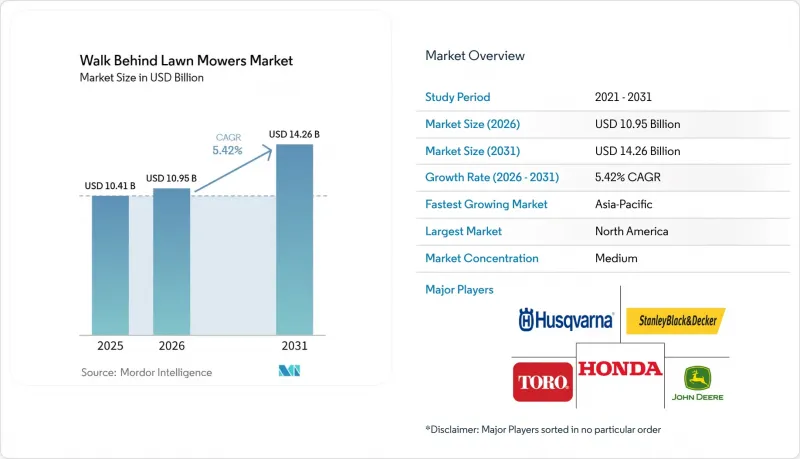
本報告按動力來源(汽油動力、有線電動等)、產品類型(手推式、自走式等)、銷售管道(線上銷售管道等)、最終用戶(住宅、商業園林綠化、政府和公共場所等)以及地區(北美、南美等)進行細分。市場預測以以金額為準呈現。
全球手推式割草機市場趨勢及洞察
市場對低噪音、低維護成本的割草機需求日益成長
在手推式割草機市場,消費者對降低噪音、減少日常維護的產品需求明顯增加。過去僅被視為舒適性功能的因素,如今會影響消費者的購買決策,尤其是在郊區和都市區住宅。歐盟委員會透過授權條例 (EU) 2024/1208 修訂了割草機噪音測量法規,修訂後的框架於 2025 年 5 月 22 日生效。這加大了進口到歐盟的汽油動力設備的合規負擔。這項變更意義重大,因為它使保證噪音輸出的展示更加突出,迫使製造商證明繼續使用噪音較大的動力系統的合理性。電池驅動的手推割草機也減少了日常維護的麻煩,無需處理燃油、引擎維修以及許多購屋者不喜歡的定期維護工作。對於尋求更簡單操作和快速安裝的首次購屋者來說,這一優勢尤其重要。因此,在降噪和便利性與割草性能同樣重要的市場中,對無線機型的需求進一步增加。
戶外電動工具品牌之間的電池生態系統鎖定
在手推式割草機市場,電池平台正成為一股強大的隱形驅動力。當家庭用戶和企業用戶透過吹風機、修剪機、鏈鋸等工具採用特定電池系列時,他們已經對充電器和電池進行了投資,這使得他們下次購買割草機時更加便捷。總部位於日本、業務遍及全球的專業電動工具和戶外設備製造商牧田公司(Makita Corporation)在2025年繼續擴展其無線生態系統。該公司的40V XGT平台支援超過170種相容工具,這表明整合電池平台正在成為戶外動力設備產業的關鍵競爭優勢。這正在改變競爭格局,因為買家不再只是比較割草機的寬度、運作時間和價格,還會考慮割草機與他們車庫或拖車中已有的工具的兼容性。史丹利百得(Stanley Black & Decker)以及創科實業(Techtronic Industries)旗下的品牌正從這個平台中受益,而專注於汽油動力設備的供應商則難以複製這種優勢。鎖定在電池生態系統中能夠提升品牌知名度,從而在多次更換週期中實現重複購買。因此,儘早採用電池平台是維持長期市佔率最有效的方式之一。
季節性需求集中和受天氣影響的購買延遲
北美和歐洲的手推式割草機市場仍然嚴重依賴短暫的銷售旺季。一年中的大部分需求集中在春季和初夏,因此銷售時機極易受到製造商無法控制的天氣模式的影響。春季到來延遲、持續降雨或長期乾旱都可能導致購買延遲數週,從而影響零售商的銷售業績。對於高階電池動力產品而言,這種影響更為顯著,因為與價格較低的傳統設備相比,消費者往往需要更長的時間來決定是否購買價格較高的產品。零售商已採取了一些應對措施,例如延長春季促銷活動、提供線上訂單的商店取貨服務以及推出季初折扣,但這些措施並未完全改變需求的季節性結構。換句話說,即使品類基本面良好,庫存計畫和定價仍極易受到時間波動的影響。因此,雖然需求可能不會驟降,但季度業績可能會變得不穩定,這可能會影響製造商和零售商的利潤率。
細分市場分析
到2025年,汽油動力型手推式割草機將佔41.3%的市場。由於其在住宅和商業應用領域佔據主導地位,該細分市場保持了最大的市場佔有率。在這些領域,大型物業需要長時間運作、高割草能力和可靠的性能。電池動力型割草機也獲得了顯著的市場佔有率,這得益於消費者對低噪音、低維護草坪護理解決方案的偏好。有線型割草機則面向較細分的市場,尤其受到草坪面積面積且電源插座便利的家庭用戶的青睞。手動滾筒式割草機保持著有限但穩定的市場佔有率,受到那些尋求簡單、經濟且環保型割草機的消費者的青睞。
預計電池驅動電動工具將以最快的速度成長,到2031年將以11.1%的複合年成長率成長。加州於2024年推出的「零排放小型引擎法規」改變了戶外動力設備這一關鍵市場的需求方向,並鞏固了電池投資的長期合理性。本田汽車也透過加強對無線產品的投入加速了這項轉型,並於2025年推出了一系列新型電池驅動手推式割草機。隨著這項轉型的推進,汽油動力型電動工具預計仍將在重型應用中發揮作用,而有線和手動型電動工具則可能繼續集中在小規模的應用場景中。
2025年,手推式割草機佔了手推式割草機市場45.2%的佔有率,成為以金額為準最高的割草機類型。其主導地位源自於價格實惠、易於存放以及非常適合面積小於0.5英畝的住宅用地。氣墊式割草機仍然是重要的第二選擇,尤其適合那些需要高機動性維護區域的住宅,例如不平坦的地形、傾斜的花園和不規則形狀的草坪。自走式割草機的需求量排名第三,而其他類型的割草機規模較小,應用範圍也較為專業。
自走式割草機預計將成為成長最快的細分市場,預計到2031年,該細分市場的複合年成長率將達到6.8%。推動這項市場需求的因素包括:住宅擁有率的老化、操作員工作量的減少,以及在人口密集區域提高作業效率的商業性需求日益成長。為了順應這一趨勢,Toro公司於2025年3月推出了配備腳輪的30英寸TurfMaster HDX割草機,旨在滿足專業園林綠化師對移動性和穩定割草性能的需求。雖然手推式割草機仍將是銷售量的主力軍,但氣墊式和其他專業型割草機預計也將在小規模基數的基礎上繼續成長。
區域分析
到2025年,北美將佔全球銷售量的44.5%,成為手推式割草機市場中最大的地區。該地區擁有龐大的獨棟住宅群體和成熟的DIY草坪護理文化,為其市場成長提供了有力支撐。加州於2024年頒布了針對小型汽油動力越野引擎的新法規,改變了該州消費者的購買行為,也使得向電池動力割草機的轉型變得更加迫切。美國仍然是市場的主要驅動力,因為其住宅擁有率較高,每年都有可預測的更換需求。在加拿大,無線割草機產品在都市區越來越受歡迎;而在墨西哥,價格敏感度和基礎設施限制仍然是人口稀少地區面臨的挑戰。
亞太地區是市場成長最快的區域,預計到2031年複合年成長率將達到7.1%。都市化仍然是主要驅動力,住宅擴張和綠地保護正在私人和商業領域創造新的需求。根據世界銀行預測,到2025年,南亞約36%的人口將居住在都市區,凸顯了全部區域正在形成的景觀規模。南美洲、中東和非洲的貢獻仍然較低,成長受限於零售結構分散、服務差異以及除商業和旅館業以外的園林綠化產業對電池技術的接受度較低。
在歐洲,針對戶外設備的噪音法規修訂後,加大了噪音較大的割草機的合規負擔,加速了汽油動力產品向電動割草機的轉型,並因此受益。德國、英國、法國和義大利憑藉其住宅草坪護理和完善的園林綠化服務體系,構成了該地區需求的核心。義大利也是STIGA SpA和Emak SpA等品牌的製造地,為整個南歐提供產品供應。雖然高階無線割草機在北歐國家越來越受歡迎,但在中歐和東歐,從汽油動力產品向電池動力產品的過渡仍處於起步階段。
其他好處:
- Excel格式的市場預測(ME)表
- 3個月的分析師支持
目錄
第1章:引言
- 研究假設和市場定義
- 調查範圍
第2章:調查方法
第3章執行摘要
第4章 市場狀況
- 市場概覽
- 市場促進因素
- 對低噪音、低維護成本的草坪護理設備的需求日益成長。
- 戶外電動工具品牌之間的電池生態系統鎖定
- 在噪音敏感區域對市政和商業設施進行電氣化改造
- 擴大無線平台捆綁銷售和零售展示空間。
- 住宅佔地面積小,以及小型草坪的擁有量增加。
- 配備優質電池的機型更換週期更短
- 市場限制因素
- 季節性需求激增以及天氣狀況導致的購買延遲。
- 在高負載使用情境下,人們對電池更換成本和運作時間感到擔憂。
- 本地和郊區市場售後服務網路的去中心化
- 汽油車在排放氣體和噪音法規方面面臨壓力
- 監理情勢
- 技術展望
- 波特五力分析
第5章 市場規模與成長預測
- 透過電源
- 汽油車
- 有線電動型
- 電池供電
- 手動捲線器
- 依產品類型
- 推
- 自推進式
- 徘徊
- 其他類型
- 透過分銷管道
- 線上銷售管道
- 專業零售商和授權經銷商
- 最終用戶
- 住宅
- 商業景觀設計
- 政府與公共空間
- 高爾夫球場和運動草坪
- 按地區
- 北美洲
- 美國
- 加拿大
- 墨西哥
- 其他北美國家
- 南美洲
- 巴西
- 阿根廷
- 智利
- 哥倫比亞
- 其他南美國家
- 歐洲
- 德國
- 英國
- 法國
- 義大利
- 俄羅斯
- 其他歐洲國家
- 亞太地區
- 中國
- 日本
- 印度
- 澳洲
- 韓國
- 其他亞太國家
- 中東
- 沙烏地阿拉伯
- 阿拉伯聯合大公國
- 其他中東國家
- 非洲
- 南非
- 奈及利亞
- 埃及
- 其他非洲國家
- 北美洲
第6章 競爭情勢
- 市場集中度
- 策略趨勢
- 市佔率分析
- 公司簡介
- Deere & Company
- The Toro Company
- Husqvarna Group
- Stanley Black & Decker, Inc.
- Honda Motor Co., Ltd.
- Kubota Corporation
- STIHL Holding AG and Co. KG
- Ariens Company
- KPS Capital Partners(Briggs & Stratton)
- STIGA SpA
- Robert Bosch GmbH
- Techtronic Industries Co. Ltd.
- AL-KO GERTE GMBH
- Fiskars Corporation
- Falcon Garden Tools Pvt. Ltd.
- Emak SpA
第7章 市場機會與未來趨勢
According to Mordor Intelligence, the walk-behind lawn mowers market size is estimated to grow from USD 10.41 billion in 2025 and USD 10.95 billion in 2026 to reach USD 14.26 billion by 2031, at a CAGR of 5.42% during the forecast period (2026-2031).
This report is Segmented by Power Source (Gasoline-Powered, Electric Corded, and More), by Product Type (Push, Self-Propelled, and More), by Distribution Channel (Online Sales Channels and More), by End User (Residential, Commercial Landscaping, Government & Public Spaces, and More), and by Geography (North America, South America, and More). The Market Forecasts are Provided in Terms of Value.
Global Walk Behind Lawn Mowers Market Trends and Insights
Rising Demand for Low-Noise and Low-Maintenance Lawn Care Equipment
The walk-behind lawn mowers market is seeing a clear demand shift toward products that reduce neighborhood noise and routine upkeep. What was once treated as a comfort feature is now influencing buying decisions at the point of sale, especially in suburban and urban residential areas. The European Commission updated lawn mower noise measurement rules through Delegated Regulation (EU) 2024/1208, and the revised framework took effect on May 22, 2025, which raised the compliance burden for gasoline-based equipment entering the European Union. That change matters because it makes guaranteed sound power labeling more visible and pushes manufacturers to justify the continued use of louder power formats. Battery walk-behind mowers also reduce day-to-day maintenance because they avoid fuel handling, engine servicing, and several recurring upkeep tasks that many household buyers dislike. This benefit is especially important for first-time buyers who want simpler operation and faster setup. The result is a stronger pull toward cordless formats in markets where noise sensitivity and convenience now carry as much weight as cutting performance.
Battery Ecosystem Lock-In Across Outdoor Power Tool Brands
Battery platform ownership is becoming one of the strongest hidden forces inside the walk-behind lawn mowers market. Once a household or contractor buys into a battery family through a blower, trimmer, or chainsaw, the next mower purchase becomes easier because the charger and battery investment are already in place. Makita Corporation, a Japan-headquartered manufacturer of professional power tools and outdoor equipment with a global presence, continued to expand its cordless ecosystem in 2025. The company's 40V XGT platform supported over 170 compatible tools, illustrating how integrated battery platforms have become an important competitive differentiator across the outdoor power equipment industry. This changes the competition because buyers are no longer comparing only deck width, runtime, and price. They are also comparing how well a mower fits the tools already stored in the garage or trailer. Stanley Black & Decker, Inc., along with brands under Techtronic Industries, benefits from this platform effect in ways that gasoline-focused suppliers struggle to match. Battery ecosystem lock-in is turning brand familiarity into repeat purchasing behavior that may last across several replacement cycles. That makes early adoption of the battery platform one of the most defensible ways to retain long-term share.
Seasonal Demand Concentration and Weather-Linked Purchase Deferrals
The walk-behind lawn mowers market still depends heavily on a narrow selling season in North America and Europe. Much of the annual demand is concentrated in the spring and early summer window, making revenue timing sensitive to weather patterns beyond the manufacturer's control. A delayed spring, extended rainfall, or a prolonged drought can shift purchases by weeks and disrupt dealer sell-through. This pressure is more noticeable in premium battery products because buyers tend to take longer to make higher-ticket decisions than for lower-cost legacy equipment. Retailers have responded with longer spring promotions, online order pickup, and earlier-season discounts, but those tactics have not fully altered the seasonal structure of demand. That means inventory planning and pricing remain exposed to timing volatility even when category fundamentals stay healthy. The result is not a collapse in demand, but rather uneven quarterly performance that can compress margins for both manufacturers and retailers.
Other drivers and restraints analyzed in the detailed report include:
- Municipal and Commercial Electrification in Noise-Sensitive Zones
- Growth of Compact-Lot Housing and Smaller Lawn Ownership
- Battery Replacement Cost and Runtime Anxiety in High-Duty Use Cases
For complete list of drivers and restraints, kindly check the Table Of Contents.
Segment Analysis
Gasoline-powered models accounted for 41.3% of the walk-behind lawn mowers market size in 2025. This segment maintained the largest share due to its established presence in residential and commercial applications that require extended runtime, higher cutting power, and reliable performance across larger properties. Battery-powered equipment accounted for a significant share of the market, driven by growing consumer preference for lower-noise, lower-maintenance lawn care solutions. Electric corded products catered to a smaller niche, particularly among households with compact lawns and convenient access to power outlets. Manual reel mowers retained a limited but stable market presence, appealing to consumers seeking simple, cost-effective, and environmentally friendly mowing options.
Battery-powered models are anticipated to expand at the fastest pace, advancing at a 11.1% CAGR through 2031. California's 2024 zero-emission small engine rule changed the direction of demand in a major outdoor power market and strengthened the long-term case for battery investment. Honda Motor Co., Ltd. also accelerated the shift by introducing new battery-powered walk-behind lineups and deepening its focus on cordless products in 2025. As this transition continues, gasoline will retain a role in heavier-duty work, while corded and manual formats will stay concentrated in smaller use cases.
Push mowers held 45.2% of the walk-behind lawn mowers market share in 2025, which made them the largest product type by value. Their lead came from price accessibility, easy storage, and a strong fit with sub-half-acre residential lots. Hover mowers followed as a meaningful secondary choice, particularly for homeowners maintaining uneven terrain, sloped gardens, and irregularly shaped lawns where enhanced maneuverability is valued. Self-propelled units formed the next major layer of demand, while other product types remained smaller and more specialized.
Self-propelled models are anticipated to record the fastest growth, with the market segment estimated to grow at a 6.8% CAGR through 2031. Demand is being helped by aging homeowner demographics, reduced operator effort, and stronger commercial interest in productivity gains on dense routes. The Toro Company supported that direction with the TurfMaster HDX 30-inch with casters, introduced in March 2025 for professional landscaping crews that need maneuverability and stable cutting performance. Push mowers should remain the volume anchor, while hover and other specialized formats will continue to grow from a smaller base.
Complete Report Scope:
- By Power Source
- Gasoline-Powered
- Electric Corded
- Battery-Powered
- Manual Reel
- By Product Type
- Push
- Self-Propelled
- Hover
- Other Types
- By Distribution Channel
- Online Sales Channels
- Specialty Retailers and Authorized Dealers
- By End User
- Residential
- Commercial Landscaping
- Government and Public Spaces
- Golf Courses and Sports Turf
- By Geography
- North America
- United States
- Canada
- Mexico
- Rest of North America
- South America
- Brazil
- Argentina
- Chile
- Colombia
- Rest of South America
- Europe
- Germany
- United Kingdom
- France
- Italy
- Russia
- Rest of Europe
- Asia-Pacific
- China
- Japan
- India
- Australia
- South Korea
- Rest of Asia-Pacific
- Middle East
- Saudi Arabia
- United Arab Emirates
- Rest of Middle East
- Africa
- South Africa
- Nigeria
- Egypt
- Rest of Africa
- North America
Geography Analysis
North America accounted for 44.5% of global revenue in 2025, making it the largest region in the walk-behind lawn mowers market. The region is supported by a large base of single-family homes and a well-established do-it-yourself lawn care culture. California's 2024 rule on new gasoline-powered small off-road engines changed purchase behavior in a highly visible state and increased the urgency around battery conversion. The United States remains the dominant national contributor because residential ownership patterns create predictable annual replacement demand. Canada is stronger in urban cordless adoption, while Mexico continues to face more price sensitivity and infrastructure constraints in lower-density areas.
Asia-Pacific is the fastest-growing region in the market, with a projected CAGR of 7.1% through 2031. Urbanization remains the primary driver, as expanding residential communities and the preservation of green spaces create new demand across both private and commercial settings. According to the World Bank, about 36% of South Asia's population lived in urban areas in 2025, highlighting the scale of the landscape being formed across the region. South America, the Middle East, and Africa remain smaller contributors, with growth limited by fragmented retail structures, service gaps, and slower battery adoption outside commercial and hospitality landscaping.
Europe is benefiting from faster gasoline displacement as revised outdoor equipment noise rules increase the compliance burden on louder mower formats. Germany, the United Kingdom, France, and Italy form the core of regional demand because they combine residential lawn maintenance with stronger landscaping service ecosystems. Italy also stands out as a manufacturing base for brands such as STIGA S.p.A. and Emak S.p.A., which helps support product availability across Southern Europe. Nordic countries show stronger adoption of premium cordless models, while Central and Eastern Europe remain earlier in the shift from gasoline to battery products.
- Deere & Company
- The Toro Company
- Husqvarna Group
- Stanley Black & Decker, Inc.
- Honda Motor Co., Ltd.
- Kubota Corporation
- STIHL Holding AG and Co. KG
- Ariens Company
- KPS Capital Partners (Briggs & Stratton)
- STIGA S.p.A
- Robert Bosch GmbH
- Techtronic Industries Co. Ltd.
- AL-KO GERTE GMBH
- Fiskars Corporation
- Falcon Garden Tools Pvt. Ltd.
- Emak S.p.A.
Additional Benefits:
- The market estimate (ME) sheet in Excel format
- 3 months of analyst support
TABLE OF CONTENTS
1 Introduction
- 1.1 Study Assumptions and Market Definition
- 1.2 Scope of the Study
2 Research Methodology
3 Executive Summary
4 Market Landscape
- 4.1 Market Overview
- 4.2 Market Drivers
- 4.2.1 Rising demand for low-noise and low-maintenance lawn care equipment
- 4.2.2 Battery ecosystem lock-in across outdoor power tool brands
- 4.2.3 Municipal and commercial electrification in noise-sensitive zones
- 4.2.4 Dealer bundling and retail shelf expansion for cordless platforms
- 4.2.5 Growth of compact-lot housing and smaller lawn ownership
- 4.2.6 Faster replacement cycles for premium battery models
- 4.3 Market Restraints
- 4.3.1 Seasonal demand concentration and weather-linked purchase deferrals
- 4.3.2 Battery replacement cost and runtime anxiety in high-duty use cases
- 4.3.3 Fragmented aftermarket service coverage in rural and semi-urban markets
- 4.3.4 Emissions and noise compliance pressure on gasoline models
- 4.4 Regulatory Landscape
- 4.5 Technological Outlook
- 4.6 Porter's Five Forces Analysis
- 4.6.1 Threat of New Entrants
- 4.6.2 Bargaining Power of Buyers
- 4.6.3 Bargaining Power of Suppliers
- 4.6.4 Threat of Substitutes
- 4.6.5 Intensity of Competitive Rivalry
5 Market Size and Growth Forecasts (Value)
- 5.1 By Power Source
- 5.1.1 Gasoline-Powered
- 5.1.2 Electric Corded
- 5.1.3 Battery-Powered
- 5.1.4 Manual Reel
- 5.2 By Product Type
- 5.2.1 Push
- 5.2.2 Self-Propelled
- 5.2.3 Hover
- 5.2.4 Other Types
- 5.3 By Distribution Channel
- 5.3.1 Online Sales Channels
- 5.3.2 Specialty Retailers and Authorized Dealers
- 5.4 By End User
- 5.4.1 Residential
- 5.4.2 Commercial Landscaping
- 5.4.3 Government and Public Spaces
- 5.4.4 Golf Courses and Sports Turf
- 5.5 By Geography
- 5.5.1 North America
- 5.5.1.1 United States
- 5.5.1.2 Canada
- 5.5.1.3 Mexico
- 5.5.1.4 Rest of North America
- 5.5.2 South America
- 5.5.2.1 Brazil
- 5.5.2.2 Argentina
- 5.5.2.3 Chile
- 5.5.2.4 Colombia
- 5.5.2.5 Rest of South America
- 5.5.3 Europe
- 5.5.3.1 Germany
- 5.5.3.2 United Kingdom
- 5.5.3.3 France
- 5.5.3.4 Italy
- 5.5.3.5 Russia
- 5.5.3.6 Rest of Europe
- 5.5.4 Asia-Pacific
- 5.5.4.1 China
- 5.5.4.2 Japan
- 5.5.4.3 India
- 5.5.4.4 Australia
- 5.5.4.5 South Korea
- 5.5.4.6 Rest of Asia-Pacific
- 5.5.5 Middle East
- 5.5.5.1 Saudi Arabia
- 5.5.5.2 United Arab Emirates
- 5.5.5.3 Rest of Middle East
- 5.5.6 Africa
- 5.5.6.1 South Africa
- 5.5.6.2 Nigeria
- 5.5.6.3 Egypt
- 5.5.6.4 Rest of Africa
- 5.5.1 North America
6 Competitive Landscape
- 6.1 Market Concentration
- 6.2 Strategic Moves
- 6.3 Market Share Analysis
- 6.4 Company Profiles (Includes Global Level Overview, Market Level Overview, Core Segments, Financials as Available, Strategic Information, Market Rank/Share, Products and Services, Recent Developments)
- 6.4.1 Deere & Company
- 6.4.2 The Toro Company
- 6.4.3 Husqvarna Group
- 6.4.4 Stanley Black & Decker, Inc.
- 6.4.5 Honda Motor Co., Ltd.
- 6.4.6 Kubota Corporation
- 6.4.7 STIHL Holding AG and Co. KG
- 6.4.8 Ariens Company
- 6.4.9 KPS Capital Partners (Briggs & Stratton)
- 6.4.10 STIGA S.p.A
- 6.4.11 Robert Bosch GmbH
- 6.4.12 Techtronic Industries Co. Ltd.
- 6.4.13 AL-KO GERTE GMBH
- 6.4.14 Fiskars Corporation
- 6.4.15 Falcon Garden Tools Pvt. Ltd.
- 6.4.16 Emak S.p.A.
7 Market Opportunities and Future Trends

 美國割草機:市場佔有率分析、行業趨勢和統計數據、成長預測(2026-2031 年)電動割草機:市場佔有率分析、行業趨勢和統計數據、成長預測(2026-2031 年)
 電動割草機市場-2026-2032年全球市場預測割草機市場-2026-2032年全球市場預測
 自動割草機市場 - 全球產業規模、佔有率、趨勢、機會、預測:按產品類型、技術、燃料類型、應用、地區和競爭格局分類,2021-2031年
 無線園藝設備市場機會、成長要素、產業趨勢分析及2026-2035年預測電動切割機:市場佔有率分析、行業趨勢和統計數據、成長預測(2026-2031 年)
 割草機市場:依最終用戶產業、產品類型、驅動系統、預期用途、動力來源和地區分類
 無線割草機市場規模、佔有率、成長及全球產業分析:按類型、應用和地區分類的洞察,2026-2034 年預測割草機市場:產品類型、動力系統、銷售管道、應用、最終用途 - 2026-2032年全球市場預測