


 |
市場調查報告書
商品編碼
2125716
印度IT硬體市場:市場佔有率分析、產業趨勢與統計及成長預測(2026-2031年)India IT Hardware - Market Share Analysis, Industry Trends & Statistics, Growth Forecasts (2026 - 2031) |
||||||

※ 本網頁內容可能與最新版本有所差異。詳細情況請與我們聯繫。
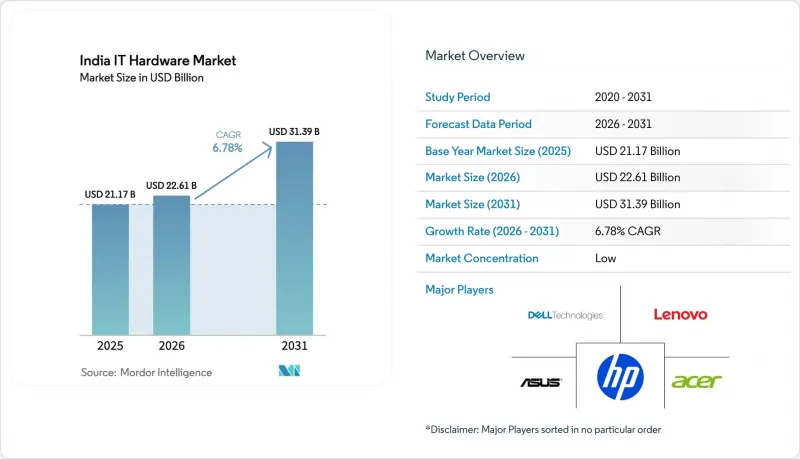
根據 Mordor Intelligence 預測,印度 IT 硬體市場規模預計到 2026 年將達到 226.1 億美元,高於 2025 年的 211.7 億美元。
此外,預計到 2031 年市場規模將達到 313.9 億美元,並且預計從 2026 年到 2031 年將以 6.78% 的複合年成長率成長。
本報告按產品類型(個人電腦和工作站、企業網路硬體、企業儲存設備及其他)、應用領域(消費品、企業)、最終用戶產業(銀行、金融服務和保險、零售、IT和電信及其他)以及地區(印度北部、印度東部、印度西部和中部、印度南部)進行細分。市場預測以美元計價。
印度IT硬體市場的趨勢與洞察
人工智慧工作負載對高效能運算的需求日益成長
由於企業級人工智慧專案所需的運算能力是傳統應用的3到5倍,企業被迫採用加速器、高階記憶體和液冷系統,即使是在中階機架中也是如此。戴爾科技預測,其人工智慧伺服器的銷售額將在2025會計年度增加至150億美元,高於上年度的100億美元。 Ola與聯想合作建造擁有7000億參數的「Krutrim 3」模型,需要印度最大的超級電腦,以及200億印度盧比(約2.4億美元)的初始硬體投資。這些旗艦級部署正在樹立採購標準,並將推廣至二級供應商,推高印度IT硬體市場的平均售價,並促使供應商將產品藍圖轉向客製化設計的人工智慧節點。
「印度製造」優惠政策(PLI 2.0)適用於國內個人電腦和伺服器製造商。
生產關聯激勵計劃(PLI)框架為本地生產的個人電腦和伺服器的淨銷售額成長提供4-6%的額外獎勵,鼓勵全球原始設備製造商(OEM)將高價值組裝遷至泰米爾納德邦。迪克森科技公司(Dixon Technologies)正在泰米爾納德邦投資1.15億美元,開始生產惠普筆記型電腦,年產量目標為200萬台。聯想的目標是實現個人電腦生產的100%本地化,並計劃在國內組裝人工智慧伺服器。這將減少其高達101億美元的筆記型電腦進口成本,從而減輕其外匯儲備的壓力。早期本地化也將為建構相關組件生態系統奠定基礎。富士康已承諾在泰米爾納德邦投資10億美元用於顯示模組組裝,以降低其對東亞進口的依賴。
半導體供應鏈的波動性
印度目前仍有65-70%的半導體依賴進口,使得製造商極易受到DRAM和NAND快閃記憶體價格波動的影響,預計2024-2025年這兩種晶片的價格將上漲15-20%。由於在塔塔PSMC位於古吉拉突邦的工廠於2025年底運作之前,印度國內的晶圓製造廠無法出貨,原始設備製造商(OEM)被迫增加安全庫存,並外匯波動風險。高效能GPU仍然是供應最緊張的領域,前置作業時間長達52-60週,人工智慧伺服器的部署也陷入停滯。這種供應瓶頸增加了營運資金需求,擠壓了利潤空間,並使印度IT硬體市場的預期複合年成長率下降了90個基點。
細分市場分析
預計到2031年,企業儲存將以8.08%的複合年成長率(CAGR)實現最高成長,這主要得益於企業對AI最佳化陣列和NVMe over Fabrics架構的廣泛採用。 NetApp在2024會計年度的混合雲端營收達到56.6億美元,其AIPod參考設計成為國內資料中心升級的藍圖。伺服器緊隨其後,複合年成長率為7.18%,這主要得益於邊緣部署和公共部門的需求。 PC和工作站維持了6.94%的複合年成長率,這主要受混合辦公相關的設備升級所推動。企業儲存佔了印度IT硬體市場的大部分佔有率,而PC則佔了42.08%的市場。印表機和影印機的成長速度放緩,反映數位文件工作流程和雲端表單的普及。為了維持平均售價(ASP),供應商透過將AI推理加速器整合到筆記型電腦中,展現了客戶端和伺服器設計理念的融合。
這些進步也導致了價值鏈的重組。專注於 PCIe 5.0 控制器和支援 CXL 的 DIMM 的組件供應商獲得了長期訂單,因為超大規模資料中心業者需要確定性的延遲。網路硬體的重心轉向軟體定義疊加網路,這蠶食了傳統底盤交換機的收入,同時也為針對分店邊緣環境最佳化的安全 SD-WAN 設備創造了新的機會。這種消費模式的轉變,從資本支出 (CapEx) 採購轉向結合設備和訂閱的混合套餐,擴大了印度 IT 硬體市場。
其他好處
- Excel格式的市場預測(ME)表
- 3個月的分析師支持
目錄
第1章:引言
- 研究假設和市場定義
- 調查範圍
第2章:調查方法
第3章執行摘要
第4章 市場狀況
- 市場概覽
- 市場促進因素
- 混合辦公政策下,筆記型電腦需求快速成長
- 人工智慧工作負載對高效能運算的需求日益成長
- 透過「數位印度」和國家資訊中心計畫促進公共部門數位轉型
- 「印度製造」優惠政策(PLI 2.0)適用於國內個人電腦和伺服器製造商。
- 二線城市對邊緣資料中心伺服器的需求增加(未充分通報)。
- 企業 ESG 政策正在推動節能硬體的發展(未充分報告)。
- 市場限制因素
- 與電子廢棄物相關的合規成本不斷上升
- 半導體供應鏈的波動性
- 周邊設備灰色市場進口持續存在(未充分報告)。
- 公部門競標公司續約週期緩慢(瞞報)
- 產業價值鏈分析
- 監理情勢
- 技術展望
- 波特五力分析
- 市場宏觀經濟趨勢的評估
第5章 市場規模與成長預測
- 依產品類型
- 個人電腦和工作站
- 企業網路硬體
- 企業儲存設備
- 伺服器
- 其他硬體(印表機和影印機)
- 透過使用
- 一般消費者
- 公司
- 小型企業
- 大公司
- 按最終用戶行業分類
- BFSI
- 零售
- IT/通訊
- 其他
- 按地區
- 印度北部
- 東印度
- 印度西部和中部
- 南印度
第6章 競爭情勢
- 市場集中度
- 策略趨勢
- 市佔率分析
- 公司簡介
- Dell Inc.
- Lenovo Group Ltd
- ASUS Tek Computer Inc.
- HP Inc.
- Acer Inc.
- IBM Corporation
- Apple Inc.
- Samsung Electronics Co. Ltd.
- NetApp Inc.
- Hitachi Ltd.
- Cisco Systems Inc.
- Juniper Networks Inc.
- Arista Networks Inc.
- Hewlett Packard Enterprise(HPE)Inc.
- Wistron India Inc.
- Foxconn India Inc.
- Super Micro Computer Inc.
- Dell EMC Indian Ops
- Supertron Electronics Inc.
- RP Tech India
第7章 市場機會與未來展望
According to Mordor Intelligence, India IT hardware market size in 2026 is estimated at USD 22.61 billion, growing from 2025 value of USD 21.17 billion with 2031 projections showing USD 31.39 billion, growing at 6.78% CAGR over 2026-2031.
This report is Segmented by Product Type (PCs and Workstations, Enterprise Networking Hardware, Enterprise Storage Devices, and More), End-User Industry (Consumer, and Enterprise), Industry (BFSI, Retail, IT and Telecom, and Other End-User Industries), and Geography (North India, East India, West and Central India, and South India). The Market Forecasts are Provided in Terms of Value (USD).
India IT Hardware Market Trends and Insights
Elevated Need for High-Performance Computing in AI Workloads
Enterprise AI projects require 3-5 times more compute capacity than traditional applications, pushing firms to specify accelerators, advanced memory, and liquid cooling even for mid-range racks. Dell Technologies projects USD 15 billion in AI server revenue in fiscal 2025, up from USD 10 billion a year earlier. Ola's partnership with Lenovo to build Krutrim 3, a 700-billion-parameter model, necessitates India's largest supercomputer and an initial INR 2,000 crore (USD 240 million) hardware outlay. Such flagship deployments set procurement baselines that ripple into Tier-2 enterprises, increasing the India IT Hardware market's average selling price and shifting vendor roadmaps toward purpose-built AI nodes.
Make-in-India Incentives for Local PC/Server Manufacturing (PLI 2.0)
The PLI framework offers 4-6% incremental incentive on net incremental sales of locally manufactured PCs and servers, encouraging global OEMs to relocate higher-value assembly lines. Dixon Technologies invested USD 115 million in Tamil Nadu to manufacture HP notebooks, with output slated at 2 million laptops annually. Lenovo targets 100% local PC production and plans to assemble AI servers domestically, cutting a USD 10.1 billion laptop import bill that previously constrained foreign-exchange reserves. Early localization also seeds ancillary component ecosystems. Foxconn has committed USD 1 billion for display module assembly in Tamil Nadu, reducing dependence on East Asian imports.
Semiconductor Supply-Chain Volatility
India still imports 65-70% of its semiconductors, exposing manufacturers to volatile DRAM and NAND pricing that rose 15-20% over 2024-25. Local fabrication will not ship commercial wafers until Tata-PSMC's Gujarat fab comes online in late 2025, prompting OEMs to hold larger safety stocks and hedge currency in component sourcing. High-performance GPUs remain the tightest node, stretching lead times to 52-60 weeks and stalling AI server rollouts. The bottleneck inflates working capital needs and dampens margin profiles, carving 90 basis points off the projected India IT Hardware market CAGR.
Other drivers and restraints analyzed in the detailed report include:
- Public-Sector Digitization Push via Digital India and NIC Projects
- Rising Demand for Edge Data-Center Servers in Tier-2 Cities
- Escalating E-Waste Compliance Costs
For complete list of drivers and restraints, kindly check the Table Of Contents.
Segment Analysis
Enterprise storage accounted for the fastest 8.08% CAGR through 2031 as enterprises deployed AI-optimized arrays and NVMe-over-Fabrics architectures. NetApp's hybrid-cloud revenue reached USD 5.66 billion in fiscal 2024, and its AIPod reference design became a blueprint for domestic data-center upgrades. Servers followed at 7.18% CAGR, fueled by edge deployments and public-sector demand. PCs and workstations maintained a 6.94% CAGR, buttressed by hybrid-work refreshes. The India IT Hardware market size for enterprise storage represented a significant share, while PCs retained 42.08% of the India IT Hardware market share. Printers and copiers trailed, reflecting digital document workflows and cloud forms adoption. Vendors integrated AI-inference accelerators inside notebooks to protect ASPs, signaling the convergence of client and server design philosophies.
The evolution also reshaped value chains. Component suppliers focusing on PCIe 5.0 controllers and CXL-ready DIMMs secured longer-term orders as hyperscalers demanded deterministic latency. Networking hardware pivoted toward software-defined overlays, cannibalizing traditional chassis switch revenues but opening opportunities in secure SD-WAN appliances tuned for branch edge. The shift enlarged the India IT Hardware market as consumption moved from capex purchases to hybrid device-plus-subscription bundles.
Complete Report Scope:
- By Product Type
- PCs and Workstations
- Enterprise Networking Hardware
- Enterprise Storage Devices
- Servers
- Other Hardware (Printers and Copiers)
- By Application
- Consumer
- Enterprise
- SMEs
- Large Enterprises
- By End-user Industry
- BFSI
- Retail
- IT and Telecom
- Other End-user Industries
- By Region
- North India
- East India
- West and Central India
- South India
List of Companies Covered in this Report:
- Dell Inc.
- Lenovo Group Ltd
- ASUS Tek Computer Inc.
- HP Inc.
- Acer Inc.
- IBM Corporation
- Apple Inc.
- Samsung Electronics Co. Ltd.
- NetApp Inc.
- Hitachi Ltd.
- Cisco Systems Inc.
- Juniper Networks Inc.
- Arista Networks Inc.
- Hewlett Packard Enterprise (HPE) Inc.
- Wistron India Inc.
- Foxconn India Inc.
- Super Micro Computer Inc.
- Dell EMC Indian Ops
- Supertron Electronics Inc.
- RP Tech India
Additional Benefits:
- The market estimate (ME) sheet in Excel format
- 3 months of analyst support
TABLE OF CONTENTS
1 INTRODUCTION
- 1.1 Study Assumptions and Market Definition
- 1.2 Scope of the Study
2 RESEARCH METHODOLOGY
3 EXECUTIVE SUMMARY
4 MARKET LANDSCAPE
- 4.1 Market Overview
- 4.2 Market Drivers
- 4.2.1 Rapid growth in laptop demand under hybrid-work policies
- 4.2.2 Elevated need for high-performance computing in AI workloads
- 4.2.3 Public-sector digitization push via Digital India and NIC projects
- 4.2.4 Make-in-India incentives for local PC/server manufacturing (PLI 2.0)
- 4.2.5 Rising demand for edge data-centre servers in Tier-2 cities (under-reported)
- 4.2.6 Corporate ESG mandates favour energy-efficient hardware (under-reported)
- 4.3 Market Restraints
- 4.3.1 Escalating e-waste compliance costs
- 4.3.2 Semiconductor supply-chain volatility
- 4.3.3 Persistent grey-market imports in peripherals (under-reported)
- 4.3.4 Slow enterprise refresh cycles in public-sector tenders (under-reported)
- 4.4 Industry Value Chain Analysis
- 4.5 Regulatory Landscape
- 4.6 Technological Outlook
- 4.7 Porter's Five Forces Analysis
- 4.7.1 Bargaining Power of Suppliers
- 4.7.2 Bargaining Power of Buyers
- 4.7.3 Threat of New Entrants
- 4.7.4 Threat of Substitutes
- 4.7.5 Intensity of Competitive Rivalry
- 4.8 Assessment of Macro-economic Trends on the Market
5 MARKET SIZE AND GROWTH FORECASTS (VALUE)
- 5.1 By Product Type
- 5.1.1 PCs and Workstations
- 5.1.2 Enterprise Networking Hardware
- 5.1.3 Enterprise Storage Devices
- 5.1.4 Servers
- 5.1.5 Other Hardware (Printers and Copiers)
- 5.2 By Application
- 5.2.1 Consumer
- 5.2.2 Enterprise
- 5.2.2.1 SMEs
- 5.2.2.2 Large Enterprises
- 5.3 By End-user Industry
- 5.3.1 BFSI
- 5.3.2 Retail
- 5.3.3 IT and Telecom
- 5.3.4 Other End-user Industries
- 5.4 By Region
- 5.4.1 North India
- 5.4.2 East India
- 5.4.3 West and Central India
- 5.4.4 South India
6 COMPETITIVE LANDSCAPE
- 6.1 Market Concentration
- 6.2 Strategic Moves
- 6.3 Market Share Analysis
- 6.4 Company Profiles (includes Global level Overview, Market level overview, Core Segments, Financials as available, Strategic Information, Market Rank/Share for key companies, Products and Services, and Recent Developments)
- 6.4.1 Dell Inc.
- 6.4.2 Lenovo Group Ltd
- 6.4.3 ASUS Tek Computer Inc.
- 6.4.4 HP Inc.
- 6.4.5 Acer Inc.
- 6.4.6 IBM Corporation
- 6.4.7 Apple Inc.
- 6.4.8 Samsung Electronics Co. Ltd.
- 6.4.9 NetApp Inc.
- 6.4.10 Hitachi Ltd.
- 6.4.11 Cisco Systems Inc.
- 6.4.12 Juniper Networks Inc.
- 6.4.13 Arista Networks Inc.
- 6.4.14 Hewlett Packard Enterprise (HPE) Inc.
- 6.4.15 Wistron India Inc.
- 6.4.16 Foxconn India Inc.
- 6.4.17 Super Micro Computer Inc.
- 6.4.18 Dell EMC Indian Ops
- 6.4.19 Supertron Electronics Inc.
- 6.4.20 RP Tech India
7 MARKET OPPORTUNITIES AND FUTURE OUTLOOK
- 7.1 White-Space and Unmet-Need Assessment

 IT硬體訂閱(DaaS - 設備即服務):市場佔有率分析、產業趨勢與統計、成長預測(2026-2031年)永續IT硬體:市場佔有率分析、產業趨勢與統計及成長預測(2026-2031年)IT硬體更新周期最佳化軟體:市場佔有率分析、產業趨勢與統計、成長預測(2026-2031年)IT設備分銷:市場佔有率分析、產業趨勢與統計、成長預測(2026-2031年)
 2026年全球可解釋人工智慧儀表板顯示市場報告2026年全球硬體儲存市場報告
 全球硬檢驗市場全球硬體儲存市場
 硬體儲存市場規模、佔有率、成長分析,按硬體儲存解決方案類型、儲存容量、使用環境、地區 - 產業預測,2025-2032