


 |
市場調查報告書
商品編碼
2065593
IT設備分銷:市場佔有率分析、產業趨勢與統計、成長預測(2026-2031年)IT Hardware Distribution And Channel - Market Share Analysis, Industry Trends & Statistics, Growth Forecasts (2026 - 2031) |
||||||

※ 本網頁內容可能與最新版本有所差異。詳細情況請與我們聯繫。
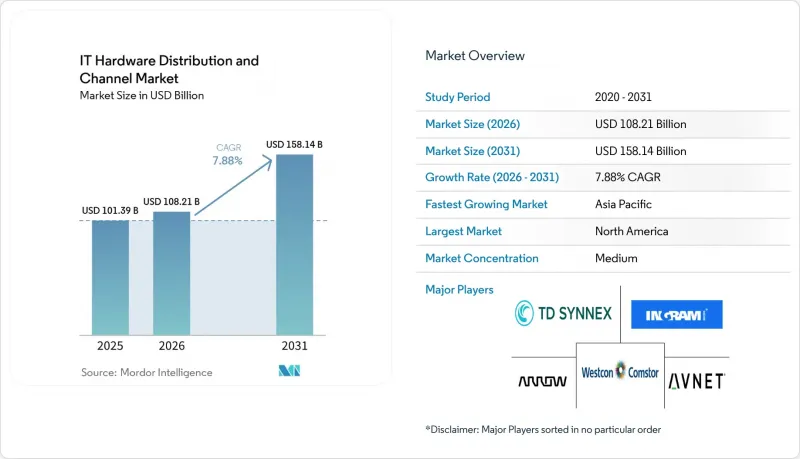
根據 Mordor Intelligence 預測,IT 設備分銷市場預計將從 2025 年的 1013.9 億美元成長到 2026 年的 1082.1 億美元,到 2031 年達到 1581.4 億美元,2026 年至 2031 年的複合年成長率預計為 7.88%。
本報告按產品類型(伺服器、儲存系統、網路硬體等)、通路類型(綜合經銷商、加值經銷商等)、最終用戶產業(大型企業、中小企業等)、服務模式(加值分銷等)及地區細分。市場預測以美元計價。
全球IT設備分銷市場的趨勢與洞察
雲端資料中心擴容的需求日益成長
超大規模資料中心業者累計到2026年資本支出將超過6,000億美元,其中亞馬遜、微軟和谷歌在跨區域伺服器採購方面主導,通常繞過大型仲介業者。與原始設備製造商 (OEM) 的直接交易和白盒產品正在擠壓商品產品的利潤空間,同時也為支援託管服務提供商和區域雲運營商的分銷商創造了進入相關服務領域的機會。 AWS在路易斯安那州投資120億美元的設施擴建計畫凸顯了這些計畫在北美的集中性。同時,印度一項2070兆瓦的計畫和日本一項260億美元的投資公告顯示亞太地區持續保持成長勢頭。即使在直接採購趨勢盛行的情況下,能夠確保本地庫存、整合冷卻系統並提供合規諮詢的經銷商也能獲得額外收入。
邊緣運算基礎設施的廣泛應用
企業正在工廠、零售店和行動電話基地台部署推理節點,以降低延遲和雲端出口成本。邊緣站點需要以NPU為中心的伺服器、E3.S儲存和強大的交換機,但這些設備通常不會被一般分銷商大量囤積,這為專注於特定領域和增值的合作夥伴創造了商機。解決方案以承包捆綁包的形式交付,包括水冷模組和編配軟體,從而帶來更高的利潤率。思科於2026年推出的「360合作夥伴計畫」透過獎勵認證邊緣編配工程師的經銷商來強化技術鎖定。分散的、特定產業的需求有利於能夠客製化SKU和資金籌措的區域專家,而這些方案對全球經銷商來說無利可圖。
半導體供應鏈中斷
高頻寬記憶體預計將持續缺貨至2026年底,DRAM現貨價格在第一季幾乎加倍,3奈米製程的前置作業時間超過50週。為此,原始設備製造商(OEM)不得不在產品生命週期中期提價,導致企業更新換代計畫受限,經銷商的利潤率下降了120至150個基點。晶圓代工廠的供應限制有利於能夠直接協商配額的超大規模資料中心業者,而通路夥伴則被迫在現貨市場苦苦尋覓,導致成本上漲3%至5%。與依賴單一供應鏈的競爭對手相比,採用包含多家OEM廠商的避險策略的經銷商更能抵禦價格上漲的影響。
細分市場分析
預計到2025年,伺服器出貨量佔總收入的34.32%,但隨著超大規模資料中心業者轉向直接採購,經銷商的潛在基本客群正在萎縮,該領域的成長速度正在放緩。相較之下,隨著企業推行混合辦公模式,並升級筆記型電腦和平板電腦以運行人工智慧,行動裝置預計將在2031年之前以9.08%的複合年成長率加速成長。隨著Windows 11過渡期限的臨近以及配備NPU的筆記型電腦進入市場,行動裝置的IT設備分銷市場預計將穩步成長。經銷商透過捆綁銷售OEM廠商難以擴展和複製的服務(例如鏡像、資產標籤和延長保固)來確保利潤率。
邊緣人工智慧工作負載正在推動對E3.S外形尺寸高密度儲存的需求。同時,隨著企業對預先配置防火牆和合規性文件的需求日益成長,強大的網路硬體仍然是分銷商的必備產品。 TD SYNNEX旗下的Hyve Solutions部門透過從區域雲端服務供應商獲得客製化白盒伺服器業務,預計到2026年初,銷售量將幾乎翻倍。隨著水冷和高效能GPU機架逐漸成為主流,擁有精通這些技術的認證工程師的加值經銷商能夠制定更高的價格。安全設備、零信任閘道器和入侵偵測設備正作為整合套件的一部分進行銷售,進一步擴大了IT設備分銷商在網路設備領域的市場佔有率。
2025年,綜合經銷商的銷售額佔比為31.28%,但隨著客戶轉向「點擊報價」平台,其毛利率正面臨下滑。電子商務平台以9.18%的複合年成長率成長,滿足了買家對即時供貨和自動化合規性的需求。英邁(Ingram Micro)的Xvantage服務將SaaS訂閱與實體硬體結合,而戴爾(Dell)的Premier平台每天已處理數十萬筆企業交易。
加值經銷商透過設立配置實驗室、預先組裝中心和財務部門,開闢出具有競爭優勢的細分市場,並減輕價格透明化帶來的影響。系統整合商承接了數百萬美元的項目,其中硬體成本佔不到總發票金額的一半,但通路管理對於保固和生命週期服務仍然至關重要。零售業持續低迷,而提供當日提貨和技術支援的專業連鎖店則成功留住了中小企業的忠實客戶。將豐富的產品線與高價值專業知識相結合的混合型企業正在蓬勃發展,這預示著IT設備分銷市場未來將呈現靈活多變的格局。
區域分析
預計到2025年,北美將佔全球銷售額的29.41%,這主要得益於超大規模資料中心的建置以及訂閱式硬體模式的早期應用。儘管美國仍佔據大部分支出,但由於亞馬遜、微軟和谷歌等公司的直接採購,Broadline產品的銷售量正在下降。加拿大受益於公共部門的數位轉型以及接近性,而墨西哥則受益於近岸外包,這推動了對耐環境邊緣設備的需求。該地區的經銷商正透過整合合規諮詢、逆向物流以及與雲端市場的整合來彌補利潤率的下降。
亞太地區預計將以8.88%的複合年成長率成長,成為全球成長最快的地區。印度計畫到2029年新建52座資料中心,總裝置容量達2,070兆瓦,這將為冷卻、電力和合規相關捆綁產品的銷售管道創造商機。日本價值260億美元的雲端運算計畫因電網建設延誤數年,促使經銷商囤積柴油發電機和電池組。在中國,集中採購制度有利於國內原始設備製造商(OEM),這增加了海外分銷商的市場准入難度,也加重了合規負擔。韓國的半導體生態系統正在推動對無塵室相容伺服器的需求,而澳洲和紐西蘭對安全設備的投資也蓬勃發展。
歐洲面臨獨特的局面,循環經濟法規與宏觀經濟逆風交織在一起。 「維修權指令」和更嚴格的WEEE(廢棄電子電氣設備)法規使缺乏逆向物流基礎設施的經銷商的營運成本增加了高達其收入的1.8%。儘管如此,翻新硬體出貨量佔全球總量的30%以上,成為擁有認證翻新生產線的合作夥伴公司新的利潤來源。中東和非洲雖然絕對規模小規模,但公共雲端的普及速度很快,阿拉伯聯合大公國的資料中心容量已超過1000兆瓦。外匯波動和分散的海關系統仍然是障礙,但擁有本地倉庫和靈活信貸體系的經銷商正在擴大其市場佔有率。以巴西為首的南美洲,透過近岸外包和5G部署刺激對邊緣基礎設施的需求,進一步增強了IT設備分銷市場的區域多樣性。
其他好處:
- Excel格式的市場預測(ME)表
- 3個月的分析師支持
目錄
第1章:引言
- 研究假設和市場定義
- 調查範圍
第2章:調查方法
第3章執行摘要
第4章 市場狀況
- 市場概覽
- 市場促進因素
- 雲端資料中心擴容的需求日益成長
- 擴大邊緣運算基礎設施的採用
- 電子商務採購管道的成長
- 供應商通路獎勵計劃
- 合規性推動翻新硬體市場快速成長
- 經銷商擴大網路安全硬體捆綁銷售
- 市場限制因素
- 半導體供應鏈中斷
- 原始設備製造商 (OEM) 與銷售管道之間因直接向客戶銷售而產生的衝突。
- 生產者責任延伸制度增加了資產回收的成本。
- 透過「設備即服務」模式限制出貨量。
- 宏觀經濟因素對市場的影響
- 產業價值鏈分析
- 監理情勢
- 技術展望
- 波特五力分析
第5章 市場規模與成長預測
- 依產品類型
- 伺服器
- 儲存系統
- 網路裝置
- 個人電腦及周邊設備
- 行動裝置
- 其他產品類型
- 通道特異性
- 總批發商
- 增值分銷商
- 經銷商
- 零售
- 電子商務
- 系統整合商
- 按最終用戶行業分類
- 大公司
- 小型企業
- 政府/公共部門
- 通訊業者
- 雲端服務供應商
- 消費者
- 按服務模式
- 加值分配
- 廣泛發行
- 專業分銷
- 混合模式
- 按地區
- 北美洲
- 美國
- 加拿大
- 墨西哥
- 南美洲
- 巴西
- 阿根廷
- 其他南美國家
- 歐洲
- 英國
- 德國
- 法國
- 義大利
- 西班牙
- 其他歐洲國家
- 亞太地區
- 中國
- 日本
- 印度
- 韓國
- 其他亞太國家
- 中東和非洲
- 中東
- 阿拉伯聯合大公國
- 沙烏地阿拉伯
- 其他中東國家
- 非洲
- 南非
- 埃及
- 其他非洲國家
- 中東
- 北美洲
第6章 競爭情勢
- 市場集中度
- 策略趨勢
- 市佔率分析
- 公司簡介
- TD SYNNEX Corporation
- Ingram Micro Inc.
- Arrow Electronics, Inc.
- Avnet, Inc.
- Westcon Group, Inc.
- ScanSource, Inc.
- ALSO Holding AG
- Exertis(UK)Ltd.
- Redington(India)Limited
- Digital China Holdings Limited
- WPG Holdings Limited
- Esprinet SpA
- SiS Distribution(Thailand)Public Company Limited
- Intcomex Holdings, Inc.
- Synnex Technology International Corp.
- Sahara Computers(Pty)Ltd.
- Datatec Limited
- Logicom Public Ltd
- MS Distribution(India)Private Limited
- HNA Technology Co., Ltd.
第7章 市場機會與未來展望
According to Mordor Intelligence, the iT hardware distribution market size is expected to increase from USD 101.39 billion in 2025 to USD 108.21 billion in 2026 and reach USD 158.14 billion by 2031, growing at a CAGR of 7.88% over 2026-2031.
This report is Segmented by Product Type (Servers, Storage Systems, Networking Hardware, and More), Channel Type (Broadline Distributors, Value-Added Distributors, and More), End-User Vertical (Large Enterprises, and Small and Medium Businesses, and More), Service Model (Value-Added Distribution, and More), and Geography. The Market Forecasts are Provided in Terms of Value (USD).
Global IT Hardware Distribution And Channel Market Trends and Insights
Rising Demand for Cloud Data Center Expansion
Hyperscalers allocated more than USD 600 billion in capital expenditure during 2026, with Amazon, Microsoft, and Google leading multi-region server purchases that often bypass broadline intermediaries. Direct OEM and white-box engagement compresses commodity margins yet opens service adjacencies for distributors that support colocation providers and regional cloud operators. AWS's USD 12 billion Louisiana buildout underscores the North American concentration of these projects, while India's 2,070 megawatt pipeline and Japan's USD 26 billion commitment signal sustained Asia-Pacific momentum. Distributors capable of staging localized inventory, integrating cooling systems, and offering compliance consulting capture incremental revenue despite the trend toward direct sourcing.
Increasing Adoption of Edge Computing Infrastructure
Enterprises are deploying inference nodes in factories, retail stores, and cell towers to reduce latency and cloud egress fees. Edge sites demand NPU-centric servers, E3.S storage, and ruggedized switches that broadline distributors rarely stock at scale, creating white space for niche value-added partners. Margins rise because solutions ship as turnkey bundles that include liquid-cooling modules and orchestration software. Cisco's 360 Partner Program, launched in 2026, rewards distributors for certifying edge-orchestration engineers, reinforcing technical lock-in. Fragmented vertical requirements favor regional specialists that can customize SKUs and financing in ways global distributors find uneconomical.
Semiconductor Supply-Chain Disruptions
High-bandwidth memory sold out through year-end 2026, DRAM spot prices nearly doubled in Q1, and 3-nanometer lead times exceeded 50 weeks. OEMs responded with mid-cycle price increases that suppressed enterprise refresh schedules and shaved 120-150 basis points off distributor margins. Foundry constraints privilege hyperscalers that negotiate direct allocations, leaving channel partners to scour spot markets that add 3%-5% to costs. Distributors with multi-OEM hedging strategies weather price spikes better than peers tethered to single-source pipelines.
Other drivers and restraints analyzed in the detailed report include:
- Growth of E-Commerce Procurement Channels
- Vendor Channel Incentive Programs
- OEM-Channel Conflict From Direct-to-Customer Sales
For complete list of drivers and restraints, kindly check the Table Of Contents.
Segment Analysis
Server shipments accounted for 34.32% of 2025 revenue, but the segment's growth rate moderates as hyperscalers source directly, shrinking the distributor addressable base. Mobility devices, in contrast, are forecast to accelerate at 9.08% CAGR through 2031 as enterprises refresh laptops and tablets to enable hybrid work and run on-device AI. The IT hardware distribution market for mobility devices is projected to grow steadily as Windows 11 migration deadlines approach and NPU-equipped notebooks roll out. Distributors protect margins by bundling imaging, asset tagging, and extended warranties, services difficult for OEMs to replicate at scale.
Edge AI workloads spur demand for high-density storage in E3.S form factors, while ruggedized networking hardware remains a distributor staple because enterprises insist on pre-configured firewalls and compliance paperwork. TD SYNNEX's Hyve Solutions division nearly doubled volume in early 2026 by capturing custom white-box server business from regional cloud operators. As liquid-cooling and power-efficient GPU racks become mainstream, value-added distributors that employ certified engineers in these technologies enjoy premium pricing. The IT hardware distribution market share for networking gear is further boosted when security appliances, zero-trust gateways, and intrusion detection devices ship as part of integrated bundles.
Broadline distributors accounted for 31.28% of 2025 revenue but face gross-margin erosion as clients migrate to click-to-quote portals. E-commerce storefronts, growing at 9.18% CAGR, meet buyer expectations for instant availability and automated compliance. Ingram Micro's Xvantage stacks SaaS subscriptions on top of physical hardware, while Dell's Premier platform already processes hundreds of thousands of corporate transactions daily.
Value-added distributors carve out defensible niches by embedding configuration labs, staging centers, and financing desks, reducing the impact of price transparency. System integrators capture multi-million-dollar projects in which hardware accounts for less than half of the total bill, yet channel control remains critical for warranty and lifecycle services. Retail continues its secular decline, though specialty chains that offer same-day pickup and technical support retain loyal small-business customers. The hybrid blend of broadline inventory and value-added expertise gains traction, signaling an adaptive future for the IT hardware distribution market.
Geography Analysis
North America retained 29.41% of 2025 revenue, buoyed by hyperscale data-center builds and early adoption of subscription hardware models. The United States dominates spending, yet the direct-sourcing behavior of Amazon, Microsoft, and Google diminishes broadline volumes. Canada benefits from public-sector digitalization and proximity to U.S. inventory hubs, while Mexico gains from nearshoring that raises demand for ruggedized edge gear. Distributors in the region offset margin erosion by layering compliance consulting, reverse logistics, and cloud marketplace integration.
Asia-Pacific is set to grow at an 8.88% CAGR, the fastest globally. India plans to build 52 new data center facilities totaling 2,070 megawatts by 2029, creating channel opportunities for cooling, power, and compliance bundles. Japan's USD 26 billion cloud pipeline confronts multi-year power-grid delays, prompting distributors to stock diesel generators and battery arrays. China's centralized procurement favors domestic OEMs, complicating routes to market for foreign distributors and increasing compliance overhead. South Korea's semiconductor ecosystem drives demand for clean-room compliant servers, while Australia and New Zealand spend aggressively on security appliances.
Europe faces a unique blend of circular-economy regulation and macroeconomic headwinds. The Right to Repair Directive and stricter WEEE rules increase operating costs by up to 1.8% of revenue for distributors that lack reverse logistics infrastructure. Still, refurbished hardware volumes exceed 30% of global totals, creating fresh profit pools for partners with certified remanufacturing lines. The Middle East and Africa, though smaller in absolute value, show strong public-cloud uptake as the United Arab Emirates surpasses 1,000 megawatts of data-center capacity. Currency volatility and fragmented customs regimes remain obstacles, yet distributors with local warehousing and flexible credit win share. South America, led by Brazil, is leveraging nearshoring and 5G rollouts to stimulate demand for edge infrastructure, reinforcing the regional diversity of the IT hardware distribution market.
- TD SYNNEX Corporation
- Ingram Micro Inc.
- Arrow Electronics, Inc.
- Avnet, Inc.
- Westcon Group, Inc.
- ScanSource, Inc.
- ALSO Holding AG
- Exertis (UK) Ltd.
- Redington (India) Limited
- Digital China Holdings Limited
- WPG Holdings Limited
- Esprinet S.p.A.
- SiS Distribution (Thailand) Public Company Limited
- Intcomex Holdings, Inc.
- Synnex Technology International Corp.
- Sahara Computers (Pty) Ltd.
- Datatec Limited
- Logicom Public Ltd
- M.S. Distribution (India) Private Limited
- HNA Technology Co., Ltd.
Additional Benefits:
- The market estimate (ME) sheet in Excel format
- 3 months of analyst support
TABLE OF CONTENTS
1 INTRODUCTION
- 1.1 Study Assumptions and Market Definition
- 1.2 Scope of the Study
2 RESEARCH METHODOLOGY
3 EXECUTIVE SUMMARY
4 MARKET LANDSCAPE
- 4.1 Market Overview
- 4.2 Market Drivers
- 4.2.1 Rising Demand for Cloud Data Center Expansion
- 4.2.2 Increasing Adoption of Edge Computing Infrastructure
- 4.2.3 Growth of E-Commerce Procurement Channels
- 4.2.4 Vendor Channel Incentive Programs
- 4.2.5 Compliance-Driven Boom in Refurbished Hardware Trade
- 4.2.6 Expansion of Cyber-Security Hardware Bundling by Distributors
- 4.3 Market Restraints
- 4.3.1 Semiconductor Supply-Chain Disruptions
- 4.3.2 OEM-Channel Conflict From Direct-to-Customer Sales
- 4.3.3 EPR Rules Elevating Asset Take-Back Costs
- 4.3.4 Device-as-a-Service Models Curtailing Unit Shipments
- 4.4 Impact of Macroeconomic Factors on the Market
- 4.5 Industry Value Chain Analysis
- 4.6 Regulatory Landscape
- 4.7 Technological Outlook
- 4.8 Porter's Five Forces Analysis
- 4.8.1 Bargaining Power of Suppliers
- 4.8.2 Bargaining Power of Buyers
- 4.8.3 Threat of New Entrants
- 4.8.4 Threat of Substitutes
- 4.8.5 Intensity of Competitive Rivalry
5 MARKET SIZE AND GROWTH FORECASTS (VALUE)
- 5.1 By Product Type
- 5.1.1 Servers
- 5.1.2 Storage Systems
- 5.1.3 Networking Hardware
- 5.1.4 Personal Computers and Peripherals
- 5.1.5 Mobility Devices
- 5.1.6 Other Product Types
- 5.2 By Channel Type
- 5.2.1 Broadline Distributors
- 5.2.2 Value-Added Distributors
- 5.2.3 Resellers
- 5.2.4 Retail
- 5.2.5 E-Commerce
- 5.2.6 System Integrators
- 5.3 By End-User Vertical
- 5.3.1 Large Enterprises
- 5.3.2 Small and Medium Businesses
- 5.3.3 Government and Public Sector
- 5.3.4 Telecom Operators
- 5.3.5 Cloud Service Providers
- 5.3.6 Consumer
- 5.4 By Service Model
- 5.4.1 Value-Added Distribution
- 5.4.2 Broadline Distribution
- 5.4.3 Specialized Distribution
- 5.4.4 Hybrid Model
- 5.5 By Geography
- 5.5.1 North America
- 5.5.1.1 United States
- 5.5.1.2 Canada
- 5.5.1.3 Mexico
- 5.5.2 South America
- 5.5.2.1 Brazil
- 5.5.2.2 Argentina
- 5.5.2.3 Rest of South America
- 5.5.3 Europe
- 5.5.3.1 United Kingdom
- 5.5.3.2 Germany
- 5.5.3.3 France
- 5.5.3.4 Italy
- 5.5.3.5 Spain
- 5.5.3.6 Rest of Europe
- 5.5.4 Asia-Pacific
- 5.5.4.1 China
- 5.5.4.2 Japan
- 5.5.4.3 India
- 5.5.4.4 South Korea
- 5.5.4.5 Rest of Asia-Pacific
- 5.5.5 Middle East and Africa
- 5.5.5.1 Middle East
- 5.5.5.1.1 United Arab Emirates
- 5.5.5.1.2 Saudi Arabia
- 5.5.5.1.3 Rest of Middle East
- 5.5.5.2 Africa
- 5.5.5.2.1 South Africa
- 5.5.5.2.2 Egypt
- 5.5.5.2.3 Rest of Africa
- 5.5.5.1 Middle East
- 5.5.1 North America
6 COMPETITIVE LANDSCAPE
- 6.1 Market Concentration
- 6.2 Strategic Moves
- 6.3 Market Share Analysis
- 6.4 Company Profiles (includes Global Level Overview, Market Level Overview, Core Segments, Financials as available, Strategic Information, Market Rank/Share, Products and Services, Recent Developments)
- 6.4.1 TD SYNNEX Corporation
- 6.4.2 Ingram Micro Inc.
- 6.4.3 Arrow Electronics, Inc.
- 6.4.4 Avnet, Inc.
- 6.4.5 Westcon Group, Inc.
- 6.4.6 ScanSource, Inc.
- 6.4.7 ALSO Holding AG
- 6.4.8 Exertis (UK) Ltd.
- 6.4.9 Redington (India) Limited
- 6.4.10 Digital China Holdings Limited
- 6.4.11 WPG Holdings Limited
- 6.4.12 Esprinet S.p.A.
- 6.4.13 SiS Distribution (Thailand) Public Company Limited
- 6.4.14 Intcomex Holdings, Inc.
- 6.4.15 Synnex Technology International Corp.
- 6.4.16 Sahara Computers (Pty) Ltd.
- 6.4.17 Datatec Limited
- 6.4.18 Logicom Public Ltd
- 6.4.19 M.S. Distribution (India) Private Limited
- 6.4.20 HNA Technology Co., Ltd.
7 MARKET OPPORTUNITIES AND FUTURE OUTLOOK
- 7.1 White-Space and Unmet-Need Assessment

 印度IT硬體市場:市場佔有率分析、產業趨勢與統計及成長預測(2026-2031年)IT硬體訂閱(DaaS - 設備即服務):市場佔有率分析、產業趨勢與統計、成長預測(2026-2031年)永續IT硬體:市場佔有率分析、產業趨勢與統計及成長預測(2026-2031年)IT硬體更新周期最佳化軟體:市場佔有率分析、產業趨勢與統計、成長預測(2026-2031年)
 2026年全球可解釋人工智慧儀表板顯示市場報告2026年全球硬體儲存市場報告
 全球硬檢驗市場全球硬體儲存市場
 硬體儲存市場規模、佔有率、成長分析,按硬體儲存解決方案類型、儲存容量、使用環境、地區 - 產業預測,2025-2032