


 |
市場調查報告書
商品編碼
2119068
永續IT硬體:市場佔有率分析、產業趨勢與統計及成長預測(2026-2031年)Sustainable IT Hardware - Market Share Analysis, Industry Trends & Statistics, Growth Forecasts (2026 - 2031) |
||||||

※ 本網頁內容可能與最新版本有所差異。詳細情況請與我們聯繫。
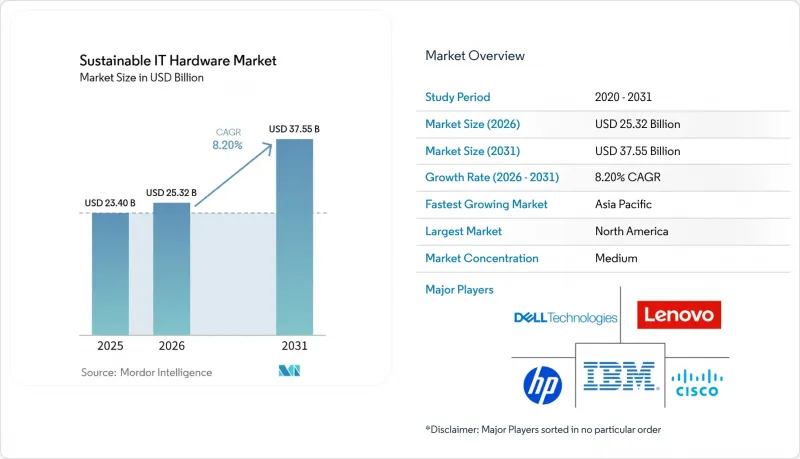
根據 Mordor Intelligence 預測,永續IT 硬體市場預計將從 2025 年的 234 億美元成長到 2026 年的 253.2 億美元,到 2031 年達到 375.5 億美元,2026 年至 2031 年的複合年預計成長率為 8.20%。
本報告按產品類型(伺服器、網路設備、個人電腦和工作站等)、組件(硬體、軟體、服務)、最終用戶產業(資料中心、銀行、金融服務和保險 (BFSI)、政府和公共部門等)、生命週期階段(採購和製造、營運和使用等)以及地區進行細分。市場預測以美元 (USD) 計價。
全球永續IT硬體市場趨勢與洞察
對全球電子廢棄物和碳排放實施嚴格監管。
繼歐盟2024年修訂《廢棄電子電氣設備指令》(WEEE指令)將回收目標提高至70%,並對未能資助回收計畫的製造商處以罰款之後,設計團隊現在優先考慮易於拆卸的機殼和標準化緊固件。中國修訂後的回收法規要求企業級儲存陣列供應商在2026年前建立省級回收網路,這將加速對逆向物流中心的投資。加州參議院第244號法案規定,到2028年,在該州銷售的所有IT設備必須包含30%的消費後回收材料,這將提振對經認證的再生塑膠和低碳鋁的需求。
企業環境、社會及治理 (ESG) 和淨零排放採購要求
根據碳資訊揭露項目 (CDP) 2024 年的一項調查,68% 的財富 500 強企業在其伺服器和儲存產品的提案書中納入了生命週期排放閾值,高於 2022 年的 41%。微軟的「2025 年供應商行為準則」強制要求進行符合 ISO 14040 標準的產品級生命週期評估,並提供每兆次浮點運算或Terabyte資料每年的嵌入式碳減排量證明。谷歌揭露,其 2024 年採購的伺服器中有 82% 符合 EPEAT Climate+ 標準,這推動了業界對可再生能源驅動型製造和檢驗的碳抵銷方案的需求。
永續硬體和冷卻系統維修的初始成本較高。
由於冷卻液分配裝置、洩漏感測器和設施管道維修等成本,液冷機架的安裝成本比同類風冷機架高出 40% 至 60%。因此,在電費低於每千瓦時 0.08 美元的地區,投資回收期將超過三年。獲得能源之星認證的儲存陣列由於採用低功耗 NAND 快閃記憶體、先進的糾錯功能以及檢驗成本,其標價高出 12% 至 18%,抵消了低利用率環境下效率提升帶來的成本節約。
細分市場分析
到2025年,伺服器將佔總營收的37.6%,預計其複合年成長率將達到10.9%,成為該類別中成長最快的產品。這主要得益於超大規模雲端採用針對生成式人工智慧推理工作負載最佳化的液冷底盤。這種普及將支撐伺服器IT硬體市場的永續規模,使營運商能夠將運算密度提高一倍,並推遲申請新的建築許可。基於晶片組的x86和ARM處理器整合了碳化矽(SiC)電源模組,透過將轉換損耗降低高達25%,符合企業淨零排放藍圖的要求。儲存供應商正轉向NVMe over Fabrics和運算驅動器,例如希捷的Exos CORVAULT,這些產品在降低每次I/O循環能耗的同時,將平均資料遺失時間(MTD)延長至350萬小時以上。在網路設備方面,用於800 Gbps交換器的晶片將每Gigabit的功耗降低了35%,隨著人工智慧叢集架構的成長,這將支援永續IT硬體市場佔有率的擴大。
周邊設備、個人電腦和電源產品市場正穩定成長,這主要得益於USB Power Delivery 3.1、睡眠模式感測器和預測性UPS分析等技術的進步。這些創新對於滿足更嚴格的能源之星9.0版標準至關重要,該標準強調能源效率和永續性。例如,Vertiv的機器學習驅動型UPS演算法已被證實可在10年內將電池更換週期延長高達20%。這不僅降低了營運成本,還顯著降低了整個生命週期的排放,從而有助於環境永續性。此外,這些創新透過確保常用金屬的回收利用,全面支持循環採購慣例,從而促進更永續、更有效率的資源生產週期。
至2025年,硬體將佔永續IT硬體市場收入的61.9%,但隨著企業將碳會計、資產追蹤和回收等業務外包,服務領域正以9.4%的複合年成長率快速成長。這一趨勢推動了託管服務在永續IT硬體市場中所佔佔有率的成長,尤其是在缺乏內部廢棄物處理能力的全球銀行和零售商中。Schneider Electric的EcoStruxure IT解決方案透過將工作負載轉移到非尖峰時段,在2024年幫助財富100強企業的資料中心降低了14%的電力消耗量。 HPE GreenLake永續發展服務符合採購商品的範圍3要求,並按季度發布減排和節水報告。像Iron Mountain這樣的物流專家在2024年從230萬台IT設備中回收了18,500公噸鋼鐵和貴金屬,從而加強了其閉合迴路供應鏈。
軟體支出與硬體更新周期密切相關,利用人工智慧驅動的工作負載分配引擎和數位孿生技術,負責人可以即時模擬動態和電網運行。這些先進技術能夠幫助企業最佳化能耗、減少營運低效率環節並提升系統整體效能。透過運用人工智慧洞察,負責人可以預測並緩解潛在問題,確保無縫運行,並將停機時間降至最低。此外,這些編配層還能減少設備閒置,提高資源利用效率。這一趨勢正推動著對捆綁了安全、能源管理和生命週期儀錶板等關鍵功能的訂閱許可的需求不斷成長,從而為應對現代運營挑戰提供全面的解決方案。
區域分析
預計到2025年,北美將佔全球銷售額的大規模%,這主要得益於超大規模雲端運算、嚴格的能源之星標準以及美國證券交易委員會(SEC)新推出的氣候變遷資訊揭露規則。此規則強制要求對負有重大報告義務的公司進行IT資產範圍3排放的審計。由於聯邦機構和29個州強制要求達到EPEAT銀級或更高等級,供應商被迫揭露其產品層面的碳足跡。加拿大政府的「綠色戰略」要求在2030年實現淨零排放運營,這將進一步加速高效能伺服器和筆記型電腦的採購。
亞太地區是成長最快的地區,預計到2031年複合年成長率將達到12.2%。印度正透過撥款1700億印度盧比(約20.4億美元)加強其本地供應鏈,用於發展國內伺服器製造和可再生能源工廠。日本綠色轉型聯盟正在資助一個稀土元素磁鐵回收的示範項目,而韓國的《K-循環經濟法》則對回收材料的含量設定了強制性標準,並對設備從銷售到拆解的整個過程進行追蹤。新加坡和印尼的超大規模資料中心業者正在部署液冷人工智慧叢集,以應對熱帶地區的高溫,無需依賴蒸發冷卻,從而保持了其在東南亞永續IT硬體市場的佔有率。歐洲則位居第二,這得益於針對永續產品的生態設計法規以及支援資料中心維修為餘熱回收設施的津貼。
德國已累計5億歐元(約5.6億美元)用於建造向其區域供熱網路供熱的設施,這推動了對水冷機架的需求,因為水冷機架能夠在60度C的排放溫度下高效地回收利用熱量。英國擬議的法規要求超過500千瓦的資料中心每月公佈用電量和用水量指標,這將加速計量系統的升級。在中東,作為經濟多元化的一部分,沙烏地阿拉伯和阿拉伯聯合大公國(阿拉伯聯合大公國)正在建造人工智慧園區,主要租戶要求實施可再生能源購買協議和數位通行證。非洲的成長中心是南非,Teraco在約翰尼斯堡建造的20兆瓦太陽能資料中心已成為該地區永續運算的典範,尤其是在電力供應不穩定的市場中。
其他好處:
- Excel格式的市場預測(ME)表
- 3個月的分析師支持
目錄
第1章:引言
- 研究假設和市場定義
- 調查範圍
第2章:調查方法
第3章執行摘要
第4章 市場狀況
- 市場概覽
- 市場促進因素
- 更嚴格的全球電子廢棄物和碳排放法規
- 企業環境、社會及治理 (ESG) 和淨零排放採購要求
- 超大規模和邊緣資料中心的快速擴張
- 對節能高效、高密度人工智慧伺服器的需求日益成長。
- 循環經濟中IT即服務模式的興起
- 低壓碳化矽和氮化鎵功率元件的技術進步
- 市場限制因素
- 永續硬體和冷卻系統維修的初始成本較高。
- 低碳零件供應鏈的波動性
- 各區域缺乏統一的永續發展指標
- 日益嚴峻的水資源壓力正在影響新興亞洲國家對液冷技術的採用。
- 產業價值鏈分析
- 監理情勢
- 技術展望
- 宏觀經濟因素對市場的影響
- 波特五力分析
第5章 市場規模與成長預測
- 依產品類型
- 伺服器
- 儲存裝置
- 網路裝置
- 個人電腦和工作站
- 周邊設備和配件
- UPS和配電設備
- 按組件
- 硬體
- 軟體
- 服務
- 按最終用戶行業分類
- 資料中心
- 大公司
- 小型企業
- 政府/公共部門
- 衛生保健
- BFSI
- 通訊/IT
- 其他終端用戶產業
- 依生命週期階段
- 採購和製造
- 操作和使用
- 維護和升級
- 二手產品及回收
- 按地區
- 北美洲
- 美國
- 加拿大
- 墨西哥
- 歐洲
- 德國
- 英國
- 法國
- 俄羅斯
- 其他歐洲國家
- 亞太地區
- 中國
- 日本
- 印度
- 韓國
- 其他亞太國家
- 中東
- 沙烏地阿拉伯
- 阿拉伯聯合大公國
- 其他中東國家
- 非洲
- 南非
- 奈及利亞
- 其他非洲國家
- 南美洲
- 巴西
- 阿根廷
- 其他南美國家
- 北美洲
第6章 競爭情勢
- 市場集中度
- 策略趨勢
- 市佔率分析
- 公司簡介
- Lenovo Group Limited
- HP Inc.
- Dell Technologies Inc.
- International Business Machines Corporation
- Cisco Systems Inc.
- Huawei Technologies Co., Ltd.
- Inspur Electronic Information Industry Co., Ltd.
- Super Micro Computer, Inc.
- Fujitsu Limited
- NEC Corporation
- Hewlett Packard Enterprise Company
- Schneider Electric SE
- Vertiv Holdings Co.
- Eaton Corporation plc
- Delta Electronics, Inc.
- Seagate Technology Holdings plc
- Western Digital Corporation
- Pure Storage, Inc.
- Advanced Micro Devices, Inc.
- NVIDIA Corporation
第7章 市場機會與未來展望
According to Mordor Intelligence, the sustainable IT hardware market size is expected to increase from USD 23.4 billion in 2025 to USD 25.32 billion in 2026 and reach USD 37.55 billion by 2031, growing at a CAGR of 8.20% over 2026-2031.
This report is Segmented by Product Type (Servers, Networking Equipment, Personal Computers and Workstations, and More), Component (Hardware, Software, and Services), End-User Industry (Data Centers, BFSI, Government and Public Sector, and More), Lifecycle Phase (Procurement and Manufacturing, Operation and Usage, and More), and Geography. The Market Forecasts are Provided in Terms of Value (USD).
Global Sustainable IT Hardware Market Trends and Insights
Stringent E-Waste and Carbon Regulations Globally
Amendments to the European Union's WEEE Directive in 2024 lifted collection targets to 70% and introduced financial penalties for manufacturers that fail to fund take-back schemes, prompting design teams to prioritize easy-to-disassemble chassis and standardized fasteners. China's updated recovery rules require suppliers of enterprise-grade storage arrays to set up provincial collection networks by 2026, accelerating investment in reverse logistics hubs. California's Senate Bill 244 mandates 30% post-consumer recycled content in all IT equipment sold in the state by 2028, driving demand for certified recycled plastics and low-carbon aluminum.
Enterprise ESG and Net-Zero Procurement Mandates
A 2024 Carbon Disclosure Project survey found that 68% of Fortune 500 firms embedded lifecycle-emission thresholds into server and storage requests for proposals, up from 41% in 2022. Microsoft's 2025 Supplier Code of Conduct now requires product-level lifecycle assessments aligned with ISO 14040 and evidence of annual embodied-carbon reductions per teraflop or terabyte. Google disclosed that 82% of its 2024 server purchases met EPEAT Climate+ criteria, lifting industry demand for renewable-powered manufacturing and verified offset schemes.
High Upfront Cost of Sustainable Hardware and Cooling Retrofits
Liquid-cooled racks cost 40%-60% more to install than air-cooled equivalents because of coolant distribution units, leak sensors, and facility piping upgrades, extending payback periods beyond three years in regions where electricity prices remain below USD 0.08 per kWh. ENERGY STAR-certified storage arrays carry 12%-18% higher list prices driven by low-power NAND, advanced error correction, and verification fees, offsetting efficiency savings in low-utilization environments.
Other drivers and restraints analyzed in the detailed report include:
- Rapid Expansion of Hyperscale and Edge Data Centers
- Growing Demand for Energy-Efficient High-Density AI Servers
- Supply Chain Volatility for Low-Carbon Components
For complete list of drivers and restraints, kindly check the Table Of Contents.
Segment Analysis
Servers accounted for 37.6% of 2025 revenue and are forecast to grow at a 10.9% CAGR, the highest among categories, as hyperscale clouds adopt liquid-cooled chassis optimized for generative-AI inference workloads. This uptake supports the sustainable IT hardware market size for servers, enabling operators to double compute density and defer new building permits. Chiplet-based x86 and ARM processors integrate silicon-carbide power modules that cut conversion losses up to 25%, aligning with corporate net-zero roadmaps. Storage vendors pivot to NVMe-over-Fabrics and computational drives like Seagate's Exos CORVAULT, which extends mean-time-to-data-loss past 3.5 million hours while lowering energy per I/O cycle. Networking equipment benefits from 800 Gbps switch silicon that delivers 35% better watts per gigabit, sustaining sustainable IT hardware market share gains as AI cluster fabrics expand.
Peripherals, PCs, and power equipment are experiencing steady growth, driven by advancements in technologies such as USB Power Delivery 3.1, sleep-mode sensors, and predictive UPS analytics. These innovations are essential to meet the stricter ENERGY STAR Version 9.0 thresholds, which emphasize energy efficiency and sustainability. For instance, Vertiv's machine-learning UPS algorithms have proven effective in delaying battery replacements by up to 20% over a ten-year period. This not only reduces operational costs but also significantly curtails lifecycle emissions, contributing to environmental sustainability. Furthermore, these advancements collectively support circular procurement practices by ensuring that commodity metals are preserved and reintroduced into manufacturing processes, thereby promoting a more sustainable and resource-efficient production cycle.
Hardware delivered 61.9% of sustainable IT hardware market revenue in 2025, though services are expanding at a 9.4% CAGR as enterprises outsource carbon accounting, asset tracking and refurbishment. This dynamic underpins a rising sustainable IT hardware market share for managed services, especially among global banks and retailers that lack in-house disposal capacity. Schneider Electric's EcoStruxure IT shifted workloads to off-peak windows, cutting one Fortune 100 firm's data-center power by 14% in 2024. HPE GreenLake Sustainability Services publishes quarterly reports on avoided emissions and water savings, aligning with Scope 3 requirements for purchased goods. Logistics specialists such as Iron Mountain recovered 18,500 metric tons of steel and precious metals from 2.3 million IT units in 2024, reinforcing closed-loop supply chains.
Software spending mirrors hardware refresh cycles, with AI workload-placement engines and digital twins enabling operators to model thermodynamics and electricity grids in real time. These advanced technologies allow businesses to optimize energy consumption, reduce operational inefficiencies, and enhance overall system performance. By leveraging AI-driven insights, operators can predict and mitigate potential issues, ensuring seamless operations and minimizing downtime. Additionally, these orchestration layers reduce stranded capacity, enabling more efficient resource utilization. This trend drives incremental demand for subscription licenses that bundle essential features such as security, energy management, and lifecycle dashboards, offering a comprehensive solution for modern operational challenges.
Complete Report Scope:
- By Product Type
- Servers
- Storage Devices
- Networking Equipment
- Personal Computers and Workstations
- Peripherals and Accessories
- UPS and Power Distribution Units
- By Component
- Hardware
- Software
- Services
- By End-User Industry
- Data Centers
- Large Enterprises
- Small and Medium Enterprises
- Government and Public Sector
- Healthcare
- BFSI
- Telecom and IT
- Other End-User Industries
- By Lifecycle Phase
- Procurement and Manufacturing
- Operation and Usage
- Maintenance and Upgrades
- End-of-Life and Recycling
- By Geography
- North America
- United States
- Canada
- Mexico
- Europe
- Germany
- United Kingdom
- France
- Russia
- Rest of Europe
- Asia-Pacific
- China
- Japan
- India
- South Korea
- Rest of Asia Pacific
- Middle East
- Saudi Arabia
- United Arab Emirates
- Rest of Middle East
- Africa
- South Africa
- Nigeria
- Rest of Africa
- South America
- Brazil
- Argentina
- Rest of South America
- North America
Geography Analysis
North America captured 53.8% of 2025 revenue, powered by hyperscale clouds, stringent ENERGY STAR standards, and new U.S. Securities and Exchange Commission climate-disclosure rules that force large filers to audit Scope 3 emissions from IT assets. Federal agencies and 29 states require EPEAT-Silver or higher ratings, pushing vendors to publish product-level carbon footprints. Canada's Greening Government Strategy mandates net-zero operations by 2030, further boosting procurement of high-efficiency servers and laptops.
Asia-Pacific is the fastest-growing region at a 12.2% CAGR through 2031. India's INR 170 billion (USD 2.04 billion) incentive for domestic server manufacturing and renewable-powered factories strengthens local supply chains. Japan's Green Transformation League funds pilots to recycle rare-earth magnets, while South Korea's K-Circular Economy Act sets mandatory recycled-content thresholds and tracks devices from sale to dismantling. Hyperscalers in Singapore and Indonesia deploy liquid-cooled AI clusters to manage tropical heat without evaporative cooling, sustaining sustainable IT hardware market share across Southeast Asia. Europe ranks second, boosted by the Ecodesign for Sustainable Products Regulation and grants to retrofit data centers with waste-heat recovery.
Germany budgets EUR 500 million (USD 560 million) for facilities that supply district-heating networks, driving demand for liquid-cooled racks with 60°C outlet temperatures that enable efficient heat reuse. The United Kingdom's draft rules compel data centers above 500 kilowatts to publish monthly power-usage and water-usage metrics, accelerating metering upgrades. The Middle East builds AI-ready campuses in Saudi Arabia and the UAE as part of diversification agendas, with anchor tenants demanding renewable-energy purchase agreements and digital passports. Africa's growth centers on South Africa, where Teraco's 20-megawatt solar data center in Johannesburg sets a regional template for sustainable compute in markets with intermittent grids.
- Lenovo Group Limited
- HP Inc.
- Dell Technologies Inc.
- International Business Machines Corporation
- Cisco Systems Inc.
- Huawei Technologies Co., Ltd.
- Inspur Electronic Information Industry Co., Ltd.
- Super Micro Computer, Inc.
- Fujitsu Limited
- NEC Corporation
- Hewlett Packard Enterprise Company
- Schneider Electric SE
- Vertiv Holdings Co.
- Eaton Corporation plc
- Delta Electronics, Inc.
- Seagate Technology Holdings plc
- Western Digital Corporation
- Pure Storage, Inc.
- Advanced Micro Devices, Inc.
- NVIDIA Corporation
Additional Benefits:
- The market estimate (ME) sheet in Excel format
- 3 months of analyst support
TABLE OF CONTENTS
1 INTRODUCTION
- 1.1 Study Assumptions and Market Definition
- 1.2 Scope of the Study
2 RESEARCH METHODOLOGY
3 EXECUTIVE SUMMARY
4 MARKET LANDSCAPE
- 4.1 Market Overview
- 4.2 Market Drivers
- 4.2.1 Stringent E-Waste and Carbon Regulations Globally
- 4.2.2 Enterprise ESG and Net-Zero Procurement Mandates
- 4.2.3 Rapid Expansion of Hyperscale and Edge Data Centers
- 4.2.4 Growing Demand for Energy-Efficient High-Density AI Servers
- 4.2.5 Emergence of Circular Economy IT-as-a-Service Models
- 4.2.6 Advancements in Low-Voltage Silicon Carbide and GaN Power Components
- 4.3 Market Restraints
- 4.3.1 High Upfront Cost of Sustainable Hardware and Cooling Retrofits
- 4.3.2 Supply Chain Volatility for Low-Carbon Components
- 4.3.3 Lack of Standardized Sustainability Metrics Across Regions
- 4.3.4 Rising Water Stress Impacting Liquid Cooling Adoption in Emerging Asia
- 4.4 Industry Value Chain Analysis
- 4.5 Regulatory Landscape
- 4.6 Technological Outlook
- 4.7 Impact of Macroeconomic Factors on the Market
- 4.8 Porter's Five Forces Analysis
- 4.8.1 Threat of New Entrants
- 4.8.2 Bargaining Power of Suppliers
- 4.8.3 Bargaining Power of Buyers
- 4.8.4 Threat of Substitutes
- 4.8.5 Competitive Rivalry
5 MARKET SIZE AND GROWTH FORECASTS (VALUE)
- 5.1 By Product Type
- 5.1.1 Servers
- 5.1.2 Storage Devices
- 5.1.3 Networking Equipment
- 5.1.4 Personal Computers and Workstations
- 5.1.5 Peripherals and Accessories
- 5.1.6 UPS and Power Distribution Units
- 5.2 By Component
- 5.2.1 Hardware
- 5.2.2 Software
- 5.2.3 Services
- 5.3 By End-User Industry
- 5.3.1 Data Centers
- 5.3.2 Large Enterprises
- 5.3.3 Small and Medium Enterprises
- 5.3.4 Government and Public Sector
- 5.3.5 Healthcare
- 5.3.6 BFSI
- 5.3.7 Telecom and IT
- 5.3.8 Other End-User Industries
- 5.4 By Lifecycle Phase
- 5.4.1 Procurement and Manufacturing
- 5.4.2 Operation and Usage
- 5.4.3 Maintenance and Upgrades
- 5.4.4 End-of-Life and Recycling
- 5.5 By Geography
- 5.5.1 North America
- 5.5.1.1 United States
- 5.5.1.2 Canada
- 5.5.1.3 Mexico
- 5.5.2 Europe
- 5.5.2.1 Germany
- 5.5.2.2 United Kingdom
- 5.5.2.3 France
- 5.5.2.4 Russia
- 5.5.2.5 Rest of Europe
- 5.5.3 Asia-Pacific
- 5.5.3.1 China
- 5.5.3.2 Japan
- 5.5.3.3 India
- 5.5.3.4 South Korea
- 5.5.3.5 Rest of Asia Pacific
- 5.5.4 Middle East
- 5.5.4.1 Saudi Arabia
- 5.5.4.2 United Arab Emirates
- 5.5.4.3 Rest of Middle East
- 5.5.5 Africa
- 5.5.5.1 South Africa
- 5.5.5.2 Nigeria
- 5.5.5.3 Rest of Africa
- 5.5.6 South America
- 5.5.6.1 Brazil
- 5.5.6.2 Argentina
- 5.5.6.3 Rest of South America
- 5.5.1 North America
6 COMPETITIVE LANDSCAPE
- 6.1 Market Concentration
- 6.2 Strategic Moves
- 6.3 Market Share Analysis
- 6.4 Company Profiles (includes Global Level Overview, Market Level Overview, Core Segments, Financials as available, Strategic Information, Market Rank/Share, Products and Services, Recent Developments)
- 6.4.1 Lenovo Group Limited
- 6.4.2 HP Inc.
- 6.4.3 Dell Technologies Inc.
- 6.4.4 International Business Machines Corporation
- 6.4.5 Cisco Systems Inc.
- 6.4.6 Huawei Technologies Co., Ltd.
- 6.4.7 Inspur Electronic Information Industry Co., Ltd.
- 6.4.8 Super Micro Computer, Inc.
- 6.4.9 Fujitsu Limited
- 6.4.10 NEC Corporation
- 6.4.11 Hewlett Packard Enterprise Company
- 6.4.12 Schneider Electric SE
- 6.4.13 Vertiv Holdings Co.
- 6.4.14 Eaton Corporation plc
- 6.4.15 Delta Electronics, Inc.
- 6.4.16 Seagate Technology Holdings plc
- 6.4.17 Western Digital Corporation
- 6.4.18 Pure Storage, Inc.
- 6.4.19 Advanced Micro Devices, Inc.
- 6.4.20 NVIDIA Corporation
7 MARKET OPPORTUNITIES AND FUTURE OUTLOOK
- 7.1 White-Space and Unmet-Need Assessment

 印度IT硬體市場:市場佔有率分析、產業趨勢與統計及成長預測(2026-2031年)IT硬體訂閱(DaaS - 設備即服務):市場佔有率分析、產業趨勢與統計、成長預測(2026-2031年)IT硬體更新周期最佳化軟體:市場佔有率分析、產業趨勢與統計、成長預測(2026-2031年)IT設備分銷:市場佔有率分析、產業趨勢與統計、成長預測(2026-2031年)
 2026年全球可解釋人工智慧儀表板顯示市場報告2026年全球硬體儲存市場報告
 全球硬檢驗市場全球硬體儲存市場
 硬體儲存市場規模、佔有率、成長分析,按硬體儲存解決方案類型、儲存容量、使用環境、地區 - 產業預測,2025-2032