


 |
市場調查報告書
商品編碼
2125701
歐洲硬質塑膠包裝:市場佔有率分析、產業趨勢與統計及成長預測(2026-2031)Europe Rigid Plastic Packaging - Market Share Analysis, Industry Trends & Statistics, Growth Forecasts (2026 - 2031) |
||||||

※ 本網頁內容可能與最新版本有所差異。詳細情況請與我們聯繫。
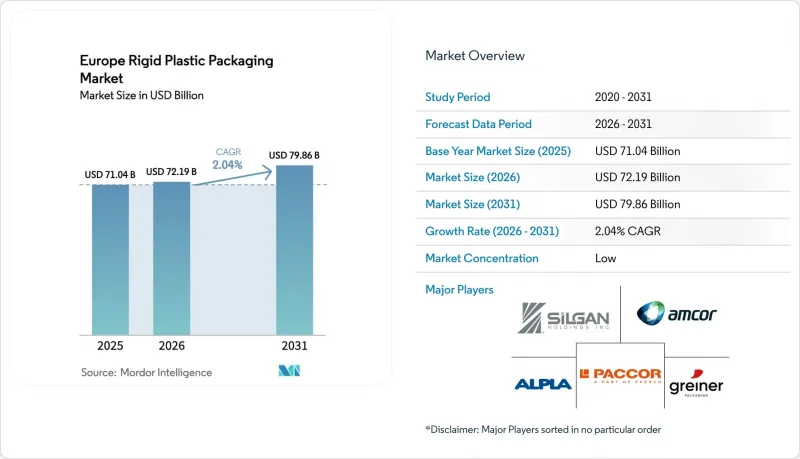
根據 Mordor Intelligence 預測,歐洲硬質塑膠包裝市場規模將從 2025 年的 710.4 億美元和 2026 年的 721.9 億美元成長到 2031 年的 798.6 億美元,2026 年至 2031 年的複合年成長率為 2.04%。
本報告按樹脂類型(聚對苯二甲酸乙二醇酯、聚丙烯及其他)、產品類型(瓶罐、托盤容器、蓋子與封口裝置其他)、終端用戶行業(食品、飲料、醫療和製藥及其他)、製造程序(射出成型、吹塑成型及其他)和國家/地區進行細分。市場預測以美元(USD)計價。
歐洲硬質塑膠包裝市場趨勢與洞察
飲料業對可回收硬質寶特瓶的需求正在激增。
為了滿足歐盟到2025年再生材料含量達到25%、2030年達到30%的標準,飲料製造商正逐步過渡到使用100%可回收的PET瓶。這項標準推動了德國、荷蘭和法國對瓶到瓶回收的投資。至2025年,德國的押金回收系統將回收98.5%的PET容器,並供應約45萬噸食品級rPET原料。西歐rPET的平均現貨價格為每噸1200至1500歐元(每噸1356至1695美元),但品牌商已簽訂多年協議以緩解價格波動。拉伸吹塑成型技術的改進已將寶特瓶的平均重量從18克降低至15克,並將樹脂用量減少了17%。在持續的監管壓力和消費者對透明永續性的需求推動下,預計到 2028 年,對 rPET 瓶的需求將呈現兩位數的成長。
電子商務的快速發展正在推動對硬質包裝容器的需求。
預計西歐線上零售額將從2023年的18%成長到2025年的22%,這將推動對硬質托盤、翻蓋包裝盒和可重複使用的HDPE板條箱的需求成長,以保護易碎商品在都市區最後一公里配送過程中免受損壞。波蘭一家履約中心採用的可回收包裝材料可承受50-100次循環使用,與瓦楞紙板相比,每次使用成本降低了40%。熱成型聚丙烯托盤搭配卡扣式蓋子,正在取代瓦楞紙板,用於線上雜貨店的生鮮產品二次包裝,使包裝總重量減輕了25%。化妝品品牌傾向於使用帶有防篡改蓋的硬質罐,以提升D2C(直接面對消費者)管道的開箱體驗。這些結構性變化表明,電子商務硬質包裝的成長速度將持續超過傳統零售包裝,尤其是在人口密集、當日達服務盛行的都市區。
一次性塑膠稅和生產者延伸責任(EPR)費用
在英國,對回收材料含量低於30%的包裝徵收每噸210.82英鎊(274美元)的課稅,預計到2025年,這將使加工成本增加約10%。在西班牙,一項於2023年推出的每公斤0.45歐元(0.51美元)的稅,鼓勵肉類加工商從聚苯乙烯托盤轉向纖維替代品。義大利的生態調節計畫根據可回收性徵收每公斤0.05至0.80歐元(0.06至0.90歐元)的稅,並對多層包裝處以罰款。因此,小型熱成型製造商成為產業結構調整的主要目標,波蘭和捷克共和國在2025年發生的一系列收購案證明了這一點。繁重的行政報告負擔正在擠壓創新資源,而關於統一收費的討論表明,到2028年,監管力度可能會進一步加強。
細分市場分析
2025年,聚乙烯的市佔率維持在28.43%,這主要得益於用於乳製品、清潔劑和運輸包裝箱的高密度聚苯乙烯瓶。相較之下,聚對苯二甲酸乙二醇酯(PET)預計到2031年將以3.12%的年成長率成長,這主要得益於押金返還計劃擴大了rPET的原料來源,以及歐盟法規強制要求到2030年瓶子中必須使用30%的再生PET。 2025年,瓶到瓶的回收量將達到280萬噸,但15%的供不應求導致rPET價格居高不下,促使加工商在飲料廠附近投資興建清洗和切片生產線。
諸如伊士曼公司位於諾曼第的年產16萬噸乙二醇裂解裝置等化學回收試點項目,預計將從2027年起擴大食品級材料的供應。聚丙烯約佔總量的23%,仍是熱填充托盤和藥品泡殼包裝的主要材料,這些產品需要耐熱性和透明度。大型消費品製造商的再填充試點計畫正在使用高耐久性HDPE瓶,這種瓶子設計可承受10至15次再填充循環,每次再填充使用的原生樹脂量減少了三分之一。儘管由於法國和比利時禁止使用發泡塑膠,聚苯乙烯的使用量有所下降,但PET的成長動能預計將在2029年縮小與聚乙烯的差距,歐洲硬質塑膠包裝市場預計將轉向可回收性更高的產品形式。
到2025年,瓶罐將佔據主導地位,市佔率高達46.65%,廣泛應用於飲料、乳製品和個人保健產品。然而,蓋子與封口裝置預計將保持最高的成長率,到2031年將以3.37%的複合年成長率成長,因為所有飲料生產商都在向繫繩式瓶蓋結構過渡,以滿足2024年7月生效的一次性塑膠指令的要求。模具改造成本高昂,每個模腔的成本在5萬歐元到15萬歐元(5.65萬美元到16.95萬美元)之間,這迫使小規模模具製造商退出市場,並將生產轉移到大型的專業瓶蓋製造商。
寶特瓶,例如500毫升礦泉水瓶,重量已減輕至僅15克,是提高材料利用率而不影響跌落測試性能的絕佳例證。硬質聚丙烯托盤在生鮮食品和冷藏食品市場佔據30%的佔有率,能夠有效防止紙質托盤在對濕度敏感的領域被滲透。中型散貨箱,主要是高密度聚乙烯(HDPE)桶,在化學和塗料行業仍然至關重要,租賃模式的引入有望創造持續的收入來源。總體而言,隨著歐盟內部設計規範的日益統一,預計瓶蓋將保持優於其他產品線的成長,預計未來在模具研發和消費者教育方面的投入也將進一步增加。
其他好處
- Excel格式的市場預測(ME)表
- 3個月的分析師支持
目錄
第1章:引言
- 研究假設和市場定義
- 調查範圍
第2章:調查方法
第3章執行摘要
第4章 市場狀況
- 市場概覽
- 市場促進因素
- 飲料業對可回收硬質寶特瓶的需求正在激增。
- 電子商務的快速發展推高了對防護性硬質包裝的需求。
- 歐盟存款返還制度的擴展將加速收款基礎設施的發展。
- 歐洲生質塑膠產能迅速擴張
- 透過試點計畫對「可填充和可重複使用」商店中的高密度聚乙烯瓶進行重新設計。
- 由於醫藥產業冷鏈的擴展,對高阻隔阻隔性硬質包裝的需求增加。
- 市場限制因素
- 一次性塑膠稅和生產者延伸責任(EPR)費用
- 由於重量減輕,轉向使用紙張和軟性材料。
- 由於能源價格急劇上漲,擠出和射出成型的成本不斷上升。
- rPET 和 rHDPE 價格的波動給加工商的利潤率帶來了壓力。
- 產業價值鏈分析
- 監理情勢
- 技術展望
- 宏觀經濟因素對市場的影響
- 波特五力分析
第5章 市場規模與成長預測
- 依樹脂類型
- 聚乙烯
- 高密度聚苯乙烯(HDPE)
- 低密度聚乙烯(LDPE)
- 線型低密度聚乙烯(LLDPE)
- 聚對苯二甲酸乙二酯
- 聚丙烯
- 聚苯乙烯(EPS)
- 其他
- 聚乙烯
- 依產品類型
- 瓶子罐
- 托盤和容器
- 蓋子與封口裝置
- 中型散貨箱(IBC)
- 鼓
- 其他
- 按最終用戶行業分類
- 食物
- 糖果和糖果甜點
- 乳製品和冷凍食品
- 肉類、雞肉、魚貝類
- 其他食物類型
- 飲料
- 醫療和藥品
- 化妝品和個人護理
- 工業化學品
- 建築/施工
- 其他
- 食物
- 透過製造程序
- 射出成型
- 吹塑成型
- 熱成型
- 壓縮成型
- 擠出成型
- 其他製造程序
- 國家
- 英國
- 德國
- 法國
- 義大利
- 西班牙
- 波蘭
- 荷蘭
- 其他歐洲國家
第6章 競爭情勢
- 市場集中度
- 策略趨勢
- 市佔率分析
- 公司簡介
- Alpla Werke Alwin Lehner GmbH & Co KG
- Mauser Packaging Solutions Holding Company
- Amcor plc
- Greiner Packaging International GmbH
- Greif, Inc.
- PACCOR Packaging GmbH(Faerch Group)
- Plastipak Holdings, Inc.
- Schoeller Allibert Services BV
- Silgan Holdings Inc.
- Albea Group
- Coda Plastics Ltd.
- Frapak Packaging BV
- Schutz GmbH & Co. KGaA
- WERIT Kunststoffwerke W. Schneider GmbH & Co. KG
- ACTI PACK SAS
- RETAL Industries Ltd.
- RIKUTEC Group
- AST Kunststoffverarbeitung GmbH
- Robinson plc
- Esterform Packaging Ltd.
第7章 市場機會與未來展望
According to Mordor Intelligence, the Europe rigid plastic packaging market size is projected to expand from USD 71.04 billion in 2025 and USD 72.19 billion in 2026 to USD 79.86 billion by 2031, registering a CAGR of 2.04% between 2026 to 2031.
This report is Segmented by Resin Type (Polyethylene Terephthalate, Polypropylene, and More), Product Type (Bottles and Jars, Trays and Containers, Caps and Closures, and More), End-User Industry (Food, Beverage, Healthcare and Pharmaceuticals, and More), Manufacturing Process (Injection Moulding, Blow Moulding, and More), and Country. The Market Forecasts are Provided in Terms of Value (USD).
Europe Rigid Plastic Packaging Market Trends and Insights
Surging Demand for Recyclable Rigid PET Bottles in Beverages
Beverage producers are shifting to 100% recyclable PET to meet the European Union's 25% recycled-content rule by 2025 and the 30% threshold by 2030, spurring investment in bottle-to-bottle recycling in Germany, the Netherlands, and France. Germany's deposit network captured 98.5% of PET containers in 2025, supplying roughly 450,000 tonnes of food-grade rPET feedstock. Spot prices for Western European rPET averaged EUR 1,200-1,500 per tonne (USD 1,356-1,695 per tonne) yet brand owners lock in multi-year contracts that mute volatility. Stretch-blow-moulding upgrades trimmed average water-bottle weight from 18 g to 15 g, cutting resin use by 17%. Continued regulatory pressure and consumer preference for transparent sustainability claims are forecast to drive double-digit rPET bottle demand through 2028.
Booming E-Commerce Boosting Protective Rigid Formats
Western Europe's online retail share rose to 22% of total sales in 2025, up from 18% in 2023, heightening demand for rigid trays, clamshells, and reusable HDPE crates that protect fragile goods during urban last-mile delivery. Returnable transport packaging adopted in Polish fulfillment hubs withstands 50-100 cycles and lowers per-trip cost by 40% relative to corrugated alternatives. Thermoformed polypropylene trays with snap-fit lids are replacing secondary cardboard for e-grocery produce, reducing overall packaging weight by 25%. Cosmetics brands favor rigid jars with tamper-evident closures to elevate unboxing experiences in direct-to-consumer channels. This structural shift suggests that e-commerce-oriented rigid formats will continue to outpace traditional retail packaging, especially in dense metro markets served by same-day couriers.
Single-Use-Plastic Taxes and Extended Producer Responsibility Fees
The United Kingdom levies GBP 210.82 per tonne (USD 274 per tonne) on packaging containing less than 30% recycled content, increasing converter costs by roughly 10% in 2025. Spain's EUR 0.45 per kg (USD 0.51 per kg) tax, in place since 2023, spurred meat processors to switch from polystyrene trays to fiber-based alternatives. Italy's eco-modulation scheme charges EUR 0.05-0.80 per kg (USD 0.06-0.90 per kg) based on recyclability, penalizing multilayer packs. Smaller thermoformers lacking scale are therefore prime consolidation targets, as seen in multiple 2025 acquisitions across Poland and the Czech Republic. Administrative reporting burdens divert resources from innovation, and fee harmonization discussions suggest further tightening through 2028.
Other drivers and restraints analyzed in the detailed report include:
- Growth of EU Deposit-Return Schemes Accelerating Collection Infrastructure
- Rapid Scale-Up of European Bioplastics Capacity
- Shift Toward Paper and Flexible Substitutes for Lightweighting
For complete list of drivers and restraints, kindly check the Table Of Contents.
Segment Analysis
Polyethylene retained 28.43% market share in 2025, anchored by high-density bottles for dairy, detergents and transport crates. In contrast, polyethylene terephthalate is forecast to grow 3.12% annually through 2031, propelled by deposit-return schemes that widen rPET feedstock and by EU rules mandating 30% recycled PET in bottles by 2030. Bottle-to-bottle recycling capacity climbed to 2.8 million tonnes in 2025, yet a 15% shortfall keeps rPET at a premium, reinforcing converter investments in washing and flake lines close to beverage plants.
Chemical recycling pilots, such as Eastman's 160,000-tonne glycolysis unit in Normandy, are expected to boost food-grade supply beyond 2027. Polypropylene, holding roughly 23% of volume, remains a staple for hot-fill trays and pharmaceutical blister packs that demand heat resistance and clarity. Refill pilots by consumer-goods majors use durable HDPE bottles engineered for 10-15 refill cycles, trimming virgin resin per use by one-third. Despite polystyrene declines tied to French and Belgian foam bans, PET's momentum will likely narrow the gap with polyethylene before 2029, shifting the Europe rigid plastic packaging market size composition toward higher-recycled-content formats.
Bottles and jars dominated with 46.65% share in 2025, servicing beverages, dairy and personal care. However, caps and closures are on pace for the strongest 3.37% CAGR through 2031 as every beverage player converts to tethered-cap geometry to satisfy July 2024 Single-Use Plastics Directive rules. Retooling costs of EUR 50,000-150,000 (USD 56,500-169,500) per cavity have prompted exit by small moulders, shifting volume toward large closure specialists.
Lightweighted PET bottles, already down to 15 g for 500 mL water, exemplify material-efficiency gains without sacrificing drop performance. Rigid polypropylene trays capture 30% volume in produce and chilled food, resisting the creep of paper trays where moisture is a concern. Intermediate bulk containers, predominantly HDPE drums, remain indispensable for chemicals and coatings, and adoption of leasing models is expected to open recurring revenue streams. Overall, caps will likely keep outpacing other product lines as design guidelines become uniform across the bloc, reinforcing tooling investment and consumer-education spending.
Complete Report Scope:
- By Resin Type
- Polyethylene
- High-Density Polyethylene (HDPE)
- Low-Density Polyethylene (LDPE)
- Linear Low-Density Polyethylene (LLDPE)
- Polyethylene Terephthalate
- Polypropylene
- Polystyrene and EPS
- Other Resin Types
- Polyethylene
- By Product Type
- Bottles and Jars
- Trays and Containers
- Caps and Closures
- Intermediate Bulk Containers (IBCs)
- Drums
- Other Product Types
- By End-user Industry
- Food
- Candy and Confectionery
- Dairy and Frozen
- Meat, Poultry and Seafood
- Other Food Types
- Beverage
- Healthcare and Pharmaceuticals
- Cosmetics and Personal Care
- Industrial Chemicals
- Building and Construction
- Other End-user Industries
- Food
- By Manufacturing Process
- Injection Moulding
- Blow Moulding
- Thermoforming
- Compression Moulding
- Extrusion
- Other Manufacturing Process
- By Country
- United Kingdom
- Germany
- France
- Italy
- Spain
- Poland
- Netherlands
- Rest of Europe
List of Companies Covered in this Report:
- Alpla Werke Alwin Lehner GmbH & Co KG
- Mauser Packaging Solutions Holding Company
- Amcor plc
- Greiner Packaging International GmbH
- Greif, Inc.
- PACCOR Packaging GmbH (Faerch Group)
- Plastipak Holdings, Inc.
- Schoeller Allibert Services B.V.
- Silgan Holdings Inc.
- Albea Group
- Coda Plastics Ltd.
- Frapak Packaging B.V.
- Schutz GmbH & Co. KGaA
- WERIT Kunststoffwerke W. Schneider GmbH & Co. KG
- ACTI PACK S.A.S.
- RETAL Industries Ltd.
- RIKUTEC Group
- AST Kunststoffverarbeitung GmbH
- Robinson plc
- Esterform Packaging Ltd.
Additional Benefits:
- The market estimate (ME) sheet in Excel format
- 3 months of analyst support
TABLE OF CONTENTS
1 INTRODUCTION
- 1.1 Study Assumptions and Market Definition
- 1.2 Scope of the Study
2 RESEARCH METHODOLOGY
3 EXECUTIVE SUMMARY
4 MARKET LANDSCAPE
- 4.1 Market Overview
- 4.2 Market Drivers
- 4.2.1 Surging Demand for Recyclable Rigid PET Bottles in Beverages
- 4.2.2 Booming E-Commerce Boosting Protective Rigid Formats
- 4.2.3 Growth of EU Deposit-Return Schemes Accelerating Collection Infrastructure
- 4.2.4 Rapid Scale-Up of European Bioplastics Capacity
- 4.2.5 Refill-and-Reuse Store Pilots Driving HDPE Bottle Redesigns
- 4.2.6 Pharma Cold-Chain Expansion Needing High-Barrier Rigid Packs
- 4.3 Market Restraints
- 4.3.1 Single-Use-Plastic Taxes and Extended Producer Responsibility Fees
- 4.3.2 Shift Toward Paper and Flexible Substitutes for Lightweighting
- 4.3.3 Energy-Price Shocks Raising Extrusion and Injection Costs
- 4.3.4 Volatile rPET and rHDPE Prices Squeezing Converter Margins
- 4.4 Industry Value Chain Analysis
- 4.5 Regulatory Landscape
- 4.6 Technological Outlook
- 4.7 Impact of Macroeconomic Factors on the Market
- 4.8 Porter's Five Forces Analysis
- 4.8.1 Threat of New Entrants
- 4.8.2 Bargaining Power of Buyers
- 4.8.3 Bargaining Power of Suppliers
- 4.8.4 Threat of Substitutes
- 4.8.5 Intensity of Competitive Rivalry
5 MARKET SIZE AND GROWTH FORECASTS (VALUE)
- 5.1 By Resin Type
- 5.1.1 Polyethylene
- 5.1.1.1 High-Density Polyethylene (HDPE)
- 5.1.1.2 Low-Density Polyethylene (LDPE)
- 5.1.1.3 Linear Low-Density Polyethylene (LLDPE)
- 5.1.2 Polyethylene Terephthalate
- 5.1.3 Polypropylene
- 5.1.4 Polystyrene and EPS
- 5.1.5 Other Resin Types
- 5.1.1 Polyethylene
- 5.2 By Product Type
- 5.2.1 Bottles and Jars
- 5.2.2 Trays and Containers
- 5.2.3 Caps and Closures
- 5.2.4 Intermediate Bulk Containers (IBCs)
- 5.2.5 Drums
- 5.2.6 Other Product Types
- 5.3 By End-user Industry
- 5.3.1 Food
- 5.3.1.1 Candy and Confectionery
- 5.3.1.2 Dairy and Frozen
- 5.3.1.3 Meat, Poultry and Seafood
- 5.3.1.4 Other Food Types
- 5.3.2 Beverage
- 5.3.3 Healthcare and Pharmaceuticals
- 5.3.4 Cosmetics and Personal Care
- 5.3.5 Industrial Chemicals
- 5.3.6 Building and Construction
- 5.3.7 Other End-user Industries
- 5.3.1 Food
- 5.4 By Manufacturing Process
- 5.4.1 Injection Moulding
- 5.4.2 Blow Moulding
- 5.4.3 Thermoforming
- 5.4.4 Compression Moulding
- 5.4.5 Extrusion
- 5.4.6 Other Manufacturing Process
- 5.5 By Country
- 5.5.1 United Kingdom
- 5.5.2 Germany
- 5.5.3 France
- 5.5.4 Italy
- 5.5.5 Spain
- 5.5.6 Poland
- 5.5.7 Netherlands
- 5.5.8 Rest of Europe
6 COMPETITIVE LANDSCAPE
- 6.1 Market Concentration
- 6.2 Strategic Moves
- 6.3 Market Share Analysis
- 6.4 Company Profiles (Includes Global Level Overview, Market Level Overview, Core Segments, Financials as Available, Strategic Information, Market Rank/Share, Products and Services, and Recent Developments)
- 6.4.1 Alpla Werke Alwin Lehner GmbH & Co KG
- 6.4.2 Mauser Packaging Solutions Holding Company
- 6.4.3 Amcor plc
- 6.4.4 Greiner Packaging International GmbH
- 6.4.5 Greif, Inc.
- 6.4.6 PACCOR Packaging GmbH (Faerch Group)
- 6.4.7 Plastipak Holdings, Inc.
- 6.4.8 Schoeller Allibert Services B.V.
- 6.4.9 Silgan Holdings Inc.
- 6.4.10 Albea Group
- 6.4.11 Coda Plastics Ltd.
- 6.4.12 Frapak Packaging B.V.
- 6.4.13 Schutz GmbH & Co. KGaA
- 6.4.14 WERIT Kunststoffwerke W. Schneider GmbH & Co. KG
- 6.4.15 ACTI PACK S.A.S.
- 6.4.16 RETAL Industries Ltd.
- 6.4.17 RIKUTEC Group
- 6.4.18 AST Kunststoffverarbeitung GmbH
- 6.4.19 Robinson plc
- 6.4.20 Esterform Packaging Ltd.
7 MARKET OPPORTUNITIES AND FUTURE OUTLOOK
- 7.1 White-Space and Unmet-Need Assessment

 北美硬質塑膠包裝:市場佔有率分析、產業趨勢與統計及成長預測(2026-2031 年)印度硬質塑膠包裝:市場佔有率分析、產業趨勢與統計及成長預測(2026-2031)印尼硬質塑膠包裝:市場佔有率分析、產業趨勢與統計及成長預測(2026-2031)
 硬質塑膠包裝市場:2026-2032年全球市場預測(按產品類型、材料類型、製造流程、蓋/密封類型和最終用途行業分類)
 2026-2030年全球硬質塑膠包裝市場
 硬質塑膠包裝市場規模、佔有率、趨勢和預測:按產品、材料、製造程序、最終用途行業和地區分類,2026-2034年
 硬質塑膠包裝市場規模、佔有率和成長分析:按製造流程、原料、包裝類型、最終用戶和地區分類-2026-2033年產業預測
 硬質塑膠包裝市場分析及預測(至2035年):類型、產品類型、材質類型、技術、應用、最終用戶、功能、製程和設備
 全球硬質塑膠包裝市場規模、佔有率、趨勢和成長分析報告(2026-2034年)
 2026年全球硬質塑膠包裝市場報告