


 |
市場調查報告書
商品編碼
2116915
印度硬質塑膠包裝:市場佔有率分析、產業趨勢與統計及成長預測(2026-2031)India Rigid Plastic Packaging - Market Share Analysis, Industry Trends & Statistics, Growth Forecasts (2026 - 2031) |
||||||

※ 本網頁內容可能與最新版本有所差異。詳細情況請與我們聯繫。
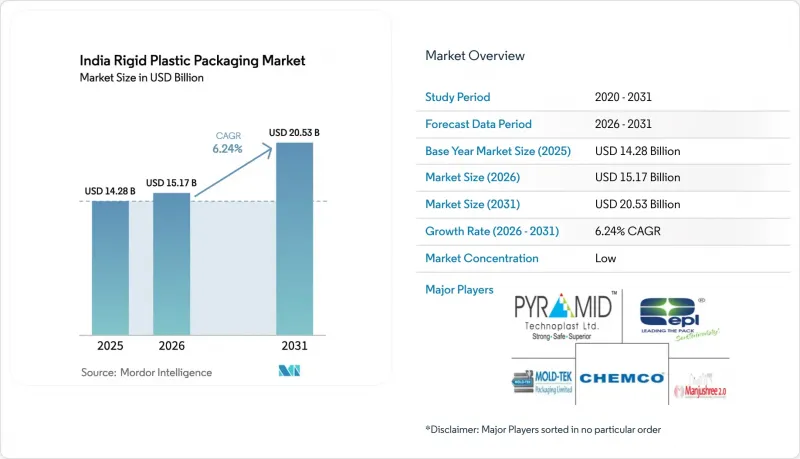
根據 Mordor Intelligence 預測,印度硬質塑膠包裝市場規模將從 2025 年的 142.8 億美元成長到 2026 年的 151.7 億美元,然後在 2031 年達到 205.3 億美元,2026 年至 2031 年的複合年成長率為 6.24%。
本報告按樹脂類型(例如聚乙烯 (PE)、聚對苯二甲酸乙二醇酯 (PET)、聚丙烯 (PP))、產品類型(例如瓶子和罐子、托盤和容器、蓋子與封口裝置)、最終用途行業(例如食品、餐飲、飲料)和製造程序(例如吹塑成型、射出成型)對行業進行分類。
印度硬質塑膠包裝市場趨勢與洞察
印度二線城市和都市區包裝乳製品市場爆炸性成長
預計到2025年,印度原乳消費量將達9,100萬噸,較2024年成長2.2%。這將為印度硬質塑膠包裝市場帶來穩定的瓶罐需求。隨著中都市區的消費者從散裝產品轉向品牌產品,光是預包裝原乳市場預計到2026年就將達到200億美元。價值15,000印度盧比的畜牧業基礎設施基金正在資助加工企業採用多層高密度聚乙烯(HDPE)瓶以延長保存期限。像Country Delight這樣的D2C品牌(該公司在2025年籌集了2000萬美元的新資金)正在採用防篡改PET包裝設計,以確保36小時內送達。這些因素共同為印度硬質塑膠包裝市場的加工商帶來了長期的銷售量前景。
政府推廣乙醇混合燃料,提振了對高密度聚乙烯(HDPE)塑膠桶的需求。
在印度,2024年乙醇平均摻混比例達到11.5%,目標在2025年達到20%,這將刺激下游對耐化學腐蝕的高密度聚乙烯(HDPE)儲槽的需求。 2024年產能達到63.5億升,並在修訂後的「總理吉瓦恩計畫」(Pradan Mantri Ji-Van Yojana)的推動下持續成長。隨著新的釀酒廠在遠離甘蔗產區的地區落成,對塑膠桶的需求也日益多元化,擴大了印度硬質塑膠包裝市場的地域覆蓋範圍。能夠耐受乙醇腐蝕的高級HDPE產品利潤率更高,這將使擁有複合材料加工專業知識的加工商受益。
BIS提出的限制鄰苯二甲酸酯含量的標準正在推高合規成本。
將於2024年1月生效的印度標準局(BIS)修訂版低密度聚乙烯(LDPE)、線性低密度聚乙烯(LLDPE)和高密度聚乙烯(HDPE)標準,對認證設置了諸多障礙,使得小規模加工商難以承擔相關成本。同時,食品安全局(FSA)的規定強制要求對再生聚對苯二甲酸乙二醇酯(PET)進行遷移測試,這增加了實驗室的營運成本。這種成本負擔正使印度硬質塑膠包裝市場的議價能力向擁有認證實驗室並能通過規模經濟分攤合規成本的大型企業傾斜。
細分市場分析
該細分市場佔據印度硬質塑膠包裝市場的最大佔有率,其中PET在2025年將佔據33.02%的市場佔有率,主要受飲料和製藥行業需求的推動。 PP雖然規模較小,但預計到2031年將以7.42%的複合年成長率成長,這主要得益於微波爐食品容器和汽車零件的需求。監管機構要求提高再生PET的含量,這促進了對rPET的投資,而聚丙烯價格的波動(2025年初到岸價為每噸970-990美元)則給中小企業的現金流帶來了壓力。隨著運作7.5萬噸生質塑膠PLA產能的投產,新的競爭將會出現,但預計成本持平仍需數年時間才能實現。
由於PET在乳製品瓶裝和藥品管瓶的持續應用,其需求保持穩定,但循環經濟的趨勢正在提升消費者對再生塑膠的品牌接受度。 PP的耐熱性確保了其在熱填充應用領域的成長,但樹脂價格的不確定性促使加工商對沖採購風險。總體而言,樹脂選擇趨勢可能會重新調整印度硬質塑膠包裝市場的利潤率。
到2025年,瓶罐包裝將佔印度硬質塑膠包裝市場佔有率的35.31%,這主要得益於其在牛奶、飲用水和非成藥的廣泛應用。即使在潮濕環境下也能延長保存期限的阻隔托盤,正被應用於米、零食和即食食品等產品的包裝中。中型散貨箱在化學行業中保持穩定的市場佔有率,並且由於乙醇項目推動了20升桶的採購,其需求將進一步擴大。產品創新的核心在於輕量化的瓶頸設計,這種設計可以減少單位樹脂用量,而這對於維持印度硬質塑膠包裝市場的盈利至關重要。
其他好處:
- Excel格式的市場預測(ME)表
- 3個月的分析師支持
目錄
第1章:引言
- 研究假設和市場定義
- 調查範圍
第2章:調查方法
第3章執行摘要
第4章 市場狀況
- 市場概覽
- 市場促進因素
- 印度二線城市和都市區包裝乳製品市場爆炸性成長
- 政府推廣乙醇混合燃料,提振了對高密度聚乙烯(HDPE)油桶的需求。
- 各大快速消費品品牌擴大採用強制性添加PCR材料的做法,這正在加速rPET瓶的市場滲透。
- 連鎖餐廳的激增帶動了翻蓋式和托盤式餐盒產品的銷售。
- 冷鏈的擴展正在推動對飲料和藥品管瓶用PET瓶坯的需求。
- 市場限制因素
- BIS提出的限制鄰苯二甲酸酯含量的標準正在推高合規成本。
- 各州對一次性塑膠製品的禁令正在將需求轉向紙盒。
- 丙烯價格的波動給中小加工企業的聚丙烯利潤率帶來了壓力。
- 電子商務中對軟性包裝材料的偏好正在減少小型包裹對硬質包裝材料的使用。
- 供應鏈分析
- 技術展望
- 監理展望
- 波特五力分析
- 貿易概覽(基於相關HS編碼)
- 貿易分析-五大主要國家的進出口狀況
- 回收和永續性趨勢
第5章 市場規模與成長預測
- 依樹脂類型
- 聚乙烯(PE)
- 低密度聚乙烯(LDPE)
- 線型低密度聚乙烯(LLDPE)
- 高密度聚苯乙烯(HDPE)
- 聚對苯二甲酸乙二醇酯(PET)
- 聚丙烯(PP)
- 聚苯乙烯(PS)和發泡聚苯乙烯(EPS)
- 聚氯乙烯(PVC)
- 其他樹脂類型
- 聚乙烯(PE)
- 依產品類型
- 瓶子和罐子
- 托盤和容器
- 中型散貨箱(IBC)
- 鼓和油桶
- 其他產品類型
- 按最終用途行業分類
- 食物
- 零食和糖果甜點
- 生鮮食品
- 乳製品
- 乾貨和穀物
- 寵物食品
- 其他食物
- 飲料
- 瓶裝水
- 果汁和花蜜
- 乳製品飲料
- 碳酸軟性飲料
- 其他飲料
- 食品服務業
- 製藥
- 化妝品和個人護理
- 產業
- 其他終端用戶產業
- 食物
- 透過生產過程
- 吹塑成型
- 射出成型
- 擠壓
- 熱成型
第6章 競爭情勢
- 市場集中度
- 策略趨勢
- 市佔率分析
- 公司簡介
- Amcor PLC
- ALPLA India Pvt Ltd
- Manjushree Technopack Ltd
- Mold-Tek Packaging Ltd
- Time Technoplast Ltd
- Pyramid Technoplast Pvt Ltd
- Chemco Group
- Parekhplast India Ltd
- Hitech Corporation
- Pearl Polymers Ltd(Pearlpet)
- Regent Plast Pvt Ltd
- Bericap India Pvt Ltd
- Nilkamal Ltd
- Supreme Industries Ltd-Crates Division
- Unity Poly Barrels Pvt Ltd
- Essel Propack(EPL Ltd)
- Time Technopack-Reusable Drums
- Greif Flexibles India
- UFlex Rigid Packaging
- Supreme Plasto Containers
第7章 市場機會與未來展望
According to Mordor Intelligence, the india rigid plastic packaging market size is expected to grow from USD 14.28 billion in 2025 to USD 15.17 billion in 2026 and is forecast to reach USD 20.53 billion by 2031 at 6.24% CAGR over 2026-2031.
This report Segments the Industry Into by Resin Type (Polyethylene (PE), Polyethylene Terephthalate (PET), Polypropylene (PP), and More), Product Type (Bottles and Jars, Trays and Containers, Caps and Closures, and More), and End-Use Industries (Food, Foodservice, Beverage, and More), and Production Process ( Blow Molding, Injection Molding, and More)
India Rigid Plastic Packaging Market Trends and Insights
Explosive Growth of Packaged Dairy in Tier-II and Semi-Urban India
Fluid milk consumption is set to touch 91 million tonnes in 2025, a 2.2% rise from 2024, converting into consistent bottle and jar demand inside the India rigid plastic packaging market. Packaged fresh milk alone pursues a USD 20 billion opportunity by 2026 as semi-urban consumers shift from loose to branded supply. The INR 15,000 crore Animal Husbandry Infrastructure Fund is financing processing units that specify multilayer HDPE bottles for improved shelf life. Direct-to-consumer brands such as Country Delight, backed by USD 20 million of fresh capital in 2025, adopt tamper-evident PET designs to guarantee delivery within 36 hours. Together these forces embed long-run volume visibility for converters operating in the India rigid plastic packaging market.
Government Push for Ethanol-Blended Fuel Boosting HDPE Jerrycan Demand
India averaged an 11.5% ethanol blend in 2024 and eyes 20% by 2025, triggering downstream demand for chemically resistant HDPE storage drums. Production capacity reached 6.35 billion liters in 2024 and continues to climb under the modified Pradhan Mantri JI-VAN Yojana. As new distilleries open away from cane belts, distributed jerrycan demand follows, widening geographic spread within the India rigid plastic packaging market. Premium grade HDPE that withstands ethanol corrosion commands higher margins, rewarding processors with compounding expertise.
Draft BIS Standards Limiting Phthalate Levels Raising Compliance Costs
Revised BIS norms for LDPE, LLDPE and HDPE effective January 2024 impose certification hurdles that smaller converters struggle to finance. Parallel Food Safety Authority rules demand migration testing for recycled PET, adding laboratory overheads. The expense tilts bargaining power toward larger players inside the India rigid plastic packaging market that operate accredited labs and can amortize compliance over scale.
Other drivers and restraints analyzed in the detailed report include:
- Rising Adoption of PCR-Content Mandates by Top FMCG Brands Accelerating rPET Bottle Penetration
- Cold-Chain Expansion Enabling PET Preform Demand for Beverage and Pharma Vials
- State-Level Single-Use Plastic Bans Shifting Volume to Paper Cartons
For complete list of drivers and restraints, kindly check the Table Of Contents.
Segment Analysis
The segment generated the largest slice of the India rigid plastic packaging market size, as PET secured 33.02% share in 2025 on the strength of beverage and pharma demand. PP, while smaller, is projected to clock a 7.42% CAGR to 2031 supported by microwave-safe food tubs and automotive components. Regulatory pushes for higher recycled content favor rPET investments, whereas polypropylene volatility, with prices at USD 970-990 per tonne CFR in early 2025, stresses SME cash flows. Bioplastic PLA capacity of 75,000 tonnes coming onstream by 2026 introduces fresh competition, yet cost parity is some years away.
Continued dairy bottling and pharmaceutical vial adoption anchor PET volume, while the circular-economy narrative lifts brand acceptance of recycled grades. PP's heat-resistance profile secures growth in hot-fill applications even as resin price uncertainty leads converters to hedge procurement. Collectively, resin choice trends will recalibrate margins across the India rigid plastic packaging market.
Bottles & Jars contributed 35.31% of the India rigid plastic packaging market share in 2025 due to universal use in milk, water and OTC medicine. Rice, snack and ready-to-eat portfolios rely on barrier trays that extend shelf life under humid conditions. Intermediate bulk containers maintain a stable niche in chemicals, amplified by the ethanol program that lifts 20-liter drum procurement. Product innovation centers on lightweight neck finishes that drop resin usage per unit, a vital lever to sustain profitability inside the India rigid plastic packaging market.
Complete Report Scope:
- By Resin Type
- Polyethylene (PE)
- Low-Density Polyethylene (LDPE)
- Linear Low-Density Polyethylene (LLDPE)
- High-Density Polyethylene (HDPE)
- Polyethylene Terephthalate (PET)
- Polypropylene (PP)
- Polystyrene (PS) and Expanded PS (EPS)
- Polyvinyl Chloride (PVC)
- Other Resin Type
- Polyethylene (PE)
- By Product Type
- Bottles and Jars
- Trays and Containers
- Intermediate Bulk Containers (IBCs)
- Drums and Jerrycans
- Other Product Type
- By End-Use Industry
- Food
- Snacks and Confectionery
- Fresh Produce
- Dairy Based Products
- Dry Foods and Cereals
- Pet Food
- Other Food Products
- Beverage
- Bottled Water
- Juices and Nectars
- Dairy Based Beverages
- Carbonated Soft Drinks
- Other Beverages
- Food-service
- Pharmaceuticals
- Cosmetics and Personal Care
- Industrial
- Other End-Use Industry
- Food
- By Production Process
- Blow Molding
- Injection Molding
- Extrusion
- Thermoforming
List of Companies Covered in this Report:
- Amcor PLC
- ALPLA India Pvt Ltd
- Manjushree Technopack Ltd
- Mold-Tek Packaging Ltd
- Time Technoplast Ltd
- Pyramid Technoplast Pvt Ltd
- Chemco Group
- Parekhplast India Ltd
- Hitech Corporation
- Pearl Polymers Ltd (Pearlpet)
- Regent Plast Pvt Ltd
- Bericap India Pvt Ltd
- Nilkamal Ltd
- Supreme Industries Ltd - Crates Division
- Unity Poly Barrels Pvt Ltd
- Essel Propack (EPL Ltd)
- Time Technopack - Reusable Drums
- Greif Flexibles India
- UFlex Rigid Packaging
- Supreme Plasto Containers
Additional Benefits:
- The market estimate (ME) sheet in Excel format
- 3 months of analyst support
TABLE OF CONTENTS
1 INTRODUCTION
- 1.1 Study Assumptions and Market Definition
- 1.2 Scope of the Study
2 RESEARCH METHODOLOGY
3 EXECUTIVE SUMMARY
4 MARKET LANDSCAPE
- 4.1 Market Overview
- 4.2 Market Drivers
- 4.2.1 Explosive Growth of Packaged Dairy in Tier-II and Semi-Urban India
- 4.2.2 Government Push for Ethanol-Blended Fuel Boosting HDPE Jerrycan Demand
- 4.2.3 Rising Adoption of PCR-Content Mandates by Top FMCG Brands Accelerating rPET Bottle Penetration
- 4.2.4 Surge in Organized Food-service Chains Driving Clamshell and Tray Volumes
- 4.2.5 Cold-Chain Expansion Enabling PET Preform Demand for Beverage and Pharma Vials
- 4.3 Market Restraints
- 4.3.1 Draft BIS Standards Limiting Phthalate Levels Raising Compliance Costs
- 4.3.2 State-Level Single-Use Plastic Bans Shifting Volume to Paper Cartons
- 4.3.3 Volatile Propylene Prices Squeezing PP Margins for SME Converters
- 4.3.4 E-commerce Preference for Flexible Mailers Reducing Small-Parcel Rigid Use
- 4.4 Supply-Chain Analysis
- 4.5 Technological Outlook
- 4.6 Regulatory Outlook
- 4.7 Porter's Five Forces Analysis
- 4.7.1 Bargaining Power of Suppliers
- 4.7.2 Bargaining Power of Buyers/Consumers
- 4.7.3 Threat of New Entrants
- 4.7.4 Threat of Substitutes
- 4.7.5 Intensity of Competitive Rivalry
- 4.8 Trade Scenario (Under Relevant HS Code)
- 4.8.1 Trade Analysis - Top 5 Import/Export Countries
- 4.9 Recycling and Sustainability Landscape
5 MARKET SIZE AND GROWTH FORECASTS (VALUE)
- 5.1 By Resin Type
- 5.1.1 Polyethylene (PE)
- 5.1.1.1 Low-Density Polyethylene (LDPE)
- 5.1.1.2 Linear Low-Density Polyethylene (LLDPE)
- 5.1.1.3 High-Density Polyethylene (HDPE)
- 5.1.2 Polyethylene Terephthalate (PET)
- 5.1.3 Polypropylene (PP)
- 5.1.4 Polystyrene (PS) and Expanded PS (EPS)
- 5.1.5 Polyvinyl Chloride (PVC)
- 5.1.6 Other Resin Type
- 5.1.1 Polyethylene (PE)
- 5.2 By Product Type
- 5.2.1 Bottles and Jars
- 5.2.2 Trays and Containers
- 5.2.3 Intermediate Bulk Containers (IBCs)
- 5.2.4 Drums and Jerrycans
- 5.2.5 Other Product Type
- 5.3 By End-Use Industry
- 5.3.1 Food
- 5.3.1.1 Snacks and Confectionery
- 5.3.1.2 Fresh Produce
- 5.3.1.3 Dairy Based Products
- 5.3.1.4 Dry Foods and Cereals
- 5.3.1.5 Pet Food
- 5.3.1.6 Other Food Products
- 5.3.2 Beverage
- 5.3.2.1 Bottled Water
- 5.3.2.2 Juices and Nectars
- 5.3.2.3 Dairy Based Beverages
- 5.3.2.4 Carbonated Soft Drinks
- 5.3.2.5 Other Beverages
- 5.3.3 Food-service
- 5.3.4 Pharmaceuticals
- 5.3.5 Cosmetics and Personal Care
- 5.3.6 Industrial
- 5.3.7 Other End-Use Industry
- 5.3.1 Food
- 5.4 By Production Process
- 5.4.1 Blow Molding
- 5.4.2 Injection Molding
- 5.4.3 Extrusion
- 5.4.4 Thermoforming
6 COMPETITIVE LANDSCAPE
- 6.1 Market Concentration
- 6.2 Strategic Moves
- 6.3 Market Share Analysis
- 6.4 Company Profiles (Includes Global Overview, Market-level Overview, Core Segments, Financials, Strategic Information, Market Rank/Share, Products and Services, Recent Developments)
- 6.4.1 Amcor PLC
- 6.4.2 ALPLA India Pvt Ltd
- 6.4.3 Manjushree Technopack Ltd
- 6.4.4 Mold-Tek Packaging Ltd
- 6.4.5 Time Technoplast Ltd
- 6.4.6 Pyramid Technoplast Pvt Ltd
- 6.4.7 Chemco Group
- 6.4.8 Parekhplast India Ltd
- 6.4.9 Hitech Corporation
- 6.4.10 Pearl Polymers Ltd (Pearlpet)
- 6.4.11 Regent Plast Pvt Ltd
- 6.4.12 Bericap India Pvt Ltd
- 6.4.13 Nilkamal Ltd
- 6.4.14 Supreme Industries Ltd - Crates Division
- 6.4.15 Unity Poly Barrels Pvt Ltd
- 6.4.16 Essel Propack (EPL Ltd)
- 6.4.17 Time Technopack - Reusable Drums
- 6.4.18 Greif Flexibles India
- 6.4.19 UFlex Rigid Packaging
- 6.4.20 Supreme Plasto Containers
7 MARKET OPPORTUNITIES AND FUTURE OUTLOOK
- 7.1 White-space and Unmet-need Assessment

 北美硬質塑膠包裝:市場佔有率分析、產業趨勢與統計及成長預測(2026-2031 年)歐洲硬質塑膠包裝:市場佔有率分析、產業趨勢與統計及成長預測(2026-2031)印尼硬質塑膠包裝:市場佔有率分析、產業趨勢與統計及成長預測(2026-2031)
 硬質塑膠包裝市場:2026-2032年全球市場預測(按產品類型、材料類型、製造流程、蓋/密封類型和最終用途行業分類)
 2026-2030年全球硬質塑膠包裝市場
 硬質塑膠包裝市場規模、佔有率、趨勢和預測:按產品、材料、製造程序、最終用途行業和地區分類,2026-2034年
 硬質塑膠包裝市場規模、佔有率和成長分析:按製造流程、原料、包裝類型、最終用戶和地區分類-2026-2033年產業預測
 硬質塑膠包裝市場分析及預測(至2035年):類型、產品類型、材質類型、技術、應用、最終用戶、功能、製程和設備
 全球硬質塑膠包裝市場規模、佔有率、趨勢和成長分析報告(2026-2034年)
 2026年全球硬質塑膠包裝市場報告