


 |
市場調查報告書
商品編碼
2124587
印尼硬質塑膠包裝:市場佔有率分析、產業趨勢與統計及成長預測(2026-2031)Indonesia Rigid Plastic Packaging - Market Share Analysis, Industry Trends & Statistics, Growth Forecasts (2026 - 2031) |
||||||

※ 本網頁內容可能與最新版本有所差異。詳細情況請與我們聯繫。
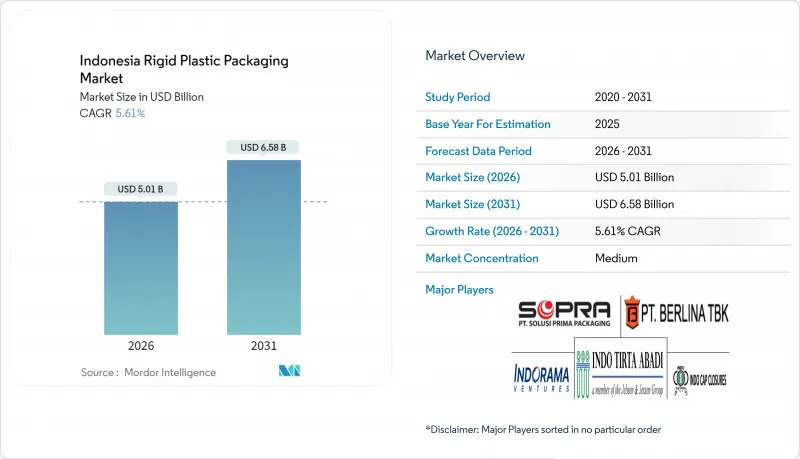
根據 Mordor Intelligence 預測,印尼硬質塑膠包裝市場規模預計將在 2026 年達到 50.1 億美元,到 2031 年達到 65.8 億美元,預測期內複合年成長率為 5.61%。
本報告按樹脂類型(聚乙烯、PET、聚丙烯、聚苯乙烯等)、產品類型(瓶/罐、托盤、蓋子與封口裝置、IBC噸桶、桶等)、最終用戶(食品、飲料、醫療保健、化妝品、工業、建築等)和製造程序(射出成型、吹塑成型等)進行細分。市場預測以美元計價。
印尼硬質塑膠包裝市場趨勢及洞察
包裝食品和飲料消費量增加
預計印尼包裝食品支出將從2023年的414億美元增加到2028年的約667億美元,這將推動對高密度聚乙烯(HDPE)乳製品瓶、聚丙烯零食罐和聚對苯二甲酸乙二醇酯(PET)飲料容器的需求。 2024年至2025年間,印尼人均加工食品支出增加了12%,因為雙薪家庭尋求保存期限更長、更便利的產品。 2024年,光是瓶裝水就消耗了30萬噸PET,碳酸飲料消耗了20萬噸,兩者合計佔PET總用量的一半。快餐店正在採用薄壁托盤和防篡改蓋,這推動了熱成型托盤的普及。消費者從生鮮市場轉向超級市場,強化了他們對硬質塑膠能夠確保食品安全的認知,而國家藥品和食品管理局的標籤法規也進一步強化了這個趨勢。
都市區中產階級的購買力不斷增強
到2030年,年收入在5,000美元至15,000美元之間的家庭數量將達到1.35億戶,他們購買的品牌包裝商品數量將是低收入家庭的三倍。預計2024年人均GDP將達到4,925美元,持續5%的經濟成長將推動消費者在硬包裝化妝品、高級飲料和個人保養用品方面的自由裁量權支配支出。
原油衍生樹脂價格波動
聚乙烯和聚丙烯的成本與布蘭特原油價格有三個月的滯後關係,這意味著加工商會受到每桶15美元價格波動的影響,這可能導致利潤率下降6個百分點。 2024年12月,東南亞聚丙烯的到岸價(CFR)為每噸930至970美元。原油價格每上漲10美元,石腦油成本就會上漲7美元,這將給採用60天付款週期的工廠的盈利帶來壓力。 2025年天然氣價格飆升迫使乙烯裂解裝置減產12%,導致樹脂供應緊張,並擾亂了印尼硬質塑膠包裝市場客戶的交貨時間。
細分市場分析
2025年,聚乙烯在印尼硬質塑膠包裝市場佔有29.43%的佔有率,主要得益於其高密度等級產品在清潔劑瓶和乳製品容器的應用。 2024年,光是高密度聚苯乙烯就滿足了家用和工業化學品21萬噸的需求。聚對苯二甲酸乙二醇酯(PET)的需求主要來自瓶裝水,瓶裝水的年消耗量已達30萬噸,預計到2031年,PET的年成長率將達到5.94%,成為樹脂中成長率最高的材料。目前,Indorama Ventures正致力於消除產能瓶頸,預計到2026年,印尼國內食品級PET的產能將增加15萬噸,從而減少對進口的依賴,並促進瓶到瓶的循環利用。
在印尼硬質塑膠包裝市場,加工商約40%的聚乙烯和32%的聚丙烯供應依賴Chandra Asri Petrochemical公司,這形成了一種準寡占格局,既穩定了價格,也限制了其他企業的議價能力。輕量化仍然是重要的競爭優勢。 PT Berlina公司在2023年至2024年間將其瓶坯重量降低了15%,為一家大型飲料生產商客戶節省了4,200噸樹脂和840萬美元。這清楚地表明,技術進步對客戶維繫有著直接的影響。
到2025年,瓶罐將佔總銷售額的45.65%,其中PET飲料瓶就佔28%。瓶蓋是成長最快的細分市場,預計到2031年將以每年6.32%的速度成長,這主要得益於兒童安全蓋和運動蓋等產品成為監管和行銷的強制性要求。 Indo Cap Closures公司於2024年推出的一條新的壓縮成型生產線將使瓶蓋年產能提升至20億個,從而幫助製藥業的客戶滿足ISO 15378可追溯性標準。
印尼硬質塑膠包裝市場的企業也正致力於托盤和容器的創新。熱成型聚丙烯托盤重12克,而射出成型產品重18克,每單位成本優勢達0.04美元,因此對速食店和調理食品品牌極具吸引力。中型散貨箱和桶裝產品佔產品銷售額的9%,主要用於工業化學品和潤滑油;托盤和板條箱等小眾產品則佔剩餘的7%。
其他好處:
- Excel格式的市場預測(ME)表
- 3個月的分析師支持
目錄
第1章:引言
- 研究假設和市場定義
- 調查範圍
第2章:調查方法
第3章執行摘要
第4章 市場狀況
- 市場概覽
- 市場促進因素
- 包裝食品和飲料消費量增加
- 都市區中產階級購買力的增強
- 現代零售和電子商務通路的擴張
- 人們越來越傾向於選擇PET材料,因為它比玻璃更輕。
- 鼓勵擴大國內石化產能的獎勵
- 品牌主導的可重複填充硬質包裝試點項目
- 市場限制因素
- 來自軟包裝的競爭
- 原油衍生樹脂價格波動
- 各州禁止使用一次性塑膠製品
- 消費後回收基礎設施不足。
- 產業價值鏈分析
- 宏觀經濟因素對市場的影響
- 監理情勢
- 技術展望
- 波特五力分析
- 回收和永續性趨勢
第5章 市場規模與成長預測
- 依樹脂類型
- 聚乙烯
- 高密度聚苯乙烯(HDPE)
- 低密度聚乙烯(LDPE)
- 線型低密度聚乙烯(LLDPE)
- 聚對苯二甲酸乙二酯
- 聚丙烯
- 聚苯乙烯和EPS
- 其他樹脂類型
- 聚乙烯
- 依產品類型
- 瓶子和罐子
- 托盤和容器
- 蓋子和封口
- 中型散貨箱(IBC)
- 鼓
- 其他產品類型
- 按最終用戶行業分類
- 食物
- 糖果和糖果甜點
- 乳製品和冷凍食品
- 肉類、雞肉、魚貝類
- 其他類型的食物
- 飲料
- 醫療和藥品
- 化妝品和個人護理
- 工業化學品
- 建築/施工
- 其他終端用戶產業
- 食物
- 透過製造程序
- 射出成型
- 吹塑成型
- 熱成型
- 壓縮成型
- 擠壓
- 其他製造程序
第6章 競爭情勢
- 市場集中度
- 策略趨勢
- 市佔率分析
- 公司簡介
- PT. Berlina Tbk
- PT Indo Tirta Abadi
- PT Solusi Prima Packaging
- PT. Indorama Ventures Indonesia
- Indo Cap Closures
- PT. Hasil Raya Industries
- PT. Hokkan Deltapack Industri
- PT Rheem Indonesia
- PT. Neilsen
- PT. Namasindo Plus
- PT Dynapack Asia
- PT ALPLA Packaging Indonesia
- PT Plasindo Lestari
- PT Avesta Continental Pack
- PT Universal Kemas Indah
- PT Multi Kemas Plastindo
- PT Cemerlang Pola Plast
- PT Sumber Indah Plastik
- PT Cipta Kemas Abadi
第7章 市場機會與未來展望
According to Mordor Intelligence, the Indonesia rigid plastic packaging market size stands at USD 5.01 billion in 2026 and is projected to reach USD 6.58 billion by 2031, expanding at a 5.61% CAGR during the forecast period.
This report is Segmented by Resin Type (Polyethylene, PET, Polypropylene, Polystyrene, and More), Product Type (Bottles and Jars, Trays, Caps and Closures, Ibcs, Drums, and More), End-User (Food, Beverage, Healthcare, Cosmetics, Industrial, Construction, and More), Manufacturing Process (Injection Moulding, Blow Moulding, and More). The Market Forecasts are Provided in Terms of Value (USD).
Indonesia Rigid Plastic Packaging Market Trends and Insights
Rising Consumption of Packaged Food and Beverages
Indonesia's packaged-food outlays are projected to grow from USD 41.4 billion in 2023 to an estimated USD 66.7 billion by 2028, driving demand for HDPE dairy bottles, polypropylene snack jars, and PET beverage containers. Per-capita spending on processed food increased by 12% from 2024 to 2025, as dual-income households sought products with longer shelf lives and greater convenience. Bottled water alone consumed 300,000 tonnes of PET in 2024, while carbonated soft drinks added 200,000 tonnes, together half of PET usage. Quick-service restaurants utilize thin-wall trays and tamper-evident lids, thereby boosting the adoption of thermoformed trays. The migration from wet markets to supermarkets reinforces consumer perceptions that rigid plastic is equivalent to food safety, a trend supported by labeling rules from the National Agency of Drug and Food Control.
Growing Urban Middle-Class Purchasing Power
Households earning USD 5,000-15,000 annually numbered 135 million by 2030 and buy three times more branded packaged goods than lower-income groups. GDP per capita reached USD 4,925 in 2024, and sustained 5% economic growth fuels discretionary purchases of cosmetics, premium beverages, and personal-care items packaged in rigid formats.
Volatility in Crude-Derived Resin Prices
Polyethylene and polypropylene costs track Brent crude with a three-month lag, exposing converters to swings of USD 15 per barrel that can compress margins by six percentage points. Southeast-Asian polypropylene traded at USD 930-970 per tonne CFR in December 2024, and every USD 10 rise in crude lifts naphtha costs by USD 7 per tonne, eroding profitability for plants running on 60-day payment terms. Natural-gas spikes in 2025 forced ethylene crackers to curtail output by 12%, tightening resin supply and disrupting delivery schedules for Indonesia rigid plastic packaging market customers.
Other drivers and restraints analyzed in the detailed report include:
- Expansion of Modern Retail and E-Commerce Channels
- Preference for Lightweight PET over Glass
- Provincial Bans on Single-Use Plastics
For complete list of drivers and restraints, kindly check the Table Of Contents.
Segment Analysis
Polyethylene accounted for 29.43% of Indonesia rigid plastic packaging market share in 2025 thanks to high-density grades used for detergent bottles and dairy containers. High-density polyethylene alone served 210,000 tonnes of household-chemical and industrial-chemical demand in 2024. Polyethylene terephthalate is projected to grow at 5.94% through 2031, the fastest among resins, buoyed by bottled-water orders that already consume 300,000 tonnes annually. Indorama Ventures' ongoing debottlenecking will lift domestic food-grade PET capacity by 150,000 tonnes by 2026, easing dependence on imports and encouraging bottle-to-bottle recycling.
Indonesia rigid plastic packaging market converters rely on Chandra Asri Petrochemical for roughly 40% of polyethylene and 32% of polypropylene supply, creating a quasi-oligopoly that stabilizes pricing yet limits bargaining leverage. Lightweighting remains a critical competitive lever; PT Berlina's 15% preform weight drop between 2023 and 2024 saved 4,200 tonnes of resin and USD 8.4 million for core beverage clients, underscoring how engineering gains directly affect customer retention.
Bottles and jars generated 45.65% of 2025 revenue, with PET beverage bottles alone representing 28%. Caps and closures are the fastest movers, set to expand 6.32% annually through 2031 as child-resistant and sports-cap variants become regulatory and marketing necessities. Indo Cap Closures' new compression-moulding lines, installed in 2024, raise closure capacity to 2 billion units per year and allow pharmaceutical customers to meet ISO 15378 traceability rules.
Indonesia rigid plastic packaging market players also emphasize tray and container innovation. Thermoformed polypropylene trays weigh 12 g versus 18 g for an injection-moulded equivalent, translating to a USD 0.04 cost advantage per unit that appeals to quick-service restaurants and ready-meal brands. Intermediate bulk containers and drums, at 9% of product revenue, address industrial chemicals and lubricants, while niche items such as pallets and crates account for the remaining 7%.
Complete Report Scope:
- By Resin Type
- Polyethylene
- High-Density Polyethylene (HDPE)
- Low-Density Polyethylene (LDPE)
- Linear Low-Density Polyethylene (LLDPE)
- Polyethylene Terephthalate
- Polypropylene
- Polystyrene and EPS
- Other Resin Types
- Polyethylene
- By Product Type
- Bottles and Jars
- Trays and Containers
- Caps and Closures
- Intermediate Bulk Containers (IBCs)
- Drums
- Other Product Types
- By End-user Industry
- Food
- Candy and Confectionery
- Dairy and Frozen
- Meat, Poultry and Seafood
- Other Food Types
- Beverage
- Healthcare and Pharmaceuticals
- Cosmetics and Personal Care
- Industrial Chemicals
- Building and Construction
- Other End-user Industries
- Food
- By Manufacturing Process
- Injection Moulding
- Blow Moulding
- Thermoforming
- Compression Moulding
- Extrusion
- Other Manufacturing Process
List of Companies Covered in this Report:
- PT. Berlina Tbk
- PT Indo Tirta Abadi
- PT Solusi Prima Packaging
- PT. Indorama Ventures Indonesia
- Indo Cap Closures
- PT. Hasil Raya Industries
- PT. Hokkan Deltapack Industri
- PT Rheem Indonesia
- PT. Neilsen
- PT. Namasindo Plus
- PT Dynapack Asia
- PT ALPLA Packaging Indonesia
- PT Plasindo Lestari
- PT Avesta Continental Pack
- PT Universal Kemas Indah
- PT Multi Kemas Plastindo
- PT Cemerlang Pola Plast
- PT Sumber Indah Plastik
- PT Cipta Kemas Abadi
Additional Benefits:
- The market estimate (ME) sheet in Excel format
- 3 months of analyst support
TABLE OF CONTENTS
1 INTRODUCTION
- 1.1 Study Assumptions and Market Definition
- 1.2 Scope of the Study
2 RESEARCH METHODOLOGY
3 EXECUTIVE SUMMARY
4 MARKET LANDSCAPE
- 4.1 Market Overview
- 4.2 Market Drivers
- 4.2.1 Rising Consumption of Packaged Food and Beverages
- 4.2.2 Growing Urban Middle-Class Purchasing Power
- 4.2.3 Expansion of Modern Retail and E-commerce Channels
- 4.2.4 Preference for Lightweight PET over Glass
- 4.2.5 Domestic Petrochemical Capacity Expansion Incentives
- 4.2.6 Brand-Led Refillable Rigid Packaging Pilots
- 4.3 Market Restraints
- 4.3.1 Competition from Flexible Packaging
- 4.3.2 Volatility in Crude-Derived Resin Prices
- 4.3.3 Provincial Bans on Single-Use Plastics
- 4.3.4 Poor Post-Consumer Recycling Infrastructure
- 4.4 Industry Value Chain Analysis
- 4.5 Impact of Macroeconomic Factors on the Market
- 4.6 Regulatory Landscape
- 4.7 Technological Outlook
- 4.8 Porter's Five Forces Analysis
- 4.8.1 Bargaining Power of Suppliers
- 4.8.2 Bargaining Power of Buyers/Consumers
- 4.8.3 Threat of New Entrants
- 4.8.4 Threat of Substitutes
- 4.8.5 Intensity of Competitive Rivalry
- 4.9 Recycling and Sustainability Landscape
5 MARKET SIZE AND GROWTH FORECASTS (VALUE)
- 5.1 By Resin Type
- 5.1.1 Polyethylene
- 5.1.1.1 High-Density Polyethylene (HDPE)
- 5.1.1.2 Low-Density Polyethylene (LDPE)
- 5.1.1.3 Linear Low-Density Polyethylene (LLDPE)
- 5.1.2 Polyethylene Terephthalate
- 5.1.3 Polypropylene
- 5.1.4 Polystyrene and EPS
- 5.1.5 Other Resin Types
- 5.1.1 Polyethylene
- 5.2 By Product Type
- 5.2.1 Bottles and Jars
- 5.2.2 Trays and Containers
- 5.2.3 Caps and Closures
- 5.2.4 Intermediate Bulk Containers (IBCs)
- 5.2.5 Drums
- 5.2.6 Other Product Types
- 5.3 By End-user Industry
- 5.3.1 Food
- 5.3.1.1 Candy and Confectionery
- 5.3.1.2 Dairy and Frozen
- 5.3.1.3 Meat, Poultry and Seafood
- 5.3.1.4 Other Food Types
- 5.3.2 Beverage
- 5.3.3 Healthcare and Pharmaceuticals
- 5.3.4 Cosmetics and Personal Care
- 5.3.5 Industrial Chemicals
- 5.3.6 Building and Construction
- 5.3.7 Other End-user Industries
- 5.3.1 Food
- 5.4 By Manufacturing Process
- 5.4.1 Injection Moulding
- 5.4.2 Blow Moulding
- 5.4.3 Thermoforming
- 5.4.4 Compression Moulding
- 5.4.5 Extrusion
- 5.4.6 Other Manufacturing Process
6 COMPETITIVE LANDSCAPE
- 6.1 Market Concentration
- 6.2 Strategic Moves
- 6.3 Market Share Analysis
- 6.4 Company Profiles (includes Global Level Overview, Market Level Overview, Core Segments, Financials as available, Strategic Information, Market Rank/Share for Key Companies, Products and Services, and Recent Developments)
- 6.4.1 PT. Berlina Tbk
- 6.4.2 PT Indo Tirta Abadi
- 6.4.3 PT Solusi Prima Packaging
- 6.4.4 PT. Indorama Ventures Indonesia
- 6.4.5 Indo Cap Closures
- 6.4.6 PT. Hasil Raya Industries
- 6.4.7 PT. Hokkan Deltapack Industri
- 6.4.8 PT Rheem Indonesia
- 6.4.9 PT. Neilsen
- 6.4.10 PT. Namasindo Plus
- 6.4.11 PT Dynapack Asia
- 6.4.12 PT ALPLA Packaging Indonesia
- 6.4.13 PT Plasindo Lestari
- 6.4.14 PT Avesta Continental Pack
- 6.4.15 PT Universal Kemas Indah
- 6.4.16 PT Multi Kemas Plastindo
- 6.4.17 PT Cemerlang Pola Plast
- 6.4.18 PT Sumber Indah Plastik
- 6.4.19 PT Cipta Kemas Abadi
7 MARKET OPPORTUNITIES AND FUTURE OUTLOOK
- 7.1 White-space and Unmet-Need Assessment

 北美硬質塑膠包裝:市場佔有率分析、產業趨勢與統計及成長預測(2026-2031 年)歐洲硬質塑膠包裝:市場佔有率分析、產業趨勢與統計及成長預測(2026-2031)印度硬質塑膠包裝:市場佔有率分析、產業趨勢與統計及成長預測(2026-2031)
 硬質塑膠包裝市場:2026-2032年全球市場預測(按產品類型、材料類型、製造流程、蓋/密封類型和最終用途行業分類)
 2026-2030年全球硬質塑膠包裝市場
 硬質塑膠包裝市場規模、佔有率、趨勢和預測:按產品、材料、製造程序、最終用途行業和地區分類,2026-2034年
 硬質塑膠包裝市場規模、佔有率和成長分析:按製造流程、原料、包裝類型、最終用戶和地區分類-2026-2033年產業預測
 硬質塑膠包裝市場分析及預測(至2035年):類型、產品類型、材質類型、技術、應用、最終用戶、功能、製程和設備
 全球硬質塑膠包裝市場規模、佔有率、趨勢和成長分析報告(2026-2034年)
 2026年全球硬質塑膠包裝市場報告