


 |
市場調查報告書
商品編碼
2122900
中國施工機械市場:市場佔有率分析、產業趨勢與統計及成長預測(2026-2031年)China Construction Equipment - Market Share Analysis, Industry Trends & Statistics, Growth Forecasts (2026 - 2031) |
||||||

※ 本網頁內容可能與最新版本有所差異。詳細情況請與我們聯繫。
根據 Mordor Intelligence 預測,中國施工機械市場規模預計將從 2025 年的 561.8 億美元成長到 2026 年的 596.2 億美元,到 2031 年達到 802.4 億美元,2026 年至 2031 年的複合年成長率為 6.12%。
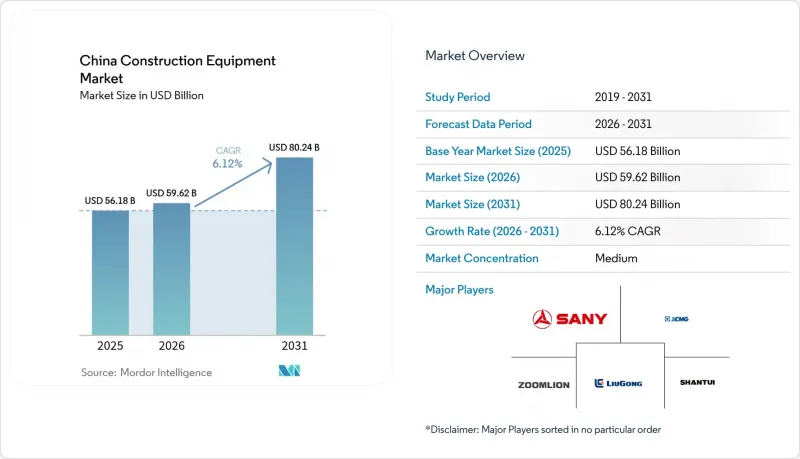
本報告按機械類型(土木工程機具、物料輸送機械及其他)、驅動系統(內燃機、混合動力及其他)、分銷管道(OEM廠商直銷、授權經銷商銷售)和應用領域(建築施工、基礎設施建設及其他)進行分類。市場預測以價值(美元)和銷售(台)兩種形式呈現。
中國施工機械市場趨勢與洞察
政府的「2025-30年新基礎設施」計劃
中央規劃部門已將交通網路、水資源項目和電網走廊列為未來五年發展計畫的核心組成部分。首批項目清單已引發對挖土機、起重機和道路施工機械的積極競標。在西部邊境省份營運的建築公司更傾向於選擇能夠快速適應當地地理和氣候挑戰的國產品牌。此外,隨著各公司採取策略以減少多年期建設專案中的資產投入,對施工機械租賃的需求也不斷成長。這些變化共同確保了即使在住宅建設低迷的情況下,訂單也能保持穩定。
碳中和義務正在促進電子機械。
中國的碳排放交易體系如今為重工業設定了碳價格,迫使專案管理人員在權衡全生命週期燃料成本與合規成本時更加謹慎。因此,零排放車型正從示範車隊走向常規採購清單,這一趨勢在空氣品質目標嚴格的都市區項目中尤其明顯。沿海地方政府為採用電動車的建築公司提供快速核准和宣傳推廣等優惠政策。作為回應,製造商正在擴大電池和動力總成產能,並加強售後服務,以降低買家感知到的風險。這些非價格獎勵正在加速電動車的普及,而不僅限於經濟因素。
房地產市場長期低迷。
公寓銷售持續低迷,令私人開發人員的現金流承壓,進而抑制了對混凝土泵、塔式起重機和其他建築相關機械的需求。即使政府出手相助,也只能暫時止住這股下滑趨勢,無法扭轉乾坤。大型租賃公司正將車輛從住宅轉向基礎建設,但運轉率的下降趨勢仍持續。嚴重依賴混凝土機械的製造商如今正日益依賴零件和服務收入。在家庭景氣回升之前,高層建築相關機械的成長預計將落後於整體市場成長。
細分市場分析
到2025年,挖土機將佔據中國施工機械市場55.28%的佔有率,對機型發展和供應商的優先事項產生決定性影響。挖土機在土方工程、採礦和拆除等領域的多功能性確保了其不受經濟週期波動的影響,市場需求仍然強勁。建築公司對日益豐富的附件選擇讚賞有加,這些附件可以將一台基礎機型轉變為多功能解決方案。同時,不斷上漲的人事費用促使人們對半自動挖掘模式產生興趣,以減輕操作員的疲勞。雖然目前全電動挖土機的市場規模有限,但預計到2031年,它們將成為該細分市場中成長最快的領域,年複合成長率將達到12.15%,這反映了市場正逐步向零排放解決方案轉型。
其他施工機械領域也在適應這種「兩極化」的現實。裝載機和平平土機正在改進驅動系統以降低油耗,推土機正在進行氫燃料引擎的初步測試。物料輸送起重機正在擴大起重能力,以滿足離岸風力發電和模組化住宅。受住宅市場低迷衝擊最大的混凝土相關設備,正試圖透過引入數位化批量處理和預測性維護來維持其市場佔有率。
預計到2025年,柴油動力車輛仍將佔據中國施工機械市場92.64%的佔有率。這主要歸功於完善的加油基礎設施和即使在偏遠地區也保持的運轉率。車隊管理人員也青睞柴油動力車輛熟悉的維修流程和充足的零件供應。然而,日益嚴格的排放氣體法規和都市區噪音限制正在削弱柴油動力車輛的長期吸引力。政策獎勵和電池成本的下降,使得從柴油動力車輛轉向輕型車輛成為越來越合理的選擇。
純電動系統雖然起步較慢,但預計到2031年將實現37.85%的複合年成長率,成為行業領導者,這凸顯了一旦達到轉折點,變革速度將非常迅猛。混合動力汽車介於兩者之間,既能節省燃油,又無需擔心續航里程的限制。一些政府部門正在為混合動力汽車頒發排碳權,鼓勵懷疑的人們接受部分電氣化。氫燃料示範計畫正在檢驗其在重型和連續運作任務中的實用性。這些替代技術的結合,描繪出一幅未來願景:動力系統可以根據每個場所的具體限制進行選擇,而不再局限於單一的柴油車輛。
其他好處
- Excel格式的市場預測(ME)表
- 3個月的分析師支持
目錄
第1章:引言
- 研究假設和市場定義
- 調查範圍
第2章:調查方法
第3章執行摘要
第4章 市場狀況
- 市場概覽
- 市場促進因素
- 政府的「2025-30年新基礎設施」計劃
- 碳中和義務正在促進電子機械。
- 透過 OEM(原始設備製造商)計劃擴大出口,可以在國內實現規模經濟。
- 數位設備租賃平台刺激了中小企業的需求。
- 與「一帶一路」計劃相關的零件供應商訂單訂單。
- 該省的碳權市場對混合動力汽車更有利。
- 市場限制因素
- 房地產市場長期低迷。
- 國內價格競爭源自於產能過剩
- 收緊對中小型承包商的貸款環境
- 電氣設備中使用的逆變器和電池管理系統晶片供不應求。
- 價值供應鏈分析
- 監理情勢
- 技術展望
- 波特五力模型
第5章 市場規模與成長預測
- 按機器類型
- 土木工程機具
- 挖土機
- 裝載機
- 推土機
- 物料輸送機械
- 起重機
- 堆高機
- 伸縮臂堆高機
- 道路施工機械
- 平土機機
- 滾筒壓實機
- 攤舖機
- 混凝土機械
- 混凝土攪拌機
- 混凝土泵
- 土木工程機具
- 透過驅動系統
- 內燃機(柴油引擎)
- 混合
- 純電動
- 透過分銷管道
- 透過OEM(原始設備製造商)直接銷售
- 由授權經銷商出售
- 透過使用
- 建築工程
- 基礎設施建設
- 能源和自然資源
- 其他
第6章 競爭情勢
- 市場集中度
- 策略趨勢
- 市佔率分析
- 公司簡介
- Sany Group
- Xuzhou Construction Machinery Group Co., Ltd.(XCMG)
- Caterpillar Inc.
- Zoomlion Heavy Industry
- LiuGong Machinery
- Komatsu Ltd.
- Hitachi Construction Machinery
- AB Volvo(Volvo CE)
- Liebherr Group
- Shantui Construction Machinery
- Tadano Ltd.
- JC Bamford Excavators Limited
- Doosan Bobcat Ltd.
- Hyundai Construction Equipment Ltd.
- Yanmar Holdings Co. Ltd.
- Terex Corporation
- China Railway Construction Heavy Industry Co., Ltd.
第7章 市場機會與未來展望
According to Mordor Intelligence, the China construction equipment market size is expected to increase from USD 56.18 billion in 2025 to USD 59.62 billion in 2026 and reach USD 80.24 billion by 2031, growing at a CAGR of 6.12% over 2026-2031.
This report is Segmented by Machinery Type (Earth-Moving Machinery, Material-Handling Machinery, and More), Drive Type (Internal-Combustion Engine, Hybrid, and More), Sales Channel (OEM Direct Sales, and Authorized Dealer Sales), and Application (Building Construction, Infrastructure Construction, and More). The Market Forecasts are Provided in Terms of Value (USD) and Volume (Units).
China Construction Equipment Market Trends and Insights
Government 'New Infrastructure 2025-30' Pipeline
Central planners have placed transport links, water projects, and power-grid corridors at the heart of the next 5-year build-out. The early-batch project list has already accelerated tender activity for excavators, cranes, and road equipment. Contractors active in remote western provinces prefer domestic brands that can respond quickly to terrain and climate challenges. Equipment-rental demand is also rising as firms opt for asset-light participation in multi-year construction packages. Together, these shifts anchor a dependable stream of orders even as residential construction lags.
Carbon-Neutral Mandate Spurring Electric Machinery
China's emissions-trading scheme now prices carbon for heavy industry, forcing site managers to weigh lifetime fuel and compliance costs more carefully. Zero-emission models are therefore moving from demonstration fleets into regular procurement lists, especially for urban projects that face strict air-quality targets. Local governments in coastal provinces offer expedited permits and publicity benefits to contractors using electric fleets. Manufacturers respond by expanding battery and drivetrain capacity while refining after-sales support to reduce buyers' perceived risk. These non-price incentives accelerate adoption beyond what pure economics would dictate.
Prolonged Real-Estate Downturn
Weak apartment presales continue to undermine private developers' cash flow, curbing demand for concrete pumps, tower cranes, and other building-centric gear. Even state rescue measures have merely slowed, not reversed, the slide. Large rental companies are redeploying fleets from housing to infrastructure, but utilization gaps remain. Manufacturers with heavy exposure to concrete machinery now lean harder on parts and service revenue. Until household sentiment turns, equipment tied to vertical construction is likely to lag broader market growth.
Other drivers and restraints analyzed in the detailed report include:
- OEM Export Push Enables Domestic Economies of Scale
- Digital Equipment-Rental Platforms Unlocking SME Demand
- Domestic Price Wars from Over-Capacity
For complete list of drivers and restraints, kindly check the Table Of Contents.
Segment Analysis
Excavators captured 55.28% of the Chinese construction equipment market share in 2025, giving them a commanding influence over model development and supplier priorities. Their versatility in earthworks, mining, and demolition keeps demand resilient across cycles. Contractors value the growing range of attachments that convert one base machine into multiple task solutions. Meanwhile, rising labor costs elevate interest in semi-autonomous dig modes that reduce operator fatigue. Although full-electric excavators are currently limited, they are expected to achieve the segment's fastest growth, with a 12.15% CAGR projected through 2031, reflecting a gradual transition toward zero-emission solutions.
The rest of the machinery spectrum is adapting to this two-speed reality. Loaders and graders refine drivetrains for fuel savings, while dozers see early trials of hydrogen engines. Material-handling cranes stretch lifting capacities to serve offshore wind and modular housing. Concrete equipment, hit hardest by housing weakness, experiments with digital batching and predictive maintenance to stay relevant.
Diesel power retained 92.64% of the Chinese construction equipment market share in 2025, thanks to dense refueling infrastructure and proven uptime in remote areas. Fleet managers appreciate the familiar maintenance routines and broad availability of parts. However, tightening emissions caps and urban noise rules erode diesel's long-term appeal. Policy incentives, paired with falling battery costs, make the switch increasingly rational for lighter classes.
Full-electric systems, although starting from a low base, are projected to deliver a sector-leading 37.85% CAGR through 2031, underscoring the speed of change once tipping points are reached. Hybrids sit between these poles, offering fuel savings without range anxiety. Some provinces reward them with carbon credits, nudging skeptics toward partial electrification. Hydrogen pilots probe viability for heavy, continuous-duty tasks. Together, these alternatives sketch a future in which drivetrain choice aligns with specific site constraints rather than a one-size-fits-all diesel.
Complete Report Scope:
- By Machinery Type
- Earth-moving Machinery
- Excavators
- Loaders
- Dozers
- Material-Handling Machinery
- Cranes
- Fork-lifts
- Telescopic Handlers
- Road-Construction Machinery
- Motor Graders
- Rollers/Compactors
- Pavers
- Concrete Equipment
- Concrete Mixers
- Concrete Pumps
- Earth-moving Machinery
- By Drive Type
- Internal-Combustion Engine (Diesel)
- Hybrid
- Full-Electric
- By Sales Channel
- Original Equipment Manufacturer (OEM) Direct Sales
- Authorized Dealer Sales
- By Application
- Building Construction
- Infrastructure Construction
- Energy and Natural Resources
- Others
List of Companies Covered in this Report:
- Sany Group
- Xuzhou Construction Machinery Group Co., Ltd. (XCMG)
- Caterpillar Inc.
- Zoomlion Heavy Industry
- LiuGong Machinery
- Komatsu Ltd.
- Hitachi Construction Machinery
- AB Volvo (Volvo CE)
- Liebherr Group
- Shantui Construction Machinery
- Tadano Ltd.
- J.C. Bamford Excavators Limited
- Doosan Bobcat Ltd.
- Hyundai Construction Equipment Ltd.
- Yanmar Holdings Co. Ltd.
- Terex Corporation
- China Railway Construction Heavy Industry Co., Ltd.
Additional Benefits:
- The market estimate (ME) sheet in Excel format
- 3 months of analyst support
TABLE OF CONTENTS
1 Introduction
- 1.1 Study Assumptions and Market Definition
- 1.2 Scope of the Study
2 Research Methodology
3 Executive Summary
4 Market Landscape
- 4.1 Market Overview
- 4.2 Market Drivers
- 4.2.1 Government 'New Infrastructure 2025-30' Pipeline
- 4.2.2 Carbon-Neutral Mandate Spurring Electric Machinery
- 4.2.3 OEM Export Push Enables Domestic Economies of Scale
- 4.2.4 Digital Equipment-Rental Platforms Unlocking SME Demand
- 4.2.5 Belt And Road Back-Orders for Component Suppliers
- 4.2.6 Provincial Carbon-Credit Markets Favouring Hybrids
- 4.3 Market Restraints
- 4.3.1 Prolonged Real-Estate Downturn
- 4.3.2 Domestic Price Wars from Over-Capacity
- 4.3.3 Tight Credit to SME Contractors
- 4.3.4 Inverter and BMS Chip Shortages For E-Equipment
- 4.4 Value / Supply-Chain Analysis
- 4.5 Regulatory Landscape
- 4.6 Technological Outlook
- 4.7 Porter's Five Forces
- 4.7.1 Threat of New Entrants
- 4.7.2 Bargaining Power of Buyers
- 4.7.3 Bargaining Power of Suppliers
- 4.7.4 Threat of Substitutes
- 4.7.5 Competitive Rivalry
5 Market Size and Growth Forecasts (Value (USD) and Volume (Units))
- 5.1 By Machinery Type
- 5.1.1 Earth-moving Machinery
- 5.1.1.1 Excavators
- 5.1.1.2 Loaders
- 5.1.1.3 Dozers
- 5.1.2 Material-Handling Machinery
- 5.1.2.1 Cranes
- 5.1.2.2 Fork-lifts
- 5.1.2.3 Telescopic Handlers
- 5.1.3 Road-Construction Machinery
- 5.1.3.1 Motor Graders
- 5.1.3.2 Rollers/Compactors
- 5.1.3.3 Pavers
- 5.1.4 Concrete Equipment
- 5.1.4.1 Concrete Mixers
- 5.1.4.2 Concrete Pumps
- 5.1.1 Earth-moving Machinery
- 5.2 By Drive Type
- 5.2.1 Internal-Combustion Engine (Diesel)
- 5.2.2 Hybrid
- 5.2.3 Full-Electric
- 5.3 By Sales Channel
- 5.3.1 Original Equipment Manufacturer (OEM) Direct Sales
- 5.3.2 Authorized Dealer Sales
- 5.4 By Application
- 5.4.1 Building Construction
- 5.4.2 Infrastructure Construction
- 5.4.3 Energy and Natural Resources
- 5.4.4 Others
6 Competitive Landscape
- 6.1 Market Concentration
- 6.2 Strategic Moves
- 6.3 Market Share Analysis
- 6.4 Company Profiles (Includes Global level Overview, Market level overview, Core Segments, Financials as available, Strategic Information, Market Rank/Share for key companies, Products and Services, and Recent Developments)
- 6.4.1 Sany Group
- 6.4.2 Xuzhou Construction Machinery Group Co., Ltd. (XCMG)
- 6.4.3 Caterpillar Inc.
- 6.4.4 Zoomlion Heavy Industry
- 6.4.5 LiuGong Machinery
- 6.4.6 Komatsu Ltd.
- 6.4.7 Hitachi Construction Machinery
- 6.4.8 AB Volvo (Volvo CE)
- 6.4.9 Liebherr Group
- 6.4.10 Shantui Construction Machinery
- 6.4.11 Tadano Ltd.
- 6.4.12 J.C. Bamford Excavators Limited
- 6.4.13 Doosan Bobcat Ltd.
- 6.4.14 Hyundai Construction Equipment Ltd.
- 6.4.15 Yanmar Holdings Co. Ltd.
- 6.4.16 Terex Corporation
- 6.4.17 China Railway Construction Heavy Industry Co., Ltd.
7 Market Opportunities and Future Outlook
- 7.1 White-space and Unmet-Need Assessment

 泰國施工機械市場:市場佔有率分析、產業趨勢與統計及成長預測(2026-2031)義大利施工機械市場:市場佔有率分析、產業趨勢與統計及成長預測(2026-2031)
 2026-2030年全球挖溝機市場
 2026-2030年全球施工機械市場歐洲施工機械:市場佔有率分析、產業趨勢與統計、成長預測(2026-2031)
 2035年前施工機械輪胎市場分析和預測:按類型、產品、技術、組件、應用、材料類型、製程、最終用戶和安裝方法進行分析和預測。對 2035 年前施工機械引擎市場進行分析和預測:按類型、產品、服務、技術、組件、應用、材料類型、製程、最終用戶和功能分類。
 輪式挖溝機市場規模、佔有率和成長分析:按產品類型、動力來源、應用、最終用戶、銷售管道和地區分類-2026-2033年產業預測
 道路堆垛機市場規模、佔有率和成長分析:按產品類型、負載容量、應用、最終用戶、分銷管道和地區分類-2026-2033年產業預測
 施工機械市場-2026-2032年全球市場預測