


 |
市場調查報告書
商品編碼
2125688
中東瓦楞紙包裝市場:市場佔有率分析、產業趨勢與統計及成長預測(2026-2031)Middle East Corrugated Packaging - Market Share Analysis, Industry Trends & Statistics, Growth Forecasts (2026 - 2031) |
||||||

※ 本網頁內容可能與最新版本有所差異。詳細情況請與我們聯繫。
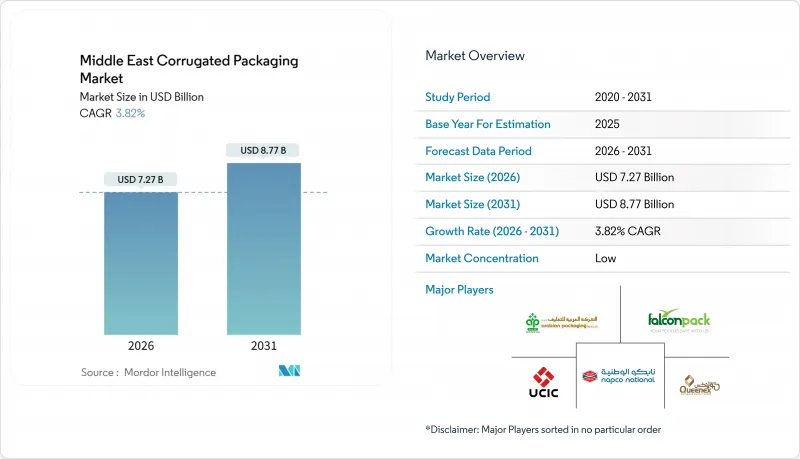
根據 Mordor Intelligence 的數據,預計到 2026 年,中東瓦楞紙包裝市場將達到 72.7 億美元,到 2031 年將達到 87.7 億美元,年複合成長率為 3.82%。
本報告依產品類型(開槽紙盒、伸縮式多片紙盒、其他)、紙板類型(單層、雙層、三層)、瓦楞型(A型、B型、其他)、終端用戶行業(食品、飲料、製藥、工業、其他)、印刷技術(彈性凸版印刷、數位印刷、其他)和國家/地區進行細分。市場預測以美元計價。
中東瓦楞紙包裝市場趨勢與洞察
電子商務的快速發展正在加速對紙箱的需求。
預計到2025年,波灣合作理事會(GCC)的線上銷售額將達到500億美元,年增30%。每增加一個小包裹的運輸,至少會消耗一個瓦楞紙板製品。品牌擁有者要求定製圖案、可回收包裝條和「按需包裝」演算法以降低運輸成本,這迫使加工商轉型使用能夠小批量印刷(低至500個)的數位印刷機。沙烏地阿拉伯國家工業發展和物流計畫已撥款4,270億美元用於配送中心和自動化分類中心,每個中心都根據最佳化體積重量的紙箱形狀進行標準化。仍依賴柔版印刷生產線進行大規模生產的本地加工商面臨著被能夠在48小時內交貨並提供可變數據印刷的靈活工廠搶佔市場佔有率的風險。來自中國和印度的跨境經銷商已經制定了輕量化、高圖案化的包裝標準,提高了區域客戶的期望。
海灣合作理事會食品配送市場的成長
預計到2028年,海灣合作理事會(GCC)地區的食品配送市場規模將達到300億美元,其中沙烏地阿拉伯和阿拉伯聯合大公國的訂單量佔70%,推動了對防潮單層瓦楞紙箱的需求。到2025年底,該地區的雲端廚房和暗店數量將超過1200家,它們需要能夠承受冷凝並至少保持45分鐘溫度的包裝。加工商正在紙板上塗覆聚乙烯或蠟乳液,這會使材料成本增加8-12%,但允許連鎖餐廳收取更高的配送費。訂閱式食材自煮包服務商正在使用透氣托盤,這可以將生鮮食品的保存期限延長至多三天,並減少食物廢棄物。迄今為止,海灣合作理事會的監管機構尚未制定多少關於食品配送包裝的強制性法規,性能標準更多地被視為一種競爭優勢,而非合規要求。
牛皮紙價格波動
儘管北方漂白軟木牛皮紙漿(NBSK)的價格從2022年的每噸1400美元跌至2024年的每噸800-900美元,但箱板紙的價格僅下跌了15-20%,導致加工商的利潤率壓縮了多達300個基點。由於中東國家60%的牛皮紙襯紙依賴進口,加工商很容易受到紅海運輸中斷和美元走強時期運費上漲的影響。國內造紙企業將價格與全球基準掛鉤,限制了關稅的保護作用。像歐貝坎產業投資集團這樣的後向整合企業利潤率在150-200個基點之間,並繼續投資產能,而中小企業則推遲了自動化改造的步伐。
細分市場分析
到2025年,開槽紙箱將佔總銷售額的42.43%,主要用於大宗物流和一般商品運輸。同時,托盤、折疊紙盒和紙板預計到2031年將以5.66%的複合年成長率成長,這主要得益於會員製商店的商品展示以及偏好敞口和自展示形式的直銷模式。中東瓦楞紙包裝市場受益於超級市場業者對「即上架即用」包裝設計的需求,這種設計無需二次處理,從而降低了高達30%的人事費用。數位印刷技術使得季節性促銷圖案的快速更新成為可能,加工商報告稱,與通用型普通開槽紙箱相比,使用特種托盤可使利潤率提高15%。伸縮紙箱和多片紙箱佔據了對耐用性要求較高的細分市場,例如工業機械行業,其中兩片式設計可減少因邊角破損造成的故障。瓦楞紙托盤和模切紙盒廣泛應用於醫藥和電子產品行業,在緊湊的尺寸下提供高防護性能。
隨著冷鏈的擴展,托盤和折疊包裝也不斷改進,透過加快透氣性農產品向零售冷藏櫃的運輸速度,可將保存期限縮短2-3天。食材自煮包供應商更傾向於使用折疊式的郵寄包裝,這種包裝形式能夠放入標準宅配櫃,而食品配送業務的成長也帶動了這種包裝形式的需求。因此,預計中東瓦楞紙包裝市場中托盤和折疊包裝的市場佔有率將穩步擴大。掌握了模切技術以實現快速換模和高解析度圖形處理的加工商將有望抓住這一成長機會。這一趨勢在阿拉伯聯合大公國尤為顯著,該國每週的線上食品雜貨配送量已超過100萬件。
到2025年,單層瓦楞紙板將佔據38.32%的市場佔有率,在電子商務、速食和輕工業等對單價要求較高的應用領域佔據主導地位。雙層瓦楞紙板則滿足中重型家用電器和家用電子電器的需求,在不增加材料成本的情況下提高了堆疊性能。預計到2031年,三層瓦楞紙板的複合年成長率將達到4.32%,這主要得益於沙烏地阿拉伯和阿拉伯聯合大公國重型機械出口的需求,這些產品需要抗壓能力超過1000磅的瓦楞紙板。例如,薩勒曼國王能源園區等工業園區使用帶有聚乙烯防潮層的三層瓦楞紙箱運輸燃氣渦輪機,以防止海運過程中發生腐蝕。
區域加工商正在擴建其重型瓦楞紙板生產線,這些生產線可在一次工序中複合三層中階,從而縮短30-40%的生產時間。擁有ISO 9001品質管理系統認證的三層瓦楞紙板生產商正獲得溢價,因為跨國買家要求產品符合全球標準。從長遠來看,中東地區三層瓦楞紙板包裝的市場佔有率與資本財出口的成長密切相關。儘管原料成本較高,但透過收取專業設計費和使用高附加價值緩衝材料,可以確保單位盈利。
其他好處
- Excel格式的市場預測(ME)表
- 3個月的分析師支持
目錄
第1章:引言
- 研究假設和市場定義
- 調查範圍
第2章:調查方法
第3章執行摘要
第4章 市場狀況
- 市場概覽
- 市場促進因素
- 電子商務的快速發展正在加速對紙箱的需求。
- 海灣合作理事會食品配送市場的成長
- 政府主導的產業多元化項目
- 過渡到輕質高強度板材
- 小批量包裝數位印刷技術的應用
- 椰棗出口溫控包裝
- 市場限制因素
- 牛皮紙價格波動
- 水資源短缺對造紙廠的影響
- 再生紙進口關稅
- 農產品產業可重複使用塑膠箱的興起
- 產業價值鏈分析
- 監理情勢
- 技術展望
- 宏觀經濟因素對市場的影響
- 波特五力分析
第5章 市場規模與成長預測
- 依產品類型
- 帶插槽的盒子
- 望遠鏡多件套裝
- 托盤、文件夾、紙張
- 其他
- 依電路板類型
- 單層
- 雙層
- 三層
- 笛形輪廓
- 長笛
- 低音長笛
- C調長笛
- E 長笛
- F調長笛
- 其他笛型
- 按最終用戶行業分類
- 食物
- 飲料
- 製藥
- 個人護理和家居用品
- 產業
- 電氣和電子設備
- 其他
- 透過印刷技術
- 彈性凸版印刷
- 數位的
- 光刻
- 其他印刷技術
- 國家
- 沙烏地阿拉伯
- 阿拉伯聯合大公國
- 卡達
- 約旦
- 其他中東國家
第6章 競爭情勢
- 市場集中度
- 策略趨勢
- 市佔率分析
- 公司簡介
- Arabian Packaging Co. LLC
- Queenex Corrugated Carton Factory LLC
- United Carton Industries Company JSC
- Napco National
- Falcon Pack Industries LLC
- Cepack Group DMCC
- World Pack Industries LLC
- Universal Carton Industries Group LLC
- Green Packaging Boxes Ind LLC
- Tarboosh Packaging Co. LLC
- Unipack Containers and Carton Products LLC
- Al Rumanah Packaging LLC
- Arabian Paper Products Co. Ltd
- Saudi Paper Manufacturing Co.
- Middle East Packaging LLC
- Obeikan Industrial Investment Group
- Al-Jazira Printing Inks LLC
- United Printing and Publishing LLC
- Majan Printing and Packaging SAOG
- Delta Printing Press LLC
第7章 市場機會與未來展望
According to Mordor Intelligence, the Middle East corrugated packaging market size stands at USD 7.27 billion in 2026 and is projected to reach USD 8.77 billion by 2031, expanding at a 3.82% CAGR, according to Mordor Intelligence data.
This report is Segmented by Product Type (Slotted Box, Telescope/Multi-Piece Boxes, and More), Board Type (Single Wall, Double Wall, and Triple Wall), Flute Profile (A Flute, B Flute, and More), End-User Industry (Food, Beverages, Pharmaceuticals, Industrial, and More), Print Technology (Flexography, Digital, and More), and Country. The Market Forecasts are Provided in Terms of Value (USD).
Middle East Corrugated Packaging Market Trends and Insights
E-Commerce Boom Accelerating Corrugated Demand
Gulf Cooperation Council (GCC) online sales reached USD 50 billion in 2025, up 30% year-over-year, and every additional parcel shipped translates into at least one corrugated unit consumed. Brand owners demand custom graphics, return-ready tear strips, and pack-to-fit algorithms that reduce freight costs, pushing converters toward digital presses capable of printing lots as small as 500 units. Saudi Arabia's National Industrial Development and Logistics Program earmarked USD 427 billion for delivery hubs and automated sortation centers, each standardized around dimensional-weight optimized box footprints. Local converters that still rely on long-run flexographic lines risk losing share to agile plants that offer 48-hour turnaround and variable-data printing. Cross-border sellers from China and India have already set the benchmark for lightweight, high-graphic packaging, raising regional customer expectations.
Food Delivery Growth in GCC Nations
The GCC food-delivery channel is projected to generate USD 30 billion by 2028, with Saudi Arabia and the UAE accounting for 70% of orders and driving corrugated demand toward moisture-resistant single-wall boxes. Cloud kitchens and dark stores, which numbered over 1,200 in the region by end-2025, insist on packaging that maintains temperature for at least 45 minutes while surviving condensation. Converters coat boards with polyethylene or wax emulsions, raising material cost 8-12% but enabling restaurant chains to charge premium delivery fees. Subscription meal-kit providers use vented trays that extend the shelf life of fresh produce by up to 3 days, thereby reducing food waste. So far, GCC regulators have issued few binding rules on food-delivery packaging, leaving performance standards to competitive differentiation rather than compliance.
Kraft Paper Price Volatility
Northern Bleached Softwood Kraft (NBSK) pulp prices fell from USD 1,400 per ton in 2022 to USD 800-900 in 2024, yet containerboard prices slipped only 15-20%, compressing converter margins by up to 300 basis points. The Middle East imports 60% of its kraft liner, leaving converters exposed to freight surcharges during Red Sea disruptions and dollar strength cycles. Domestic mills tie prices to global benchmarks, so tariffs give limited shelter. Backward-integrated players, such as Obeikan Industrial Investment Group, enjoy a 150-200 basis-point cushion, and they continue to invest in capacity while smaller firms defer automation.
Other drivers and restraints analyzed in the detailed report include:
- Government-Led Industrial Diversification Projects
- Shift Toward Lightweight High-Strength Boards
- Water Scarcity Impact on Paper Mills
For complete list of drivers and restraints, kindly check the Table Of Contents.
Segment Analysis
Slotted boxes maintained 42.43% of 2025 revenue, anchoring shipments in bulk logistics and general merchandise. Trays, folders, and sheets, however, show a 5.66% CAGR through 2031, propelled by club-store merchandising and direct-to-consumer (DTC) models that prefer open-top or self-display formats. The Middle East corrugated packaging market benefits when supermarket operators demand shelf-ready designs that avoid secondary handling, reducing labor cost up to 30%. Digital print capability allows rapid artwork changes for seasonal promotions, and converters report margin uplifts of 15% on specialty trays versus commodity regular slotted containers. Telescope and multi-piece boxes occupy heavy-duty niches, such as industrial machinery, where two-piece designs reduce corner-crush failures. Corrugated pallets and die-cut shapes serve pharmaceuticals and electronics, delivering high protective performance in compact footprints.
Trays and folders also align with cold-chain expansion, carrying vented produce that reaches retail coolers faster, cutting spoilage by 2-3 days. Meal-kit providers prefer folded mailers that fit standard courier lockers, a format boosted by food-delivery growth. As a result, the Middle East corrugated packaging market size allocated to trays and folders will rise steadily. Converters that master quick-change die-cutting and high-resolution graphics look set to capture this incremental volume, especially in the UAE, where e-grocery shipments already exceed 1 million orders per week.
Single-wall accounted for 38.32% share in 2025, dominating e-commerce, fast food, and light industrial uses where unit cost drives specification. Double-wall satisfies mid-weight appliances and consumer electronics, offering improved stacking without high material expense. Triple-wall grows 4.32% CAGR through 2031 on the back of Saudi and UAE heavy machinery exports, which require crush resistances above 1,000 pounds. Industrial estates such as King Salman Energy Park ship gas turbines in triple-wall cartons fitted with polyethylene vapor barriers, preventing corrosion during sea voyages.
Regional converters expand heavy-duty corrugator lines capable of laminating three mediums in a single pass, cutting production time by 30-40%. Triple-wall producers that certify ISO 9001 quality systems command price premiums, because multinational buyers stipulate global standards. Over time, the Middle East corrugated packaging market share for triple-wall aligns closely with capital-goods export growth. Although raw material costs are higher, unit economics are protected by specialized design fees and value-added cushioning inserts.
Complete Report Scope:
- By Product Type
- Slotted Box
- Telescope/Multi-Piece Boxes
- Trays, Folder and Sheets
- Other Product Types
- By Board Type
- Single Wall
- Double Wall
- Triple Wall
- By Flute Profile
- A Flute
- B Flute
- C Flute
- E Flute
- F Flute
- Other Flute Profiles
- By End-user Industry
- Food
- Beverages
- Pharmaceuticals
- Personal Care and Household
- Industrial
- Electrical and Electronics
- Other End-user Industries
- By Print Technology
- Flexography
- Digital
- Lithography
- Other Print Technology
- By Country
- Saudi Arabia
- United Arab Emirates
- Qatar
- Jordan
- Rest of Middle East
List of Companies Covered in this Report:
- Arabian Packaging Co. LLC
- Queenex Corrugated Carton Factory LLC
- United Carton Industries Company JSC
- Napco National
- Falcon Pack Industries LLC
- Cepack Group DMCC
- World Pack Industries LLC
- Universal Carton Industries Group LLC
- Green Packaging Boxes Ind LLC
- Tarboosh Packaging Co. LLC
- Unipack Containers and Carton Products LLC
- Al Rumanah Packaging LLC
- Arabian Paper Products Co. Ltd
- Saudi Paper Manufacturing Co.
- Middle East Packaging LLC
- Obeikan Industrial Investment Group
- Al-Jazira Printing Inks LLC
- United Printing and Publishing LLC
- Majan Printing and Packaging SAOG
- Delta Printing Press LLC
Additional Benefits:
- The market estimate (ME) sheet in Excel format
- 3 months of analyst support
TABLE OF CONTENTS
1 INTRODUCTION
- 1.1 Study Assumptions and Market Definition
- 1.2 Scope of the Study
2 RESEARCH METHODOLOGY
3 EXECUTIVE SUMMARY
4 MARKET LANDSCAPE
- 4.1 Market Overview
- 4.2 Market Drivers
- 4.2.1 E-commerce Boom Accelerating Corrugated Demand
- 4.2.2 Food Delivery Growth in GCC Nations
- 4.2.3 Government-Led Industrial Diversification Projects
- 4.2.4 Shift Toward Lightweight High-Strength Boards
- 4.2.5 Digital Printing Adoption for Short-Run Packaging
- 4.2.6 Temperature-Controlled Date Export Packaging
- 4.3 Market Restraints
- 4.3.1 Kraft Paper Price Volatility
- 4.3.2 Water Scarcity Impact on Paper Mills
- 4.3.3 Import Tariffs on Recovered Paper
- 4.3.4 Rise of Reusable Plastic Crates in Produce Sector
- 4.4 Industry Value Chain Analysis
- 4.5 Regulatory Landscape
- 4.6 Technological Outlook
- 4.7 Impact of Macroeconomic Factors on the Market
- 4.8 Porter's Five Forces Analysis
- 4.8.1 Bargaining Power of Suppliers
- 4.8.2 Bargaining Power of Buyers
- 4.8.3 Threat of New Entrants
- 4.8.4 Threat of Substitute Products
- 4.8.5 Intensity of Competitive Rivalry
5 MARKET SIZE AND GROWTH FORECASTS (VALUE)
- 5.1 By Product Type
- 5.1.1 Slotted Box
- 5.1.2 Telescope/Multi-Piece Boxes
- 5.1.3 Trays, Folder and Sheets
- 5.1.4 Other Product Types
- 5.2 By Board Type
- 5.2.1 Single Wall
- 5.2.2 Double Wall
- 5.2.3 Triple Wall
- 5.3 By Flute Profile
- 5.3.1 A Flute
- 5.3.2 B Flute
- 5.3.3 C Flute
- 5.3.4 E Flute
- 5.3.5 F Flute
- 5.3.6 Other Flute Profiles
- 5.4 By End-user Industry
- 5.4.1 Food
- 5.4.2 Beverages
- 5.4.3 Pharmaceuticals
- 5.4.4 Personal Care and Household
- 5.4.5 Industrial
- 5.4.6 Electrical and Electronics
- 5.4.7 Other End-user Industries
- 5.5 By Print Technology
- 5.5.1 Flexography
- 5.5.2 Digital
- 5.5.3 Lithography
- 5.5.4 Other Print Technology
- 5.6 By Country
- 5.6.1 Saudi Arabia
- 5.6.2 United Arab Emirates
- 5.6.3 Qatar
- 5.6.4 Jordan
- 5.6.5 Rest of Middle East
6 COMPETITIVE LANDSCAPE
- 6.1 Market Concentration
- 6.2 Strategic Moves
- 6.3 Market Share Analysis
- 6.4 Company Profiles (includes Global Level Overview, Market Level Overview, Core Segments, Financials as Available, Strategic Information, Market Rank/Share for Key Companies, Products and Services, and Recent Developments)
- 6.4.1 Arabian Packaging Co. LLC
- 6.4.2 Queenex Corrugated Carton Factory LLC
- 6.4.3 United Carton Industries Company JSC
- 6.4.4 Napco National
- 6.4.5 Falcon Pack Industries LLC
- 6.4.6 Cepack Group DMCC
- 6.4.7 World Pack Industries LLC
- 6.4.8 Universal Carton Industries Group LLC
- 6.4.9 Green Packaging Boxes Ind LLC
- 6.4.10 Tarboosh Packaging Co. LLC
- 6.4.11 Unipack Containers and Carton Products LLC
- 6.4.12 Al Rumanah Packaging LLC
- 6.4.13 Arabian Paper Products Co. Ltd
- 6.4.14 Saudi Paper Manufacturing Co.
- 6.4.15 Middle East Packaging LLC
- 6.4.16 Obeikan Industrial Investment Group
- 6.4.17 Al-Jazira Printing Inks LLC
- 6.4.18 United Printing and Publishing LLC
- 6.4.19 Majan Printing and Packaging SAOG
- 6.4.20 Delta Printing Press LLC
7 MARKET OPPORTUNITIES AND FUTURE OUTLOOK
- 7.1 White-Space and Unmet-Need Assessment

 北美瓦楞紙和折疊式紙盒包裝:市場佔有率分析、行業趨勢和統計數據以及成長預測(2026-2031 年)中東和非洲瓦楞紙包裝市場:市場佔有率分析、行業趨勢和統計數據以及成長預測(2026-2031 年)北美瓦楞紙包裝市場:市場佔有率分析、產業趨勢與統計及成長預測(2026-2031)英國瓦楞紙板包裝:市場佔有率分析、行業趨勢和統計數據以及成長預測(2026-2031 年)
 瓦楞紙市場規模、佔有率和成長分析:按產品類型、紙張重量、應用、最終用途產業、包裝類型和地區分類 - 產業預測,2026-2033年
 瓦楞紙板配件市場規模、佔有率和成長分析:按產品類型、材料、應用、最終用戶、分銷管道和地區分類-2026-2033年產業預測
 瓦楞紙板包裝軟體市場-2026-2032年全球市場預測
 2026-2030年全球瓦楞紙包裝軟體市場
 紙盒包裝市場預測至2034年-全球分析(按紙板類型、材料、印刷和表面處理、封裝類型、應用、最終用途、分銷管道和地區分類)南美瓦楞紙包裝市場:市場佔有率分析、產業趨勢與統計及成長預測(2026-2031 年)