


 |
市場調查報告書
商品編碼
2119887
北美瓦楞紙和折疊式紙盒包裝:市場佔有率分析、行業趨勢和統計數據以及成長預測(2026-2031 年)North America Corrugated And Folding Carton Packaging - Market Share Analysis, Industry Trends & Statistics, Growth Forecasts (2026 - 2031) |
||||||

※ 本網頁內容可能與最新版本有所差異。詳細情況請與我們聯繫。
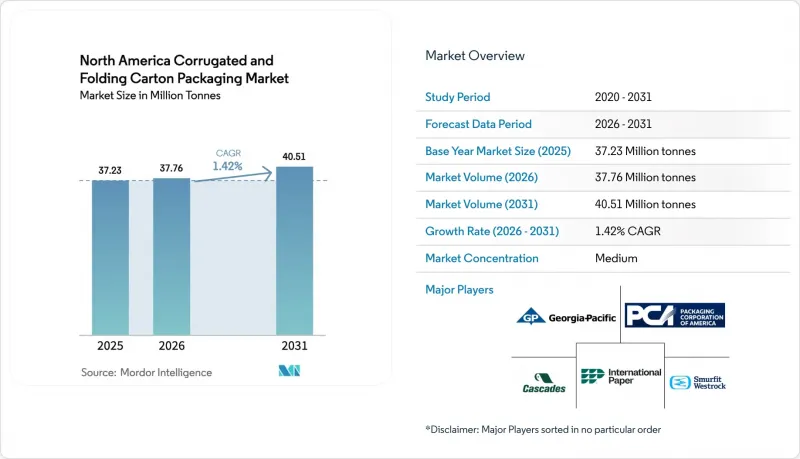
據 Mordor Intelligence 稱,北美瓦楞紙板和折疊紙盒包裝市場預計到 2026 年將達到 3,776 萬噸,高於 2025 年的 3,723 萬噸,預計到 2031 年將達到 4,051 萬噸。
預計 2026 年至 2031 年的複合年成長率為 1.42%。
本報告按材料(例如,再生纖維)、包裝類型(例如,折疊紙盒、瓦楞紙箱)、紙板類型(例如,單層、雙層)、印刷技術(例如,柔版印刷、數位印刷)和終端用戶行業(例如,食品飲料、電子產品和家用電器)進行分類。市場預測以數量單位(噸)表示。
北美瓦楞紙板和折疊式紙盒包裝市場的趨勢和見解。
電子商務包裝量激增。
自動化履約提高了對瓦楞紙箱的容差要求,單層瓦楞紙板必須具備更高的性能,以承受直接送達消費者的壓力。美國食品藥物管理局 (FDA) 於 2024 年發布的指南規定,處方藥配送將被視為電子商務貨物,因此折疊式瓦楞紙箱必須具備防篡改和兒童安全功能,並與小包裹分類系統相容。整合到生產線中的人工智慧演算法使工廠每小時能夠生產超過 1200 種不同尺寸的紙箱,從而減少 35% 的緩衝材料用量並節省瓦楞紙芯。這種能力推動了對結構性瓦楞紙板和可作為運輸包裝的高級印刷可折疊紙盒的需求。因此,北美瓦楞紙箱和折疊式紙盒包裝市場的平均每噸銷量正在成長,同時出貨量也在多樣化,從而緩解了成熟需求曲線的強勁成長動能。
對減輕重量和提高材料效率的需求
美國環保署 (EPA) 於 2024 年發布的廢棄物減量目標,正推動低紙張重量瓦楞紙板的投資。這些紙板符合自動化運輸規範,並透過先進的瓦楞設計,在保持抗壓強度的前提下,將紙板重量降低 18% 至 22%。根據 FSC 的審核數據,北美 89% 的瓦楞紙板產量已獲得產銷監管鏈 (CoC) 認證,較前一年的 76% 顯著成長。這一趨勢正促使加工商採用高精度瓦楞紙板生產設備,即使使用更薄的紙張也能保持嚴格的公差,並實現閉合迴路品管。雖然材料重量正在逐步降低,但由於客戶願意為有據可查的永續性成果付費,單價略有上漲,這推動了北美瓦楞紙板和折疊式紙盒包裝市場附加價值的逐步提升。
再生紙(OCC)價格波動
根據美國勞工統計局(BLS)的生產者價格數據,預計到2024年,箱板紙價格將波動28%至35%,這將對依賴再生纖維貿易的造紙廠的利潤率帶來壓力。喬治亞太平洋公司已投資5.5億美元進行垂直整合,以確保瓦楞紙板(OCC)的穩定供應,但對於小規模的獨立製造商而言,這種選擇仍然難以負擔。儘管加工商正在價格飆升期間加速番茄秸稈和麥稈衍生纖維的試點應用,但商業應用仍處於起步階段,且成本仍然高。各州強制執行的回收政策正在提高再生材料的使用比例,這在瓦楞紙板供應本已緊張的情況下,進一步加重了採購負擔。由此導致的供應緊張將抑制北美瓦楞紙板和折疊紙盒包裝市場的銷售量成長潛力,直到替代纖維成熟為止。
細分市場分析
預計到2025年,再生纖維將佔北美瓦楞紙板和可折疊紙盒包裝市場48.05%的佔有率,凸顯了市政回收系統優先處理消費後纖維以及零售商採購義務的有效性。儘管市場參與企業正在利用規模經濟,但OCC價格的波動迫使Cascade公司在2024年初額外支出4,500萬歐元(約4,860萬美元)的原物料成本。因此,對番茄秸稈和麥稈等農業殘餘物的策略性投資正變得更加活躍。該領域正以3.16%的複合年成長率成長,僅2024年就提交了23項專利申請。
隨著加工商尋求成本穩定性和市場差異化,替代纖維先導計畫正從實驗室走向生產線。雖然其機械性能已接近木漿,但確保供應穩定性和食品接觸適用性仍然是大規模轉型的一大障礙。因此,北美瓦楞紙板和折疊紙盒包裝市場正面臨著兩種發展路徑的平衡:一方面是再生纖維的成本風險和完善的供應鏈,另一方面是正處於商業性化應用階段、快速成長的利基纖維。
到2025年,瓦楞紙箱將佔據北美瓦楞紙和折疊紙盒包裝市場54.55%的佔有率。這主要得益於電子商務物流對高耐用性運輸包裝箱的需求。隨著小包裹數量的成長,運輸量也在增加,而利潤率的提高則歸功於「智慧紙箱」演算法,該演算法能夠在保持強度的同時使用更輕的襯紙板。儘管規模較小,但折疊紙盒的複合年成長率也達到了2.15%,這主要得益於FDA法規促使製藥品牌採用多層阻隔層和防篡改鎖,而這些特性也推高了紙盒的單價。
加工商正透過混合設計,在瓦楞紙板的剛性和紙盒的圖形設計之間尋求平衡,在減少層數的同時滿足商店展示的要求。對數位印刷的投資進一步模糊了兩者之間的界限,使瓦楞紙板製造商能夠在微型瓦楞紙板上實現平版印刷的圖像質量,從而使紙盒能夠用作二級包裝。這種融合正在擴大北美瓦楞紙板和折疊紙盒包裝的整體潛在市場規模。
其他好處:
- Excel格式的市場預測(ME)表
- 3個月的分析師支持
目錄
第1章:引言
- 研究假設和市場定義
- 調查範圍
第2章:調查方法
第3章執行摘要
第4章 市場狀況
- 市場概覽
- 市場促進因素
- 電子商務包裝量激增
- 減輕重量和材料效率的要求
- 企業永續發展採購目標
- 推出零售貨架包裝
- 人工智慧驅動的包裝盒尺寸最佳化平台
- 微型倉配中心的興起
- 市場限制因素
- OCC價格波動
- 對森林砍伐的擔憂以及來自非政府組織的壓力
- 轉換器資本投資成本不斷上升
- 紙板廠勞動力短缺
- 波特五力分析
- 宏觀經濟因素對市場的影響
- 產業價值鏈分析
- 行業標準和法規
- 北美紙包裝關鍵統計數據
- 目前貿易情勢分析(相關HS編碼)
第5章 市場規模與成長預測
- 材料
- 原生光纖
- 再生纖維
- 竹纖維和農業殘餘纖維的混合物
- 按包裝類型
- 折疊紙箱
- 瓦楞紙箱
- 依電路板類型
- 單層
- 雙層壁
- 三層壁
- 折疊紙板(FBB)
- 其他基板類型
- 透過印刷技術
- 膠印光刻
- 柔版印刷
- 數位印刷
- 其他印刷技術
- 按最終用戶行業分類
- 食品/飲料
- 醫療和藥品
- 個人護理化妝品
- 電子設備及家用電器
- 其他終端用戶產業
- 按地區
- 美國
- 加拿大
- 墨西哥
第6章 競爭情勢
- 市場集中度
- 策略性舉措(併購、合資、業務擴張)
- 市佔率分析
- 公司簡介
- International Paper Company
- Smurfit WestRock
- Packaging Corporation of America
- Georgia-Pacific LLC
- Cascades Inc.
- Graphic Packaging Holding Company
- Sonoco Products Company
- Pratt Industries, Inc.
- KapStone Paper and Packaging Corporation
- Norampac(Division of Cascades Canada ULC)
- Domtar Corporation
- Mondi plc
- Klabin SA
- Stora Enso Oyj
- Clearwater Paper Corporation
- Rengo Co., Ltd.
- Visy Industries Holdings Pty Ltd
- Oji Holdings Corporation
第7章 市場機會與未來展望
According to Mordor Intelligence, the North America corrugated and folding carton packaging market size in 2026 is estimated at 37.76 million tonnes, growing from 2025 value of 37.23 million tonnes with 2031 projections showing 40.51 million tonnes, growing at 1.42% CAGR over 2026-2031.
This report is Segmented by Material (Recycled Fiber, and More), Packaging Type (Folding Cartons, and Corrugated Boxes), Board Type (Single Wall, Double Wall, and More), Printing Technology (Flexography, Digital Printing, and More), End-User Industry (Food and Beverage, Electronics and Appliances, and More). The Market Forecasts are Provided in Terms of Volume (Tonne).
North America Corrugated And Folding Carton Packaging Market Trends and Insights
E-commerce packaging volume surge
Automation in fulfillment drives stricter tolerances for cartons, prompting performance upgrades in single-wall boards that must withstand direct-to-consumer shipping stresses. FDA guidance released in 2024 now treats prescription deliveries as e-commerce shipments, compelling folding cartons to integrate tamper-evidence and child-resistant features that align with parcel sortation systems. AI algorithms embedded in converting lines enable plants to output more than 1,200 discrete box sizes per hour, slashing void-fill usage by 35% and saving corrugating medium. This capability boosts demand for both structural corrugated formats and premium-printed folding cartons that travel as their own shipper. Consequently, the North America corrugated and folding carton packaging market gains diversified volume with higher average revenue per tonne, tempering the mature demand curve.
Lightweighting and material efficiency mandates
EPA waste-reduction targets published in 2024 catalyze investment in lower basis-weight containerboard that maintains compression strength through advanced flute designs, trimming board weight by 18-22% yet meeting automated handling specs. FSC audit data confirms that 89% of corrugated output in North America now carries chain-of-custody certifications, a leap from 76% a year earlier. Such momentum encourages converters to adopt precision corrugators and closed-loop quality control that keep tight tolerances as the paper caliper shrinks. As material weight inches down, unit price edges up because clients pay for documented sustainability progress, contributing incremental value growth in the North America corrugated and folding carton packaging market.
Volatility in OCC prices
BLS producer-price data show containerboard swings of 28-35% through 2024, eroding margins for mills dependent on traded recycled fiber. Georgia-Pacific spent USD 550 million on vertical integration to steady inbound OCC, an option out of reach for smaller independents. During price spikes, converters accelerate tests of tomato-stem and wheat-straw fiber, but the commercial scale remains embryonic and premium priced. State recycling mandates elevate recovered-content quotas, increasing purchasing stress exactly when OCC supplies tighten. The resulting squeeze subtracts volume growth potential from the North America corrugated and folding carton packaging market until fiber alternatives mature.
Other drivers and restraints analyzed in the detailed report include:
- Corporate sustainability procurement targets
- Retail shelf-ready packaging adoption
- Converters' capital-expenditure inflation
For complete list of drivers and restraints, kindly check the Table Of Contents.
Segment Analysis
Recycled fiber accounted for 48.05% of the North America corrugated and folding carton packaging market share in 2025, validating municipal collection systems and retailer procurement mandates that favor post-consumer content. Market participants exploit its scale economies, yet volatile OCC pricing drove Cascades to incur an extra EUR 45 million (USD 48.6 million) in raw-material spend during early 2024. Consequently, strategic investment flows into agro-residue like tomato stems and wheat straw, a cohort expanding at 3.16% CAGR and supported by 23 patent filings in 2024 alone.
Alternative fiber pilots now move from lab to line as converters search for cost stability and marketing differentiation. While mechanical properties approach those of wood pulp, supply consistency and food-contact compliance still gate large-scale switch-overs. The North America corrugated and folding carton packaging market thus balances two trajectories: recycled fiber's cost-risk yet comprehensive network, and fast-growing niche fibers still ramping into commercial breadth.
Corrugated boxes held 54.55% of the North America corrugated and folding carton packaging market share in 2025, thanks to e-commerce logistics that demand durable shippers. Volumes rise in line with parcel counts, yet margin uplift stems from smart-box algorithms and linerboard weight reductions that preserve strength. Folding cartons, though smaller, grow at a 2.15% CAGR because FDA compliance pushes pharma brands into multi-layer barriers and tamper-evident locks that command higher unit pricing.
Converters straddle both forms through hybrid designs that marry corrugated rigidity with carton graphics, satisfying shelf-ready tasks while trimming layers. Investments in digital print blur the line further, allowing corrugators to deliver offset-like imagery on micro-flute and enabling cartons to assume secondary-pack roles. This convergence elevates the total addressable opportunity for the North America corrugated and folding carton packaging market.
Complete Report Scope:
- By Material
- Virgin Fiber
- Recycled Fiber
- Bamboo and Agro-residue Fiber Blends
- By Packaging Type
- Folding Cartons
- Corrugated Boxes
- By Board Type
- Single Wall
- Double Wall
- Triple Wall
- Folding Boxboard (FBB)
- Other Board Types
- By Printing Technology
- Offset Lithography
- Flexography
- Digital Printing
- Other Printing Technologies
- By End-User Industry
- Food and Beverage
- Healthcare and Pharmaceutical
- Personal Care and Cosmetics
- Electronics and Appliances
- Other End-user Industries
- BY Geography
- United States
- Canada
- Mexico
List of Companies Covered in this Report:
- International Paper Company
- Smurfit WestRock
- Packaging Corporation of America
- Georgia-Pacific LLC
- Cascades Inc.
- Graphic Packaging Holding Company
- Sonoco Products Company
- Pratt Industries, Inc.
- KapStone Paper and Packaging Corporation
- Norampac (Division of Cascades Canada ULC)
- Domtar Corporation
- Mondi plc
- Klabin S.A.
- Stora Enso Oyj
- Clearwater Paper Corporation
- Rengo Co., Ltd.
- Visy Industries Holdings Pty Ltd
- Oji Holdings Corporation
Additional Benefits:
- The market estimate (ME) sheet in Excel format
- 3 months of analyst support
TABLE OF CONTENTS
1 INTRODUCTION
- 1.1 Study Assumptions and Market Definition
- 1.2 Scope of the Study
2 RESEARCH METHODOLOGY
3 EXECUTIVE SUMMARY
4 MARKET LANDSCAPE
- 4.1 Market Overview
- 4.2 Market Drivers
- 4.2.1 E-commerce Packaging Volume Surge
- 4.2.2 Lightweighting and Material Efficiency Mandates
- 4.2.3 Corporate Sustainability Procurement Targets
- 4.2.4 Retail Shelf-Ready Packaging Adoption
- 4.2.5 AI-Driven Box-Size Optimization Platforms
- 4.2.6 Rise of Micro-Fulfilment Centers
- 4.3 Market Restraints
- 4.3.1 Volatility in OCC Prices
- 4.3.2 Deforestation Concerns and NGO Pressure
- 4.3.3 Converters' Capex Inflation
- 4.3.4 Labor Shortages in Box Plants
- 4.4 Porter's Five Forces Analysis
- 4.4.1 Threat of New Entrants
- 4.4.2 Bargaining Power of Suppliers
- 4.4.3 Bargaining Power of Buyers
- 4.4.4 Threat of Substitutes
- 4.4.5 Competitive Rivalry
- 4.5 Impact of Macroeconomic Factors on the Market
- 4.6 Industry Value Chain Analysis
- 4.7 Industry Standards and Regulations
- 4.8 Key Statistics Related to Paper-based Packaging in North America
- 4.9 Analysis of the Current Trade Scenario (Relevant HS Codes)
5 MARKET SIZE AND GROWTH FORECASTS (Volume)
- 5.1 By Material
- 5.1.1 Virgin Fiber
- 5.1.2 Recycled Fiber
- 5.1.3 Bamboo and Agro-residue Fiber Blends
- 5.2 By Packaging Type
- 5.2.1 Folding Cartons
- 5.2.2 Corrugated Boxes
- 5.3 By Board Type
- 5.3.1 Single Wall
- 5.3.2 Double Wall
- 5.3.3 Triple Wall
- 5.3.4 Folding Boxboard (FBB)
- 5.3.5 Other Board Types
- 5.4 By Printing Technology
- 5.4.1 Offset Lithography
- 5.4.2 Flexography
- 5.4.3 Digital Printing
- 5.4.4 Other Printing Technologies
- 5.5 By End-User Industry
- 5.5.1 Food and Beverage
- 5.5.2 Healthcare and Pharmaceutical
- 5.5.3 Personal Care and Cosmetics
- 5.5.4 Electronics and Appliances
- 5.5.5 Other End-user Industries
- 5.6 BY Geography
- 5.6.1 United States
- 5.6.2 Canada
- 5.6.3 Mexico
6 COMPETITIVE LANDSCAPE
- 6.1 Market Concentration
- 6.2 Strategic Moves (M&A, JVs, Expansions)
- 6.3 Market Share Analysis
- 6.4 Company Profiles (includes Global level Overview, Market level overview, Core Segments, Financials as available, Strategic Information, Market Rank/Share for key companies, Products & Services, and Recent Developments)
- 6.4.1 International Paper Company
- 6.4.2 Smurfit WestRock
- 6.4.3 Packaging Corporation of America
- 6.4.4 Georgia-Pacific LLC
- 6.4.5 Cascades Inc.
- 6.4.6 Graphic Packaging Holding Company
- 6.4.7 Sonoco Products Company
- 6.4.8 Pratt Industries, Inc.
- 6.4.9 KapStone Paper and Packaging Corporation
- 6.4.10 Norampac (Division of Cascades Canada ULC)
- 6.4.11 Domtar Corporation
- 6.4.12 Mondi plc
- 6.4.13 Klabin S.A.
- 6.4.14 Stora Enso Oyj
- 6.4.15 Clearwater Paper Corporation
- 6.4.16 Rengo Co., Ltd.
- 6.4.17 Visy Industries Holdings Pty Ltd
- 6.4.18 Oji Holdings Corporation
7 MARKET OPPORTUNITIES AND FUTURE OUTLOOK
- 7.1 White-space and Unmet-need Assessment

 中東瓦楞紙包裝市場:市場佔有率分析、產業趨勢與統計及成長預測(2026-2031)中東和非洲瓦楞紙包裝市場:市場佔有率分析、行業趨勢和統計數據以及成長預測(2026-2031 年)北美瓦楞紙包裝市場:市場佔有率分析、產業趨勢與統計及成長預測(2026-2031)英國瓦楞紙板包裝:市場佔有率分析、行業趨勢和統計數據以及成長預測(2026-2031 年)
 瓦楞紙市場規模、佔有率和成長分析:按產品類型、紙張重量、應用、最終用途產業、包裝類型和地區分類 - 產業預測,2026-2033年
 瓦楞紙板配件市場規模、佔有率和成長分析:按產品類型、材料、應用、最終用戶、分銷管道和地區分類-2026-2033年產業預測
 瓦楞紙板包裝軟體市場-2026-2032年全球市場預測
 2026-2030年全球瓦楞紙包裝軟體市場
 紙盒包裝市場預測至2034年-全球分析(按紙板類型、材料、印刷和表面處理、封裝類型、應用、最終用途、分銷管道和地區分類)南美瓦楞紙包裝市場:市場佔有率分析、產業趨勢與統計及成長預測(2026-2031 年)