


 |
市場調查報告書
商品編碼
2124742
北美瓦楞紙包裝市場:市場佔有率分析、產業趨勢與統計及成長預測(2026-2031)North America Corrugated Packaging - Market Share Analysis, Industry Trends & Statistics, Growth Forecasts (2026 - 2031) |
||||||

※ 本網頁內容可能與最新版本有所差異。詳細情況請與我們聯繫。
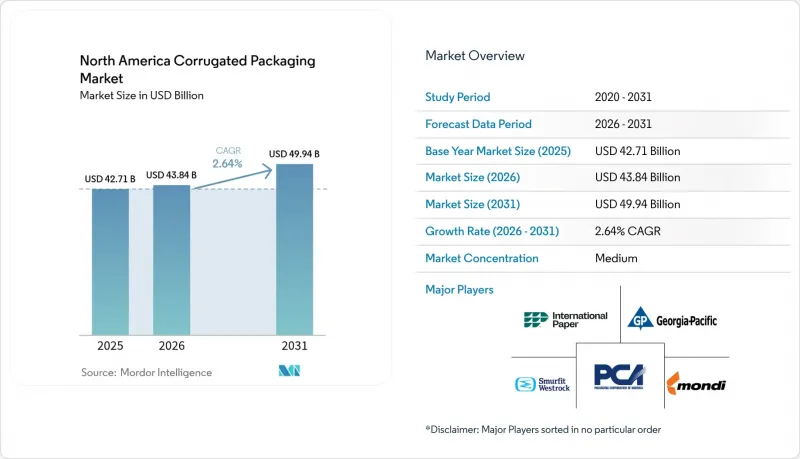
根據 Mordor Intelligence 預測,北美瓦楞紙包裝市場規模將從 2025 年的 427.1 億美元和 2026 年的 438.4 億美元成長到 2031 年的 499.4 億美元,2026 年至 2031 年的年複合成長率(CAGR)為 2.64%。
本報告依紙板等級(再生紙板、原生牛皮箱紙板等)、壁厚結構(單層、三層等)、瓦楞類型(A型瓦楞、B型瓦楞等)、產品類型(硬紙盒等)、終端用戶行業(飲料、紙製品等)、印刷技術(數位印刷等)和國家/地區進行細分。市場預測以美元計價。
北美瓦楞紙板包裝市場趨勢與洞察
電子商務小包裹量激增
到2025年,北美地區的電子商務包裹運輸量將超過200億件,其中92%將使用紙箱包裝,這將直接導致紙箱需求的成長。根據美國郵政服務(USPS)統計,2025年上半年小包裹量年增7.2%,而同期私人快遞公司承運的B2C(企業對消費者)包裹量則增加了12%。亞馬遜計劃在2025年中期在其區域網路中設立200多個按需包裝站,淘汰26種固定尺寸紙箱的庫存,並將每個小包裹的材料浪費減少18%。美國零售聯合會(NRF)預測,到2027年,線上銷售額將占美國零售總額的28%,這意味著即使實體零售通路保持平穩,紙箱市場也將持續成長。因此,履約中心優先使用線速度快的普通牛皮紙開槽容器,瓦楞紙板已穩固確立了其作為運輸包裝材料標準的地位。
監管政策轉向可回收包裝和塑膠禁令
加拿大聯邦塑膠註冊制度將於2024年6月生效,該制度要求製造商報告其塑膠使用量和再生材料含量,但紡織包裝材料不受此項合規要求的約束。此外,包括加州和紐約州在內的八個美國州將在2024年至2025年間實施《生產者延伸責任法案》,對不可回收產品徵收噸費,但回收率高達89%的瓦楞紙箱則可豁免。墨西哥城於2024年禁止使用發泡聚苯乙烯食品容器,預計將有3.5萬短噸的需求轉向紙板翻蓋式容器和比薩盒。永續包裝聯盟2025年的一項調查顯示,73%的北美品牌所有者在選擇初級包裝時優先考慮可回收性而非重量減輕。這些政策共同作用,正在提升紙板相對於塑膠的整體競爭力,加速餐飲服務、零售外帶和直銷通路的材料轉換。
再生紙板(OCC)和原生紙漿的價格波動
再生瓦楞紙板(OCC)的價格波動幅度高達80%,從2025年2月的每短噸50美元漲至同年9月的每短噸90美元,擠壓了加工商的利潤空間。中國對再生纖維的需求下降,導致210萬短噸的再生瓦楞紙板重新出口到北美市場,湧入國內市場,壓低了現貨價格。同時,造紙企業在2025年初關閉了12%的瓦楞紙板芯材產能。原生牛皮箱紙板的價格徘徊在每噸620至650美元左右,造成了顯著的成本差異,這有利於一體化生產商,但損害了沒有造紙資產的公司的利益。價格談判週期從年度合約轉向季度合約加劇了不確定性,可能導致加工廠的資本項目延長。除非出口通路恢復或新的國內產能投入運作,否則纖維價格波動對利潤空間的壓力將持續存在。
細分市場分析
到2025年,再生瓦楞紙板將佔北美瓦楞包裝市場佔有率的68.34%,這充分展現了該地區成熟的再生纖維網路的有效性。其成本優勢和89%的回收率使其成為優先考慮降低總落地成本的食品雜貨、飲料和電子商務企業的首選。同時,受化妝品、食材自煮包和家用電器品牌對更亮麗的印刷表面和耐油塗層的需求推動,預計到2031年,半化學和特種基材將以3.31%的最高複合年成長率成長。這種對更高品質表面的追求正促使綜合造紙企業解決特種機械設備的瓶頸問題,並與加工商簽訂面向D2C(直接面對消費者)通路的長期合約。
在北美瓦楞紙包裝市場,對再生紙的需求預計仍將穩定成長。這是因為加工食品處理量的成長速度超過了高階基材市場佔有率的流失速度。原生牛皮箱紙板仍然是出口包裝箱和重型工業貨物的必需品,因為這些產品需要高堆疊強度以應對長途運輸,但其高出40%的成本限制了其更廣泛的應用。再生紙的重量也不斷減輕,其吸引力進一步增強,尤其是在服裝產品的運輸方面,因為紙面紙的紙張重量已從47磅降至42磅。總體而言,基材策略不再受原料總噸位的驅動,而是受品牌細分市場的驅動,能夠使用同一套設備在棕色紙和白色頂級紙之間切換的造紙商可以提高其生產計劃的柔軟性。
2025年,單層壁包裝產品佔區域銷售額的59.76%,其中68%的出貨產品重量低於20磅。這些產品仍然是小包裹、零售和輕工業領域的主力軍,在這些領域,32 ECT的強度足以滿足需求,而由於高速自動化,更薄的壁厚更受歡迎。預計從2026年到2031年,三層壁包裝產品的複合年成長率將達到3.28%,成為成長最快的產品。這主要是由於近岸汽車和機械生產中引擎缸體和重型鑄件需要275 ECT的強度。在墨西哥北部和美國南部的邊境地區,三層壁包裝產品的普及尤為顯著,該地區的新建組裝廠正在指定使用更厚的包裝箱進行海運和多式聯運。
雙層瓦楞紙板介於兩者之間,既能保護那些單層瓦楞紙板太重而無法使用,三層瓦楞紙板又不經濟的電器、散裝食品和冷鏈貨物。沃爾瑪強制使用48-ECT托盤的做法,已經加速了部分食品雜貨領域從單層瓦楞紙板轉向雙層瓦楞紙板的轉變。同時,隨著履約中心降低體積重量,微瓦楞技術的創新正在蠶食低價單層瓦楞紙板市場,甚至在主流品類中也引發了市場佔有率的變化。能夠在同一瓦楞紙板生產窗口內生產多種壁厚的製造商,可以提高設備運轉率,並在不延長前置作業時間下滿足客戶不斷變化的強度要求。
其他好處:
- Excel格式的市場預測(ME)表
- 3個月的分析師支持
目錄
第1章:引言
- 研究假設和市場定義
- 調查範圍
第2章:調查方法
第3章執行摘要
第4章 市場狀況
- 市場概覽
- 市場促進因素
- 電子商務導致小包裹數量激增
- 法規轉向可回收包裝,並禁止使用塑膠製品。
- 輕量化、高強度的微波紋結構和材料節省
- 擴大食材自煮包和藥品物流的冷鏈。
- 人工智慧驅動的最佳化和按需包裝盒生產
- 製造業近岸外包正在提振國內對瓦楞紙板的需求。
- 市場限制因素
- OCC和原生紙漿價格波動
- 柔軟性和硬質塑膠。
- 人手不足加劇了自動化設備投資的負擔。
- 能源和運輸成本不斷上漲
- 波特五力分析
- 宏觀經濟因素對市場的影響
- 產業價值鏈分析
- 技術展望
第5章 市場規模與成長預測
- 董事會等級
- 再生紙箱
- 維珍工藝襯板
- 半化學級和特殊級
- 透過牆體結構
- 單層壁
- 雙層壁
- 三層壁
- 長笛類型
- 長笛
- 低音長笛
- C調長笛
- E 長笛
- F/N 微型笛
- 依產品類型
- 帶插槽的盒子
- 硬盒
- 望遠鏡盒
- 文件夾盒
- 散裝箱和八角形箱
- 按最終用戶行業分類
- 加工食品
- 生鮮食品
- 飲料
- 紙製品
- 電氣和電子設備
- 個人護理化妝品
- 其他
- 透過印刷技術
- 柔版印刷
- 數位印刷
- 乳化
- 其他
- 國家
- 美國
- 加拿大
- 墨西哥
第6章 競爭情勢
- 市場集中度
- 策略趨勢
- 市佔率分析
- 公司簡介
- International Paper Company
- Smurfit Westrock plc
- Packaging Corporation of America
- Georgia-Pacific LLC
- Mondi plc
- Pratt Industries, Inc.
- Cascades Inc.
- Sonoco Products Company
- Nine Dragons Paper(Holdings)Limited
- Oji Holdings Corporation
- Graphic Packaging Holding Company
- Stora Enso Oyj
- Nippon Paper Industries Co., Ltd.
- Orora Limited
- Rengo Co., Ltd.
- Viking Packaging, LLC
- Sealed Air Corporation
- Menasha Corporation
- Hood Packaging Corporation
- Green Bay Packaging Inc.
- Clearwater Paper Corporation
第7章 市場機會與未來展望
According to Mordor Intelligence, the North America corrugated packaging market size is projected to expand from USD 42.71 billion in 2025 and USD 43.84 billion in 2026 to USD 49.94 billion by 2031, registering a CAGR of 2.64% between 2026 to 2031.
This report is Segmented by Board Grade (Virgin Kraft Linerboard, and More), Wall Type (Single Wall, Triple Wall, and More), Flute Type (A-Flute, B-Flute, and More), Product Type (Rigid Boxes, and More), End-User Industry (Beverages, Paper Products, and More), Printing Technology (Digital Printing, and More), and Country. The Market Forecasts are Provided in Terms of Value (USD).
North America Corrugated Packaging Market Trends and Insights
Surge in E-commerce Parcel Volumes
E-commerce shipments in North America topped 20 billion parcels in 2025, and 92% moved in corrugated containers, directly translating into higher box demand. The United States Postal Service reported a 7.2% year-over-year rise in package volume during the first half of 2025, while private carriers absorbed an additional 12% jump in business-to-consumer deliveries the same year. Amazon installed more than 200 on-demand packaging stations across its regional network by mid-2025, eliminating inventory of 26 fixed box sizes and cutting material waste by 18% per parcel. The National Retail Federation projects online sales will reach 28% of total United States retail by 2027, ensuring sustained corrugated growth even if brick-and-mortar channels stabilize. Fulfillment centers are therefore prioritizing plain kraft slotted containers that run at higher line speeds, reinforcing corrugated's position as the default transport medium.
Regulatory Shift Toward Recyclable Packaging and Plastic Bans
Canada's Federal Plastics Registry, effective June 2024, requires producers to report plastic volumes and recycled content, a compliance burden that fiber packaging is exempt from. Eight United States states, including California and New York, enacted extended producer responsibility laws during 2024-2025 that levy per-ton fees on non-recyclable formats, but spare corrugated boxes, which have an 89% recovery rate. Mexico City's 2024 ban on expanded polystyrene foodservice ware redirected an estimated 35,000 short tons of demand to corrugated clamshells and pizza boxes. The Sustainable Packaging Coalition found in 2025 that 73% of North American brand owners now rank recyclability above lightweighting when specifying primary packs. These converging policies collectively lift corrugated's competitive edge versus plastics and accelerate substrate switching in foodservice, retail carry-out, and direct-to-consumer channels.
Volatility in OCC and Virgin Pulp Prices
Old corrugated container prices fluctuated from USD 50 per short ton in February 2025 to USD 90 in September 2025, an 80% swing that eroded converter margins. China's reduced appetite for recovered fiber redirected 2.1 million short tons of exports back into North America, flooding the domestic stream and depressing spot values while mills idled 12% of corrugating-medium capacity in early 2025. Virgin Kraft linerboard held near USD 620-650 per ton, creating a wide cost gap that favored integrated producers but punished merchants lacking mill assets. Quarterly price renegotiations have replaced annual contracts, adding uncertainty that can delay capital projects in converting plants. Unless export channels recover or new domestic capacity starts, margin pressure from fiber price volatility will persist.
Other drivers and restraints analyzed in the detailed report include:
- Lightweight High-Strength Microflutes and Material Savings
- Cold-Chain Expansion for Meal-Kit and Pharma Logistics
- Substitution Threat from Flexible and Rigid Plastics
For complete list of drivers and restraints, kindly check the Table Of Contents.
Segment Analysis
Recycled containerboard captured 68.34% of the North America corrugated packaging market share in 2025, validating the region's mature recovered-fiber network. The grade's cost advantage and 89% recovery rate keep it the default choice for grocery, beverage, and e-commerce shippers that prize low total landed cost. Semi-chemical and specialty substrates, however, are forecast to record the fastest 3.31% CAGR through 2031 as cosmetics, meal-kit, and consumer-electronics brands demand brighter print surfaces and grease-resistant coatings. This migration toward premium surfaces is prompting integrated mills to debottleneck specialty machines and secure long-term contracts with converters serving direct-to-consumer channels.
The North America corrugated packaging market for recycled grades will still expand modestly, as volume gains in processed foods outweigh share drift to premium substrates. Virgin Kraft linerboard remains essential for export crates and heavy industrial loads, where stacking strength must offset long transit times, yet its 40% cost premium limits wider use. Recycled grades are also adopting lightweight grammages, notably a switch from 47-pound to 42-pound liner in apparel shipping, widening their appeal. Overall, brand segmentation rather than raw tonnage now guides substrate strategy, and mills that can toggle between brown and white-top grades on the same machine gain scheduling flexibility.
Single-wall formats accounted for 59.76% of regional revenue in 2025, as 68% of shipped items weighed under 20 pounds. They remain the workhorse in parcel, retail-ready, and light industrial cases where 32 ECT strength is sufficient and high-speed automation favors thin caliper. Triple-wall constructions are projected to notch the highest 3.28% CAGR over 2026-2031 as nearshored automotive and machinery output demands 275-pound ECT durability for engine blocks and heavy castings. Rising adoption is visible in northern Mexico and southern United States border corridors, where new assembly plants are specifying heavier boxes for ocean and intermodal transit.
Double-wall sits between the extremes, protecting appliances, bulk foods, and cold-chain payloads that are too heavy for single-wall yet do not justify triple-wall cost. Walmart's 48-ECT pallet mandate has already spurred upgrades from single-wall to double-wall in selected grocery lanes. Meanwhile, microflute innovation is eroding the lower end of single-wall as fulfillment centers trim dimensional weight, indicating share churn even within the dominant class. Producers that can run multiple wall types on the same corrugator window improve asset utilization and meet shifting customer strength specifications without lengthening lead times.
Complete Report Scope:
- By Board Grade
- Recycled Containerboard
- Virgin Kraft Linerboard
- Semi-chemical and Specialty Grades
- By Wall Type
- Single Wall
- Double Wall
- Triple Wall
- By Flute Type
- A-flute
- B-flute
- C-flute
- E-flute
- F/N Microflute
- By Product Type
- Slotted Boxes
- Rigid Boxes
- Telescope Boxes
- Folder Boxes
- Bulk Bins and Octabins
- By End-user Industry
- Processed Foods
- Fresh Foods
- Beverages
- Paper Products
- Electrical and Electronics
- Personal Care and Cosmetics
- Other End-user Industries
- By Printing Technology
- Flexographic Printing
- Digital Printing
- Litho-lamination
- Other Printing Technologies
- By Country
- United States
- Canada
- Mexico
List of Companies Covered in this Report:
- International Paper Company
- Smurfit Westrock plc
- Packaging Corporation of America
- Georgia-Pacific LLC
- Mondi plc
- Pratt Industries, Inc.
- Cascades Inc.
- Sonoco Products Company
- Nine Dragons Paper (Holdings) Limited
- Oji Holdings Corporation
- Graphic Packaging Holding Company
- Stora Enso Oyj
- Nippon Paper Industries Co., Ltd.
- Orora Limited
- Rengo Co., Ltd.
- Viking Packaging, LLC
- Sealed Air Corporation
- Menasha Corporation
- Hood Packaging Corporation
- Green Bay Packaging Inc.
- Clearwater Paper Corporation
Additional Benefits:
- The market estimate (ME) sheet in Excel format
- 3 months of analyst support
TABLE OF CONTENTS
1 INTRODUCTION
- 1.1 Study Assumptions and Market Definition
- 1.2 Scope of the Study
2 RESEARCH METHODOLOGY
3 EXECUTIVE SUMMARY
4 MARKET LANDSCAPE
- 4.1 Market Overview
- 4.2 Market Drivers
- 4.2.1 Surge in E-commerce Parcel Volumes
- 4.2.2 Regulatory Shift toward Recyclable Packaging and Plastic Bans
- 4.2.3 Lightweight High-Strength Micro-flutes and Material Savings
- 4.2.4 Cold-chain Expansion for Meal-kit and Pharma Logistics
- 4.2.5 AI-enabled Right-sizing and On-demand Box Production
- 4.2.6 Nearshoring of Manufacturing Boosting Domestic Box Demand
- 4.3 Market Restraints
- 4.3.1 Volatility in OCC and Virgin Pulp Prices
- 4.3.2 Substitution Threat from Flexible and Rigid Plastics
- 4.3.3 Labor Shortages Driving Automation Capex Burden
- 4.3.4 Rising Energy and Transportation Costs
- 4.4 Porter's Five Forces Analysis
- 4.4.1 Bargaining Power of Buyers
- 4.4.2 Bargaining Power of Suppliers
- 4.4.3 Threat of Substitutes
- 4.4.4 Threat of New Entrants
- 4.4.5 Intensity of Competitive Rivalry
- 4.5 Impact of Macroeconomic Factors on the Market
- 4.6 Industry Value Chain Analysis
- 4.7 Technological Outlook
5 MARKET SIZE AND GROWTH FORECASTS (VALUE)
- 5.1 By Board Grade
- 5.1.1 Recycled Containerboard
- 5.1.2 Virgin Kraft Linerboard
- 5.1.3 Semi-chemical and Specialty Grades
- 5.2 By Wall Type
- 5.2.1 Single Wall
- 5.2.2 Double Wall
- 5.2.3 Triple Wall
- 5.3 By Flute Type
- 5.3.1 A-flute
- 5.3.2 B-flute
- 5.3.3 C-flute
- 5.3.4 E-flute
- 5.3.5 F/N Microflute
- 5.4 By Product Type
- 5.4.1 Slotted Boxes
- 5.4.2 Rigid Boxes
- 5.4.3 Telescope Boxes
- 5.4.4 Folder Boxes
- 5.4.5 Bulk Bins and Octabins
- 5.5 By End-user Industry
- 5.5.1 Processed Foods
- 5.5.2 Fresh Foods
- 5.5.3 Beverages
- 5.5.4 Paper Products
- 5.5.5 Electrical and Electronics
- 5.5.6 Personal Care and Cosmetics
- 5.5.7 Other End-user Industries
- 5.6 By Printing Technology
- 5.6.1 Flexographic Printing
- 5.6.2 Digital Printing
- 5.6.3 Litho-lamination
- 5.6.4 Other Printing Technologies
- 5.7 By Country
- 5.7.1 United States
- 5.7.2 Canada
- 5.7.3 Mexico
6 COMPETITIVE LANDSCAPE
- 6.1 Market Concentration
- 6.2 Strategic Moves
- 6.3 Market Share Analysis
- 6.4 Company Profiles (includes Global Level Overview, Market Level Overview, Core Segments, Financials as available, Strategic Information, Market Rank/Share, Products and Services, Recent Developments)
- 6.4.1 International Paper Company
- 6.4.2 Smurfit Westrock plc
- 6.4.3 Packaging Corporation of America
- 6.4.4 Georgia-Pacific LLC
- 6.4.5 Mondi plc
- 6.4.6 Pratt Industries, Inc.
- 6.4.7 Cascades Inc.
- 6.4.8 Sonoco Products Company
- 6.4.9 Nine Dragons Paper (Holdings) Limited
- 6.4.10 Oji Holdings Corporation
- 6.4.11 Graphic Packaging Holding Company
- 6.4.12 Stora Enso Oyj
- 6.4.13 Nippon Paper Industries Co., Ltd.
- 6.4.14 Orora Limited
- 6.4.15 Rengo Co., Ltd.
- 6.4.16 Viking Packaging, LLC
- 6.4.17 Sealed Air Corporation
- 6.4.18 Menasha Corporation
- 6.4.19 Hood Packaging Corporation
- 6.4.20 Green Bay Packaging Inc.
- 6.4.21 Clearwater Paper Corporation
7 MARKET OPPORTUNITIES AND FUTURE OUTLOOK
- 7.1 White-space and Unmet-need Assessment

 北美瓦楞紙和折疊式紙盒包裝:市場佔有率分析、行業趨勢和統計數據以及成長預測(2026-2031 年)中東瓦楞紙包裝市場:市場佔有率分析、產業趨勢與統計及成長預測(2026-2031)中東和非洲瓦楞紙包裝市場:市場佔有率分析、行業趨勢和統計數據以及成長預測(2026-2031 年)英國瓦楞紙板包裝:市場佔有率分析、行業趨勢和統計數據以及成長預測(2026-2031 年)
 瓦楞紙市場規模、佔有率和成長分析:按產品類型、紙張重量、應用、最終用途產業、包裝類型和地區分類 - 產業預測,2026-2033年
 瓦楞紙板配件市場規模、佔有率和成長分析:按產品類型、材料、應用、最終用戶、分銷管道和地區分類-2026-2033年產業預測
 瓦楞紙板包裝軟體市場-2026-2032年全球市場預測
 2026-2030年全球瓦楞紙包裝軟體市場
 紙盒包裝市場預測至2034年-全球分析(按紙板類型、材料、印刷和表面處理、封裝類型、應用、最終用途、分銷管道和地區分類)南美瓦楞紙包裝市場:市場佔有率分析、產業趨勢與統計及成長預測(2026-2031 年)