


 |
市場調查報告書
商品編碼
2125610
中東和非洲瓦楞紙包裝市場:市場佔有率分析、行業趨勢和統計數據以及成長預測(2026-2031 年)Middle-East And Africa Corrugated Packaging - Market Share Analysis, Industry Trends & Statistics, Growth Forecasts (2026 - 2031) |
||||||

※ 本網頁內容可能與最新版本有所差異。詳細情況請與我們聯繫。
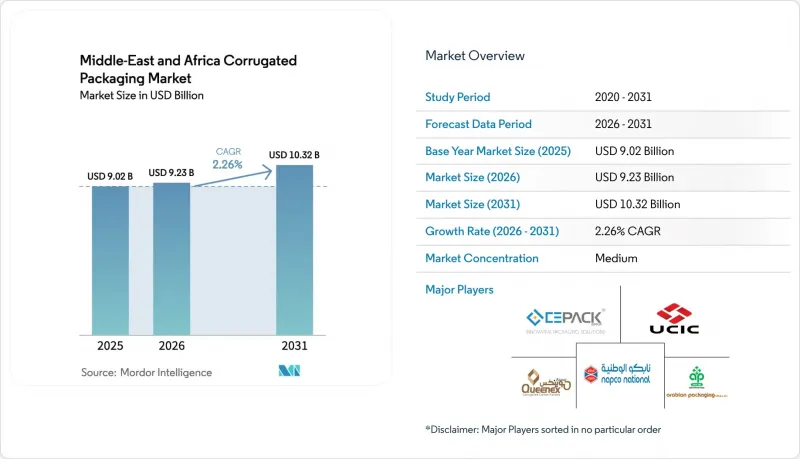
根據 Mordor Intelligence 預測,中東和非洲的瓦楞紙板包裝市場規模將從 2025 年的 90.2 億美元和 2026 年的 92.3 億美元成長到 2031 年的 103.2 億美元,2026 年至 2031 年的複合年成長率為 2.26%。
本報告按紙盒類型(開槽紙盒、模切紙盒、五摺紙盒、伸縮紙盒等)、紙板等級(單層紙板、雙層紙板等)、瓦楞規格(A型瓦楞、B型瓦楞等)、終端用戶行業(食品、飲料等)和地區進行細分。市場預測以美元計價。
中東和非洲瓦楞紙板包裝市場的趨勢和洞察
電子商務的快速發展正在推動包裹的最後一公里配送。
2024年,該地區的線上零售市場成長了30%,推動了對模切紙盒的需求,這種紙盒能夠大幅降低體積重量成本,並能承受逆向物流處理。沙烏地阿拉伯數位支付的日益普及,使得電子商務在二線城市滲透率更高,促使加工商推廣使用F型瓦楞和微型瓦楞紙盒,以降低20-30%的材料成本。在阿拉伯聯合大公國(阿拉伯聯合大公國),跨境電商平台對防篡改功能和多語言圖形的需求日益成長,也提升了人們對可變數據數位印刷的興趣。在2024年德魯巴印刷展上展出的一款聯線混合印刷機能夠小批量生產500個產品,使微型品牌無需製版即可實現圖形前置作業時間化。這些變化共同促使加工商對其設備進行現代化改造,以縮短訂單週期、減少瓦楞寬度,並支援兼具退貨功能的互動式QR碼。
快速消費品和有組織零售的快速擴張
沙烏地阿拉伯、阿拉伯聯合大公國和埃及的大賣場超市正將業務拓展至夏季氣溫超過攝氏45度的省會城市。紙板包裝生產商必須遵守沙烏地阿拉伯食品藥物管理局(SFDA)的標籤標準,包括阿拉伯語標籤,並提供能夠承受高濕度環境下物流運輸的產品。隨著埃及食品零售業的現代化,符合ISO 22,000標準的食品級紙板正日益受到關注。儘管奈及利亞展現出發展潛力,但港口擁擠和外匯波動阻礙了對波灣合作理事會的投資。儘管如此,海灣合作理事會(GCC)國家的紙包裝產值預計到2032年將達到128億美元,這表明零售業主導的需求將持續存在。
牛皮紙供應和價格的波動
由於埃及60%的牛皮紙襯紙依賴進口,2024年英鎊兌歐元匯率下跌10%導致埃及進口成本增加。奈及利亞加工商則因奈拉貶值和拉各斯港堵塞而面臨15%至20%的附加費。繞道紅海將運往肯亞的前置作業時間從30天延長至50天,迫使他們轉而使用再生纖維,即使這意味著紙張的耐破強度會降低。諸如中東紙業公司斥資17.8億美元(以沙烏地阿拉伯裡亞爾計)擴建其造紙廠等投資項目,旨在透過提高區域內的產能來抵銷這些波動的影響。
細分市場分析
到2025年,開槽紙箱在中東和非洲瓦楞紙包裝市場仍將佔43.0%的佔有率,這主要得益於其成本效益和與紙箱組裝機的兼容性。在沙烏地阿拉伯、阿拉伯聯合大公國、埃及和南非,開槽紙箱仍然是食品和飲料大批量運輸的標準選擇。同時,預計2031年,模切紙箱的複合年成長率將達到3.11%,超過中東和非洲瓦楞紙包裝市場的整體成長率。電商平台需要與產品完美貼合的包裝,以減少空隙、降低體積重量費用並改善開箱體驗。在2024年德魯巴印刷展上發布的一款線上數位印刷系統,使加工商即使在500件的小批量訂單中也能添加帶有QR碼的圖形,從而滿足微型品牌的審美需求,而無需等待模具製作。五摺紙箱適用於出口扁平包裝的服飾,而伸縮紙箱由於其兩件式結構具有抗壓性,則用於運輸汽車和重型機械的零件。 Blissbox 和自動化組合式容器正被應用於醫藥和電子產品等細分市場,在這些市場中,防篡改、緩衝和快速履約至關重要。
在中東和非洲的瓦楞紙板包裝市場,隨著末端物流網路的擴展,模切設計的市場規模預計將穩定成長。波灣合作理事會(GCC)成員國城市的加工商正在引入雷射模切生產線,以增強紙板的抗折性,實現自鎖式封口,從而減少膠帶的使用。這項技術變革也符合生產者延伸責任制(EPR)的規定,該規定對使用不可回收的緩衝材料進行處罰。因此,在數位支付、逆向物流和智慧型手機普及率相近的市場,模切技術的應用預計將成長最快。
2025年,單層瓦楞紙板將佔據中東和非洲瓦楞紙板包裝市場48.2%的佔有率。其抗破強度為200-300磅/平方英吋(psi),足以滿足常溫食品運輸的需求,且表面光滑,便於印刷,是食品、飲料和日常消費品(FMCG)行業的領先產品。雙層瓦楞紙板適用於包裝中等重量的家用電器和電子設備,抗破強度為400-500磅/平方英吋(psi),且比木箱更輕。三層瓦楞紙板的抗破強度超過1000磅/平方英吋(psi),成長速度最快,年複合成長率(CAGR)達3.89%,這主要得益於非洲大陸自由貿易區(AfCFTA)框架下機械化工產品跨境貿易的推動。在中東和非洲的瓦楞紙板包裝市場,隨著出口商尋求輕便、無需燻蒸的木箱替代品,三層瓦楞紙板的市場規模預計將會擴大。中東紙業公司(Middle East Paper Company)的第五台機器專為生產高耐久性面紙而設計,這表明該地區的紙業公司預計對三層瓦楞紙板產能的需求將持續成長。實心纖維板雖然剛性極高,但由於其重量較大,目前仍僅限於高價值電子產品應用領域。
儘管在非洲價格敏感的主要貿易航線上,三層機艙飛機最初可能會因30-40%的溢價而受到一些阻力,但對總著陸成本的分析表明,運輸成本的降低和損壞的減少足以抵消這些初始成本。跨薩赫勒公路的改善以及非洲之角鐵路網的發展將進一步凸顯三層機艙飛機在惡劣環境下的耐久性優勢。
其他好處:
- Excel格式的市場預測(ME)表
- 3個月的分析師支持
目錄
第1章:引言
- 研究假設和市場定義
- 調查範圍
第2章:調查方法
第3章執行摘要
第4章 市場狀況
- 市場概覽
- 產業價值鏈分析
- 監理情勢
- 技術展望
- 宏觀經濟因素對市場的影響
- 市場促進因素
- 電子商務的快速成長正在推動對「最後一公里」包裝的需求。
- 快速消費品和有組織零售的快速擴張
- 政府鼓勵本地製造業和回收利用
- 出口導向型生鮮食品物流的成長
- 非洲大陸自由貿易區架構下,非洲內部貿易激增
- 為微型品牌引入數位印刷
- 市場限制因素
- 牛皮紙供應和價格的波動
- 來自柔軟性塑膠包裝的競爭
- 依賴進口的原物料物流風險
- 由於缺水,麵粉廠制定了相關規定
- 價格分析
- 進出口分析
- PESTLE分析
- 資本投資趨勢
- 瓦楞紙箱生產對環境的影響
- 產業生態系分析
- 波特五力分析
第5章 市場規模與成長預測
- 盒裝
- 槽式貨櫃
- 模切容器
- 五摺盒
- 可伸縮盒子
- 其他類型的盒子
- 董事會等級
- 單層板
- 雙層壁板
- 三層牆板
- 固體纖維板
- 按尺寸分類的笛子
- A 長笛
- 低音長笛
- C調長笛
- 電子長笛
- F調長笛
- 其他長笛
- 按最終用戶行業分類
- 食物
- 飲料
- 家用電子電器和家用電器
- 個人護理和居家護理
- 工業和化學
- 農業和生鮮食品
- 電子商務與零售
- 其他最終用戶
- 按地區
- 中東
- 沙烏地阿拉伯
- 阿拉伯聯合大公國
- 土耳其
- 其他中東國家
- 非洲
- 埃及
- 南非
- 奈及利亞
- 其他非洲國家
- 中東
第6章 競爭情勢
- 市場集中度
- 策略趨勢
- 市佔率分析
- 公司簡介
- Arabian Packaging Co. LLC
- Queenex Corrugated Carton Factory LLC
- United Carton Industries Company
- Napco National CJSC
- Cepack Group SARL
- Falcon Pack IND LLC
- World Pack Industries LLC
- Universal Carton Industries Group LLC
- Express Pack Print LLC
- Green Packaging Boxes Industries LLC
- Tarboosh Packaging Co. LLC
- Unipack Containers & Carton Products LLC
- Al Rumanah Packaging LLC
- NBM Pack LLC
- Mondi plc
- Smurfit Kappa Group plc
- International Paper Company
- Middle East Paper Company
- INDEVCO Paper Containers SAL
- Obeikan Paper Industries Co.
- National Paper Company SAE
- RAK Packaging LLC
- Al Bayader International LLC
- Hadera Paper Ltd.(Amnir Corrugated)
第7章 市場機會與未來展望
According to Mordor Intelligence, the Middle East and Africa corrugated packaging market size is projected to expand from USD 9.02 billion in 2025 and USD 9.23 billion in 2026 to USD 10.32 billion by 2031, registering a CAGR of 2.26% between 2026 and 2031.
This report is Segmented by Box Type (Slotted Containers, Die-Cut Containers, Five-Panel Folder Boxes, Telescopic Boxes, and More), Board Grade (Single-Wall Board, Double-Wall Board, and More), Flute Size (A-Flute, B-Flute, and More), End-User Industry (Food, Beverage, and More), and Geography. The Market Forecasts are Provided in Terms of Value (USD).
Middle-East And Africa Corrugated Packaging Market Trends and Insights
E-commerce Boom Driving Last-Mile-Friendly Packaging
Online retail in the region expanded by 30% in 2024, boosting demand for die-cut cartons that slash dimensional-weight fees and withstand reverse-logistics handling. Saudi Arabia's digital-payment adoption lifted e-commerce penetration in tier-2 cities, prompting converters to specify F-Flute and micro-flute profiles for 20-30% material savings. In the United Arab Emirates, cross-border marketplaces require tamper-evident, multilingual graphics, intensifying interest in variable-data digital printing. Inline hybrid presses shown at drupa 2024 allow runs of 500 units, letting micro-brands personalize graphics without plate lead times. Collectively, these shifts lead converters to retool for shorter order cycles, narrower flutes, and interactive QR-codes that double as returns portals.
Rapid Expansion of FMCG and Organised Retail
Hypermarket chains in Saudi Arabia, the United Arab Emirates, and Egypt are scaling into secondary cities where summer temperatures top 45 °C. Corrugated shippers must comply with Saudi Food and Drug Authority labelling, carry Arabic text, and survive high-humidity distribution. Egypt's grocery modernisation brings ISO 22000 food-grade board to the forefront. Nigeria, while promising, contends with port congestion and currency swings that suppress cold-chain investment. Still, Gulf Cooperation Council paper-packaging output is forecast to hit USD 12.8 billion by 2032, signalling sustained retail-led demand.
Volatility in Kraft Paper Supply and Prices
Egypt imports 60 % of its kraft liner, so a 10 % pound-euro slide in 2024 pushed up landed costs equivalently. Nigerian converters faced 15-20 % surcharges tied to naira depreciation and Lagos port congestion. Red Sea diversions extended Kenyan lead times from 30 to 50 days, forcing recycled-fiber substitution that compromised burst strength. Investments like Middle East Paper Company's SAR 1.78 billion mill expansion aim to offset such volatility via regional capacity.
Other drivers and restraints analyzed in the detailed report include:
- Government Incentives for Local Manufacturing and Recycling
- Export-Oriented Fresh-Produce Logistics Growth
- Competition from Flexible Plastic Packaging
For complete list of drivers and restraints, kindly check the Table Of Contents.
Segment Analysis
Slotted containers retained a 43.0 % share of the Middle East and Africa corrugated packaging market in 2025, testament to their cost efficiency and compatibility with case erectors. They remain the default for high-volume food and beverage shipments across Saudi Arabia, the United Arab Emirates, Egypt, and South Africa. Die-cut containers, however, chart a 3.11 % CAGR to 2031, outpacing the overall Middle East and Africa corrugated packaging market. E-commerce platforms mandate custom-fit packaging that trims void space and lowers dimensional-weight charges, while enhancing the unboxing moment. Inline digital-printing systems unveiled at drupa 2024 enable converters to add QR-coded graphics in runs as low as 500 units, meeting micro-brand aesthetics without tooling delays. Five-panel folders aid flat-packed apparel exports, whereas telescopic boxes serve automotive and heavy-machinery spares where two-piece construction ensures crush resistance. Bliss boxes and self-erecting containers sit in niche pharmaceutical and electronics channels that prize tamper evidence, cushioning, and rapid fulfilment.
The Middle East and Africa corrugated packaging market size for die-cut designs is projected to expand steadily as last-mile networks deepen. Converters in Gulf Cooperation Council cities are adding laser-die lines that sharpen crease tolerance, enabling self-locking flaps which reduce tape usage. This engineering shift also aligns with extended-producer-responsibility rules that penalize non-recyclable void-fill. As a result, die-cut adoption will rise fastest in markets where digital payments, reverse logistics, and smartphone penetration intersect.
Single-wall board accounted for 48.2 % of Middle East and Africa corrugated packaging market share in 2025. Its 200-300 psi burst strength, ample for ambient grocery distribution, and its smooth printable surface make it the workhorse across food, beverage, and FMCG lines. Double-wall board supports mid-weight consumer electronics and appliances, offering 400-500 psi while still cutting weight relative to wood crates. Triple-wall board, boasting over 1,000 psi, shows the sharpest growth at 3.89 % CAGR, propelled by AfCFTA cross-border machinery and chemicals trade. The Middle East and Africa corrugated packaging market size for triple-wall applications will accelerate as exporters seek fumigation-free, lighter alternatives to wooden crates. Middle East Paper Company's fifth machine is tailored for heavy-duty liner grades, a signal that regional mills expect sustained demand for triple-wall capacity. Solid fiber board, despite ultimate rigidity, stays relegated to high-value electronics due to its weight premium.
Price-sensitive African corridors may initially resist triple-wall's 30-40 % cost premium, yet total landed-cost analysis shows freight savings and damage reduction offsetting upfront spend. Trans- Sahel Road upgrades and rail links within the Horn of Africa will further underscore triple-wall's durability advantage in rough-handling environments.
Complete Report Scope:
- By Box Type
- Slotted Containers
- Die-cut Containers
- Five-panel Folder Boxes
- Telescopic Boxes
- Other Box Types
- By Board Grade
- Single-wall Board
- Double-wall Board
- Triple-wall Board
- Solid Fiber Board
- By Flute Size
- A-Flute
- B-Flute
- C-Flute
- E-Flute
- F-Flute
- Other Flutes
- By End-User Industry
- Food
- Beverage
- Consumer Electronics and Electrical Appliances
- Personal Care and Household Care
- Industrial and Chemicals
- Agriculture and Fresh Produce
- E-commerce and Retail
- Other End-Users
- By Geography
- Middle East
- Saudi Arabia
- United Arab Emirates
- Turkey
- Rest of Middle East
- Africa
- Egypt
- South Africa
- Nigeria
- Rest of Africa
- Middle East
List of Companies Covered in this Report:
- Arabian Packaging Co. LLC
- Queenex Corrugated Carton Factory LLC
- United Carton Industries Company
- Napco National CJSC
- Cepack Group SARL
- Falcon Pack IND LLC
- World Pack Industries LLC
- Universal Carton Industries Group LLC
- Express Pack Print LLC
- Green Packaging Boxes Industries LLC
- Tarboosh Packaging Co. LLC
- Unipack Containers & Carton Products LLC
- Al Rumanah Packaging LLC
- NBM Pack LLC
- Mondi plc
- Smurfit Kappa Group plc
- International Paper Company
- Middle East Paper Company
- INDEVCO Paper Containers SAL
- Obeikan Paper Industries Co.
- National Paper Company SAE
- RAK Packaging LLC
- Al Bayader International LLC
- Hadera Paper Ltd. (Amnir Corrugated)
Additional Benefits:
- The market estimate (ME) sheet in Excel format
- 3 months of analyst support
TABLE OF CONTENTS
1 INTRODUCTION
- 1.1 Study Assumptions and Market Definition
- 1.2 Scope of the Study
2 RESEARCH METHODOLOGY
3 EXECUTIVE SUMMARY
4 MARKET LANDSCAPE
- 4.1 Market Overview
- 4.2 Industry Value-Chain Analysis
- 4.3 Regulatory Landscape
- 4.4 Technological Outlook
- 4.5 Impact of Macroeconomic Factors on the Market
- 4.6 Market Drivers
- 4.6.1 E-commerce Boom Driving Last-Mile-Friendly Packaging
- 4.6.2 Rapid Expansion of FMCG and Organised Retail
- 4.6.3 Government Incentives for Local Manufacturing and Recycling
- 4.6.4 Export-Oriented Fresh-Produce Logistics Growth
- 4.6.5 Inter-African Trade Surge Under AfCFTA
- 4.6.6 Digital Printing Adoption for Micro-Brands
- 4.7 Market Restraints
- 4.7.1 Volatility in Kraft Paper Supply and Prices
- 4.7.2 Competition from Flexible Plastic Packaging
- 4.7.3 Import-Dependent Raw-Material Logistics Risk
- 4.7.4 Water-Scarcity-Driven Mill Regulations
- 4.8 Pricing Analysis
- 4.9 Import and Export Analysis
- 4.10 PESTLE Analysis
- 4.11 Capital Expenditure Trends
- 4.12 Environmental Impact of Corrugated Box Production
- 4.13 Industry Ecosystem Analysis
- 4.14 Porter's Five Forces Analysis
- 4.14.1 Bargaining Power of Suppliers
- 4.14.2 Bargaining Power of Buyers
- 4.14.3 Threat of New Entrants
- 4.14.4 Threat of Substitute Products
- 4.14.5 Intensity of Competitive Rivalry
5 MARKET SIZE AND GROWTH FORECASTS (VALUE)
- 5.1 By Box Type
- 5.1.1 Slotted Containers
- 5.1.2 Die-cut Containers
- 5.1.3 Five-panel Folder Boxes
- 5.1.4 Telescopic Boxes
- 5.1.5 Other Box Types
- 5.2 By Board Grade
- 5.2.1 Single-wall Board
- 5.2.2 Double-wall Board
- 5.2.3 Triple-wall Board
- 5.2.4 Solid Fiber Board
- 5.3 By Flute Size
- 5.3.1 A-Flute
- 5.3.2 B-Flute
- 5.3.3 C-Flute
- 5.3.4 E-Flute
- 5.3.5 F-Flute
- 5.3.6 Other Flutes
- 5.4 By End-User Industry
- 5.4.1 Food
- 5.4.2 Beverage
- 5.4.3 Consumer Electronics and Electrical Appliances
- 5.4.4 Personal Care and Household Care
- 5.4.5 Industrial and Chemicals
- 5.4.6 Agriculture and Fresh Produce
- 5.4.7 E-commerce and Retail
- 5.4.8 Other End-Users
- 5.5 By Geography
- 5.5.1 Middle East
- 5.5.1.1 Saudi Arabia
- 5.5.1.2 United Arab Emirates
- 5.5.1.3 Turkey
- 5.5.1.4 Rest of Middle East
- 5.5.2 Africa
- 5.5.2.1 Egypt
- 5.5.2.2 South Africa
- 5.5.2.3 Nigeria
- 5.5.2.4 Rest of Africa
- 5.5.1 Middle East
6 COMPETITIVE LANDSCAPE
- 6.1 Market Concentration
- 6.2 Strategic Moves
- 6.3 Market Share Analysis
- 6.4 Company Profiles (includes Global Level Overview, Market Level Overview, Core Segments, Financials as available, Strategic Information, Market Rank/Share, Products and Services, Recent Developments)
- 6.4.1 Arabian Packaging Co. LLC
- 6.4.2 Queenex Corrugated Carton Factory LLC
- 6.4.3 United Carton Industries Company
- 6.4.4 Napco National CJSC
- 6.4.5 Cepack Group SARL
- 6.4.6 Falcon Pack IND LLC
- 6.4.7 World Pack Industries LLC
- 6.4.8 Universal Carton Industries Group LLC
- 6.4.9 Express Pack Print LLC
- 6.4.10 Green Packaging Boxes Industries LLC
- 6.4.11 Tarboosh Packaging Co. LLC
- 6.4.12 Unipack Containers & Carton Products LLC
- 6.4.13 Al Rumanah Packaging LLC
- 6.4.14 NBM Pack LLC
- 6.4.15 Mondi plc
- 6.4.16 Smurfit Kappa Group plc
- 6.4.17 International Paper Company
- 6.4.18 Middle East Paper Company
- 6.4.19 INDEVCO Paper Containers SAL
- 6.4.20 Obeikan Paper Industries Co.
- 6.4.21 National Paper Company SAE
- 6.4.22 RAK Packaging LLC
- 6.4.23 Al Bayader International LLC
- 6.4.24 Hadera Paper Ltd. (Amnir Corrugated)
7 MARKET OPPORTUNITIES AND FUTURE OUTLOOK
- 7.1 White-space and Unmet-needs Assessment

 北美瓦楞紙和折疊式紙盒包裝:市場佔有率分析、行業趨勢和統計數據以及成長預測(2026-2031 年)中東瓦楞紙包裝市場:市場佔有率分析、產業趨勢與統計及成長預測(2026-2031)北美瓦楞紙包裝市場:市場佔有率分析、產業趨勢與統計及成長預測(2026-2031)英國瓦楞紙板包裝:市場佔有率分析、行業趨勢和統計數據以及成長預測(2026-2031 年)
 瓦楞紙市場規模、佔有率和成長分析:按產品類型、紙張重量、應用、最終用途產業、包裝類型和地區分類 - 產業預測,2026-2033年
 瓦楞紙板配件市場規模、佔有率和成長分析:按產品類型、材料、應用、最終用戶、分銷管道和地區分類-2026-2033年產業預測
 瓦楞紙板包裝軟體市場-2026-2032年全球市場預測
 2026-2030年全球瓦楞紙包裝軟體市場
 紙盒包裝市場預測至2034年-全球分析(按紙板類型、材料、印刷和表面處理、封裝類型、應用、最終用途、分銷管道和地區分類)南美瓦楞紙包裝市場:市場佔有率分析、產業趨勢與統計及成長預測(2026-2031 年)