


 |
市場調查報告書
商品編碼
2125280
歐洲報關代理:市場佔有率分析、產業趨勢與統計及成長預測(2026-2031 年)Europe Customs Brokerage - Market Share Analysis, Industry Trends & Statistics, Growth Forecasts (2026 - 2031) |
||||||

※ 本網頁內容可能與最新版本有所差異。詳細情況請與我們聯繫。
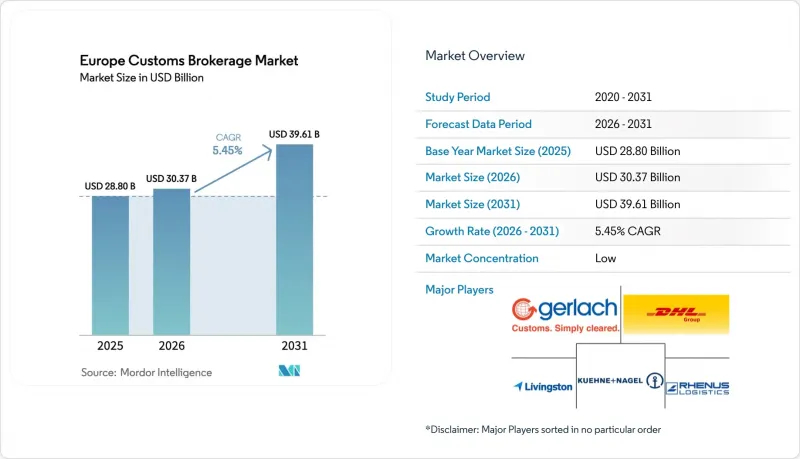
據 Mordor Intelligence 稱,2025 年歐洲報關代理市場價值 288 億美元,預計到 2031 年將從 2026 年的 303.7 億美元成長至 396.1 億美元,預測期(2026-2031 年)複合年成長率為 5.45%。
本報告按運輸方式(海運/海運、空運(快遞和普通貨物)、跨境陸路運輸(公路和鐵路))、仲介類型(純報關行、其他)、進口商規模(大型企業、其他)、數位化程度(傳統仲介、其他)、終端用戶行業(零售/電子商務、其他)和地區進行細分。市場預測以美元計價。
歐洲報關代理市場的趨勢與洞察
英國脫歐後海關申報數量激增
英國脫歐導致海關申報數量倍增,對清關專業知識的需求也因此居高不下。新的原產地規則的確認、透過邊境目標運作模式實施的基於風險的衛生管理,以及北愛爾蘭溫莎框架下「雙通道」系統的引入,都顯著增加了每批貨物的單據處理點數量。專業的報關行現在透過包裝諮詢、數據檢驗和自動化審計追蹤等方式,幫助貿易業者避免因關稅分類錯誤而受到處罰。綜合服務提供者正在將API與英國稅務海關英國)的海關申報服務整合,以縮短處理時間並最大限度地減少人為錯誤。隨著英國與歐盟之間貿易的正常化,複雜性而非簡單的數量將成為支撐報關行收入的關鍵因素,而對於歐洲海關市場上的高風險貨物,人工專業知識仍然至關重要。
電子商務推動了低價值進口貨物清關數量的增加。
取消22歐元的「最低限額」以及強制實施國際線上銷售服務(IOSS)方案,迫使平台和賣家整合其海關工作流程,因為增值稅在銷售點徵收。擁有強大IT介面的報關行正與每天向德國和荷蘭運送數千個小包裹的市場建立合作關係。小包裹承運商利用其廣泛的網路,而專注於特定領域的報關行則透過提供基於規則的產品分類、動態增值稅計算和自動產生退稅單據等服務來擴大市場佔有率。因此,歐洲報關代理市場的競爭日益激烈,在B2C清關領域,技術能力正成為比規模更重要的差異化因素。
歐盟邊境走廊的地緣政治貿易中斷
受衝突影響,貨物從北部路線轉向中部走廊,導致運輸時間延長,並造成土耳其、喬治亞和哈薩克邊境的海關堵塞。報關行面臨不穩定的法規環境、外匯波動和新實施的製裁檢查,所有這些都推高了處理成本。德國汽車和電子產品進口商面臨與準時制標準不符的不確定性,導致貨運量下降。這種不確定性正在抑制歐洲報關市場的短期成長。
細分市場分析
到2025年,海運服務將佔歐洲報關市場的41.55%,這反映出歐洲對經由鹿特丹、漢堡和安特衛普等港口從亞洲進口商品的強烈依賴。港口報關行透過處理汽車零件、電子產品和工業機械的複雜單據,獲得了豐厚的利潤。跨境陸路貨運服務預計將以4.62%的複合年成長率成長,這得益於工廠向波蘭和羅馬尼亞的轉移,從而縮短了供應鏈路線。陸上貨運日益成長的重要性也體現在對卡車更嚴格的安全檢查以及道路運輸程序的數位化,這些因素促使報關行實施電子貨運資訊報告(e-TIR)和國家海關運輸系統(NCTS)第五階段模組。在整個預測期內,歐洲報關市場的發展勢頭預計將取決於從港口到內陸地區的數位化通道的協調,從而平衡海運的主導地位與歐洲境內不斷成長的卡車運輸流量。
隨著托運人越來越傾向於單一物流供應商解決方案,與貨運代理商/第三方物流公司整合的報關行預計在2025年將佔據50.40%的收入佔有率。這些公司的技術預算、廣泛的全球網路以及倉儲營運整合能力構成了巨大的市場准入障礙。傳統的純粹報關行則憑藉在藥品進口、兩用物項和AEO諮詢等領域的專業知識維持著市場佔有率。儘管歐洲綜合報關行市場預計將以4.26%的複合年成長率成長,但純粹的專業報關行仍然吸引著需要客製化合規解決方案的客戶。隨著DSV以159億美元收購DB Schenker等大型交易的完成,預計競爭將從貨物處理能力轉向諮詢服務的深度。
其他好處
- Excel格式的市場預測(ME)表
- 3個月的分析師支持
目錄
第1章:引言
- 研究假設和市場定義
- 調查範圍
第2章:調查方法
第3章執行摘要
第4章 市場狀況
- 市場概覽
- 市場促進因素
- 英國脫歐後海關申報數量激增
- 電子商務推動了低價值進口貨物清關數量的增加。
- 歐盟關稅改革2028:引進資料中心
- 引入人工智慧驅動的HS編碼分類
- 透過將生產外包到東歐來提升跨境貿易量
- 加強對兩用物項出口管制措施的遵守
- 市場限制因素
- 歐盟邊境走廊的地緣政治貿易中斷
- 歐盟海關官員短缺和勞動力老化問題
- 小規模報關行面臨的IT和自動化相關成本負擔加重
- 小型包裹遞送公司對低價值貨物處理的侵占
- 價值供應鏈分析
- 監理情勢
- 技術展望
- 新冠疫情與地緣政治因素的影響
- 波特五力模型
第5章 市場規模與成長預測
- 透過運輸方式
- 海上運輸/航運
- 空運(快遞和普通貨物)
- 跨境陸路運輸(卡車和鐵路)
- 仲介類型
- 純粹的報關行
- 貨運代理/第三方物流綜合仲介
- 按進口商規模
- 大公司
- 中型公司
- 小規模/小型貨運商
- 透過數位化實施
- 傳統仲介
- 數位化優先/基於 API 的仲介
- 按最終用途行業分類
- 零售與電子商務
- 汽車和電動車
- 電子和半導體
- 製藥和生命科學
- 航太/國防
- 化學產品和工業產品
- 其他
- 國家
- 德國
- 英國
- 法國
- 荷蘭
- 義大利
- 西班牙
- 波蘭
- 其他歐洲國家
第6章 競爭情勢
- 市場集中度
- 策略趨勢
- 市佔率分析
- 公司簡介
- Livingston International
- DHL Group
- Kuehne+Nagel
- Rhenus Logistics
- Gerlach Customs
- APL Logistics
- DSV
- Gaston Schul Logistics
- CH Robinson
- Expeditors International
- Customs Support Group
- Dimerco Express
- UPS
- FedEx
- Geodis
- TIBA Group
- RHA Customs Brokerage
- Partida Logistics
- EFL Global
- ITG Air and Sea
第7章 市場機會與未來展望
According to Mordor Intelligence, the Europe customs brokerage market size was valued at USD 28.80 billion in 2025 and estimated to grow from USD 30.37 billion in 2026 to reach USD 39.61 billion by 2031, at a CAGR of 5.45% during the forecast period (2026-2031).
This report is Segmented by Mode of Transport (Ocean/Sea, Air Express and General Cargo, Cross-Border Land Truck and Rail), Broker Type (Pure Customs Broker, and More), Importer Size (Large Enterprises, and More), Digital Adoption (Traditional Brokerages, and More), End-Use Industry (Retail and E-Commerce, and More), and Geography. The Market Forecasts are Provided in Terms of Value (USD).
Europe Customs Brokerage Market Trends and Insights
Post-Brexit Surge in Customs Declarations
The United Kingdom's departure from the EU triggered a multi-fold rise in declaration volumes, driving sustained demand for brokerage expertise. New rules of origin checks, risk-based sanitary controls under the Border Target Operating Model, and Northern Ireland's Windsor Framework two-lane system have multiplied document touchpoints per shipment. Specialized brokers now package consulting, data validation, and automated audit trails to help traders avoid duty misclassification penalties. Integrated providers are embedding API links to HMRC's Customs Declaration Service, cutting processing time and reducing manual errors. As UK-EU traffic normalizes, complexity rather than sheer volume will sustain brokerage revenue, ensuring the Europe customs brokerage market continues to rely on human expertise for high-risk commodities.
E-Commerce-Driven Rise in Low-Value Import Clearances
Elimination of the EUR 22 de minimis threshold and the mandatory IOSS regime shifted VAT collection to the point-of-sale, compelling platforms and sellers to integrate customs workflows. Brokers with robust IT interfaces are onboarding marketplaces that ship thousands of daily parcels into Germany and the Netherlands. Parcel operators leverage network reach, yet niche brokers gain share by offering rule-based product classification, dynamic VAT calculation, and automated returns documentation. The Europe customs brokerage market is therefore witnessing intensified competition, with technology literacy overtaking scale as the main differentiator in B2C clearances.
Geopolitical Trade Disruptions in EU Border Corridors
Conflict-driven rerouting from the Northern route to the Middle Corridor has increased transit times and customs congestion at Turkish, Georgian, and Kazakh borders. Brokers face volatile regulatory environments, currency swings, and emerging sanctions checks, which collectively raise processing costs. Automotive and electronics importers in Germany confront uncertainty incompatible with just-in-time norms, thereby dampening shipment volumes. The resulting unpredictability restrains the Europe customs brokerage market's short-term growth.
Other drivers and restraints analyzed in the detailed report include:
- EU Customs Reform 2028 Data-Hub Roll-Out
- AI-Based HS-Code Classification Adoption
- EU Customs-Talent Shortages and Ageing Workforce
For complete list of drivers and restraints, kindly check the Table Of Contents.
Segment Analysis
Ocean/sea services owned 41.55% of the Europe customs brokerage market in 2025, mirroring Europe's heavy reliance on Asian imports through Rotterdam, Hamburg, and Antwerp. Port-centric brokers generate premium revenue by managing intricate documentation for automotive components, electronics, and industrial machinery. Cross-border land services are forecast to grow at a 4.62% CAGR, benefiting from factory relocations into Poland and Romania that shorten supply routes. Tightened truck security checks and the digitalization of road transit procedures encourage brokers to integrate e-TIR and NCTS-Phase 5 modules, reinforcing land-mode relevance. Over the forecast horizon, Europe customs brokerage market momentum will hinge on synchronized port-to-inland digital corridors that balance sea dominance with growing intra-European trucking flows.
Freight forwarder/3PL-integrated brokers captured 50.40% of 2025 revenue as shippers gravitated toward single-provider logistics solutions. Their technology budgets, global network reach, and ability to bundle warehousing create formidable entry barriers. Traditional pure brokers defend share through niche expertise in pharmaceutical imports, dual-use goods, and AEO consultancy. The Europe customs brokerage market size for integrated brokers is set to compound at 4.26% CAGR, but pure specialists still attract clients needing tailored compliance. As mega-deals such as DSV's USD 15.9 billion acquisition of DB Schenker close, competitive intensity will pivot on advisory depth rather than freight capacity.
Complete Report Scope:
- By Mode of Transport
- Ocean / Sea
- Air (Express and General Cargo)
- Cross-Border Land (Truck and Rail)
- By Broker Type
- Pure Customs Broker
- Freight Forwarder / 3PL-Integrated Brokers
- By Importer Size
- Large Enterprisess
- Mid-Market
- SMEs / Micro-shippers
- By Digital Adoption
- Traditional Brokerages
- Digital-first / API-based Brokerages
- By End-Use Industry
- Retail and E-commerce
- Automotive and EV
- Electronics and Semiconductors
- Pharmaceuticals and Life Sciences
- Aerospace and Defense
- Chemicals and Industrial Goods
- Others
- By Country
- Germany
- United Kingdom
- France
- Netherlands
- Italy
- Spain
- Poland
- Rest of Europe
List of Companies Covered in this Report:
- Livingston International
- DHL Group
- Kuehne + Nagel
- Rhenus Logistics
- Gerlach Customs
- APL Logistics
- DSV
- Gaston Schul Logistics
- C.H. Robinson
- Expeditors International
- Customs Support Group
- Dimerco Express
- UPS
- FedEx
- Geodis
- TIBA Group
- RHA Customs Brokerage
- Partida Logistics
- EFL Global
- ITG Air and Sea
Additional Benefits:
- The market estimate (ME) sheet in Excel format
- 3 months of analyst support
TABLE OF CONTENTS
1 Introduction
- 1.1 Study Assumptions and Market Definition
- 1.2 Scope of the Study
2 Research Methodology
3 Executive Summary
4 Market Landscape
- 4.1 Market Overview
- 4.2 Market Drivers
- 4.2.1 Post-Brexit surge in customs declarations
- 4.2.2 E-commerce-driven rise in low-value import clearances
- 4.2.3 EU Customs Reform 2028 data-hub roll-out
- 4.2.4 AI-based HS-code classification adoption
- 4.2.5 Near-shoring to Eastern Europe boosting cross-border volumes
- 4.2.6 Tightening dual-use export-control compliance
- 4.3 Market Restraints
- 4.3.1 Geopolitical trade disruptions in EU border corridors
- 4.3.2 EU customs-talent shortages and ageing workforce
- 4.3.3 Rising IT and automation fee burden on small brokers
- 4.3.4 Parcel operators cannibalising low-value clearances
- 4.4 Value / Supply-Chain Analysis
- 4.5 Regulatory Landscape
- 4.6 Technological Outlook
- 4.7 Impact of COVID-19 and Geo-Political
- 4.8 Porter's Five Forces
- 4.8.1 Bargaining Power of Suppliers
- 4.8.2 Bargaining Power of Consumers
- 4.8.3 Threat of New Entrants
- 4.8.4 Threat of Substitutes
- 4.8.5 Intensity of Competitive Rivalry
5 Market Size and Growth Forecasts (Value)
- 5.1 By Mode of Transport
- 5.1.1 Ocean / Sea
- 5.1.2 Air (Express and General Cargo)
- 5.1.3 Cross-Border Land (Truck and Rail)
- 5.2 By Broker Type
- 5.2.1 Pure Customs Broker
- 5.2.2 Freight Forwarder / 3PL-Integrated Brokers
- 5.3 By Importer Size
- 5.3.1 Large Enterprisess
- 5.3.2 Mid-Market
- 5.3.3 SMEs / Micro-shippers
- 5.4 By Digital Adoption
- 5.4.1 Traditional Brokerages
- 5.4.2 Digital-first / API-based Brokerages
- 5.5 By End-Use Industry
- 5.5.1 Retail and E-commerce
- 5.5.2 Automotive and EV
- 5.5.3 Electronics and Semiconductors
- 5.5.4 Pharmaceuticals and Life Sciences
- 5.5.5 Aerospace and Defense
- 5.5.6 Chemicals and Industrial Goods
- 5.5.7 Others
- 5.6 By Country
- 5.6.1 Germany
- 5.6.2 United Kingdom
- 5.6.3 France
- 5.6.4 Netherlands
- 5.6.5 Italy
- 5.6.6 Spain
- 5.6.7 Poland
- 5.6.8 Rest of Europe
6 Competitive Landscape
- 6.1 Market Concentration
- 6.2 Strategic Moves
- 6.3 Market Share Analysis
- 6.4 Company Profiles (includes Global level Overview, Market level overview, Core Segments, Financials as available, Strategic Information, Market Rank/Share, Products and Services, Recent Developments)
- 6.4.1 Livingston International
- 6.4.2 DHL Group
- 6.4.3 Kuehne + Nagel
- 6.4.4 Rhenus Logistics
- 6.4.5 Gerlach Customs
- 6.4.6 APL Logistics
- 6.4.7 DSV
- 6.4.8 Gaston Schul Logistics
- 6.4.9 C.H. Robinson
- 6.4.10 Expeditors International
- 6.4.11 Customs Support Group
- 6.4.12 Dimerco Express
- 6.4.13 UPS
- 6.4.14 FedEx
- 6.4.15 Geodis
- 6.4.16 TIBA Group
- 6.4.17 RHA Customs Brokerage
- 6.4.18 Partida Logistics
- 6.4.19 EFL Global
- 6.4.20 ITG Air and Sea
7 Market Opportunities and Future Outlook
- 7.1 White-space and Unmet-Need Assessment

 2026年全球海關清關服務市場報告
 美國報關代理:市場佔有率分析、行業趨勢和統計數據、成長預測(2026-2031 年)南美洲報關代理:市場佔有率分析、產業趨勢與統計及成長預測(2026-2031 年)
 海關清關服務市場:依服務類型、運輸方式、客戶類型、貨物類型及最終用戶產業分類-2026-2032年全球市場預測
 報關的全球市場:服務類型·各終端用戶產業 (~2035年)拉丁美洲報關:市場佔有率分析、產業趨勢與成長預測(2025-2030 年)亞太地區報關業務 -市場佔有率分析、產業趨勢、統計數據和成長預測(2025-2030 年)
 報關中介市場評估:服務·運輸手段·客戶類型·終端用戶·各地區的機會及預測 (2018-2032年)