


 |
市場調查報告書
商品編碼
2124796
美國水力發電:市場佔有率分析、行業趨勢和統計數據以及成長預測(2026-2031 年)United States Hydropower - Market Share Analysis, Industry Trends & Statistics, Growth Forecasts (2026 - 2031) |
||||||

※ 本網頁內容可能與最新版本有所差異。詳細情況請與我們聯繫。
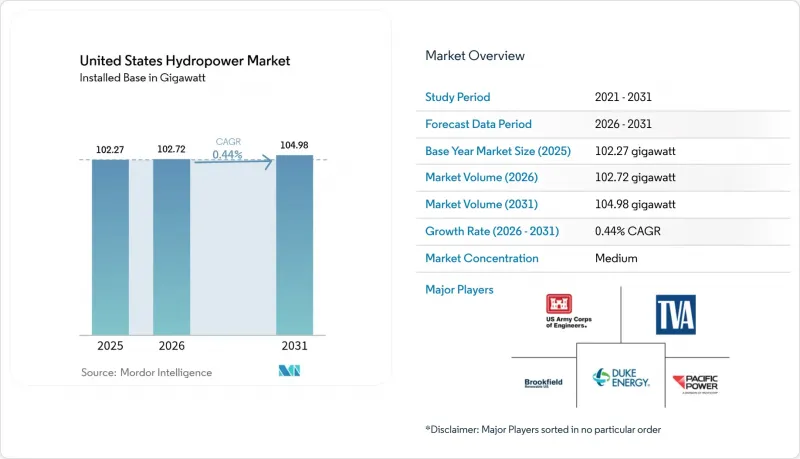
據 Mordor Intelligence 稱,2025 年美國水力發電市場規模為 102.27 吉瓦,預計到 2031 年將從 2026 年的 102.72 吉瓦成長至 104.98 吉瓦,在預測期(2026-2031 年),預計複合年成長率為 0.4%。
本報告按發電規模(大型水力發電、中型水力發電、小規模/微型水力發電)、技術類型(水庫式、徑流式、抽水蓄能式、河道式、微型管道式)和最終用戶(公共產業、獨立發電企業、工業用戶和私人用戶)進行分類。市場規模和預測以裝置容量(吉瓦,GW)為單位。
美國水力發電市場的趨勢與洞察
延長聯邦投資稅額扣抵
《基礎建設投資與就業法案》允許直接支付高達30%的現代化改造費用,使46座發電廠在不增加裝置容量的情況下,平均效率提升14%。業主已獲得24億美元的配對資金,這表明美國水力發電市場更傾向於維修,例如更換轉輪和發電機繞組,而不是新建大壩。在相同的水力發電條件下,降低勵磁機損耗和引入變速調速器可以提高年度發電量。這是一種在將授權風險降至最低的同時,提高每立方公尺流量收益的策略。由於稅收股權可以企業聯合組織,小規模的公共電力公司也正在利用這項稅額扣抵,從而加速推進長期以來被擱置的電廠基礎設備(BOP)的更新。總而言之,這項獎勵透過提高效率而非擴張來促進國內能源供應。
美國能源部新的水力發電研發(RD&D)資金籌措管道
2024年,水力發電技術辦公室撥款3,300萬美元用於一個整合數位孿生、基於聲吶的魚類探測和抽水蓄能水力發電最佳化技術的計畫。太平洋西北國家實驗室(PNNL)目前正透過在虛擬環境中對整個渦輪機組件進行建模,並在葉片損壞發生前預測空化現象,從而延長資產使用壽命並最大限度地減少停機時間。此類分析也有助於填補因電廠操作員退休而造成的專業知識缺口。因此,感測器、光纖定子線圈和基於雲端的SCADA系統供應商將抓住新的國內需求,即使國內發電能力停滯不前,美國水力發電市場也將成為診斷軟體出口的重要來源。從長遠來看,這些工具有望降低維運成本率,改善自由現金流,並吸引更多基礎設施投資。
聯邦能源監管委員會的重新授權程序耗時很長。
綜合許可流程的平均時長為7.6年,在此期間,資本支出(Capex)會受到通貨膨脹的影響,投資者的耐心也會逐漸消磨殆盡。儘管2024年12月生效的法規要求相關部門在一年內對水質認證採取行動,但其他磋商(特別是根據《瀕危物種法》進行的磋商)可能會使工期超出計畫預計時間。因此,業主越來越傾向於優先考慮資產保護,而不是會進一步擴大環境影響評估範圍的擴建項目,而是分階段實施現代化改造項目,以符合現有的授權期限。
細分市場分析
到了2025年,大型水力發電將佔據72.05%的市場佔有率,這一事實凸顯現有聯邦水壩的停滯不前,這些水壩實際上已無法擴大其水庫面積。相較之下,裝置容量小於10兆瓦的「小規模和超小規模」水力發電市場正以4.55%的複合年成長率成長,開發商利用非發電用途的水壩和灌溉渠,繞過了聯邦能源監管委員會(FERC)複雜的核准程序。雖然這些項目每次僅新增數千瓦的發電量,但其簡化的施工計劃表明,分散式資產如何在不新建輸電線路的情況下增強當地電網。對於許多電力合作社而言,在防洪設施中安裝1兆瓦的卡普蘭式水輪機可以抵消租賃柴油發電機以滿足高峰用電需求的成本。這個細分市場正在重振美國水力發電市場,而總發電量幾乎沒有變化。
投資者關注的焦點是1-5兆瓦徑流式電站組合。這些電站採用相同的控制系統,從而降低了維運人事費用。無人機巡檢和即插即用的調速器減少了現場巡檢的頻率,使業主能夠透過單一控制中心監控數十座微型電站。這種「軟體驅動的規模化」模式即使在額定功率不高的情況下也能提高內部收益率(IRR),體現了該行業從待開發區水壩向數位最佳化轉型的趨勢。
其他好處:
- Excel格式的市場預測(ME)表
- 3個月的分析師支持
目錄
第1章:引言
- 研究假設和市場定義
- 調查範圍
第2章:調查方法
第3章執行摘要
第4章 市場狀況
- 市場概覽
- 市場促進因素
- 延長聯邦投資稅額扣抵
- 美國能源部新的水力發電研發與示範(RD&D)資助計劃
- 靈活供給能力的電網支援支付
- 老舊燃煤發電廠需求。
- 公司有義務全年365天、每天24小時採購清潔能源。
- 為應對氣候變遷而提供的資金,用於現代化防洪措施
- 市場限制因素
- 聯邦能源監理委員會延長重新授權程序
- 根據《瀕危物種法案》計算的魚道維修費用
- 有組織的市場中規避成本率較低
- 分散式太陽能發電在尖峰時段時段的蠶食風險
- 供應鏈分析
- 監理情勢
- 技術展望
- 波特五力模型
- PESTLE分析
第5章 市場規模與成長預測
- 按額定容量
- 大型水力發電(100兆瓦或以上)
- 中型水力發電(10-100兆瓦)
- 小規模和超小規模水力發電(小於10兆瓦)
- 透過技術
- 儲存底部
- 河川利用類型
- 抽水蓄能水力發電
- 串流內和微型導管
- 依成分(僅限定性分析)
- 渦輪
- 發電機
- 控制與自動化
- 工廠相關設施
- 最終用戶
- 公共產業(州和公共)
- 獨立發電商(IPP)
- 工業和專有用途
第6章 競爭情勢
- 市場集中度
- 策略趨勢(併購、聯盟、購電協議)
- 市場佔有率分析(主要公司的市場排名和佔有率)
- 公司簡介
- GE Vernova
- Siemens Energy AG
- Voith Hydro GmbH
- Andritz AG
- Toshiba Energy Systems
- American Hydro
- Canyon Hydro
- Mavel Americas
- Gilkes
- Duke Energy Corporation
- NextEra Energy Resources
- Brookfield Renewable US
- PacifiCorp
- TVA
- Bonneville Power Administration
- PG&E
- Xcel Energy
- Dominion Energy
- FirstLight Power
- American Municipal Power
第7章 市場機會與未來展望
According to Mordor Intelligence, the United States hydropower market size was valued at 102.27 gigawatt in 2025 and estimated to grow from 102.72 gigawatt in 2026 to reach 104.98 gigawatt by 2031, at a CAGR of 0.44% during the forecast period (2026-2031).
This report is Segmented by Capacity Rating (Large Hydro, Medium Hydro, and Small and Micro Hydro), Technology (Reservoir-Based, Run-Of-River, Pumped-Storage, and In-Stream and Micro-Conduit), and End-User (Utilities, Independent Power Producers, and Industrial and Captive). The Market Sizes and Forecasts are Provided in Terms of Installed Capacity (GW).
United States Hydropower Market Trends and Insights
Federal Investment Tax-Credits Extension
The Infrastructure Investment and Jobs Act now delivers direct payments covering up to 30% of modernization costs, enabling 46 plants to pursue efficiency gains averaging 14% without adding capacity. Owners have lined up USD 2.4 billion in matching capital, confirming that the US hydropower market favors upgrades such as runner replacements and generator rewinds over new dams. Down-rating exciter losses and installing variable-speed governors boost annual output within the same hydraulic envelope, a strategy that improves revenue per cubic meter of flow while keeping licensing risk negligible. Because tax equity can be syndicated, smaller public-power entities also tap the credit, accelerating long-delayed electrical balance-of-plant renewals. In aggregate, the incentive nudges national energy supply upward through efficiency rather than expansion.
DOE's New Water Power RD&D Funding Pipeline
The Water Power Technologies Office earmarked USD 33 million in 2024 for projects that merge digital twins, sonar-based fish detection, and pumped-storage optimization. Pacific Northwest National Laboratory now models entire turbine assemblies in a virtual environment that predicts cavitation before it degrades blades, extending asset life with minimal downtime. Such analytics also compress the expertise gap created by retiring plant operators. Vendors of sensors, fiber-optic stator coils, and cloud SCADA, therefore, gain new domestic demand, positioning the US hydropower market as an export source of diagnostic software even while local megawatts remain flat. Over the long term, these tools could shave O&M expense ratios, improving free cash flow and attracting additional infrastructure capital.
Extended FERC Relicensing Timelines
The Integrated Licensing Process averages 7.6 years, during which capex faces inflation creep and investor patience wanes. Although a December 2024 rule requires agencies to act within one year on water-quality certifications, other consultations-particularly under the Endangered Species Act-can still stretch schedules beyond project pro-formas. As a result, owners often sequence modernization work to coincide with existing license terms, prioritizing asset preservation over expansions that would reopen environmental impact scopes.
Other drivers and restraints analyzed in the detailed report include:
- Grid-Support Payments for Flexible Capacity
- Aging Coal Retirements Creating Replacement Need
- ESA-Driven Fish-Passage Retrofit Costs
For complete list of drivers and restraints, kindly check the Table Of Contents.
Segment Analysis
Large Hydro's 72.05% share in 2025 underscores the inertia of legacy federal dams whose reservoir footprints cannot meaningfully expand. In contrast, the Small & Micro bracket below 10 MW records a 4.55% CAGR as developers tap non-powered dams and irrigation conduits that bypass complex FERC processes. These projects add just kilowatts at a time, yet their streamlined timelines illustrate how distributed assets can reinforce rural grids without new transmission corridors. For many cooperatives, slipstreaming a 1 MW Kaplan unit into a flood-control structure offsets diesel peaker rentals. The segment enhances the nationwide US hydropower market while leaving aggregate capacity largely unchanged.
Investor interest coalesces around portfolios of 1-5 MW run-of-river stations where identical control packages cut O&M labor. Because drone inspections and plug-and-play governors reduce visit frequency, owners can supervise dozens of micro-plants from a single control center. This scale-via-software model elevates the internal rate of return despite modest nameplates, and it embodies the sector's pivot from greenfield dams to digital optimization.
Complete Report Scope:
- By Capacity Rating
- Large Hydro (Above 100 MW)
- Medium Hydro (10 to 100 MW)
- Small and Micro Hydro (Below 10 MW)
- By Technology
- Reservoir-Based
- Run-of-River
- Pumped-Storage
- In-Stream and Micro-conduit
- By Component (Qualitative Analysis only)
- Turbines
- Generators
- Control and Automation
- Balance-of-Plant
- By End-User
- Utilities (State and Public)
- Independent Power Producers
- Industrial and Captive
List of Companies Covered in this Report:
- GE Vernova
- Siemens Energy AG
- Voith Hydro GmbH
- Andritz AG
- Toshiba Energy Systems
- American Hydro
- Canyon Hydro
- Mavel Americas
- Gilkes
- Duke Energy Corporation
- NextEra Energy Resources
- Brookfield Renewable US
- PacifiCorp
- TVA
- Bonneville Power Administration
- PG&E
- Xcel Energy
- Dominion Energy
- FirstLight Power
- American Municipal Power
Additional Benefits:
- The market estimate (ME) sheet in Excel format
- 3 months of analyst support
TABLE OF CONTENTS
1 Introduction
- 1.1 Study Assumptions & Market Definition
- 1.2 Scope of the Study
2 Research Methodology
3 Executive Summary
4 Market Landscape
- 4.1 Market Overview
- 4.2 Market Drivers
- 4.2.1 Federal investment tax-credits extension
- 4.2.2 DOE's new Water Power RD&D funding pipeline
- 4.2.3 Grid-support payments for flexible capacity
- 4.2.4 Aging coal retirements creating replacement need
- 4.2.5 Corporate 24*7 clean-power procurement mandates
- 4.2.6 Climate-driven flood-control modernization funds
- 4.3 Market Restraints
- 4.3.1 Extended FERC relicensing timelines
- 4.3.2 ESA-driven fish-passage retrofit costs
- 4.3.3 Low avoided-cost rates in organized markets
- 4.3.4 Distributed PV cannibalization risk for peak pricing
- 4.4 Supply-Chain Analysis
- 4.5 Regulatory Landscape
- 4.6 Technological Outlook
- 4.7 Porter's Five Forces
- 4.7.1 Threat of New Entrants
- 4.7.2 Bargaining Power of Suppliers
- 4.7.3 Bargaining Power of Buyers
- 4.7.4 Threat of Substitutes
- 4.7.5 Competitive Rivalry
- 4.8 PESTLE Analysis
5 Market Size & Growth Forecasts
- 5.1 By Capacity Rating
- 5.1.1 Large Hydro (Above 100 MW)
- 5.1.2 Medium Hydro (10 to 100 MW)
- 5.1.3 Small and Micro Hydro (Below 10 MW)
- 5.2 By Technology
- 5.2.1 Reservoir-Based
- 5.2.2 Run-of-River
- 5.2.3 Pumped-Storage
- 5.2.4 In-Stream and Micro-conduit
- 5.3 By Component (Qualitative Analysis only)
- 5.3.1 Turbines
- 5.3.2 Generators
- 5.3.3 Control and Automation
- 5.3.4 Balance-of-Plant
- 5.4 By End-User
- 5.4.1 Utilities (State and Public)
- 5.4.2 Independent Power Producers
- 5.4.3 Industrial and Captive
6 Competitive Landscape
- 6.1 Market Concentration
- 6.2 Strategic Moves (M&A, Partnerships, PPAs)
- 6.3 Market Share Analysis (Market Rank/Share for key companies)
- 6.4 Company Profiles (includes Global level Overview, Market level overview, Core Segments, Financials as available, Strategic Information, Products & Services, and Recent Developments)
- 6.4.1 GE Vernova
- 6.4.2 Siemens Energy AG
- 6.4.3 Voith Hydro GmbH
- 6.4.4 Andritz AG
- 6.4.5 Toshiba Energy Systems
- 6.4.6 American Hydro
- 6.4.7 Canyon Hydro
- 6.4.8 Mavel Americas
- 6.4.9 Gilkes
- 6.4.10 Duke Energy Corporation
- 6.4.11 NextEra Energy Resources
- 6.4.12 Brookfield Renewable US
- 6.4.13 PacifiCorp
- 6.4.14 TVA
- 6.4.15 Bonneville Power Administration
- 6.4.16 PG&E
- 6.4.17 Xcel Energy
- 6.4.18 Dominion Energy
- 6.4.19 FirstLight Power
- 6.4.20 American Municipal Power
7 Market Opportunities & Future Outlook
- 7.1 White-space & Unmet-Need Assessment

 全球水力發電廠維修市場規模、佔有率、趨勢及成長分析報告(2026-2034)
 水力發電市場-2026-2032年全球市場預測
 水力發電市場:2034 年預測 - 全球電廠類型、裝置容量、組件、渦輪機類型、應用、所有權、最終用戶、技術、服務和區域分析
 2026 年至 2035 年水力發電廠維修的市場機會、成長動力、產業趨勢與預測。
 北美水力發電:市場佔有率分析、產業趨勢與統計及成長預測(2026-2031 年)水力發電:市場佔有率分析、行業趨勢和統計數據、成長預測(2026-2031 年)東南亞水力發電:市場佔有率分析、產業趨勢與統計及成長預測(2026-2031年)
 水力發電市場-全球產業規模、佔有率、趨勢、機會、預測:產能、應用、區域及競爭格局(2021-2031年)
 水力發電市場規模、佔有率、趨勢和預測:按規模、應用和地區分類,2026-2034年水力發電控制系統市場:按產品類型、渦輪機類型、電壓等級、應用和最終用戶分類-2026-2032年全球市場預測