


 |
市場調查報告書
商品編碼
2101684
2026 年至 2035 年水力發電廠維修的市場機會、成長動力、產業趨勢與預測。Hydropower Refurbishment Market Opportunity, Growth Drivers, Industry Trend Analysis, and Forecast 2026 - 2035 |
||||||

全球水力發電維修市場預計到 2025 年將達到 133 億美元,年複合成長率為 8.5%,到 2035 年將達到 302 億美元。
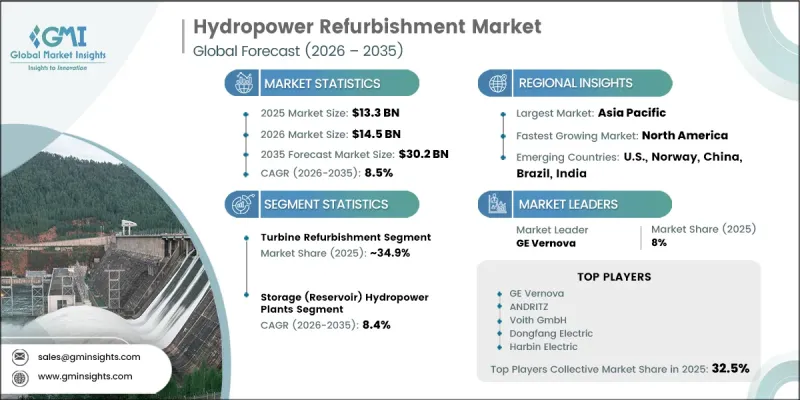
隨著電力營運商和資產所有者加大投資,延長現有水力發電設施的使用壽命,提高運作效率和電網性能,水電維修市場正穩步擴張。老化的電力基礎設施、不斷發展的可靠性標準以及對可再生能源發電併網投資的增加,正將改造項目從簡單的日常維護活動轉變為戰略重點。維修專案著重於提高電廠效率、增強運作柔軟性並提升資產的長期可靠性,以滿足不斷變化的電力需求。隨著高波動性再生能源比例的增加,維修的水力發電設施在維持電網穩定性方面也發揮著至關重要的作用,能夠提供可靠且可擴展的可再生能源發電。隨著電力系統的不斷發展,營運商優先考慮那些能夠提高電廠性能、降低維護成本並最大限度發揮現有基礎設施價值的升級改造項目。長期資產管理策略、對永續發電日益成長的興趣以及對能源基礎設施現代化投資的增加,預計將持續推動對維修服務的需求成長。無論設備類型、電廠類型或區域市場如何,這些因素預計都將在整個預測期內創造強勁的成長機會。
| 市場範圍 | |
|---|---|
| 開始年份 | 2025 |
| 預測期 | 2026-2035 |
| 起始金額 | 133億美元 |
| 預測金額 | 302億美元 |
| 複合年成長率 | 8.5% |
渦輪機維修領域佔34.9%的市場佔有率,預計到2035年將以8.3%的複合年成長率成長。由於渦輪機性能直接影響電廠的整體效率、發電量和運行可靠性,因此該領域持續推動市場成長。長期連續運轉會加速設備磨損,因此維修對於恢復性能、提高發電量和延長設備壽命至關重要。預計對先進渦輪機技術和現代化改造項目的持續投資將支撐整個預測期內的持續需求。
預計到2025年,水庫式水力發電市佔率將達到44.4%,並在2026年至2035年間維持8.4%的複合年成長率。該細分市場佔據最大市場佔有率,主要得益於其在大型水力發電設施領域擁有豐富的經驗,而這些設施需要定期進行現代化改造以維持運作效率並符合監管要求。對長期資產升級、發電能力提升和營運績效改善的投資增加,持續推動市場擴張。對可靠可再生能源發電需求的成長,也進一步促進了水庫式水力發電設施的維修改造。
預計到2025年,北美水力發電廠維修市場將佔據23.8%的市場佔有率,並在2035年之前以8.2%的複合年成長率成長。該地區的成長主要得益於大規模的水力發電裝置容量以及越來越多的老舊設施需要進行現代化改造以提高營運效率和延長資產壽命。電力營運商持續投資於設備升級、數位化監控技術和電廠最佳化,以提高可靠性、增加發電量並滿足不斷發展的電網的性能要求。對可再生能源基礎設施和長期資產管理策略的持續投資預計將支撐全部區域的市場成長。
目錄
第1章:調查方法和範圍
第2章執行摘要
第3章 行業洞察
- 產業生態系分析
- 原物料供應及採購分析
- 生產能力評估
- 供應鏈韌性與風險因素
- 配電網路分析
- 影響產業的因素
- 成長促進因素
- 產業潛在風險與挑戰
- 監理情勢
- 成長潛力分析
- 波特的分析
- PESTLE分析
- 成本結構分析:水力發電廠設施維修
- 翻新維修的新機會與現代化趨勢
- 水力發電廠維修中的數位化、自動化和狀態監測
- 老舊水力發電廠擴建與維修工程的機遇
- 投資趨勢、資產現代化策略與未來市場展望。
- 人工智慧和生成式人工智慧對市場的影響
- 利用人工智慧最佳化生產
- 預測性維護和故障檢測
第4章 競爭情勢
- 介紹
- 企業市佔率分析:按地區分類
- 北美洲
- 歐洲
- 亞太地區
- 中東和非洲
- 拉丁美洲
- 主要市場公司的競爭分析
- 競爭定位矩陣
- 主要進展
- 併購
- 夥伴關係和聯盟
- 新產品發布
- 業務拓展計劃及資金籌措
- 按公司規模進行基準測試
- 排名分類標準與選擇標準
- 按銷售額、地區和創新能力分類的層級定位矩陣。
第5章 市場規模及預測:依服務類型分類,2022-2035年
- 渦輪機維修
- 發電機維修
- 控制、自動化和SCADA升級
- 土木工程結構的維修與維修
- 變壓器和電氣設備的維修
- 環境與生態系維修
- 其他
第6章 市場規模/預測:依設備分類,2022-2035年
- 渦輪
- 發電機
- 變壓器
- 州長
- 激勵系統
- 控制和保護系統
- 切換裝置
- 閥門和閘門
- 引水管
- 其他
第7章 市場規模及預測:依設備類型分類,2022-2035年
- 河川發電廠
- 抽水蓄能電站
- 水庫水力發電廠
第8章 市場規模及預測:依產能分類,2022-2035年
- 小規模(小於10兆瓦)
- 中型(>10兆瓦至100兆瓦)
- 大型(超過100兆瓦)
第9章 市場規模及預測:依地區分類,2022-2035年
- 北美洲
- 美國
- 加拿大
- 墨西哥
- 歐洲
- 挪威
- 俄羅斯
- 西班牙
- 德國
- 法國
- 奧地利
- 瑞士
- 瑞典
- 亞太地區
- 中國
- 印度
- 日本
- 澳洲
- 越南
- 印尼
- 韓國
- 馬來西亞
- 中東和非洲
- 土耳其
- 衣索比亞
- 南非
- 埃及
- 摩洛哥
- 尚比亞
- 拉丁美洲
- 巴西
- 智利
- 阿根廷
第10章:公司簡介
- ABB
- AECOM
- AFRY
- ANDRITZ
- Ansaldo Energia
- Bharat Heavy Electricals Limited
- Dongfang Electric Corporation
- Fuji Electric
- GE Vernova
- Gilbert Gilkes & Gordon Ltd.
- Goltens
- Harbin Electric Corporation Co.
- HECO
- Hitachi Energy
- INTPOW
- Litostroj Power
- Metalock Engineering
- MITSUBISHI HEAVY INDUSTRIES, LTD.
- Mott MacDonald
- Nidec ASI
- Siemens Energy
- Stantec
- TOSHIBA AMERICA ENERGY SYSTEMS CORPORATION
- TurbinePROs
- Voith GmbH & Co.
- WEG
The Global Hydropower Refurbishment Market was valued at USD 13.3 billion in 2025 and is estimated to grow at a CAGR of 8.5% to reach USD 30.2 billion by 2035.
The hydropower refurbishment market is expanding steadily as utility operators and asset owners increasingly invest in extending the service life of existing hydropower facilities while improving operational efficiency and grid performance. Aging generation infrastructure, evolving reliability standards, and rising investments in renewable energy integration are transforming refurbishment projects into a strategic priority rather than routine maintenance activities. Modernization programs are focused on enhancing plant efficiency, increasing operational flexibility, and improving long-term asset reliability to meet changing electricity demand. Refurbished hydropower facilities also play a critical role in supporting grid stability by providing dependable and dispatchable electricity generation that complements the growing share of variable renewable energy sources. As power systems continue to evolve, operators are prioritizing upgrades that improve plant performance, reduce maintenance costs, and maximize the value of existing infrastructure. Long-term asset management strategies, growing emphasis on sustainable power generation, and increasing investments in energy infrastructure modernization are expected to drive continuous demand for refurbishment services. These factors are creating strong growth opportunities across equipment, plant type, and regional markets throughout the forecast period.
| Market Scope | |
|---|---|
| Start Year | 2025 |
| Forecast Year | 2026-2035 |
| Start Value | $13.3 Billion |
| Forecast Value | $30.2 Billion |
| CAGR | 8.5% |
The turbine refurbishment segment accounted for 34.9% share and is expected to grow at a CAGR of 8.3% through 2035. This segment continues to lead the market because turbine performance has a direct impact on overall plant efficiency, power generation, and operational reliability. Continuous operation over extended periods increase equipment wear, making refurbishment essential for restoring performance, improving energy output, and extending equipment lifespan. Ongoing investments in advanced turbine technologies and modernization programs are expected to support sustained demand throughout the forecast period.
The storage (reservoir) hydropower plants segment held 44.4% share in 2025 and is projected to register a CAGR of 8.4% during 2026-2035. This segment holds the largest market share due to the extensive installed base of large hydropower facilities that require periodic modernization to maintain operational efficiency and regulatory compliance. Increasing investments in long-term asset upgrades, improved generating capacity, and enhanced operational performance continue to support market expansion. Growing demand for reliable renewable electricity generation is further strengthening refurbishment activities across storage hydropower facilities.
North America Hydropower Refurbishment Market accounted for 23.8% share in 2025 and is expected to grow at a CAGR of 8.2% through 2035. Regional growth is supported by a substantial installed hydropower capacity and an increasing number of aging facilities requiring modernization to improve operational efficiency and extend asset life. Utility operators continue to invest in equipment upgrades, digital monitoring technologies, and plant optimization initiatives to enhance reliability, improve energy production, and meet evolving grid performance requirements. Continued investment in renewable energy infrastructure and long-term asset management strategies is expected to sustain market growth across the region.
Major companies operating in the global hydropower refurbishment market include ABB, AECOM, AFRY, ANDRITZ, Ansaldo Energia, Bharat Heavy Electricals Limited, Dongfang Electric Corporation, Fuji Electric, GE Vernova, Gilbert Gilkes & Gordon Ltd., Goltens, Harbin Electric Corporation Co., HECO, Hitachi Energy, INTPOW, Litostroj Power, Metalock Engineering, Mott MacDonald, Mitsubishi Heavy Industries Ltd., Nidec ASI, Siemens Energy, Stantec, Toshiba America Energy Systems Corporation, TurbinePROs, Voith GmbH & Co., and WEG. Companies operating in the hydropower refurbishment market are strengthening their competitive position through modernization expertise, technology innovation, and expansion of comprehensive service portfolios. Market participants are investing in advanced engineering solutions, digital monitoring systems, automation technologies, and predictive maintenance capabilities to improve plant performance and extend equipment life. Businesses are also enhancing refurbishment services through integrated project management, customized upgrade solutions, and long-term maintenance agreements that support reliable plant operation. Strategic partnerships, geographic expansion, and investments in specialized technical capabilities continue to strengthen market presence across established and emerging regions.
Table of Contents
Chapter 1 Methodology & Scope
- 1.1 Research approach
- 1.2 Quality commitments
- 1.2.1 GMI AI policy & data integrity commitment
- 1.2.1.1 Source consistency protocol
- 1.2.1 GMI AI policy & data integrity commitment
- 1.3 Research trail & confidence scoring
- 1.3.1 Research trail components
- 1.3.2 Scoring components
- 1.4 Data collection
- 1.4.1 Partial list of primary sources
- 1.5 Data mining sources
- 1.5.1 Paid sources
- 1.5.1.1 Sources, by region
- 1.5.1 Paid sources
- 1.6 Base estimates and calculations
- 1.6.1 Base year calculation for any one approach
- 1.7 Market estimates & forecasts parameters
- 1.8 Forecast model
- 1.8.1 Quantified market impact analysis
- 1.8.1.1 Mathematical impact of growth parameters on forecast
- 1.8.1 Quantified market impact analysis
- 1.9 Research transparency addendum
- 1.9.1 Source attribution framework
- 1.9.2 Quality assurance metrics
- 1.9.3 Our commitment to trust
- 1.10 Market definitions
Chapter 2 Executive Summary
- 2.1 Industry synopsis, 2022 - 2035
- 2.1.1 Business trends
- 2.1.2 Service trends
- 2.1.3 Equipment trends
- 2.1.4 Plant type trends
- 2.1.5 Capacity trends
- 2.1.6 Regional trends
Chapter 3 Industry Insights
- 3.1 Industry ecosystem analysis
- 3.1.1 Raw material availability & sourcing analysis
- 3.1.2 Manufacturing capacity assessment
- 3.1.3 Supply chain resilience & risk factors
- 3.1.4 Distribution network analysis
- 3.2 Industry impact forces
- 3.2.1 Growth drivers
- 3.2.2 Industry pitfalls & challenges
- 3.3 Regulatory landscape
- 3.4 Growth potential analysis
- 3.5 Porter's analysis
- 3.5.1 Bargaining power of suppliers
- 3.5.2 Bargaining power of buyers
- 3.5.3 Threat of new entrants
- 3.5.4 Threat of substitutes
- 3.6 PESTEL analysis
- 3.6.1 Political factors
- 3.6.2 Economic factors
- 3.6.3 Social factors
- 3.6.4 Technological factors
- 3.6.5 Legal factors
- 3.6.6 Environmental factors
- 3.7 Cost structure analysis of hydropower refurbishment
- 3.8 Emerging refurbishment opportunities & modernization trends
- 3.9 Digitalization, automation & condition-based monitoring in hydropower refurbishment
- 3.10 Expansion opportunities across aging hydropower assets and retrofit projects
- 3.11 Investment trends, asset modernization strategies & future market outlook
- 3.12 Impact of AI & Generative AI on the market (Driven by Primary Research)
- 3.12.1 AI-Driven production optimization (Driven by Primary Research)
- 3.12.2 Predictive maintenance & fault detection (Driven by Primary Research)
Chapter 4 Competitive Landscape, 2026
- 4.1 Introduction
- 4.2 Company market share analysis, by region, 2025
- 4.2.1 North America
- 4.2.2 Europe
- 4.2.3 Asia Pacific
- 4.2.4 Middle East & Africa
- 4.2.5 Latin America
- 4.3 Competitive analysis of major market players
- 4.4 Competitive positioning matrix
- 4.5 Key developments
- 4.5.1 Mergers & acquisitions
- 4.5.2 Partnerships & collaborations
- 4.5.3 New product launches
- 4.5.4 Expansion plans & funding
- 4.6 Company tier benchmarking
- 4.6.1 Tier classification criteria & qualifying thresholds
- 4.6.2 Tier positioning matrix by revenue, geography & innovation
Chapter 5 Market Size and Forecast, By Service, 2022 - 2035 (USD Million)
- 5.1 Key trends
- 5.2 Turbine refurbishment
- 5.3 Generator refurbishment
- 5.4 Control, automation & SCADA upgrades
- 5.5 Civil & structural rehabilitation
- 5.6 Transformer & electrical equipment refurbishment
- 5.7 Environmental & ecological retrofits
- 5.8 Others
Chapter 6 Market Size and Forecast, By Equipment, 2022 - 2035 (USD Million)
- 6.1 Key trends
- 6.2 Turbines
- 6.3 Generators
- 6.4 Transformers
- 6.5 Governors
- 6.6 Excitation systems
- 6.7 Control & protection systems
- 6.8 Switchgear
- 6.9 Valves & gates
- 6.10 Penstocks
- 6.11 Others
Chapter 7 Market Size and Forecast, By Plant Type, 2022 - 2035 (USD Million)
- 7.1 Key trends
- 7.2 Run-of-river plants
- 7.3 Pumped storage plants
- 7.4 Storage (reservoir) hydropower plants
Chapter 8 Market Size and Forecast, By Capacity, 2022 - 2035 (USD Million)
- 8.1 Key trends
- 8.2 Small (≤ 10 MW)
- 8.3 Medium (> 10 MW – 100 MW)
- 8.4 Large (> 100 MW)
Chapter 9 Market Size and Forecast, By Region, 2022 - 2035 (USD Million)
- 9.1 Key trends
- 9.2 North America
- 9.2.1 U.S.
- 9.2.2 Canada
- 9.2.3 Mexico
- 9.3 Europe
- 9.3.1 Norway
- 9.3.2 Russia
- 9.3.3 Spain
- 9.3.4 Germany
- 9.3.5 France
- 9.3.6 Austria
- 9.3.7 Switzerland
- 9.3.8 Sweden
- 9.4 Asia Pacific
- 9.4.1 China
- 9.4.2 India
- 9.4.3 Japan
- 9.4.4 Australia
- 9.4.5 Vietnam
- 9.4.6 Indonesia
- 9.4.7 South Korea
- 9.4.8 Malaysia
- 9.5 Middle East & Africa
- 9.5.1 Turkey
- 9.5.2 Ethiopia
- 9.5.3 South Africa
- 9.5.4 Egypt
- 9.5.5 Morocco
- 9.5.6 Zambia
- 9.6 Latin America
- 9.6.1 Brazil
- 9.6.2 Chile
- 9.6.3 Argentina
Chapter 10 Company Profiles
- 10.1 ABB
- 10.2 AECOM
- 10.3 AFRY
- 10.4 ANDRITZ
- 10.5 Ansaldo Energia
- 10.6 Bharat Heavy Electricals Limited
- 10.7 Dongfang Electric Corporation
- 10.8 Fuji Electric
- 10.9 GE Vernova
- 10.10 Gilbert Gilkes & Gordon Ltd.
- 10.11 Goltens
- 10.12 Harbin Electric Corporation Co.
- 10.13 HECO
- 10.14 Hitachi Energy
- 10.15 INTPOW
- 10.16 Litostroj Power
- 10.17 Metalock Engineering
- 10.18 MITSUBISHI HEAVY INDUSTRIES, LTD.
- 10.19 Mott MacDonald
- 10.20 Nidec ASI
- 10.21 Siemens Energy
- 10.22 Stantec
- 10.23 TOSHIBA AMERICA ENERGY SYSTEMS CORPORATION
- 10.24 TurbinePROs
- 10.25 Voith GmbH & Co.
- 10.26 WEG

 水力發電廠狀態監測解決方案市場:全球市場預測,2026-2032年
 全球水力發電廠維修市場規模、佔有率、趨勢及成長分析報告(2026-2034)
 美國水力發電:市場佔有率分析、行業趨勢和統計數據以及成長預測(2026-2031 年)水力發電市場-2026-2032年全球市場預測
 水力發電市場:2034 年預測 - 全球電廠類型、裝置容量、組件、渦輪機類型、應用、所有權、最終用戶、技術、服務和區域分析北美水力發電:市場佔有率分析、產業趨勢與統計及成長預測(2026-2031 年)水力發電:市場佔有率分析、行業趨勢和統計數據、成長預測(2026-2031 年)
 水力發電市場規模、佔有率、趨勢和預測:按規模、應用和地區分類,2026-2034年水力發電控制系統市場:按產品類型、渦輪機類型、電壓等級、應用和最終用戶分類-2026-2032年全球市場預測水力發電閘門市場:2026-2032年全球市場預測(以閘門類型、閘門操作方式、材質、安裝配置和最終用戶分類)